Alibaba Cloud is partnering with @Theta_Network EdgeCloud to bring Qwen AI models to Web3-native developers worldwide.
This milestone integration extends our frontier AI models, including Qwen3.8-Max and Qwen3.8-Flash, to a decentralized GPU compute network. We are empowering developers with greater flexibility, distributed infrastructure, and direct access to enterprise-grade AI.
ZAN is a Web3 and AI infrastructure brand under Ant Digital Technologies, delivering secure, scalable, and high-performance services to power business innovation. ZAN and @Theta_Network have formed a deep strategic partnership this year across both Web3 and AI. From underlying blockchain networks to decentralized cloud compute, we are jointly building the core foundation for next-generation digital applications.
Our collaboration began in Web3 this June. ZAN officially joined Theta Network as a strategic enterprise validator node, staking $THETA to participate in transaction validation, block production, and on-chain governance. Enterprise validators are the backbone of Theta's consensus layer. By bringing enterprise-grade infrastructure capabilities, ZAN ensures Theta's decentralized network operates with superior reliability and stability.
In September, we extended our partnership from Web3 into AI. Through ZAN Router, Ling-3.0-flash-Fin, a financial LLM from Ant Ling, went live on Theta EdgeCloud. This enables enterprises to seamlessly route, monitor, and scale AI integrations, while giving developers direct access to professional tools for financial research, analytics, and agentic workflows.
From Web3 to AI, this is just the beginning. We look forward to deeper collaboration as we continue to push boundaries across both frontiers. Whether fortifying Web3 infrastructure or accelerating AI innovation, ZAN and Theta empower builders to simply build.
@BSCNews@Theta_Network Appreciate the coverage.
The partnership brings decentralized GPU compute into Cell-Stack, connecting AI workloads with the connectivity infrastructure needed to run them onsite.
For the past three months, a good part of my spare time has gone into https://t.co/BwofRZj7LC. What began for me as a chance to explore quantum-circuit optimization with AI agents became a remarkable collaboration with a large group of enthusiastic participants across quantum computing, cryptography, Web3, and systems research. Today, I’m excited to share our arXiv paper documenting that effort and what we learned from it:
Paper: https://t.co/TNKrutonZS
Full story: https://t.co/SavqQi4rHO
https://t.co/BwofRZj7LC is an open challenge to optimize a quantum circuit for point-addition on secp256k1, the elliptic curve used by Bitcoin and Ethereum.
Why does this matter? Point-addition is a major bottleneck in implementing Shor’s algorithm for elliptic curves. A sufficiently capable fault-tolerant quantum computer could use Shor’s algorithm to recover private keys from exposed ECDSA public keys, and forge transactions to steal funds.
No existing machine can run this attack today. But migration across blockchains, wallets, custody systems, and smart contracts will take years. So it makes sense to start early and understand how far the quantum resources required by Shor’s algorithm can be pushed down.
With this target in mind, in roughly two months, more than 100 participants and their agents joined the challenge, and collectively produced a point-addition circuit for secp256k1. The circuit uses 1,151 logical qubits and 1.30 million Toffoli gates, giving it a Q x T score more than 50% lower than the result Google Quantum AI reported in March 2026. Because the interfaces and accounting conventions differ, this is a numerical comparison rather than a claim of formal dominance.
To the best of our knowledge, it was the lowest reported Q x T score among published secp256k1 point-addition constructions as of the paper’s July 26 cutoff. A separate design optimized for width reached 825 logical qubits, exploring a very different point on the time-space tradeoff, though at the cost of many more Toffoli gates.
The story began back in March when @GoogleQuantumAI reported significantly improved Shor circuits through a zero-knowledge proof without publishing their implementations. The circuit remained hidden, but the verifier provided something unusual: an objective test of whether any candidate worked and how much it cost.
Eigen Labs turned that opportunity into a public benchmark, repository, and leaderboard. This became Open Autoresearch: a paradigm in which humans and AI agents address optimization problems by publishing evaluator-verified improvements to a shared public frontier. Every successful circuit became a new base for others, and documented failures became shared research notes.
Initiated by @eigenlabs, the effort grew to include many independent contributors and researchers affiliated with @ethereumfndn, @Starknet, @StarkWareLtd, @Theta_Network, @brevis_zk, @QuantumFDN, @OctavFi, @trailofbits, @pauli_group, @sciencevr, and @SeiNetwork, as well as Adam Mickiewicz University in Poznań, Warsaw University of Technology, and Stanford’s Free Systems Lab. Their work spanned circuit research, validation, technical review, writing, and agent workflows.
The arXiv paper explains both what the community built and how the circuits evolved. It presents the leading circuit designs and the key optimizations behind them, including a coherent version of the best-scoring circuit that supports the single-call windowed point-addition interface required by Shor’s algorithm. Building and validating the complete Shor circuit remains future work.
Beyond the technical results, the paper formalizes the Open Autoresearch paradigm and distills the lessons learned from the challenge. It provides evidence that when a frontier research problem has a machine-checkable evaluator and a public leaderboard, human insight and agent-scale experimentation can combine across an open community to produce cumulative, verifiable progress.
Read the paper and the full story, explore the live frontier, or bring your agent to the challenge:
Paper: https://t.co/TNKrutonZS
Full story:https://t.co/SavqQi4rHO
Challenge: https://t.co/knLDX4UdOi
Our very own CTO @jieyilong is the lead author on a paper that cuts the estimated quantum cost of the core operation in breaking Bitcoin and Ethereum's cryptography by more than half.
theta-token:native just became the first partner token to join @OfficialXYO's Crypto Cards on @Gate, a fun new spin on prediction markets and a natural extension of our verifiable AI infrastructure work with XYO since May. Early access is live.
Decentralized networks are powering the future of AI, reshaping how the world accesses compute.
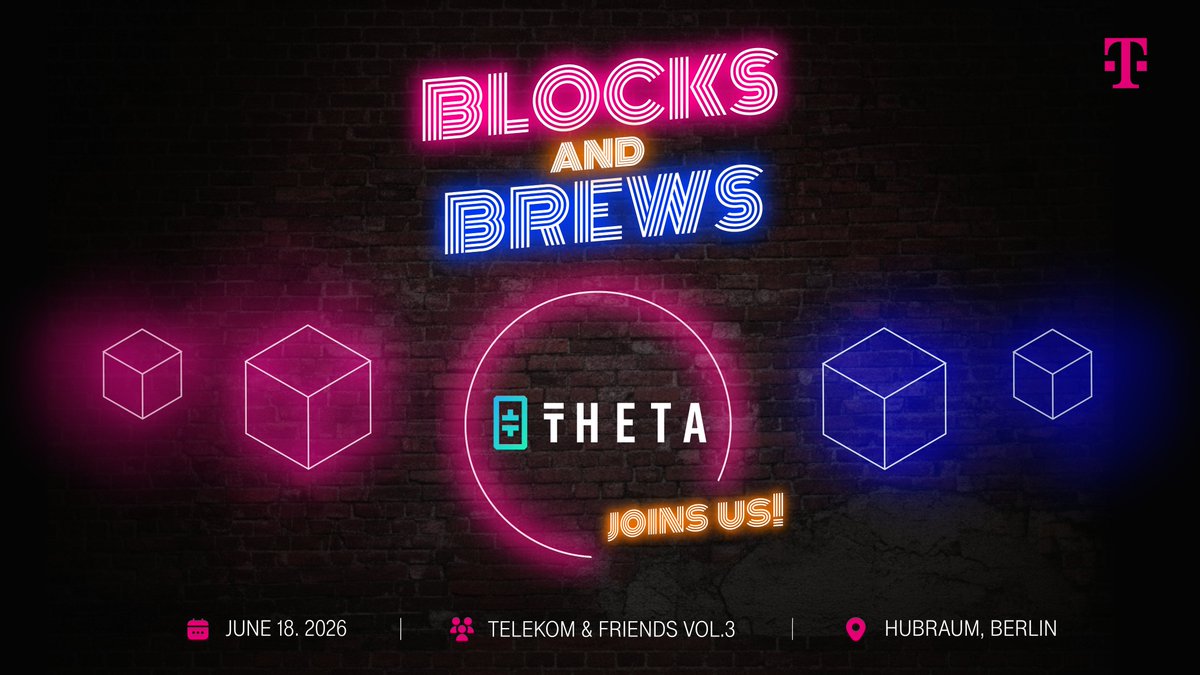
@Theta_Network is joining us at Blocks & Brews and we can't wait to talk about what's next.
June 18 | Berlin Blockchain Week
RSVP👇
https://t.co/stN2tJVPwh
@CryptoDreams888@Theta_Network On top of that, it consistently trades with the volume of random low-cap projects almost no one has heard of. That’s the concerning part.
@CryptoDreams888@Theta_Network I get that price doesn’t always reflect real usage. The issue isn’t expecting a perfect 1:1 correlation. The point is that Theta seems to be one of the worst performers in the entire AI/crypto narrative sector.
BREAKING: XYO Layer One and the XYO AI SDK are bringing verification to AI agents and AI infrastructure on Theta EdgeCloud (@Theta_Network).
Read XYO's announcement here ➡️ https://t.co/ThIB1irix0