🚨NEW ARTICLE🚨
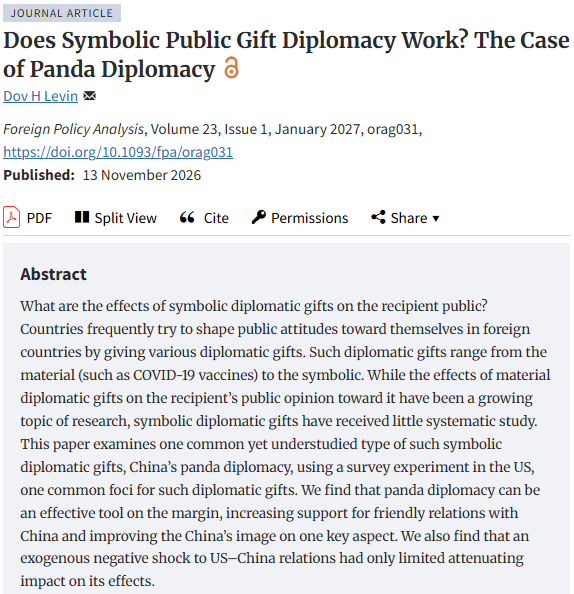
Levin (2026) asks if symbolic diplomatic gifts shape recipient public opinion of the gift giver. Examining China's panda diplomacy towards the US, Levin finds that gifting🐼can boost 🇺🇸 support for friendly relations with 🇨🇳. 🐼🐼🐼
https://t.co/qGRLBGgO6E
🚨NEW ARTICLE🚨
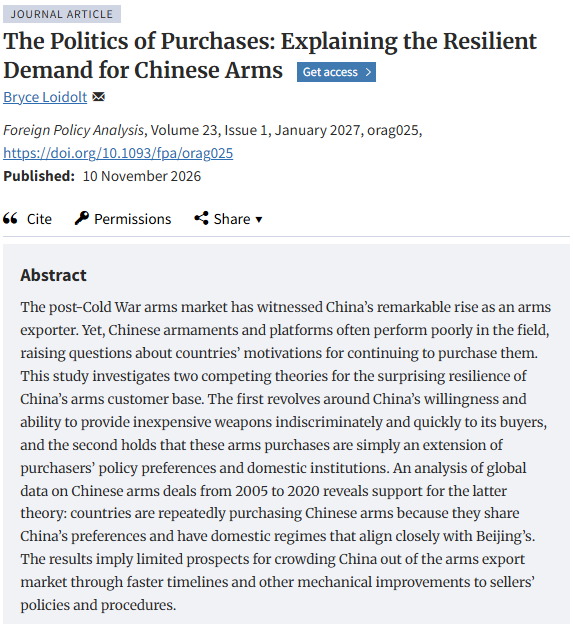
Loidolt (2026) investigates state motivations to buy Chinese arms. Analysing Chinese arms deals (2005-2020), repeat purchases reflect regime alignment and shared preferences with China, not low weapon cost and indiscriminate supply.
https://t.co/LLoyZiwYDs
Review of International Political Economy, Review of International Studies, Security Dialogue
We welcome other journals to join this initiative by reposting and adding their name to the list.
IA over AI (Intellectual Authorship over Artificial Intelligence)
Together with many leading journals in the field of International Relations, we are committed to work for intellectual rigour, originality, and scholarly quality in the research we publish.
International Interactions, International Political Sociology, International Studies Review, Journal of Global Security Studies, Journal of international relations and development, Journal of Military Ethics, Journal of Regional Security, Millenium, Peacebuilding...
🚨NEW ARTICLE🚨
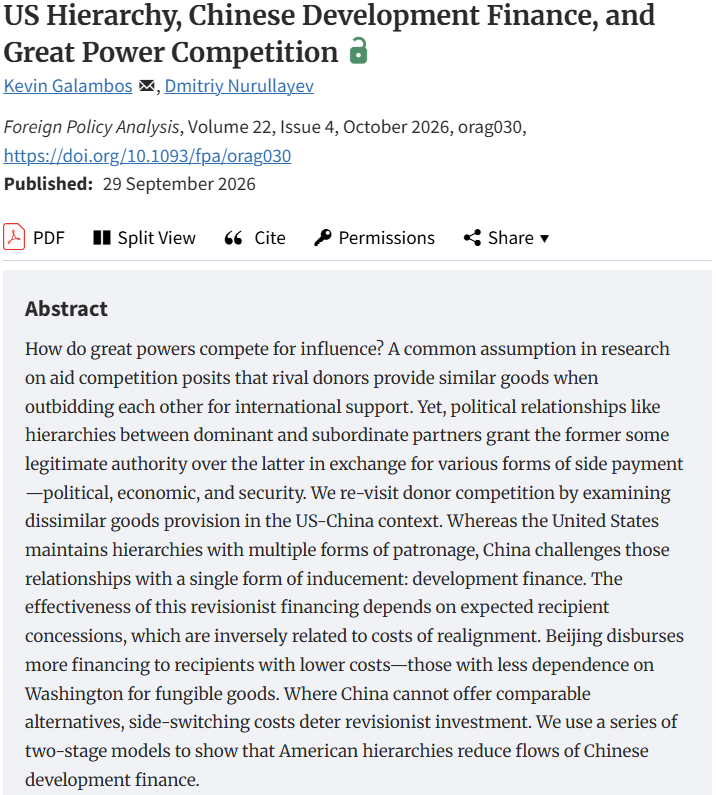
Galambos and Nurullayev (2026) examine dissimilar goods provision in the context of US-China aid competition. With both aid models providing different goods, they find the American hierarchical model reducies Chinese development finance.
https://t.co/ST1P6oNMrZ
🚨NEW ARTICLE🚨
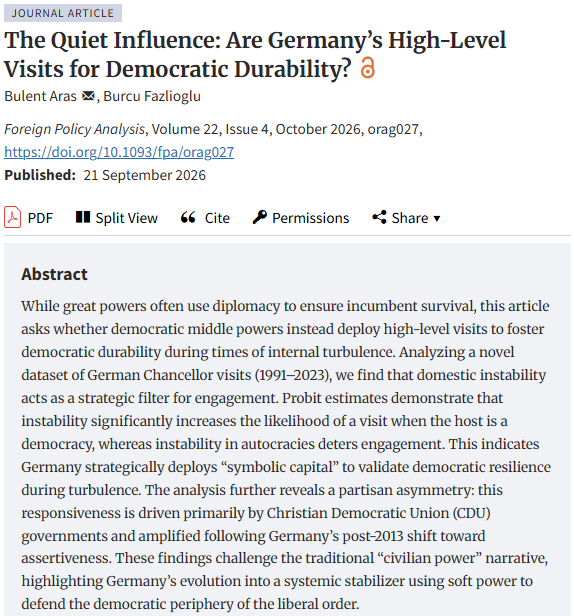
Aras and Fazlioglu (2026) ask if middle powers use high-level diplomatic visits to reinforce democratic resilience. Using data on German Chancellor visits (1991-2023), they show how Germany strategically deploys 'symbolic capital'.
https://t.co/JwtW5lvG2f
🚨NEW ARTICLE🚨
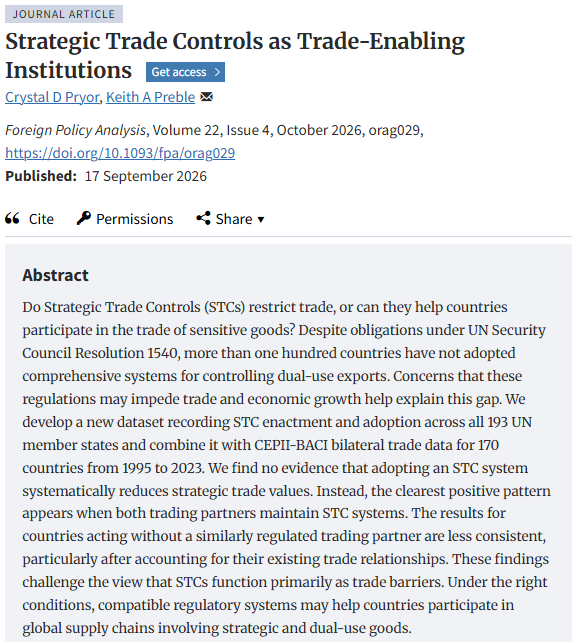
Pryor and Preble (2026) ask if Strategic Trade Controls (STCs) restrict or facilitate states' participation in trading dual-use items. They find no evidence STCs reduce trade values, challenging their characterisation as trade barriers.
https://t.co/V5r458ue3F
🚨NEW ARTICLE🚨
Kirchweger and Eder (2026) theorise intelligence agencies' international relations, proposing a framework asking how those relations are embedded in FP processes, the interaction effects they generate, and the roles agencies assume.
https://t.co/EgvVWNGsW9
🚨NEW ARTICLE🚨
Hidaka, Kubota, Matsuura, and Yukawa (2026) explore how leader biography shapes WMD proliferation. They find that leaders who studied in Western nuclear powers are likelier to pursue nuclear weapons, but discouraged from CBW development.
https://t.co/ZIfICVDbwb
🚨NEW PAGE ALERT🚨
After a short summer break, our editorial team are back and excited to launch our LinkedIn page!
We will remain active on X and Bluesky, but follow us on LinkedIn too so you don't miss journal announcements in your feed.
Join us there: https://t.co/bmlm1shLHJ
🚨NEW ARTICLE🚨
Hagan (2026) argues that governments in politically fragmented regimes are unlikely to operate coherently during international crises, drawing on the 1914 July Crisis to trace the effects of escalation across five fragmented governments
https://t.co/tDNaPYGnUR
🚨NEW ARTICLE🚨
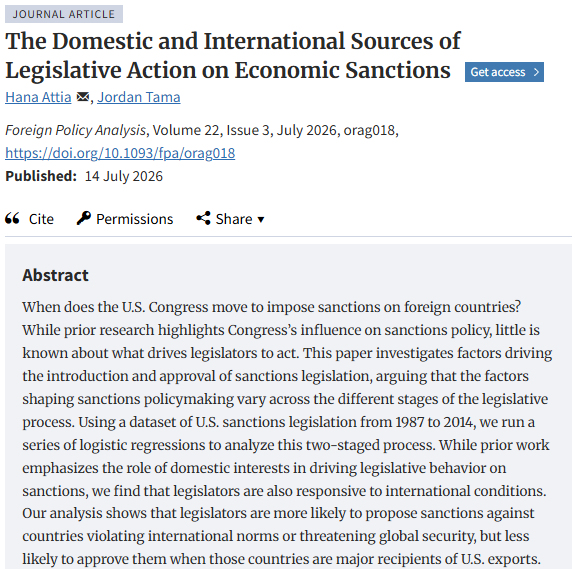
Attia and Tama (2026) investigate factors shaping approval of sanctions legislation in the US Congress between 1987 and 2014, finding that legislators are responsive to international contexts when proposing and approving sanctions.
https://t.co/ba6dIMl6mm
🚨NEW ARTICLE🚨
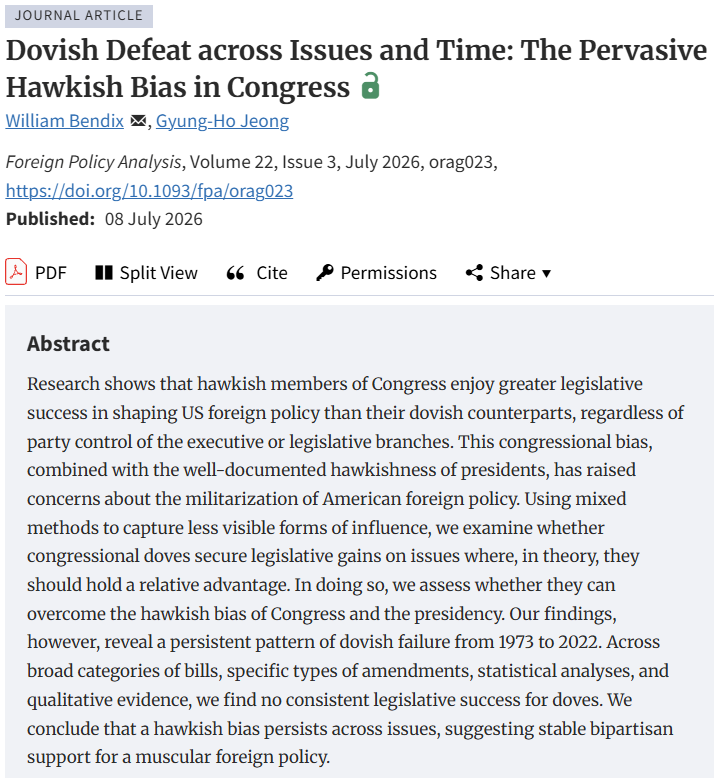
Bendix and Jeong (2026) examine whether dovish influence can overcome hawkish bias in the US Congress. Using mixed methods data from 1973-2022, they find a pattern of dovish failure to legislatively shape foreign policy.
https://t.co/n6r8BL5j4Q
🚨NEW ARTICLE🚨
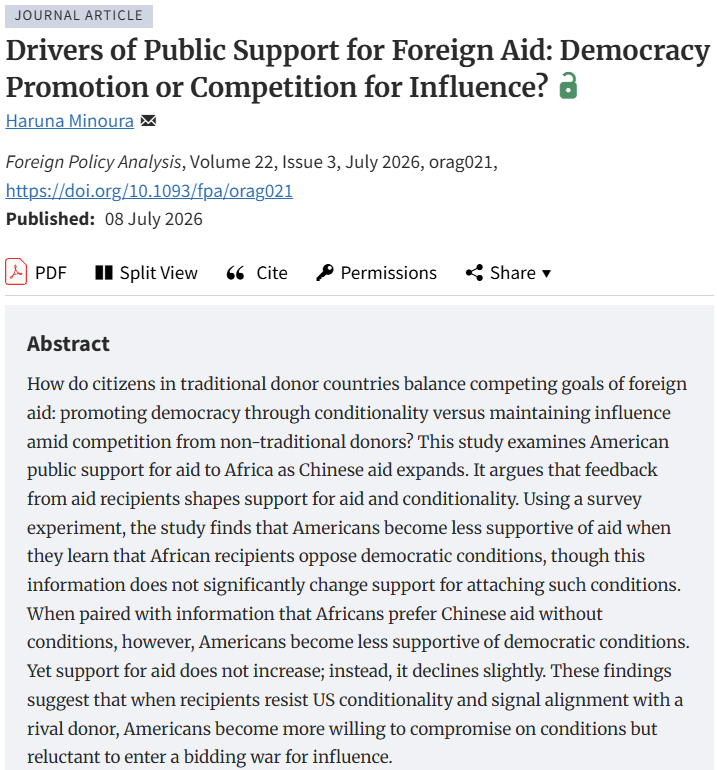
Minoura (2026) uses a survey experiment to study how donor citizens balance democracy promotion and competition from other donors, finding that US citizens may be willing to compromise on aid conditions but reluctant to outbid competitors.
https://t.co/nw76hQiKpX