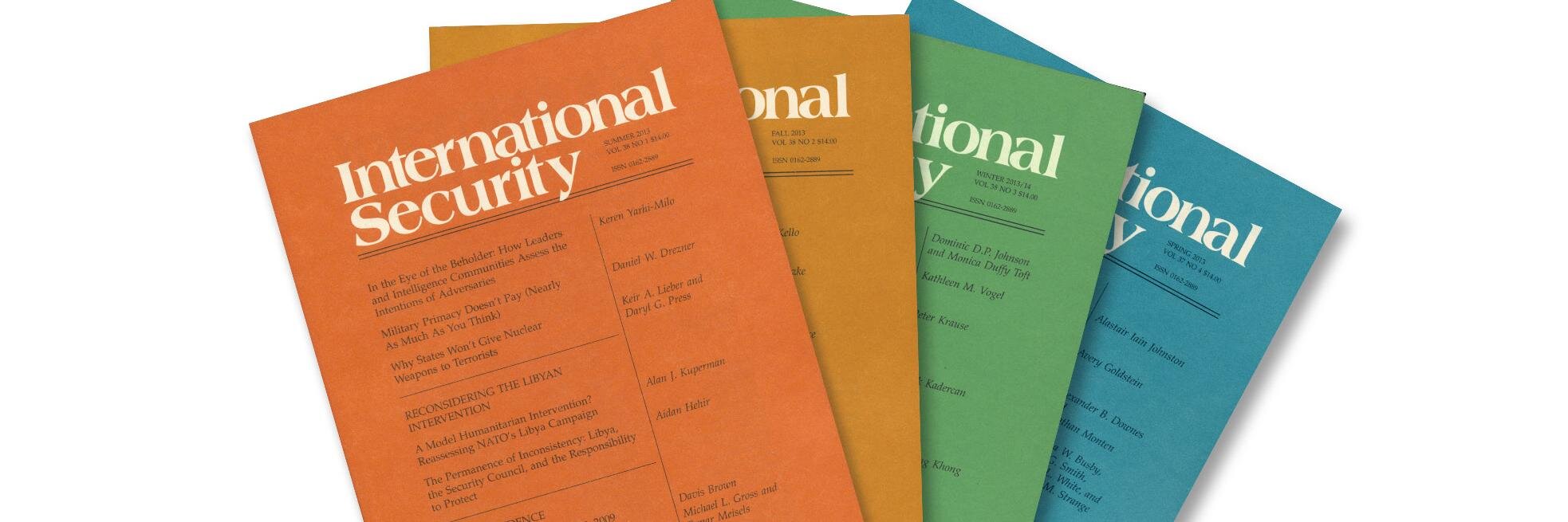
The Summer 2026 issue is online!
Read articles @stephenWalt, @MearsheimerJ, Lars-Erik Cederman et al (incl. @lucgirardin, @andijot), and Eli Sanchez.
Plus letters on studying what China wants.
https://t.co/GFIQnL3I4u
just after #9-11 I was asked by Cambridge Review of International Affairs to author an analysis of the W. administration's "war on terror" based on my just-published essay in @IntSecHarvard. the result was "https://t.co/0T8nkXDpxY." sad to say it proved uncannily prescient
Attending APSA? Stop by the MIT Press booth tomorrow, September 4, 4-5:30pm for drinks, nibbles, new magnets, and help International Security celebrates its 50th!
Among the important ideas put forward by @MearsheimerJ about international order: a tripolar great-power system, dominated by #US_China_rivalry; #Russia remains a weaker third pole; #India is the only plausible fourth entrant; #liberal_hegemony gives way to #balance_of_power politics; flashpoints in #East_Asia and the prospect of #nuclear escalation make the coming half-century far more dangerous than the last. He does not expect China to surpass the US, but argues that a powerful China gives Washington and Moscow strong incentives to cooperate, and sees economic, technological, and military power as crucial to the competition.
https://t.co/jDIzbw9naW
The latest issue of @IntSecHarvard features a paper by Eli Sanchez, former Stanton Nuclear Security Fellow, “Seeing Through ‘Transparent Oceans’: Emerging Technology, Submarine Vulnerability, and the Future of MAD”.
🔖Bookmark now, 📖read later.
The Summer 2026 issue is online!
Read articles @stephenWalt, @MearsheimerJ, Lars-Erik Cederman et al (incl. @lucgirardin, @andijot), and Eli Sanchez.
Plus letters on studying what China wants.
https://t.co/GFIQnL3I4u
“Correspondence: The Challenge of Studying What China Wants.” @RushDoshi, @AGhiselliChina, Todd Hall, Jamie Gruffydd-Jones, and Arash Heydarian Pashakhanlou respond to David Kang, @SiuHeiWong2, and @ZenobiaChan’s Summer 2025 article.
https://t.co/cduN7cpj83
“The paradox is plain: Trump is exceptionally dedicated to coercion as a core foreign policy tool yet is one of its least effective practitioners,” write @reidpauly and Matthew Cebul.
https://t.co/EFpu5Wtatt
When Trump “uses bellicose threats as a first resort,” he risks exposing the limits of U.S. military force—and emboldening adversaries to resist, write @reidpauly and Matthew Cebul. “Effective coercion requires more than heavy-handed threats.”
https://t.co/EFpu5Wtatt