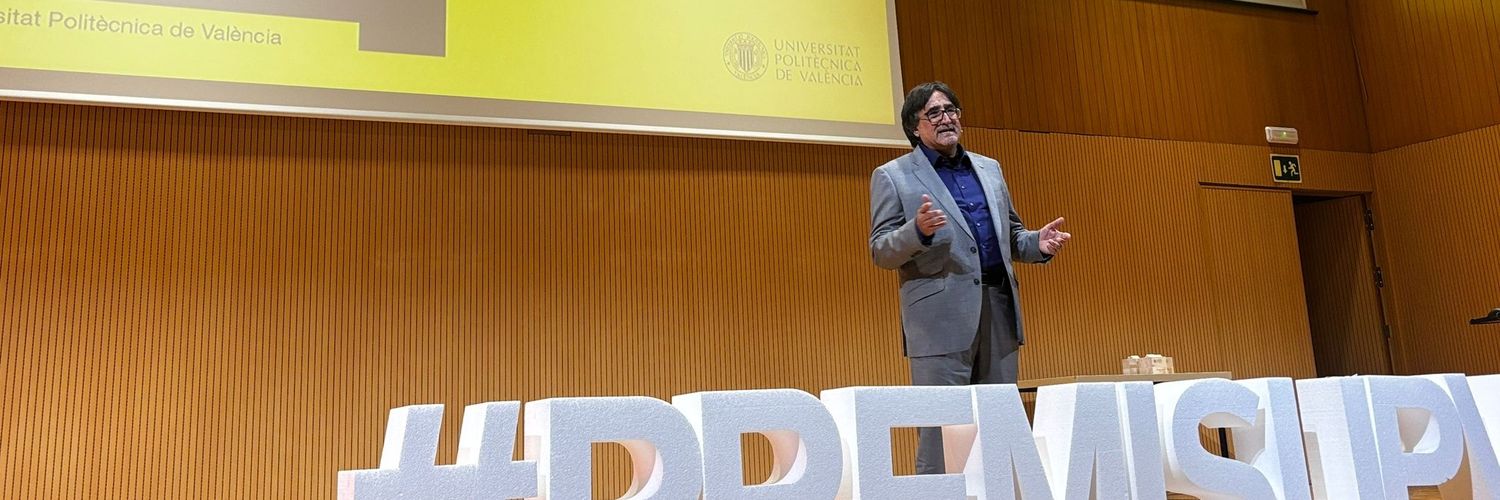
Profesor en Universitat Politècnica de València. Redes complejas y rankings. Premio monólogo científico UPV. Método alternativo para clasificación liga fútbol.
A l'@imm_UPV ens encanta veure com les matemàtiques ixen del paper i pujen a l'escenari, i @FPedroche és tot un artista 🎭
👏 Enhorabona pel premi de la @fcri_cat!
🎤 La ciència puja a l’escenari! 8 finalistes, 8 monòlegs i una gran final del Concurs de Monòlegs Científics de l'#SC26CAT
📅 20 de novembre, a les 12.30 h
📍Espai Narcís Monturiol, Parc de Recerca i Innovació de la @univgirona.
T'hi esperem! 🔗 https://t.co/yte0HOadHG
📣 El 20 de novembre, tens una cita amb l’humor i la ciència a Girona!
🎙️ Vine a la final de la 8a edició dels Monòlegs del Club de la Ciència, en el marc de l'#SC26CAT, i descobreix el talent de les 8 persones finalistes.
T'hi esperem!
https://t.co/yte0HOadHG
Ten million people have watched a comedian destroy the TED talk format in six minutes.
Will Stephen was invited to give a real TEDx talk in New York in 2014. He had nothing to say, so he decided to prove the whole thing is just a costume anyone can put on.
He did every trick the format uses: opened with a question anyone can answer, told a mildly embarrassing personal story,
pointed to a random scientist on a slide, flashed a chart of meaningless numbers, and gestured with both hands the whole time. There was zero actual content.
Speaking coaches charge thousands to teach people how to do exactly this. Stephen did it on purpose and admitted it on stage.
He later said that if you watched him with the sound off, you would think he was a genius.
The talk is still free on YouTube. Most of the ten million people who watched it still nod along at empty slides.
Durante la redacción, la persona que elabora el artículo considera que es un error de la IA sustituir INE por elDiario y decide eliminar las referencias a el Diario.
Obviamente, nosotros no éramos conscientes de esto.
Le pide a la IA que elimine las referencias
This is quite interesting:
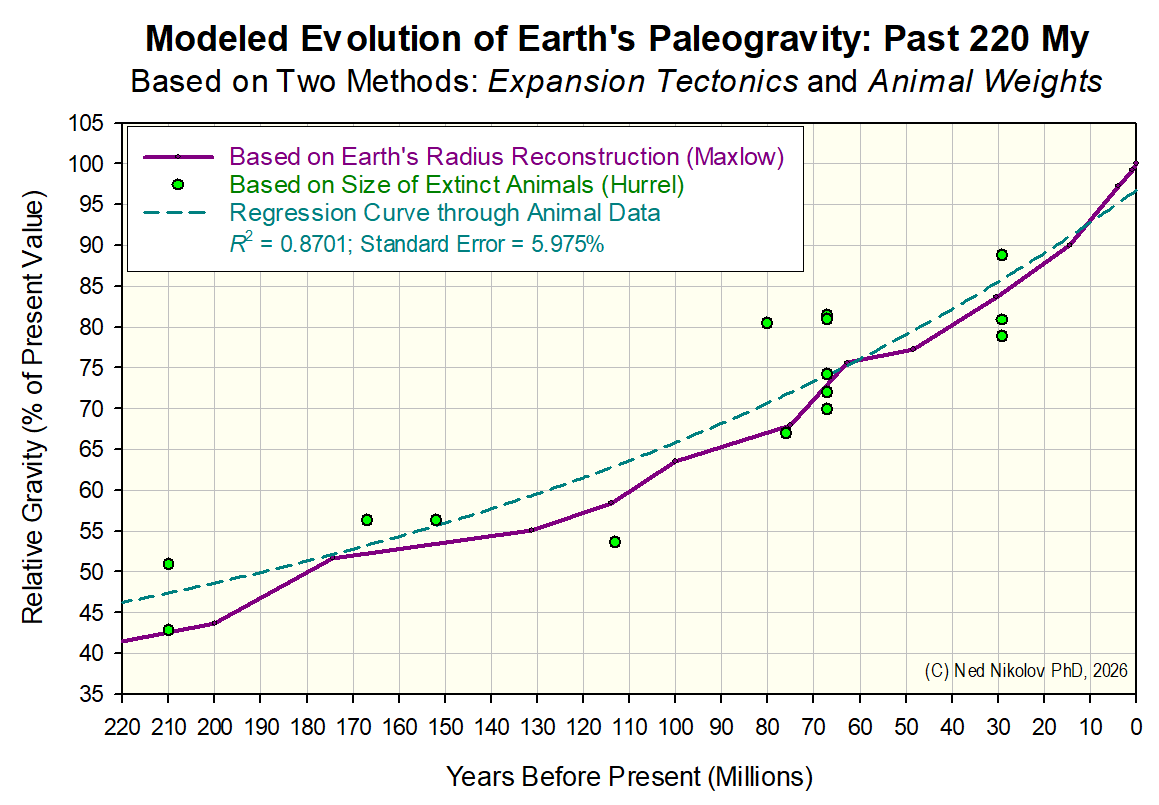
Two independent estimates of the evolution of Earth's gravity over the past 220 My produce very similar results.
One method is based on the measured body volume and estimated weight of extinct animals (mostly dinosaurs), while the other method uses a reconstruction of Earth's past diameter from a NOAA map of oceanic lithosphere ages done by Maxlow (2012). The first method uses the circumference of femur and humerus weight-bearing bones of extinct animals to estimate their weight when they were alive. The ratio of that weight to the animals' body mass (assuming an average tissue density of 0.99 tones m-3) gives an estimate of the relative gravity in the past. The second method assumes that Earth has been expanding according to Maxlow's Expansion Tectonics.
These results indicate that during the Mesozoic Era (the era of dinosaurs), from 252 My ago to 66 My ago, Earth's gravity was less than 75% of today's value. This can help explain the enormous sizes of some sauropods.
Ante los avisos meteorológicos de @AEMET_CValencia y la previsión de condiciones adversas, aplazamos el certamen de monólogos científicos "Quart és Ciència Exprés", previsto para mañana, domingo 18 de octubre.
Lamentamos las molestias y os agradecemos vuestra comprensión.
Terence Tao really changed my mind with his analogy of a robot saving dozens of orphans from a house on fire, but mathematicians don't understand how it did it. We must stop AI immediately
Why AI is not all bad news for most mathematicians
On October 6, 2026, OpenAI released hundreds of mathematical preprints. And while these results are still being evaluated, the news caused shockwaves. Some celebrated it while others warned of a mathspocalypse. But these early reactions may be a bit exaggerated. This is not to deny that AI is disrupting math research, but to question whether that disruption extends to the much larger community of people trained in mathematics. My point here is that much of what we associate with mathematics is here to stay, because the vast majority of people trained in mathematics do not operate at the frontier, and that this is a good thing.
To make my point, I’ll start with a Formula One (F1) racing analogy. F1 is the frontier. It pushes the boundaries of what is possible with exceptional drivers and technology. And because of this, it gets well-deserved attention. But F1 is not transportation.
Most professional drivers are not in F1. They drive buses, taxis, and trucks. Their job is not to show us the limit of what cars can do, but to transport children safely to school, deliver products without breaking them, and help billions of people get to work every morning. F1 is exciting, but the world keeps moving because of the millions of drivers that do not operate at the frontier.
Imagine the arrival of an alien civilization with better F1 vehicles and drivers. The aliens are so advanced that no human ever wins a Formula One race again. This would certainly change Formula One. But would it mean that the majority of professional drivers would have lost their purpose?
I don’t think so.
The morning after the race children would still need to get to school, and goods would still need to get delivered. Because the value of those activities was not derived from performance at the frontier.
Now, you might say that trucks and taxis are also bound to disappear, because AI will drive them too. But here is where the analogy breaks. Research mathematicians, mathematics educators, and professionals trained in mathematics are not the same thing. Yet they are all part of a larger mathematical ecosystem whose value comes not only from discovering new mathematics, but also from teaching, understanding, and applying what we already know.
Consider a math teacher at a K-12 school or at a local university. What I appreciate from the math teachers at my daughter's school, or from those who taught me during my education, is not that they are trying to solve the Riemann hypothesis, but their ability to help us understand math, from adding fractions to solving partial differential equations.
A good math teacher is not a machine of correct answers. They are responsible for creating a social environment in which mathematical understanding can develop, even for a thirteen-year-old that would prefer to be doing anything other than learning math. And this is an activity of enormous value. How valuable? Imagine having to choose between a world where no new frontier math is developed for the next ten years and a world where children between the ages of 6 and 16 no longer receive math education. The first one would be lamentable. The second would be catastrophic. There is nobility in recognizing the value that happens outside the frontier.
And this is true also for universities and professional practices. While frontier mathematicians compete to prove new theorems, others teach math to physicists, economists, engineers, and countless other students pursuing careers that require quantitative reasoning. In a professional practice, you want an engineer responsible for a bridge to have a good understanding of how stress is calculated on a structure, even when the calculations are performed by software or AI.
The point is that the social value of mathematics is not derived exclusively from advancing the frontier. Much of that value rests on the shoulders of millions of people who teach, practice, and apply mathematics. This is why the idea of a mathematical apocalypse is misleading: it confuses visibility with value. It reduces an entire discipline to the highly visible activity of solving difficult new problems. And of course, we want to keep that going, just like we would not like to eliminate Formula One. But my intuition is that many frontier mathematicians will be supercharged by AI. They will be human drivers on alien cars. But for the millions of people who are not pursuing the frontier, the core of their value doesn’t change. We should not confuse what’s spectacular with what is valuable.
Academic prestige tends to accumulate around frontier achievements. But the mathematician who introduced thousands of students to calculus over a career may have a larger overall impact on society. These are not consolation prizes, but achievements that keep the world working. AI is already solving difficult mathematical problems that have challenged some of the world's most talented mathematicians. But our world still needs millions of mathematicians, and billions of people with a good understanding of math. Because math is not just a race to solve the hardest problems, but a way of thinking that we pass from generation to generation.
https://t.co/pIzCYmK1It
in case you were curious if this generalizes... yes, as a packing method. not the best overall, but it finds packings other methods miss on squares and cubes. have some ideas, but not exactly sure why...
more: https://t.co/B3l7KvKs5q
@Riazi_Cafe_en It seems this ethical question was already addressed with the publication of Appel and Haken's paper on the four-color theorem in 1977. If they signed their paper—which was created with the indispensable help of a computer—why not now?
The plot thickens.
"We show that the formalised Lean proof does not correspond to the [written paper] proof of blow-up of solutions to the Navier-Stokes equations."
https://t.co/02Q52MH81g
@juanmemol Por poner un ejemplo típico, si pensamos en la caida libre de cuerpos o en tiro parabólico, se asume que la aceleración gravitatoria, g, es constante en todo punto. Y de ahí se sigue lo demás. La velocidad ha de ser gt+C, y el espacio gt^2/2 +Ct +D.
Todos los que hemos tenido contacto con personas tan mayores sabemos que un trauma así es letal para ellos.
Cualquier persona mayor quiere pasar sus últimos días en sus casa, que la hayan sacado con tantísima violencia es un trauma para cualquiera, pero para alguien de 87 años, es simplemente letal.
Hay responsables de semejante barbaridad, buitres, juzgado, falta de legislación que la proteja, una derecha política y mediática que la ha despellejado hasta cuando estaba en el hospital.
Descansa en paz Mari Carmen, tus muchos hijos y tus tantos nietos, vamos a luchar por una vivienda digna y para que nadie tenga que morir más en este país por reclamar su derecho a techo.
“okay, so what? it’s just math.”
no, you don't get it.
here’s what OpenAI’s math breakthroughs could eventually help make possible in the real world:
Vlasov–Maxwell → stronger foundations for fusion research, whose ultimate prize is virtually limitless clean energy to power civilization
Calderón’s Problem → portable body scanners using electrical signals, making medical imaging cheaper and easier to access
Maximum-Cardinality Matching → faster searches for compatible kidney swaps across large donor pools, helping hospitals coordinate lifesaving transplants
Inverse Elasticity Problem → scans that map tissue stiffness, helping doctors locate suspicious growths inside the body
Mumford–Shah Conjecture → better tools for spotting tissue changes in brain scans, helping doctors identify signs of disease
Bose–Einstein Condensation → stronger foundations for quantum sensors that could help vehicles navigate without GPS
Simple Stochastic Games → better safety checks for self-driving cars and robots before dangerous mistakes reach the real world
Matrix Multiplication → cheaper AI and bigger scientific simulations using the same computers
Edit Distance → faster DNA comparisons, helping researchers study genetic changes linked to disease
The k-Server Problem → robots that waste less movement and energy, making warehouses more efficient and goods cheaper to move
a reminder that math is the foundation of science.
so accelerating mathematical discovery could compress centuries of scientific progress into years.
insane timeline to be alive for!