In 2010, holding expansive poses for two minutes was reported to change hormones and risk-taking. A larger replication in 2015 found no effect on hormones or behaviour, only a small rise in how powerful people said they felt. #bodylanguage#charisma
https://t.co/PHetcyZ6EB
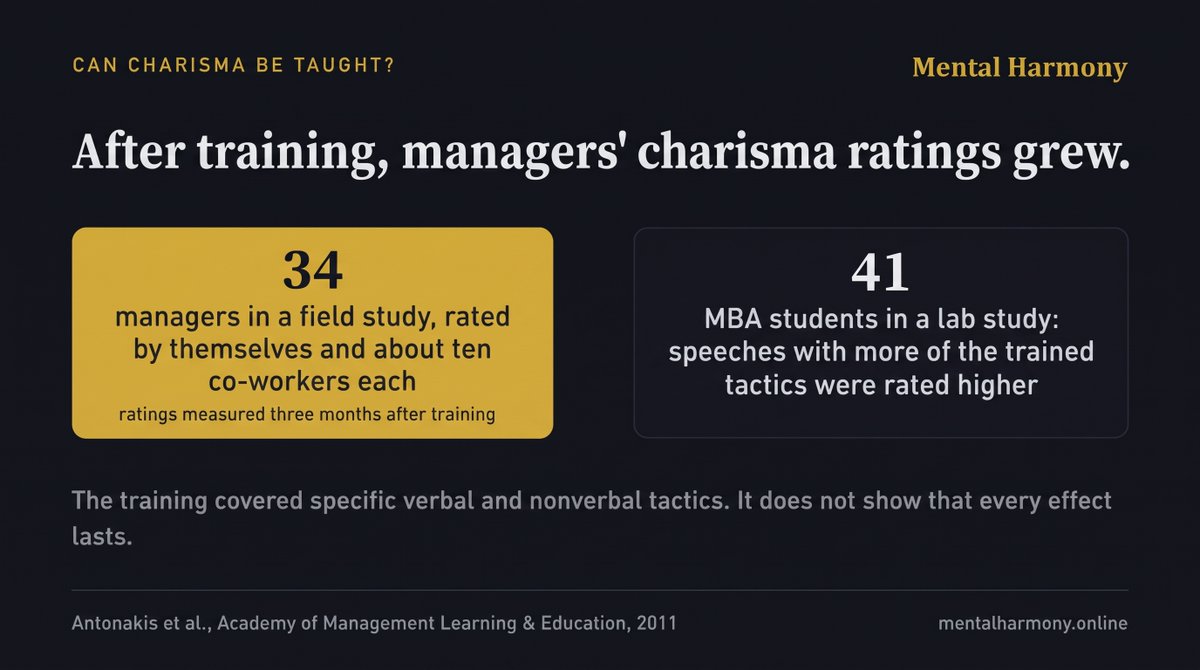
In a field study, 34 managers were rated on charisma by themselves and about ten co-workers each. Three months after training in specific tactics, their ratings had grown relative to untrained managers (Antonakis et al., 2011). #charisma#socialskills
https://t.co/T7rjZCHSGJ
Words carry only 7% of a message? That misreads Mehrabian's 1967 experiments, which used single words in different tones. The narrower lesson: when words and tone disagree about a feeling, people lean on the tone. #charisma
https://t.co/T7rjZCHkRb
In professional pianists, reported flow was related to heart timing, breathing depth and facial activity. The authors call it 'effortless attention': positive emotion plus high attention (de Manzano et al., 2010).
https://t.co/WUi5D8IDyd
People form a view of how trustworthy a face looks in about 100 milliseconds, and those quick judgments agree well with slower ones (Willis & Todorov, 2006). Arrive settled. Nerves often show in posture and voice long before the first word.
The simplest pre-performance routine with real evidence: breathe at about 6 breaths a minute for 3 minutes. Five seconds in, five out.
https://t.co/wVEIpQmPfs
#MindsetMatters#MentalHealthMonth#MusicDiscovery