Ashok’s @aelluswamy part on the earnings call is GOOD. Needed this reminder of how well FSD and robotaxi is performing.
Ill gladly hold my shares. Thanks.
Yep it really is that easy.
1. AI capex doesn’t provide good ROI? $META cuts capex and stock moons.
2. AI capex pays off? (either company’s own usage or selling compute) stock moons.
3. Stock moons
Bought all I could under 600$. Cya in a year or two.
META strikes me as one of those setups where it’s going to rip so hard that when it’s done everyone acts like it was obvious the whole time and pretends they were buying the whole way down.
Nobody i know enjoys the taxes in Quebec, no matter their income bracket.
But to say that you’re going through a “very difficult time” having to pay taxes on assets due to a planned exit “for better opportunities” is also a victim mindset. Own it and enjoy your life.
In a sane world, governments exist to improve the lives of people (at a minimum). The worst incidents of my life all stem from the provincial and federal governments repeatedly punishing me financially for being successful in ways that make you feel trapped in a Kafkaesque prison of despair. I realize that many Canadians benefit from the system, and hence will exhibit zero empathy but in a just world, this reality should not be tolerated. It can't be that a government owns 65%+ of all of your worth once all taxes are added up. Send me good vibes. Going through a very difficult time.
@TeslaBoomerMama Horrible take. SPY investors dont care about individual stocks and most would prefer having no risky bets in the basket. Thats the purpose of SPY.
Sucks for supervised FSD, because people dont know the software’s on. But I wouldnt want unsupervised rolling stops.
Nobody’s gonna care when it’ll be unsupervised.
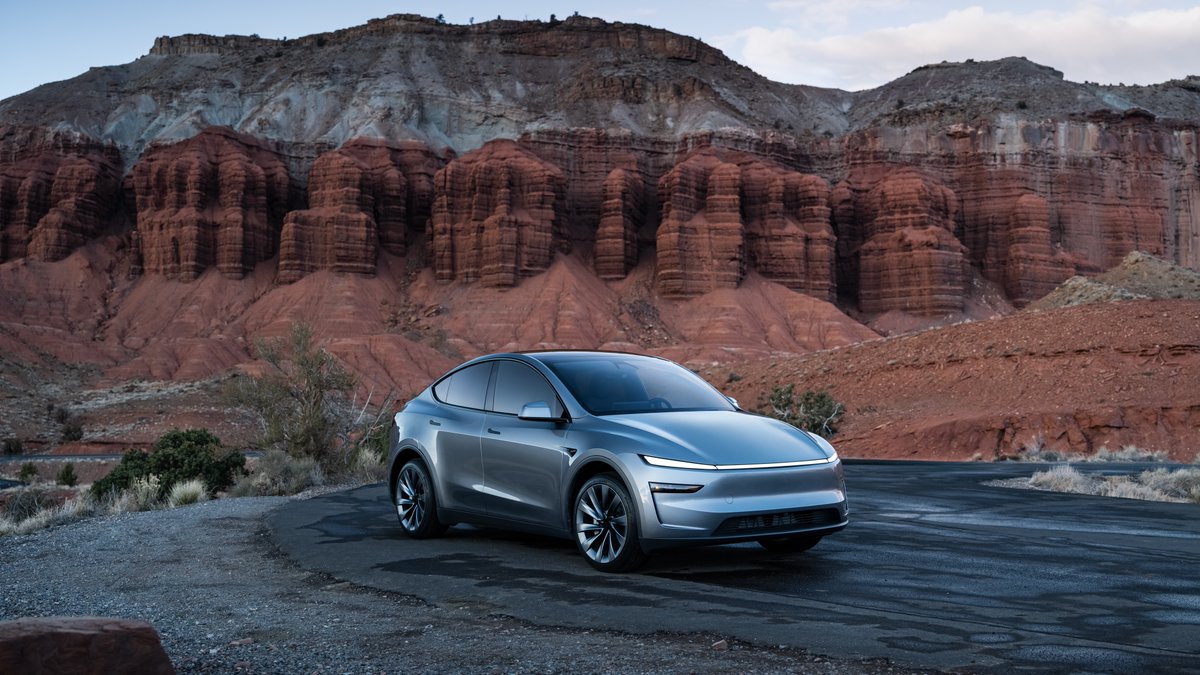
The NHTSA has just officially announced that the 2026 @Tesla Model Y is the first vehicle model to pass the agency’s new advanced driver assistance system tests.
2026 Tesla Model Y vehicles, manufactured on or after Nov. 12, 2025, successfully met the new criteria for four newly integrated advanced safety tests:
• Pedestrian automatic emergency braking
• Lane keeping assistance
• Blind spot warning
• Blind spot intervention
“Today’s announcement marks a significant step forward in our efforts to provide consumers with the most comprehensive safety ratings ever,” said NHTSA Administrator Jonathan Morrison. “By successfully passing these new tests, the 2026 Tesla Model Y demonstrates the lifesaving potential of driver assistance technologies and sets a high bar for the industry. We hope to see many more manufacturers develop vehicles that can meet these requirements.”
@DirtyTesLa Just hit preference.
I think it could even be limit to :
- critical (important things to fix)
- non critical (anything else)
The fact that you need more buttons means its “preference”
@tavi_chocochip Really don’t see the divide here. There is non zero chance (and imo close to 50%) for this to launch with a steering wheel. Or else it cant scale for a few years.
Seems like Tesla sees the roadmap of updates needed to make FSD safer and better. They won’t scale until its done.
Painful for investors short term but this is the best approach, as it avoids hiccups that could set back rollout even more.
Basically invest for 2027-2028.
The FSD subscription flywheel is real, and nobody's tracking it.
Here's what's actually happening inside Tesla's FSD business right now, from our fleet telemetry data at @TezLabApp.
The metric nobody's watching: subscribed % of fleet.
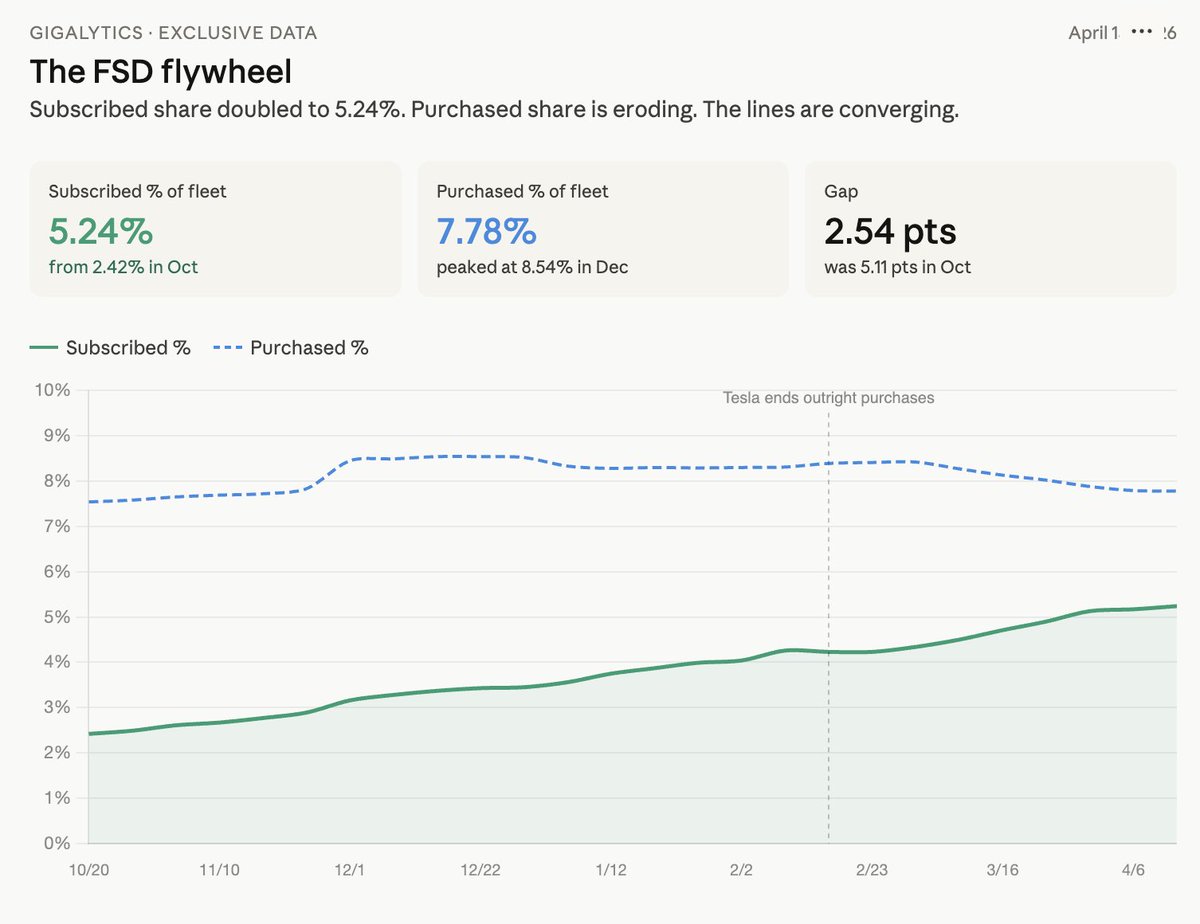
Oct '25: 2.42%
Jan '26: 3.56%
Apr '26: 5.24%
That's more than doubled in six months. And it's accelerating. Subscribed share added almost a full point in March alone (4.34% → 5.13%).
To understand why, you have to go back to what Tesla did over the holidays.
In late November 2025, Tesla pushed a free 40-day FSD v14 trial to roughly 1.5 million HW4 vehicles. Biggest trial deployment they've ever run, timed perfectly for holiday road trips. In our data, December's new subscriber cohort was 84% trial users, just 16% paid. Tesla was betting that seat time would convert free users into paying customers.
That trial expired January 8.
What happened next is the interesting part. Trial volume collapsed. December's cohort was overwhelmingly trial, but January flipped to 78% paid. By March: 97% paid.
April is tracking 96%.
The trial-as-funnel strategy didn't produce mass conversion. But what it did do is clarify the subscriber base.
Look at M1 retention (the percentage still subscribed after one month) by subscriber type:
Paid M1 retention is consistently in the 86–100% range across cohorts with meaningful sample sizes. Remarkably stable.
Trial M1 retention: 81% in October, 41% by March. And by M2 (two months), trial retention drops to single digits. The December holiday cohort, Tesla's biggest bet, retained just 1% at M2. Essentially nobody who got the free trial stuck around.
Here's the thing people will miss. The overall M1 retention number for March looks great at 91.1%. But it looks great because the composition changed, not because retention "improved" in the abstract. When 97% of your cohort is paid subscribers who retain at 92%+, the blended number naturally rises. That's not a retention improvement. It's a base quality improvement. Important distinction.
Then on February 14, Tesla ended outright FSD purchases entirely. No more $8,000 one-time buy option. It's $99/month or nothing. (as of today:)
This is where the compounding kicks in.
The mechanics: new paid subscribers enter each month. They retain at 87%+ even four months in (the October '25 paid cohort, our oldest with M4 data, is still at 87%). Very few leave. Each new month's cohort stacks on top of the ones still there. Since the trial churn cleared in late January, activations have exceeded churns every single week. 12 straight and counting. That's how you get subscribed share doubling.
Meanwhile purchased % peaked around 8.5% in December and has been slowly eroding. 7.78% and declining. Natural attrition as people sell vehicles, trade in, etc. Since Tesla killed the purchase option, that line can only go down from here. The subscribed line can only go up. At the current trajectory, they cross sometime this year. (A few older subscribers transferred FSD to HW4 but that's a very small number.)
One more corroborating signal worth paying attention to: the people who subscribe aren't casual about it. FSD now accounts for 50.5% of driving distance and 63.1% of driving duration among users. These aren't people toggling it on occasionally. FSD is their default driving mode. The gap between distance and duration is itself interesting. FSD overindexes on city and slower-speed driving versus highway, which is where the higher duration percentage comes from. That's consistent with what we see in the whole-drive autonomy data: v14.x users complete 50% of their drives entirely on FSD without intervention.
What this doesn't tell you: whether the holiday trial "failed." You could frame 1.5 million free trials with near-zero conversion as a waste. Or you could frame it as Tesla stress-testing the funnel at massive scale and learning that the product now sells itself to people who are ready to pay. No free taste needed. The fact that Tesla followed the trial by killing outright purchases suggests they're betting on the second interpretation.
Either way, the observable outcome is this: the casual users washed out, the purchase option is gone, and what's left is a subscription base that compounds because retention is high enough that inflows consistently beat outflows.
That's the flywheel. And it's the number to watch going forward.
Exclusive data from @TezLabApp fleet telemetry · https://t.co/daljga3qTo @CernBasher@herbertong@wholemars@DirtyTesLa@farzyness