The AST SpaceMobile network is taking shape, in orbit and on the ground.
Today, over 60 gateways are in various stages of completion, installation and planning worldwide.
Initial, intermittent coverage targeted before year-end 2026 in the U.S. and other key markets around the world.
A new layer of connectivity, designed to connect directly to the smartphones people already use.
🇺🇸 📶🌎📱
#ASTSpaceMobile #ConnectingtheUnconnected
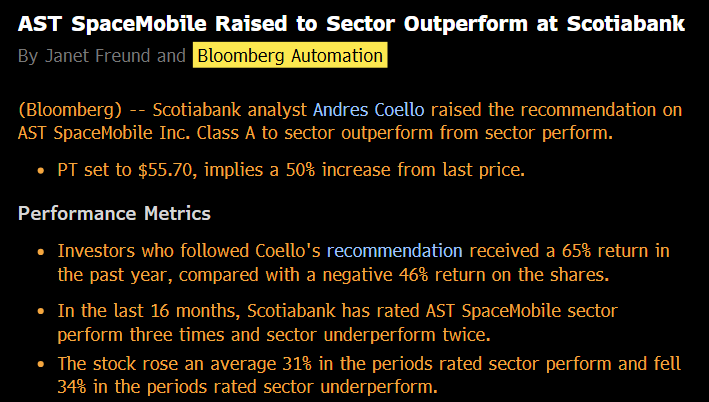
$ASTS: 🚨 SCOTIA BANK UPGRADES AST SPACEMOBILE TO SECTOR OUTPERFORM AND RAISES PRICE TARGET TO $55.70 FROM $50.80
I'd note that Coello was bearish on AST because he thought Starlink was going to get all of these MNO partnership whereas now Starlink is going to compete directly against them! Shocking news.
$ASTS 🚀🛰️ BLUE ORIGIN LAUNCH UPDATE!
The U.S. Space Force’s latest high profile missions slide now lists Blue Origin’s New Glenn 4.1 mission for NET December 28! 🔥
A target date, not a confirmed launch but an encouraging sign for New Glenn’s return to flight.
For AST SpaceMobile, New Glenn’s progress matters. ASTS has contracted Blue Origin for future BlueBird satellite launches, making a reliable New Glenn launch cadence critical to scaling the constellation.
MORE LAUNCH CAPACITY. MORE BLUEBIRDS. GLOBAL CONNECTIVITY. 🌎🚀
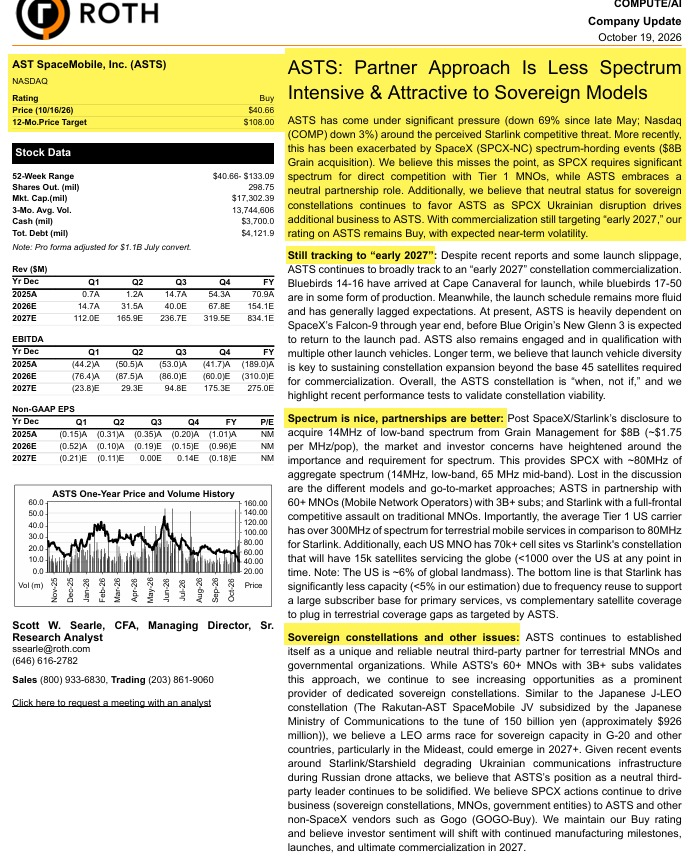
$ASTS: 🚨ROTH CAPITAL REITERATES $108 PRICE TARGET AND BUY RATING
ASTS: Partner Approach Is Less Spectrum Intensive & Attractive to Sovereign Models
ASTS has come under significant pressure (down 69% since late May; Nasdaq (COMP) down 3%) around the perceived Starlink competitive threat. More recently, this has been exacerbated by SpaceX (SPCX-NC) spectrum-hording events ($8B Grain acquisition). We believe this misses the point, as SPCX requires significant spectrum for direct competition with Tier 1 MNOs, while ASTS embraces a neutral partnership role. Additionally, we believe that neutral status for sovereign constellations continues to favor ASTS as SPCX Ukrainian disruption drives additional business to ASTS. With commercialization still targeting "early 2027," our rating on ASTS remains Buy, with expected near-term volatility.
Still tracking to "early 2027":
Despite recent reports and some launch slippage, ASTS continues to broadly track to an "early 2027" constellation commercialization. Bluebirds 14-16 have arrived at Cape Canaveral for launch, while bluebirds 17-50 are in some form of production. Meanwhile, the launch schedule remains more fluid and has generally lagged expectations. At present, ASTS is heavily dependent on SpaceX's Falcon-9 through year end, before Blue Origin's New Glenn 3 is expected to return to the launch pad. ASTS also remains engaged and in qualification with multiple other launch vehicles. Longer term, we believe that launch vehicle diversity is key to sustaining constellation expansion beyond the base 45 satellites required for commercialization. Overall, the ASTS constellation is "when, not if," and we highlight recent performance tests to validate constellation viability.
Spectrum is nice, partnerships are better:
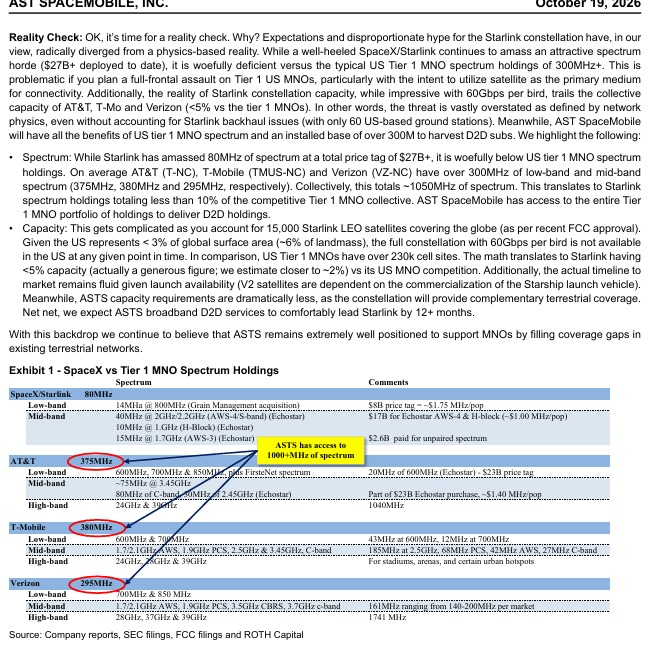
Post SpaceX/Starlink's disclosure to acquire 14MHz of low-band spectrum from Grain Management for $8B (~$1.75 per MHz/pop), the market and investor concerns have heightened around the importance and requirement for spectrum. This provides SPCX with ~80MHz of aggregate spectrum (14MHz, low-band, 65 MHz mid-band). Lost in the discussion are the different models and go-to-market approaches; ASTS in partnership with 60+ MNOs (Mobile Network Operators) with 3B+ subs; and Starlink with a full-frontal competitive assault on traditional MNOs. Importantly, the average Tier 1 US carrier has over 300MHz of spectrum for terrestrial mobile services in comparison to 80MHz for Starlink. Additionally, each US MNO has 70k+ cell sites vs Starlink's constellation that will have 15k satellites servicing the globe (<1000 over the US at any point in time. Note: The US is ~6% of global landmass). The bottom line is that Starlink has significantly less capacity (<5% in our estimation) due to frequency reuse to support a large subscriber base for primary services, vs complementary satellite coverage to plug in terrestrial coverage gaps as targeted by ASTS.
Sovereign constellations and other issues:
ASTS continues to established itself as a unique and reliable neutral third-party partner for terrestrial MNOs and governmental organizations. While ASTS's 60+ MNOs with 3B+ subs validates this approach, we continue to see increasing opportunities as a prominent provider of dedicated sovereign constellations. Similar to the Japanese J-LEO constellation (The Rakutan-AST SpaceMobile JV subsidized by the Japanese Ministry of Communications to the tune of 150 billion yen (approximately $926 million)), we believe a LEO arms race for sovereign capacity in G-20 and other countries, particularly in the Mideast, could emerge in 2027+. Given recent events around Starlink/Starshield degrading Ukrainian communications infrastructure during Russian drone attacks, we believe that ASTS's position as a neutral third-party leader continues to be solidified. We believe SPCX actions continue to drive business (sovereign constellations, MNOs, government entities) to ASTS and other non-SpaceX vendors such as Gogo (GOGO-Buy). We maintain our Buy rating and believe investor sentiment will shift with continued manufacturing milestones, launches, and ultimate commercialization in 2027.
AST SpaceMobile Advances Space-Based Cellular Broadband in Europe in Collaboration with European Mobile Network Operator Partners
https://t.co/PzfuEQdPKX
I still thinking that something big is coming at $ASTS. Last PR is from 10 August. More than two months ago.
Even the shipments have not be announced at PRs.
My bet: some agreement with a big tech (Meta, Google) or the final agreement with T-Mobile.
Stay tuned.
🛰️🌎📲
$ASTS: 🚨 CLEAR STREET REITERATES $115 PRICE TARGET AND BUY RATING
Summary
AST faces launch constraints today, and the market is watching every slip closely. AST currently depends on Falcon 9, a rocket owned by competitor SpaceX (SPCX, Buy, $217 PT). That pressure could ease if other rockets return to service, particularly New Glenn, which carries up to eight BlueBirds per flight versus three on Falcon 9. Our model continues to see AST reaching commercial broadband service by mid-2027E.
On the flip side, we think the market is underappreciating SpaceX's own launch risk. Its next-generation V2 phone satellites are how it hits its timeline, and they depend on Starship, which remains unproven. Flight 15 has already slipped from October 19 to November 8 at the earliest, and reaching service in early 2028E would require roughly 24 Starship flights in six months. Both companies are in this race and both carry launch risk. We think AST remains positioned about six months ahead of SPCX.
Key Points
SpaceX's phone leap is parked behind Starship, and the math is demanding. The real threat to AST is SpaceX's FCC-approved V2 constellation, which SpaceX says Starship will launch. We don't see the larger V2s flying in volume on Falcon 9. SpaceX's stated goal is initial global coverage of about 1,200 satellites within six months of starting launches in mid-2027, at roughly 50 per Starship. By our math, that is about 24 Starship flights in six months, roughly one a week, from a rocket with no regular cadence: Flight 15 has already slipped from October 19 to November 8 at the earliest. Service lands in early 2028 at best.
New Glenn's December return is the pivotal event for AST. It has been grounded since the May 28 pad explosion. A clean return in December would reopen AST's high-capacity rocket, but we expect it to take until mid-2027 to turn into satellites on orbit. One flight carries up to eight BlueBirds, almost three Falcon 9 flights' worth. Vulcan helps indirectly by pulling Amazon and Space Force demand off Falcon 9.
AST keeps winning where the contracts are signed. Japan's ministry initially selected the AST SpaceMobile (ASTS)-Rakuten Group (TSE: 4755, NC) venture for its ~$1B J-LEO program over a KDDI (TSE: 9433, NC)-SpaceX bid, and a U.S.-Japan joint statement then named the partnership.
What would change our mind. A New Glenn return that slips, or Starship reaching a regular cadence well ahead of SpaceX's mid-2027 plan.
Maintain $115 PT, Buy Rating: We maintain our Buy rating and $115 price target, implying 20x 2029E EBITDA of $2.0B which translates to ~$12x our revenue. ASTS sits on a fortified capital base with $3.7B in pro forma cash and restricted cash (inclusive of the July $1.15B convertible note issuance).
Investment Thesis
The AST-versus-SpaceX race is the market's favorite debate, and both sides carry launch risk. AST's is microanalyzed, with every BlueBird slip priced in real time. SpaceX's (SPCX, Buy, $217 PT) is underappreciated: its next-gen phone satellites depend on a Starship that has yet to prove a regular cadence, and its EchoStar spectrum doesn't arrive until around late 2027.
Meanwhile, ASTS is becoming the "orbital tower," a wholesale, neutral-host provider for 60+ global MNOs rather than a retail competitor. Q2 confirmed the pivot from customer acquisition to system integration, with nearly 50 gateways in various stages of completion, installation, and planning, leaving launch cadence as the one bottleneck. Management is also de-risking the commercial timeline by stacking high-margin government and defense revenue (Radar/AI Edge) ahead of full D2D service, and the initial J-LEO selection in Japan is a blueprint for future sovereign wins.
Valuation: We maintain our Buy rating and $115 PT. Shares trade at 26x our 2028E EBITDA and 11x our 2029E EBITDA, an attractive entry for an emerging wholesale infrastructure giant.
Catalyst and Risks to Watch
The next few weeks look mostly constructive for ASTS. The clearest positive is the FCC's October 29 vote on satellite spectrum leasing rules, which supports AST's carrier-partnership model. A firm launch date for BlueBirds 14–16 would also help settle the launch-pace debate. The negatives sit mainly on the SpaceX side. The October 24 SpaceX share unlock could pressure ASTS by association, and the FCC's October 29 vote on the 25 MHz auction gives SpaceX a path to build a network next to spectrum AST already uses. Two undated items could land at any time and cut both ways. A T-Mobile partnership decision in AST's favor would be the biggest upside surprise, while a SpaceX/Grain FCC filing seeking fast approval of the 800 MHz deal would be a sentiment negative.
$ASTS: 🚨 DEUTSCHE BANK UPGRADES AST SPACEMOBILE TO BUY FROM HOLD WITH $93 PRICE TARGET
Upgrading to Buy
We are upgrading ASTS to Buy and maintaining our $93 PT. The stock is down ~65% from its all-time high in May. We had downgraded the stock in May after the New Glenn launchpad explosion that introduced a material delay in ASTS' launch plans, combined with valuation concerns. However, we believe now is an opportune time to become more constructive given the recent stock-price weakness, a number of positive developments/catalysts that we think have gone under the radar, and spectrum value that we estimate now comprises all but $10 per share in ASTS' EV. Furthermore, we think the -10% move on Friday was misguided since the 800 MHz spectrum SpaceX will be acquiring doesn't make SpaceX more competitive with ASTS as an MNO partner for D2D, and ASTS isn't targeting direct-to-consumer (for which SpaceX will primarily use the 800 MHz).
We see a number of positive developments/catalysts for ASTS in the near term:
➡️ We believe it is increasingly likely that T-Mobile will switch from Starlink to ASTS as its D2D partner (through the JV). Roughly coincident with the timing of the announcement that AT&T, Verizon, and T-Mobile reached a definitive agreement to form a D2D JV on Oct. 1; T-Mobile appears to have removed many (but not all) references to Starlink from its website. Furthermore, SpaceX's efforts to compete with the Big 3 MNOs in mobile continues to antagonize the Big 3 (and shrink their market capitalizations), pushing them even closer to ASTS. SpaceX's announced purchase of 14 MHz of 800 MHz spectrum from Grain Management on October 8 was the latest shot across the bows of the Big 3, leading to a 10-13% decline in their stock prices on Friday (just the latest SpaceX-driven market-cap destruction for the telcos).
➡️ The Space Development Agency (SDA) sent a letter to the National Telecommunications and Information Administration (to be then forwarded to the FCC) in September expressing support for ASTS' request for Temporary Authority to conduct testing of pulsed radiolocation capabilities in the 902–928 MHz band using its in-orbit BlueBird satellites. The letter names ASTS as a subcontractor and stresses the national security importance of testing these capabilities (which appear to be sensing related). We believe this is indicative of continued progress by ASTS in expanding its government contract base, a revenue opportunity that seems to be expanding every day.
➡️ The preliminary selection of ASTS (along with Rakuten) for the Japan LEO project took a step forward when the October 5 Joint Statement on the U.S.-Japan Technology Prosperity Deal specifically "welcomed Japan's Rakuten Group and the U.S.-based AST SpaceMobile cooperation for the development and deployment of Low Earth Orbit (LEO) satellite infrastructure". We view this as a sign that the official J-LEO authorization could be coming soon. If/when approved, it means the Government of Japan will fund up to $1B of capex for ASTS' satellite constellation in exchange for sovereign use and control of a number of satellites while they are able to provide coverage to Japan. This "up to $1B" is not reflected in our current valuation, even though it would represent essentially free capital, significantly improving ASTS' liquidity position.
Underlying Spectrum Value Means The Value of The Business Itself Is Highly Discounted
ASTS' EV is currently $23B, while we estimate the spectrum rights ASTS has through its long-term lease with Ligado represent $19B in value, implying only a $4B valuation for the rest of the company, or $10 per share. This assumes $1.09 per MHz*POP, equal to the price SpaceX agreed to pay Echostar in that transaction signed in September 2025.
We Also See Optionality From Potential Industry Consolidation
We believe ASTS could be of significant strategic value to a larger company with LEO and D2D ambitions given its spectrum position, novel satellite architecture, IP/patent portfolio, spectrum rights, MNO partnerships, engineering talent, manufacturing capabilities/facilities, and nascent government business.
Launch Is Still A Challenge, But Looks Incrementally Better Today
Our view has been for some time that securing launch and putting satellites into orbit is the most critical success factor for ASTS over the next couple years because it would facilitate commercial-service introduction and begin to accelerate revenue growth. It is also important defensively to ensure MNO partners stick with ASTS and the company's government-contract base expands. The launch bottleneck continues to be a challenge. However, Blue Origin seems to be making encouraging progress toward rebuilding the launch pad destroyed earlier this year (potentially launching again before YE), and ASTS is prepared to pay a premium for additional launch from SpaceX and others to help mitigate the impact of less Blue Origin launch availability. Thus, while we continue to have concerns regarding launch availability; (1) we think the picture is incrementally positive relative to a quarter ago given Blue Origin's progress, and (2) we think these other aforementioned catalysts will define the narrative between now and the end of the year, since the industry launch-capacity situation is already fairly well appreciated by the market.
BlueBirds 14, 15, and 16 have arrived in Cape Canaveral! Back in Texas, satellite builds are underway through BlueBird 50.
Ready to deliver cellular broadband to everyday smartphones and support critical government applications. Next stop: orbit 🚀🚀🚀🚀🚀🚀🚀🚀🚀🚀🚀🚀🚀🚀🚀🚀
Built in Texas. A new layer of connectivity.
#ConnectingtheUnconnected#BlueBirds 🇺🇸🌎📶📱
American operators hold ~1,000 MHz of low and mid band spectrum, tunable on the @AST_SpaceMobile network. With our current satellites in orbit and in build, our United States partners will access critical low-band and mid-band spectrum that no one can match!
When combined with the mobile network operators' extensive spectrum assets, and in combination with AST SpaceMobile controlled 45 MHz of L-band spectrum, users will see peak data rates of nearly 200 Mbps from the largest-ever satellites in low Earth orbit.
Together we are making the strongest, most resilient, AI ready networks in the planet. 🇺🇸 🌎📶📱🤠
$ASTS - Berenberg's Note From This Morning...
Berenberg gets it!
"With regard to the impact of this on AST SpaceMobile (ASTS), our early take is that it will make the company's technology and carrier-aligned approach more strategically relevant."
"A central argument of our initiation was that SpaceX was positioning to compete with carriers by becoming one itself, leaving ASTS as the natural satellite partner for operators, and this week's announcements are consistent with that view. ASTS is the only D2D operator whose technology enables broadband service to existing devices and whose model is to partner with carriers, and the carriers' joint venture, which was formalised last week, offers them a vehicle to back that approach. We think that the decision by SpaceX to build its own network raises ASTS's strategic value."
H/T: @Elkathrina
After SpaceX news, what it looks clear is that D2D is the future, spectrum is raising value, and in both $ASTS is involve.
Its too simple to reduce all to a non competence market. I believe that we are on the way of big telecom M&A moves.
Lets see. 🛰️🌎📲