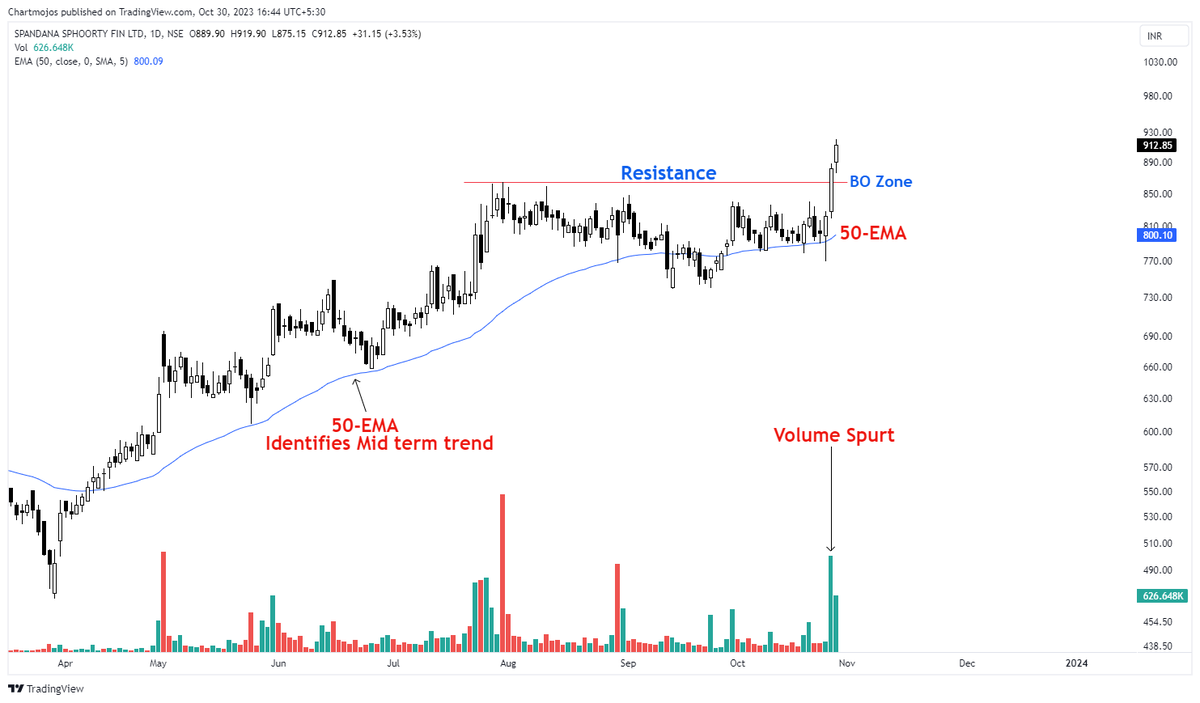
If you can fetch a trade that yields 10% on the portfolio then:
7-8 such trades = 100% on portfolio
12 trades = 200% on portfolio
15 trades = 300% on portfolio.
Let your gains compound.
Recalculate your portfolio size after closing each trade and bet acc.
Think about it.
In 2008 DLF was bigger than entire Pharma sector valuations,
In 2015, Sun Pharma was bigger than entire metals sector. In 2019 HUL was bigger than entire automobile sector valuations.
It took DLF 14 yrs to cross 2008 peaks, Sun Pharma took 7 yrs to cross 2015 peak and HUL is still at 2020 peak levels.
Back in 2021 Apple, Amazon & Microsoft were bugger than marketcap of India/Germany
Tesla was biggest then marketcap of entire global automobile industry. Let's see how that goes in next 5 yrs.
Humare gujrat Mai ek kahavat hai.
"Market ma loko ne jyare saaro bhaav male tyare taav aavi jaaye" 😆😆.
Ane jyare bhaav wadhe tyare laav laav kare 😂
#Markets
This is a superb business opportunity for an On The Go chain of takeaways at airports. An efficient QSR-centric entrepreneur can easily disrupt this income stream. Or, who knows, even a PVR can do this.
In 2017, Nitin Gadkari was sad that India is highly dependent on Taiwan and China for our Bamboo needs
Despite being the 2nd largest producer of Bamboo in the world
So, he is hell bent on destroying China’s monopoly in Bamboo
Here’s how India is becoming a Bamboo superpower:
India is second largest cultivator of Bamboo in the world, next only to China.
We also have the highest area under Bamboo — 13.96 million hectares — covering 13% of the total forest area, and the total production is 5 million tonnes per year.
Yet, we have to import it from Taiwan or China.
In 2021, we imported $66 million worth and exported only $118,000 worth of bamboo!
This is because of one rule that Britishers left us with in 1927.
In 1927, in the Indian Forest Act, bamboo was given ‘tree’ status and there was a prohibition on cutting and transporting of trees to other regions.
So, to cut the bamboo, a special permission had to be taken which resulted in the harassment of farmers.
Hence, the second largest producer of bamboo had to import it.
But in 2017, the Indian Forest Act of 1927 was amended and the bamboo grown in non-forest areas was shifted to the ‘grass’ category, which opened new avenues to utilize its potential.
This was done to achieve twin objectives of
👉🏻 increasing the income of farmers and tribals, and also
👉🏻 increasing the green cover of the country.
But, why Bamboo?
First, Bamboo is essentially grass that can grow in any climate, but it grows best in tropical climate which exists in the major parts of India.
It’s truly one of the most versatile plants in the world. It can even grow in areas where other crops wouldn’t stand a chance, like steep hillsides or wetlands.
Basically, except for Jammu & Kashmir, you can grow Bamboo anywhere in India.
Second, it doesn’t require replanting after harvesting since it regenerates from its root system.
This means there’s no need to clear new land for cultivation, which reduces deforestation and soil erosion.
In fact, it’s one of the low effort plantations that doesn’t need a lot of water or pesticides either.
It absorbs 4 times more carbon dioxide and releases 35% more oxygen than an average tree.
Also, it is a great alternative to timber which takes about 20-50 years to grow.
Bamboo just takes 4 years to grow big enough that it can be harvested for its cellulose-rich, wood-like fibre.
Not just that. Although it’s primary usage revolves around — construction, food, and medicine,
it can actually be used to create everything from furniture, paper, bio-fuel, clothing, decor, medicine, baby products, cutlery, jewellery, food, and even bike frames.
And lastly, very little waste is created when natural bamboo products are produced as all parts of the bamboo plant can be used in some way.
The stalks can be used for construction, while the leaves and roots can be used as mulch or animal feed.
Even the dust created during processing can be recycled and used as fertilizer.
Now that we understand why Bamboo, let’s understand why Bamboonomics.
See, bamboo is called green gold because it is becoming increasingly more valuable in the global economy.
In 2020, the global bamboo market was valued at USD 53.28 billion and is expected to compound at an annual growth rate of 5.7% from 2021 to 2028.
But India still imports bamboo at ₹12,000 per tonne and the govt wants to promote bamboo cultivation in India to reduce these imports.
Which is why the import duty on raw bamboo has been increased by 25%.
The industry is also rapidly growing now that Bamboo has become a symbol of sustainability.
Soft fabrics are made by blending bamboo with hemp or spandex.
Bamboo fibres are also used in making shoes.
Plastic toothbrushes are being replaced by bamboo toothbrushes.
Also, a Filipino company Banatti manufactured an electric motorbike Green Falcon, whose body is made up of lacquered bamboo.
And not only this, because of bamboo’s tensile and comprehensive strength, it might be able to replace steel as green steel.
In fact, its structural strength has already been proven at the new terminal of the Bengaluru (Kempagowda) Airport.
Other than that, it also gives a livelihood security to people.
Farmers are being provided a subsidy of ₹120 per plant as subsidy for farming bamboo. The cost may look insignificant at first, but it covers the entire cost of plantation in most cases.
Your investment could be reduced by 30-50% with just that amount. With the subsidy you would pay almost nothing for the plant’s cost.
All you’ll have to invest in is the fertilizers, irrigation, and the maintenance of the plant.
In the North East, viability gap funding has been introduced for bamboo-based enterprises.
All this and more comes under the restructured “National Bamboo Mission” launched in 2018.
The mission is to help the farmers who grow bamboo, the people who make things from bamboo, and the people who buy and sell bamboo products.
In short, it focuses on the development of the complete value chain of Bamboo sector.
If you liked this read, do RePost🔁 and follow us @FinFloww
for more such reads every Monday, Wednesday, and Friday!
9/ Remember, trading is not just about individual stock picks or timing the market perfectly. It's about understanding the broader market dynamics and utilizing tools like market breadth to gain an edge. Embrace the power of MB in your trading journey! #StayInformed#TradeSmart
6/ Furthermore, MB can help traders gauge market sentiment and psychology. During periods of high MB, when a significant number of stocks are advancing, it often indicates a positive sentiment and confidence among market participants. Same for Vice - Versa #Sentiment#Psychology
For instance, if the index is reaching new highs while breadth is deteriorating, it could suggest a bearish divergence and a possible upcoming market correction. #Divergence#Reversal
5/ Plus, MB provide valuable insights into market leadership. By analyzing the sectors that are driving MB, traders can identify where the market's strength lies. This info. can be used to make informed sector rotation or stock selection decisions. #Leadership#SectorRotation
4/ IAdditionally , MB can also help traders identify potential trend reversals. Divergences between the market index and breadth indicators can signal a shift in market sentiment.