ANDREJ KARPATHY IS THE GODFATHER OF MODERN AI
He doesn’t use Notion. He doesn’t use Roam. He doesn’t use Obsidian plugins.
He built his own second brain from scratch.
I copied him exactly.
The result:
→ 378 notes
→ 1,854 nodes
→ 3,856 edges
→ One custom 3D knowledge galaxy that thinks back at you
This isn’t note-taking.
This is a second nervous system.
Click any node - AI surfaces every hidden connection.
Zoom out - you see your entire mind as a universe.
Zoom in - you see why Fischer beating Spassky in 1972 connects directly to your trading edge today.
ChatGPT forgets you in 2 hours.
This remembers everything. Forever.
Notion users are building filing cabinets.
Roam users are building spreadsheets.
Obsidian users are building graveyards.
I built a galaxy.
The gap between people who consume knowledge and people who compound it isn’t talent.
It’s architecture.
Karpathy knew this before anyone.
Now you do too.
Imagine every pixel on your screen, streamed live directly from a model. No HTML, no layout engine, no code. Just exactly what you want to see.
@eddiejiao_obj, @drewocarr and I built a prototype to see how this could actually work, and set out to make it real. We're calling it Flipbook. (1/5)
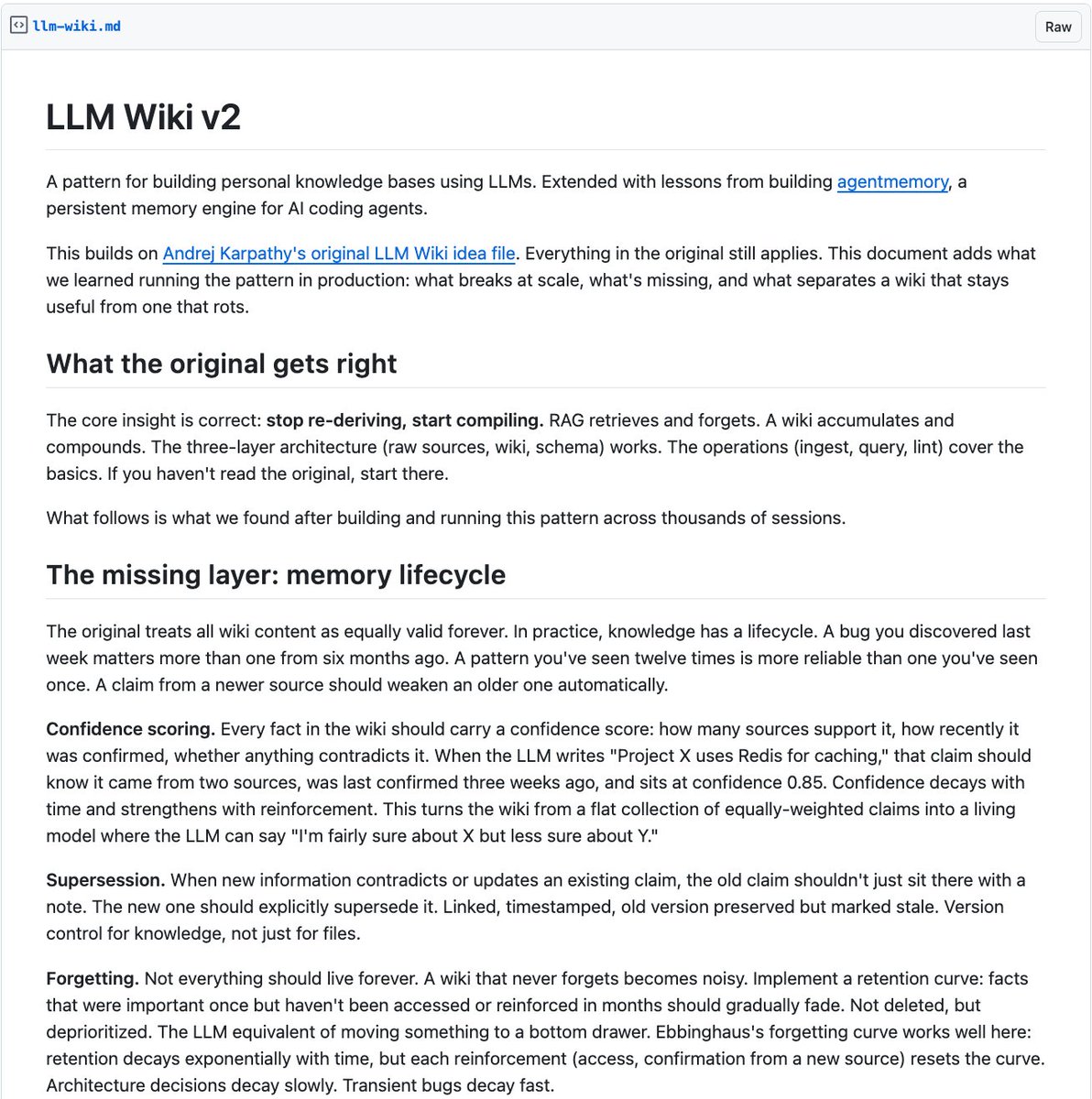
Karpathy's LLM Wiki got 5,000 stars in 48 hours. Now someone extended it with the features it was missing.
Memory lifecycle. Confidence scoring. Knowledge graphs. Automated hooks. Forgetting curves.
It's called LLM Wiki v2.
The original pattern was brilliant. AI builds a wiki instead of re-deriving knowledge from scratch every time. But it treated all knowledge as equally valid forever. In practice, that breaks.
Here's what v2 adds:
→ Confidence scoring. Every fact carries a score. How many sources support it. How recently confirmed. Whether anything contradicts it. Knowledge that decays over time. Not everything is equally true forever.
→ Memory tiers. Working memory for recent observations. Episodic memory for session summaries. Semantic memory for cross-session facts. Procedural memory for workflows. Each tier more compressed and longer-lived.
→ Knowledge graph. Not flat pages with links. Typed entities with typed relationships. "A caused B, confirmed by 3 sources, confidence 0.9." Graph traversal catches connections keyword search misses.
→ Hybrid search. BM25 for keywords. Vector search for semantics. Graph traversal for structure. Fused with reciprocal rank fusion. Replaces the index .md file that breaks past 200 pages.
→ Automated hooks. On new source: auto-ingest. On session end: compress and file. On schedule: lint, consolidate, decay. The bookkeeping that kills wikis is now fully automated.
→ Forgetting curves. Facts that haven't been accessed or reinforced in months fade. Not deleted. Deprioritized. Architecture decisions decay slowly. Transient bugs decay fast.
→ Contradiction resolution. AI doesn't only flag contradictions. It resolves them based on source recency, authority, and supporting evidence.
Here's the wildest part:
The original LLM Wiki was a flat collection of equally-weighted pages. This turns it into a living system with memory that strengthens, weakens, consolidates, and forgets. Like a real brain.
"The Memex is finally buildable. Not because we have better documents or better search, but because we have librarians that actually do the work."
Built on lessons from agentmemory, a persistent memory engine for AI agents.
Extends Karpathy's original. Open Source.
Wow, this tweet went very viral!
I wanted share a possibly slightly improved version of the tweet in an "idea file". The idea of the idea file is that in this era of LLM agents, there is less of a point/need of sharing the specific code/app, you just share the idea, then the other person's agent customizes & builds it for your specific needs.
So here's the idea in a gist format: https://t.co/NlAfEJjtJV
You can give this to your agent and it can build you your own LLM wiki and guide you on how to use it etc. It's intentionally kept a little bit abstract/vague because there are so many directions to take this in. And ofc, people can adjust the idea or contribute their own in the Discussion which is cool.
My Uber driver asked what I do for work.
"Software."
"Cool. Can you look at something?"
He handed me his phone at a red light. Terminal. Claude chat. Green P&L.
+$6,200.
He drives Uber 4 days a week. Makes $1,100. Has a 2-year-old daughter.
"Where did you find this?"
"Your article. The 14,000 wallets one."
He read it three months ago. Didn't understand half of it. Asked Claude to explain it like he's five.
214 messages. All during breaks between rides. Parked at gas stations. Waiting for pings.
First thing Claude told him: 87% of wallets lose money. Don't be the 87%.
He installed poly_data. Fed it to Claude. Found 47 wallets with Sharpe above 2.0. Filtered crypto only. Quarter Kelly. $200 starting bankroll. From his tips.
Try copytrade bot here: https://t.co/VvXrNhcD2C
93 messages later Claude helped him build the 20-line brain from the article. Bayesian updates. EV filter at 5%. Fully automated.
Last 45 days:
→ 480 trades
→ 91.3% win rate
→ +$6,200
Best trade: whale convergence on Fed rate cut. 4 wallets entered in 2 minutes. Entry $0.12. Resolved $1.00. +$1,760. While dropping off a passenger at JFK.
The passenger tipped him $5. The bot made $1,760.
His wife found the Telegram alerts on his phone. Thought he was texting another woman.
He showed her the P&L curve.
"Can you make me one?"
"How long until you quit driving?"
He looked at me through the rearview mirror.
"I'm not stopping. Uber is my cover story."
I wrote the article. He actually opened terminal.
NotchNook, something you might not need but when you have it is so cool: https://t.co/DKtEa8mdye
It makes your Mac's notch looks and behaves like the iPhone's one!