Novartis Young Investigator @ETH and Visiting Research Scientist
at @BellinzonaIrb- Peter and Geiger labs.
Research affiliate at @Stanford - J. Frydman lab.
📢 IIGM Seminar
Join us on 27th Feb 2026 at 14:00 at Biblioteca, @fpoirccs for an IIGM seminar with Fabián Morales-Polanco (ETH Zürich, Swiss).
@IIGMTurin
Chile poco a poco se transforma en una dictadura mediática. El que grita más fuerte e instala su propia narrativa es el que gana. Basta con controlar la agenda y el escándalo. Y pensar que algunos soñamos con ser parecidos a Nueva Zelanda o similares. Llega a dar risa.
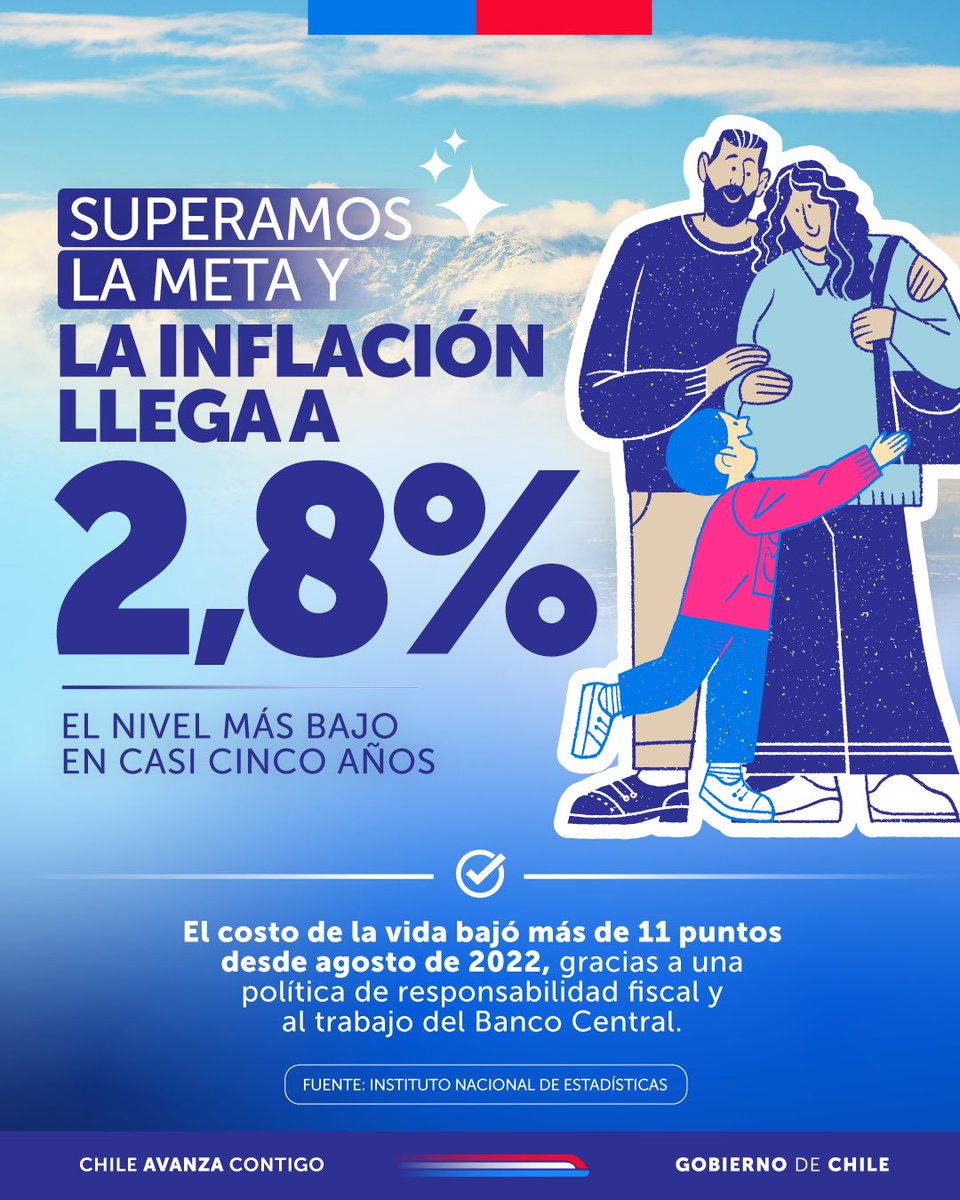
¡Bajamos del 3% de inflación!
El IPC de enero varía +0,4%, en línea con las expectativas.
En agosto del 2022, la inflación llegó hasta 14% y hoy estamos entregando un país con una inflación anual de sólo 2,8%, una buena noticia para el bolsillo de las familias.
Si hay unos pocos que hacen mal uso del pase cultural, deben ser investigados y el dinero devuelto. Pero la mayoría de lo utiliza para ir al cine, al teatro, comprar música o un libro. Anunciar ante un reportaje, sin más antecedentes, que se va a eliminar, es un perjuicio para todos quienes han accedido a cultura gracias a esta política pública.
A study led by ERC grantee Mariano Barbacid @CNIOStopCancer shows that a three-drug combination can eliminate pancreatic cancer in mice by blocking the KRAS gene in multiple ways. https://t.co/rFsd9EbVFL
This isn’t a random scientist who got lucky.
Mariano Barbacid discovered the first human oncogene in 1982. He isolated H-RAS from bladder cancer cells and proved a single point mutation could trigger cancer. That finding launched the entire field of molecular oncology.
KRAS mutations cause 90% of pancreatic cancers. For 43 years, oncologists called KRAS “undruggable” because the protein had no obvious binding pocket. Barbacid spent the last decade using genetically engineered mice to systematically test every node in the KRAS signaling pathway, looking for combinations that would work without killing the patient.
The triple therapy blocks KRAS three ways at once: the main growth signal, the escape routes through EGFR and HER2, and the stress-response backup through STAT3. Cut the engine, seal the exits, disable the emergency system. Tumors vanished in mice and didn’t return for 200+ days after treatment stopped.
Pancreatic cancer has a 13% five-year survival rate. 8% for the ductal adenocarcinoma type this therapy targets. Most patients live one year after diagnosis.
The catch: this is preclinical. Human trials are 3+ years away. One of the drugs, RMC-6236, might get approved this year, but the full triple combination has regulatory hurdles.
Still. The man who discovered human oncogenes in 1982 may have just figured out how to eliminate the cancer those genes cause. That’s a 43-year arc from first principles to potential cure. Science rarely works this clean.
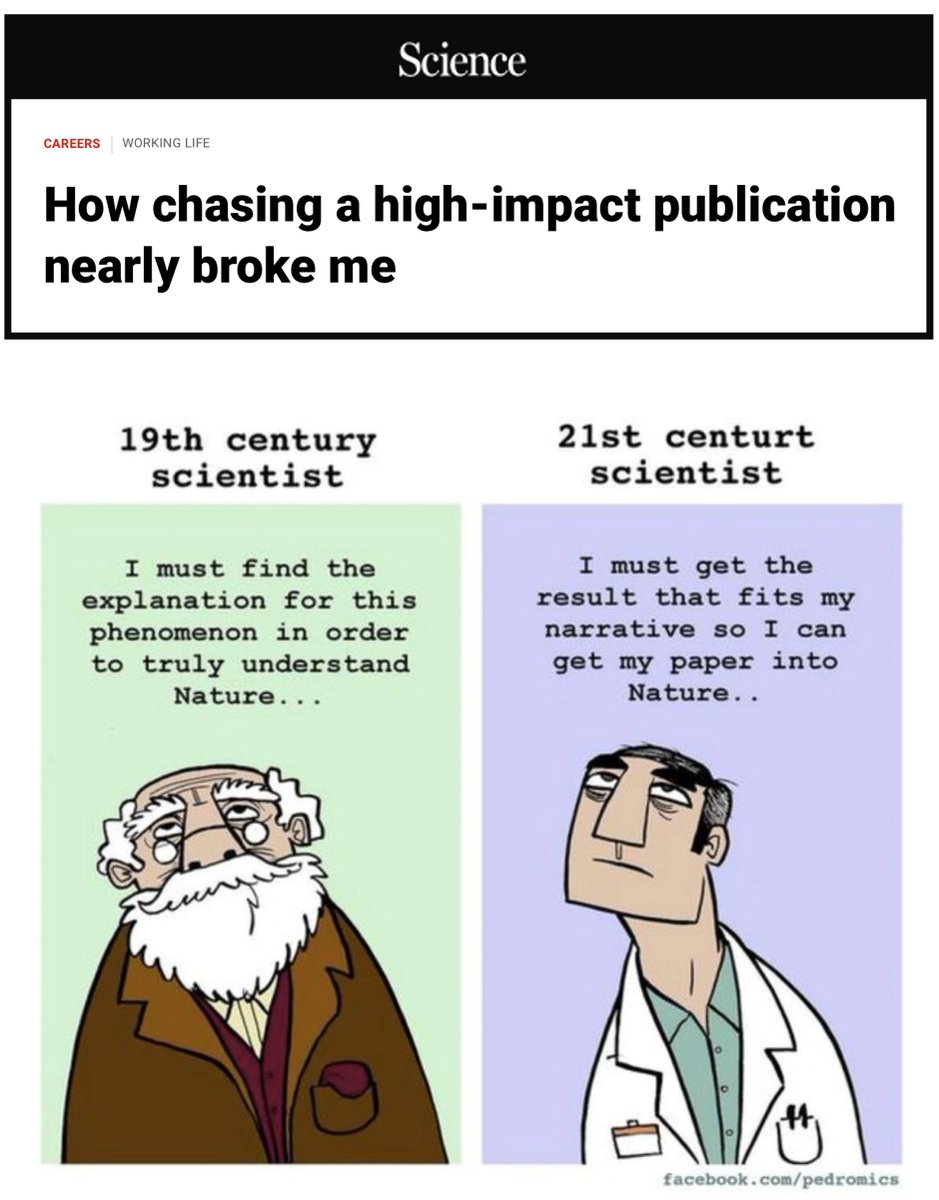
High-impact papers are crucial in academia.
Like it or not.
As a PhD student, you quickly learn that such papers are cool. They make advisors happy. Everyone admires you.
During a postdoc, high-IF papers are not just cool. They are mandatory for a PI job. They give you awards and interviews.
During the tenure track, they often become your ticket to a permanent position. Many young PIs are fighting to get their papers published in Nature/Science/Cell. It’s like getting a micro-Nobel prize. Many feel relaxed only when they publish in Nature (their tenure is finally safe!).
But:
Because such papers require a lot of time (often years), you live in constant uncertainty.
You HOPE you will get it. You spend evenings at work, you look for stronger results, and you’re battling through a battalion of failed experiments.
Then you submit it…
Then:
Stage 1. Editors reject 9/10 papers. Yours might be among them.
Stage 2. The paper goes to reviewers but they are brutal. For some reason (and you know why!) they just don’t want to see your paper in Nature. Many papers get rejected in the first round.
Stage 3. If reviewers can’t come up with reasons to kick you out immediately, they will request a lot of new experiments and changes to your work. Obviously, that will take months (if not years). Of course, some reviewers are great and genuinely help improve your work. But they are not as common as you might hope.
Stage 4. After addressing all problems and submitting it again, you will likely see some reviewers still resisting. They can simply reject your paper because they didn’t like how you addressed their requests. Or they will find new flaws and will get you to do another round of revision. (If you’re lucky, they will accept the paper.)
Stage 5. If reviewers are divided between “accept” and “reject”, the editors may send your paper to additional reviewers. That will start another cycle of hell with a likely negative outcome.
Stage 6. If you are rejected, congratulations - you’ve just wasted months on nothing. But because you need that paper, you resubmit it to another high-IF journal, and it all starts with Stage 1.
So, it’s like gambling.
You gamble your career on this publication.
During those 6–24 months of fighting with reviewers and editors, someone else may publish the same work. Then you’re screwed.
Or your paper is likely not accepted in any high-IF journal. After loosing a year or more on trying to push it through, you will have to publish it in a low-IF journal.
Is it a healthy game?
No. You get exhausted. Anxiety skyrockets.
But unfortunately that’s how academia works. I’ve been through this myself. Most of my colleagues have the same experience. We definitely despise it.
And the worst part of it?
We’ve started to see it as completely normal.
Impresiona mirar a Chile desde el extranjero. La condición explícita de “politólogos” como Mauricio Morales como operadores políticos se vuelve evidente, y burda, cuando uno no está en el país.
Donald Trump’s actions in Venezuela do not make America safer, stronger, or more affordable.
That Maduro is a brutal, illegitimate dictator does not change the fact that this action was both unlawful and unwise. We’ve seen this movie before. Wars for regime change or oil that are sold as strength but turn into chaos, and American families pay the price.
The American people do not want this, and they are tired of being lied to.
This is not about drugs or democracy. It is about oil and Donald Trump’s desire to play the regional strongman. If he cared about either, he wouldn’t pardon a convicted drug trafficker or sideline Venezuela’s legitimate opposition while pursuing deals with Maduro’s cronies.
The President is putting troops at risk, spending billions, destabilizing a region, and offering no legal authority, no exit plan, and no benefit at home.
America needs leadership whose priorities are lowering costs for working families, enforcing the rule of law, strengthening alliances, and — most importantly — putting the American people first.
Maduro fue y siempre será un vil dictador que mucho daño hizo al pueblo venezolano. Feliz de verlo en el piso. Lo triste es que la felicidad no pueda ser plena al ver a Trump y un tercer país interviniendo con violencia. Veamos como se desarrolla esto. El tiempo hablará.
La caída de un dictador parece una buena noticia, pero en D° internacional no todo vale. Hay una razón para eso. Si las potencias deciden por su cuenta cuándo intervienen contra dictaduras, cuándo no, cuándo ocupan la fuerza y contra quién, los países pequeños quedan a su merced.
@mmlagoscc Es tremenda la diferencia que hay entre Carmen Frei y su hermano, el ex presidente Eduardo Frei. Una diferencia ética abismal entre ambos hermanos que solo la historia sabrá aclarar.