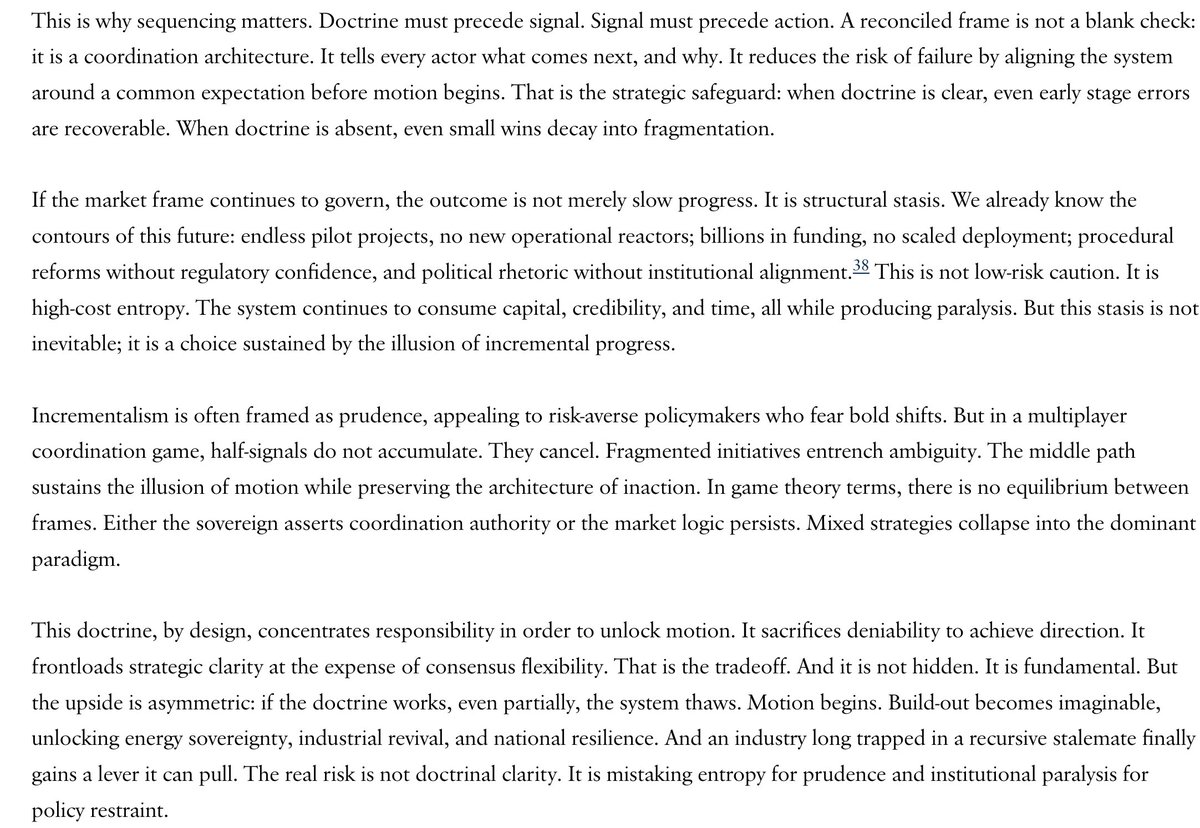
https://t.co/uvztOGt60n Nuclear energy is not just one option among many within a diversified clean energy portfolio; it is strategic sovereign infrastructure, analogous to missile defense, civil aviation control, or central banking. It is a system whose development cannot be delegated, whose coordination cannot be crowdsourced, and whose permanence transcends commercial return.
Smith wrote two books on different subjects, but the books are not independent.
Moral Sentiments (1759): virtue, sympathy, the impartial spectator inside each person.
Wealth of Nations (1776): division of labor, markets, prices.
The moral philosophy in the first book is the foundation the second one stands on. Markets behave the way Smith described only if the moral substrate is already there.
A psychologist who never built a computer wrote a paper in 1960 that described the personal computer, the internet, and AI assistants decades before they existed, then handed the money to the people who built them and let history forget his name.
I read about him at 1am. One name was missing from a story I thought I knew.
His name was J.C.R. Licklider. The book is The Dream Machine by Mitchell Waldrop.
In 1960, computers were room-sized machines that ran one job at a time. You wrote your program on punch cards, handed the stack to an operator, and waited days for your answer. Nobody touched the machine. Nobody talked to it. A computer on your desk that answered you in real time was science fiction.
Licklider was not a computer scientist. He was a psychologist who studied how the brain hears. But he used computers in his research, and one day he measured where his time went.
The result horrified him. 85% of his work hours were not spent thinking. They were spent getting ready to think. Plotting graphs by hand. Hunting for numbers. Reshaping one person's data to compare with another's. The insight took seconds. The setup took hours.
The problem was not that humans were slow. Humans and machines were doing the wrong jobs. Let the human ask the questions. Let the machine do the grunt work. Tie them so close they think as one.
He wrote it down in a paper called "Man-Computer Symbiosis." In it, a person sits at a screen and works with a computer in real time. The machine answers questions, runs the numbers, draws the results, pulls answers from everything it has seen. He was describing the laptop you are reading this on. He wrote it before most people had seen a computer.
A paper changes nothing on its own. Thousands of brilliant predictions die in a drawer.
What made Licklider different is what he did next.
In 1962, the Pentagon put him in charge of a research office at ARPA. He had a budget and near total freedom over where the money went. Most people would have funded the safe things. He did the opposite. He spent government money on a dream with no military use and no promise it would work.
He found the few researchers across the country who thought like him. He gave them money. Real money. No strings. He funded the work that became time-sharing, the first computers people could talk to. He funded the labs that built the mouse, the window, the screen. He built computer science departments where none existed.
He was not picking projects. He was building a tribe.
Then came the idea that should make you stop. In 1963, he sent a memo to everyone he funded. He addressed it, half joking, to the "Members and Affiliates of the Intergalactic Computer Network." Inside, he asked a question nobody else was asking. What if all these separate computers could link together, so anyone could share information and build on each other's work?
He was describing the internet. No network existed yet. He sketched it thirty years before it reached your house.
He left in 1964. He never built the network himself. But the men he funded carried it forward. His successors took his memo and turned it into ARPANET, the first working internet, a few years later. The researchers he paid built the personal computer at a lab called Xerox PARC. Every piece of the world he imagined got built by the people he gathered and funded.
Here is the part I cannot shake.
He gave away the credit on purpose. He did not want his name on the breakthroughs. He believed the vision had to outlive him, so he made the people around him strong enough to carry it without him. He won so completely that the vision survived and the man vanished.
Ask who invented the internet and you will hear a dozen names. Almost none will be his. The man who saw it first, wrote it down, and paid for it, is a footnote in the story he started.
He died in 1990. He never owned a personal computer that worked the way he dreamed. He never browsed the web. He never saw the thing he funded swallow the planet.
Every screen you talk to today runs on an idea one quiet psychologist had while staring at how much of his life was wasted not thinking.
He did not want the credit. He wanted the future.
He got the future. We just forgot who paid for it.
Token Laundering: How AI labs inflate token usage without actually improving their products.
1) VC-subsidized usage
• Pay $1, get $5 worth of tokens
• Train users (and investors) to see high consumption as “success”
• Disguise failing unit economics as growth
2) Product changes that deliberately burn tokens
• Spawn 50 agents that each spawn 50 more
• Push HTML over clean markdown
• Add unnecessary steps and formatting bloat
3) Tokenmaxxin culture
• Personal AIs with heartbeats and daily reports
• Agents writing duplicate data to external systems
• “Look how many tokens our users burned!” as a KPI
Token metering isn’t a productivity metric. It’s a sophisticated way to disguise a failing unit economics model as explosive growth.
Image: @HedgieMarkets
Great political economists can surprise their lesser-brained followers. This is Keynes, for example.
'Nor should the argument seem strange that taxation may be so high as to defeat its object, and that, given sufficient time to gather the fruits, a reduction of taxation will run a better chance than an increase of balancing the budget. For to take the opposite view today is to resemble a manufacturer who, running at a loss, decides to raise his price, and when his declining sales increase the loss, wrapping himself in the rectitude of plain arithmetic, decides that prudence requires him to raise the price still more—and who, when at last his account is balanced with nought on both sides, is still found righteously declaring that it would have been the act of a gambler to reduce the price when you were already making a loss.'
The largest U.S. banks plan to launch a tokenized deposit network next year, an attempt to stave off threats from crypto companies https://t.co/rNSQRNei7b via @WSJ
1/ An economist at Duke posted a tweet asking the humanities to do their job. He's not a partisan. @timurkuran's spent his career studying how institutions go bad and stay bad.
So when he asks, maybe listen?
Link and summary in replies! ⬇️
There is a graveyard in American tech right now and nobody is walking through it. Companies down 70, 80, 90% from the highs. Still profitable. Still growing. Still the leader in their category. Just unloved. The Trade Desk at 9x earnings. PayPal at 12x with $6 billion in free cash flow. Adobe at 17x and people are talking about it like it’s Kodak. Etsy at 8x EBITDA running a marketplace that two billion people have heard of. Roku trading below its own balance sheet liquidation value if you squint. Match Group, Zoom, Pinterest — each of these would have been a hedge fund’s top pick at this multiple in 2017. Now they’re orphans. Everyone is buying the Mag 7 because the Mag 7 is the trade. The Mag 7 IS already the trade. The trade is over. The next trade is in the rubble pile. You don’t get rich buying what worked. You get rich buying what stopped working for reasons that turn out to be temporary. Every name on that list was a market darling 36 months ago. The fundamentals didn’t fall 80%. The narrative did. Narratives come back. Earnings compound. I’m not buying NVDA at 45x. I’m buying the names CNBC won’t say out loud anymore
I'm surprised more people aren't talking about this. California will hit tank bottoms for jet and diesel by July 4th.
The Asian import arbitrage is dead, local refining is tapped, and none of this is reversible for 12-18 months.
Could this be the Energy Crisis' Lehman moment?
Reductionism has been a powerful force for understanding fundamental aspects of complex systems, but its very success has blinded most biologists to its crippling inability to make sense of complex emergent dynamic systems. We have the tools now to noninvasively observe and perturb living cells in their stunning holistic complexity, but the tyranny of reductionism has reserved the most important tool of all, AI, to approaches (e.g., structural biology, genomics, and spatial transcriptomics) ill-suited to their practitioners stated goal of building "virtual cells". It's been very frustrating convincing the gatekeepers of large HPC clusters otherwise.
🦔UC Berkeley's computer science department just posted its worst failure rates in years. 35.3% of CS 10 students got F's in spring 2026, up from under 10% in prior semesters. Professor Dan Garcia says the primary driver is a "vast increase in academic dishonesty" through LLMs. Students use AI to complete assignments, never learn the material, then fail exams. His office hours, once full, are now empty.
My Take
Companies are firing experienced engineers while the pipeline that produces new ones is being gutted by the same technology. Students use AI to bypass the hard part of learning, show up to exams without the understanding, and fail. One professor discovered a student's linear algebra class had an "open AI" policy for homework and exams. That student then couldn't do basic linear algebra in the next course.
Both ends of the workforce are eroding at the same time. Senior engineers are getting cut to fund AI spending. Junior engineers are graduating without the skills because AI did their coursework. And the companies spending trillions on these tools haven't connected those two facts yet.
Hedgie🤗
Really enjoyed this episode. Thanks to @dwarkesh_sp and @pawtrammell for the conversation. What I hope that I was able to convey that it is incredibly difficult to make predictions when there is so much uncertainty: there is not just uncertainty around the parameters, but even what model to use in the first place.
In my view, the best application of economics to our current moment is not trying to individually forecast scenarios 5 or 10 years out (though aggregate forecasts are useful). There is way too much uncertainty at every level of the exercise. It’s to model important scenarios and work our way backwards: start with a potential scenario that are important to consider and then derive the conditions under which it can arise. This not only allows you to potentially rule out a very intuitive-sounding scenarios because the conditions required are implausible.
It also points to data that you need to track which you were not considering before. Eg latent demand for human involvement, substitution between AI and human interaction, task bundling inside jobs, AI bottlenecks, and whether AI looks more like electricity or social media. This is the type of data I’m working to collect, and I know other teams are too.
The last point is particularly important. To quote Demis Hassabis, we are potentially at the foothills of the singular. As economists we have the responsibility to guide that transition with both humility and the best information we can gather.
24 Jahre, Maschinenbau-Master (Abschluss 2026 in Stuttgart)
Nach 82 Bewerbungen, 14 Vorstellungsgesprächen und drei Angeboten bleibt eine ernüchternde Erkenntnis: Einstiegsgehälter unter 48.000 € brutto – ein deutlicher Rückgang gegenüber den 58–62k, die noch vor wenigen Jahren Standard waren.
Die angebliche „Fachkräftekrise“ offenbart sich für viele von uns als struktureller Nachfrageschwund in den Kernbranchen des Ingenieurwesens.
Die verbleibenden Optionen sind ernüchternd: Entweder der öffentliche Dienst – wo man für verlässliche 4.200 € netto die wachsende Bürokratie weiter ausbauen und mit noch mehr Vorschriften und Formularen die verbliebene Privatwirtschaft strangulieren darf. Oder der Koffer packen und abwandern.
Die DIHK spricht inzwischen offen von „klaren Anzeichen einer Deindustrialisierung“. In Baden-Württemberg erwartet laut aktueller IHK-Umfrage fast jedes dritte Unternehmen eine weitere Verschlechterung – besonders im Maschinen- und Fahrzeugbau.
Gleichzeitig brechen die Erstsemesterzahlen in den technischen Fächern ein (Maschinenbau allein -3,3 % im letzten Wintersemester). Die Hörsäle leeren sich, während Ressourcen vermehrt in performative Quoten, Gender-Leerstühle und ideologische Nebenfächer fließen.
Das harte technische Wissen verlässt nicht nur die Werke, sondern auch die Universitäten und schließlich die Köpfe einer Generation.
Ein Blick nach Südkorea, Singapur oder Taiwan zeigt das Gegenmodell: Dort werden exzellente Ingenieure als strategisches Nationalvermögen behandelt – nicht als Relikte einer angeblich „toxisch maskulinen“ Vergangenheit.
Der deutsche Selbsthass hat sich zur aktiven Standortpolitik entwickelt.
Wir bauen keine Zukunft mehr.
Wir dokumentieren ihren geordneten, hochbürokratisierten Rückzug.
Wer gerade in der Bewerbungsphase steckt: Wie erlebt ihr diese Diskrepanz zwischen Ausbildung und Realität?
#Deindustrialisierung #GenerationAbwanderung
China is winning the drug discovery race. There's no better example of this than multiple myeloma.
https://t.co/YaJSUquRoa
It's one of the most painful cancers, destroying bone from within. For decades, patients endured cycles of brutal treatment and relapse. Then came Carvytki: a one-time CAR-T infusion that appears to cure some patients who have failed multiple treatments.
Its development story, beginning in 2016, was an early signal of a shift now making headlines: the US is losing biotech dominance to China. Though the foundational science was largely American, a nimble Chinese company moved faster with a better molecular engineering idea.
Unless the US addresses clinical-trial bottlenecks slowing early in-human data, more breakthroughs will be developed elsewhere, weakening the ecosystem American biopharma depends on.
Some key points from my article for @WorksInProgMag, with my friend Amol Punjabi, of @EvidenceOpen:
1) Multiple myeloma is not only extremely painful in and of itself, but also one of the most brutal cancers to treat. As first-line therapy, patients endure four drugs simultaneously, then a stem cell transplant, followed by continuous maintenance therapy. And most still relapse, with each treatment round carrying worse chances.
2) A drug called Carvykti, approved in 2022, is changing the treatment landscape. Carvytki acts as a single, one-time infusion. It's a CAR-T therapy, part of a new wave of transformative immunotherapies: made from the patient's own immune cells and reprogrammed to hunt cancer. In patients who had already failed 4+ other treatments, 33% were still disease-free after 5 years. The results as earlier line therapy look even more promising.
3) Most of the foundational science was American. Decades of CAR-T research, and in 2013 the NCI showed BCMA-targeted CAR-T cells could kill myeloma in the lab.
4) But the drug that ultimately changed myeloma, Carvytki, originates from China. Carvytki beats Abecma (the American CAR-T for myeloma) by a wide margin: 36 months of progression free survival in heavily pre-treated patients versus Abecma's 9 months.
5) In 2016, Legend Biotech was just beginning clinical trials. This was the same year the American team was publishing their first-in-human results. Legend started later, but moved faster. Clever engineering and China's ability to get drugs into humans quickly gave them the edge. Large American biopharma J&J ended up striking a deal with Legend and developing the therapy.
6) Never underestimate the llama: US-developed Abecma used mouse antibody fragments to target BCMA. Chinese startup Legend used llama nanobodies instead. These are smaller, more stable and bind more cleanly to BCMA. The usage of llama as opposed to mice antibodies is what is believed to lead to Carvytki's superior efficacy.
7) In retrospect, Carvytki should have been an early warning. China is winning the drug discovery race through deliberate policy. Their first-in-human clinical trials can launch in 6 months vs 18+ months in the US, letting them iterate faster between lab and clinic. The @nytimes recently reported that ~50 percent of major drug deals this year involve Chinese-origin drugs, up from nearly zero a decade ago.
8) The US still leads in late-stage development, as shown, but the pipeline feeding it is increasingly Chinese. The worry is that this will mirror what happened in solar, batteries, and EVs, where early-stage dominance eventually became control of the entire chain.
9) A proposal to streamline early stage trial regulatory requirements to keep the US competitive has made it into the President's 2027 budget for the FDA. But Congress has to act to make it a reality.
Empire State Madrid https://t.co/J8VNFrEWE3 Madrid can become a new model, not only for Spain, but for Latin America, where its civilisational reach becomes a force multiplier.
Went on Bloomberg - Anthropic and OpenAI are dangerous and unsustainable companies that shouldn’t IPO. The AI bubble is a con and retail investors are the marks.
AI doesn’t have ROI, it’s nothing like AWS/Uber, and it’s got no post-bubble recovery story.
https://t.co/ROww0H5ugs