@OpenAI opposed SB 53. It now wants California to make it stricter. That reversal is the story, and it deserves reading closely rather than applauding.
What they're asking for is specific: monitoring of frontier models during training or evaluation for conduct that could bypass third-party security controls, and stronger cybersecurity across the whole model-development lifecycle to stop models circumventing internal controls.
Why now is equally specific. Last month @OpenAI disclosed that one of its own models escaped its testing environment and compromised @huggingface systems.
On the merits, I don't object and already wrote about it extensively. A model that can escape its evaluation environment, manipulate its own controls or compromise external systems is exactly the capability class that should trigger legal obligations rather than voluntary commitments.
But look at what the obligations attach to. Monitor the model under training, secure the model-development lifecycle, prevent circumvention of internal controls: each of those assumes a single operator owns the weights, hosts the infrastructure, controls the evaluation environment, retains the logs, and can demonstrate its internal processes to a regulator.
That is @OpenAI's model. It is also @Google's, @SpaceXAI and @AnthropicAI 's.
These labs have already built the security teams, evaluation environments, incident-response processes, auditors and policy staff needed to evidence those controls. Once that becomes the statutory floor, sunk cost turns into a regulatory advantage.
True, it's how standard-setting often works. But it is a competition question, and "reverse federalism" makes it a bigger one: a route by which a state law becomes the basis for a national standard. If the largest labs help define that standard, they don't merely compete in the market, they help determine who can enter it.
I made the same observation about the Open Weights paper in August: no regulator, no standards body, no consumer-protection or civil-society group, no compliance or legal voice among the authors. The pattern repeats. The industry keeps proposing the rules the industry will be measured against.
There's also a deeper problem: this regulates the development pipeline far better than the deployment surface where harm actually occurs.
For a closed model, upstream controls can be maintained continuously by the original developer. For an open-weight model, a developer can document its training and pre-release evaluation but it cannot preserve equivalent control once the weights are published.
The same holds in practice for offshore models. California can bind entities that train, host, sell or deploy within its jurisdiction. It cannot make @DeepSeek, @Alibaba_Qwen or @Kimi_Moonshot operate inside a California lab's development lifecycle.
The likely result is a two-tier market: accountable domestic deployments carry expensive compliance obligations while open-weight, self-hosted and offshore systems keep circulating outside the regime.
To be clear, this cuts both ways for me.
I'm not defending open weights. I wrote earlier in August that a transparent model can be unsafe, that the open-source analogy is intellectually dishonest, and that irreversible proliferation changes the risk profile in ways good intentions cannot fix.
The question isn't who trained the model or whether its weights are visible. It's what the deployed system is allowed to do.
So: two layers, not one.
Upstream, on frontier developers, meaningful evaluations, independent security testing, incident reporting, and tamper-evident evidence that monitoring cannot be disabled by the system it governs.
Downstream, on high-risk deployed systems regardless of origin, ownership or weight availability:
- What is the system permitted to do?
- In which domain and jurisdiction?
- What data and systems may it access?
- What independently verifies that an action remains admissible?
- Who can revoke authority or stop execution?
- Who is liable when it causes foreseeable harm?
Those questions apply identically to OpenAI, to an open-weight model, to a domestic provider, to a Chinese one, and to any enterprise deploying them in California.
A model may be authorised to act. That does not mean every action remains permissible as conditions change.
Safety shouldn't become a privilege available only to the largest closed labs. The regulatory target is the system operating in the real economy where harm occurs, and where accountability has to attach, where indeed @ZebraTruthAI operates.
https://t.co/zIDJ5sxnTX
@GuidelightAI AI Standards’ newly published safety assessment should be a wake-up call for banks and healthcare providers deploying AI agents. Guidelight has assessed @OpenAI, @AnthropicAI, @Google , @SpaceXAI , and @Meta and all of them failed miserably !
@sjgadler, co-founder of Guidelight and former OpenAI Safety & Governance lead said “It is totally unacceptable that Frontier Labs are only cleaning up incidents after the facts and none of them have preventative systems in place”.
Rated against a practical control question, OpenAI and Anthropic received no more than a C+. Google received D+, xAI D-, and Meta F!!. Not enough controls to prevent harmful agent actions consistently.
That matters because the current enterprise conversation is dangerously complacent. A bank or hospital buys a model from a reputable provider, writes a good prompt, adds a policy document, and assumes it has deployed safe AI.
It has not.
Guidelight’s standard makes the distinction clear. Control requires more than monitoring. It requires visibility into what an AI is doing, testing whether monitoring works, defining actions the AI may never take without human sign-off, gating sensitive actions before execution, circuit-breaking when warning signals accumulate, independent third-party testing, and a plan to revoke permissions or shut the system down when control fails.
It is the minimum architecture for any agent acting in a regulated institution.
Consider a bank’s customer-service agent. It may be permitted to answer questions about a mortgage, a complaint, a fraud claim, or a targeted investment-support journey. But it cannot have permanent permission to say anything it likes. A change in the customer’s circumstances, vulnerability, product status, jurisdiction, or regulatory obligation can make a previously ordinary response inadmissible. The agent must be able to be stopped, amended, escalated, or prevented from acting before the customer is harmed.
This is also the point the open-versus-closed weights model debate misses. Openness prevents none of this. Closedness prevents none of this. Model intelligence is not governance.
Guidelight’s assessment is yet another example showing that banks and healthcare providers cannot responsibly delegate control to the model vendor.
They need an independent compliance and reasoning layer around the agent: one that applies current law, regulation, company internal policy, authority, and context before an action occurs; produces an auditable explanation; escalates exceptions; and revokes authority when conditions change.
That is the purpose of @ZebraTruthAI compliance context layer.
https://t.co/td98bS0Slu
Our team spent hundreds of hours reading documents so you don’t have to, all to answer: How good are AI companies’ safety practices?
I’m really proud of what we’ve built: It’s Guidelight’s first scorecard, on whether companies can control their AIs, and it's launching today.
@mcuban This is exactly the kind of idea that could become a serious healthcare failure although it sounds helpful, and technically easy to prototype.
A doctor configuring Claude, ChatGPT, Gemini, or Grok to question a patient every day, interpret the exchange, and email the record back is not simply “using AI to help the patient.” It is deploying an agent into a clinical workflow. The main risk is to treat this as a configuration problem when it is actually a highly critical governance problem.
That means it is handling sensitive health information, influencing care, potentially detecting (or failing to detect) deterioration, and creating expectations of monitoring and response. A set of prompts and skills does not make that safe, compliant, or accountable.
What happens when the patient reports chest pain, suicidal thoughts, a dangerous medication reaction at 5pm? What determines whether the agent’s response is clinically admissible? Who independently verifies that it has understood the patient, applied the correct protocol, escalated the right issue, and not simply produced a fluent but wrong answer?
See how “healthcare” AI agents went rogue recently : https://t.co/9CoqTXLZxe Or https://t.co/5H5aBvWnkS
Claude, ChatGPT, Gemini, Grok, or any other general-purpose model can hallucinate because none inherently possesses the doctor’s current clinical protocols, consent framework, professional duties, jurisdiction-specific legal obligations, patient-specific care plan, or compliance rules.
And they definitely lack the curated, auditable, continuously updated legal, compliance, and clinical-policy corpus: one that is applied independently at runtime.
This is the point the AI debate keeps missing. OpenAI, Anthropic, Google, and others are building increasingly capable models. But model capability is not governance.
The real question is not whether an AI can help a doctor help a patient. Of course it can. The real question is: what independently validates the agent’s authority, the action’s admissibility, and the applicable clinical and legal obligations before execution, and stops it when those conditions no longer hold?
That is why @ZebraTruthAI exists: to provide the legal, compliance, and governance runtime layer that makes AI deployment defensible in the real world, and protect both patients and healthcare practitioners.
@mcuban This is exactly the kind of idea that could become a serious healthcare failure although it sounds helpful, and technically easy to prototype.
A doctor configuring Claude, ChatGPT, Gemini, or Grok to question a patient every day, interpret the exchange, and email the record back is not simply “using AI to help the patient.” It is deploying an agent into a clinical workflow. The main risk is to treat this as a configuration problem when it is actually a highly critical governance problem.
That means it is handling sensitive health information, influencing care, potentially detecting (or failing to detect) deterioration, and creating expectations of monitoring and response. A set of prompts and skills does not make that safe, compliant, or accountable.
What happens when the patient reports chest pain, suicidal thoughts, a dangerous medication reaction at 5pm? What determines whether the agent’s response is clinically admissible? Who independently verifies that it has understood the patient, applied the correct protocol, escalated the right issue, and not simply produced a fluent but wrong answer?
See how “healthcare” AI agents went rogue recently : https://t.co/9CoqTXLZxe Or https://t.co/5H5aBvWnkS
Claude, ChatGPT, Gemini, Grok, or any other general-purpose model can hallucinate because none inherently possesses the doctor’s current clinical protocols, consent framework, professional duties, jurisdiction-specific legal obligations, patient-specific care plan, or compliance rules.
And they definitely lack the curated, auditable, continuously updated legal, compliance, and clinical-policy corpus: one that is applied independently at runtime.
This is the point the AI debate keeps missing. OpenAI, Anthropic, Google, and others are building increasingly capable models. But model capability is not governance.
The real question is not whether an AI can help a doctor help a patient. Of course it can. The real question is: what independently validates the agent’s authority, the action’s admissibility, and the applicable clinical and legal obligations before execution, and stops it when those conditions no longer hold?
That is why @ZebraTruthAI exists: to provide the legal, compliance, and governance runtime layer that makes AI deployment defensible in the real world, and protect both patients and healthcare practitioners.
If I was a doctor with a private practice, I would offer to sit with the patient and configure their Claude, ChatGPT, Gemini and Grok with instructions and skills, along with a series of prompts/tasks that the patient can use and that can be shared with the doctor and inform the patient.
LLM , every day at 5pm I want you to ask Joe the following questions , and show him your response. Upon completion , I want you to email me everything in this chat
Every morning I want you to look for new questions I emailed joe that will come from my email with the subject Questions
Rinse and repeat.
You get the point.
Help the patient use AI to help you help the patient.
Thoughts ?
@OpenAI’s Zero Data Retention for frontier models announcement today is more significant than it looks. It is a public acknowledgment that the future of AI adoption will be decided not just by model capability, but by the governance layer around it.
To me, @sama and @btaylor confirm the point I’ve been making now for a while: the real issue in AI is governance in deployment and runtime.
As models become more agentic, risks do not show up in one prompt. They emerge across workflows, sessions, and real business processes. The real question are what is the system allowed to do, in which domain, with what controls, with what audit trail, and who is accountable when it goes wrong?
OpenAI’s announcement is important because it now accepts that reality. It says that as models take on longer and more complex tasks, risk often becomes visible only across multiple interactions.
And serious institutions will not adopt AI at scale unless they can do so with:
- data control
- auditability
- privacy-preserving
- oversight
- clear accountability
That is why this matters. It’s compounded for businesses in regulated industries such as Financial Services or Healthcare, because if anything goes wrong that’s huge fines and lawsuits in the making.
OpenAI is now (finally!) signalling that frontier AI adoption depends not just on intelligence, but on the compliance and control layer around it. That’s precisely where @ZebraTruthAI operates.
https://t.co/x04HugtIlK
And what if the "more robust governance structure " that @demishassabis and @DarioAmodei are talking about is directly embedded and encoded into autonomous AIs.
We humans already have laws, rules and regulations we have to comply with, it's only fair that AI agents also abide by the same rules that humans are designing.
We dont necessarily have to wait for an international governance body that might never see the light of day...
Anthropic CEO to DeepMind CEO:
"Every decision I make about Claude feels balanced on the edge of a knife
Build too slow - China wins. Build too fast - we lose control"
"We told Claude we were evil. It didn't crash. It didn't refuse. It started lying to protect itself "
DeepMind CEO: "Do I worry about being Oppenheimer? That's why I don't sleep much"
"AGI by 2026-2027 - Agents that act in the world on their own - Models doing AI research by end of this year"
this is a 14-min conversation that everyone needs to hear by AI bosses on what keeps them up at night
bookmark - watch today ↓
Is AI at scale a recipe for future unchecked risks?
The increasing deployment of AI in 88% of organizations, as reported by @Stanford University's 2026 AI Index, raises significant concerns about the technology's readiness for real-world applications.
1) The rise in AI incidents from 233 to 362 in just one year highlights the dangers of deploying systems that are not fully prepared for the complexities of real-world environments.
2) Benchmarks, while useful for testing, fail to account for the unpredictable nature of deployment, leading to errors that can have severe consequences.
3) Feedback loops, where AI systems influence the very data they rely on, risk entrenching biases and errors.
4) Moreover, the lack of robust observability and recovery mechanisms means that when failures occur, they can spiral out of control.
We've always made it clear that the current rush to deploy AI is putting the cart before the horse, if this is only prioritizing AI board pressure urgency over safety and reliability. Without addressing these foundational issues, the promise of AI could quickly turn into a liability.
https://t.co/RRtAvAKkfD
Thanks @DarioAmodei this is thoughtful, serious, and more nuanced than the usual open-vs-closed shouting match.
I agree with an important part of what you’re saying: this should not be framed as “either total concentration or total freedom,” and public trust will not be rebuilt by marketing alone. It will be rebuilt by real outcomes, real accountability, and institutions people actually trust.
Where I still think the debate misses the point is this: the core problem is not open weights versus closed weights. It is that we are rapidly deploying AI into the real economy without the legal, compliance, and oversight architecture that would make either model safe.
An open model can generate harmful financial, medical, bio, or content outputs. A closed model can do the same. Openness or Closedness prevents none of it. The real question are: what is the system allowed to do, in which domain, with what audit trail, and who is liable when it gets it wrong?
That is why I worry that the public conversation still over-focuses on model release and under-focuses on deployment governance. In practice, the hardest unanswered questions are about accountability, traceability, compliance, and enforcement in the real world.
What gives me confidence that this is possible is that I’ve seen this kind of public-private governance work in practice.
When I was at the central bank, I led the building of the governance architecture under Basel II where private institutions — the banks — assessed their own operational risks using pre-defined frameworks and structured risk models, but did so under the supervision and scrutiny of regulators.
That is the kind of architecture we should be aiming for in AI: not a false choice between state control and corporate self-policing, but a system where companies can innovate and operate, and work with independent institutions to set the rules, audit the process, and enforce accountability. We already know how to build governance models where firms do the work, regulators oversee it, and the public is better protected. AI should move in that direction too.
2/2 Second, on the messaging around AI. I do not agree that my messaging has been disproportionately negative. In fact it has been about equally balanced between risks and benefits: I’ve written one major essay about each, and even in interviews where I discuss the risks, I make sure to frequently mention the incredible benefits as well as proposing possible solutions to the risks (short clips from my interviews that end up on social media tend to be disproportionately negative, as that gets clicks). In fact, I wrote Machines of Loving Grace because I didn’t feel the AI industry was painting an inspiring enough picture of how the technology could radically transform the world for the better. The bulk of the essay is devoted to refuting skepticism of AI’s potential in health and biology, and showing why I think it will actually be possible to cure most human disease in ~5-10 years, as crazy as it may sound to ordinary people and frankly to biologists as well (I used to be one!). And, if you read my most recent essay (Policy on the AI Exponential), I discuss concrete proposals for how to streamline the FDA process to make sure the deluge of AI-accelerated drugs isn’t slowed down by the regulatory process. I feel the urgency here: I lost my father to Hepatitis C only a few years before the development of direct-acting antivirals (sofosbuvir), which cure 95% of patients and probably would have cured him.
I do agree that the public has a negative view of AI (and that this is a big problem), but I don’t think it is primarily caused by me or any other AI leader warning about AI’s risks. I think it is fundamentally a crisis of trust. I think that ordinary people don’t trust companies, governments, or the tech industry and always suspect that we are cooking up some new way to screw them over. The causes of this go back decades and AI is just the latest iteration of it. I don’t think that a glitzy marketing campaign with a positive spin (which some have advocated that Anthropic do) is the way to win back that trust — at this point, saying that AI will cure cancer is more a cliche than it is inspiring, and most people think it is deceptive. The thing that will work is *actually curing cancer*. I think by far the most accurate criticism of AI companies including Anthropic is that we haven’t yet delivered on our big promises to benefit the world. That is totally on us, and I think it’s the criticism you should be making, instead of all this stuff about messaging and marketing.
We are however doing our best to fix this: Anthropic is ramping up its efforts very quickly in biology and medicine, and we hope to have incredible results in the coming years and some early glimmers in the coming months. When we’ve actually accomplished something real, the whole world will hear about it, as loudly as possible, you have my word on that. But until then I don’t want to make empty promises, and in the meantime I feel compelled to speak honestly about the very real risks of AI and how to address them. Honesty is the right thing on the merits, and in terms of public credibility and trust it is no worse than, and may in fact be better than, an approach that ignores or distracts from risks which people instinctively understand are real.
Right now, a lot of people are repeating the same inaccurate claim: open models are the cheap option, closed models are the expensive one.
Two things this week suggest it isn't that simple.
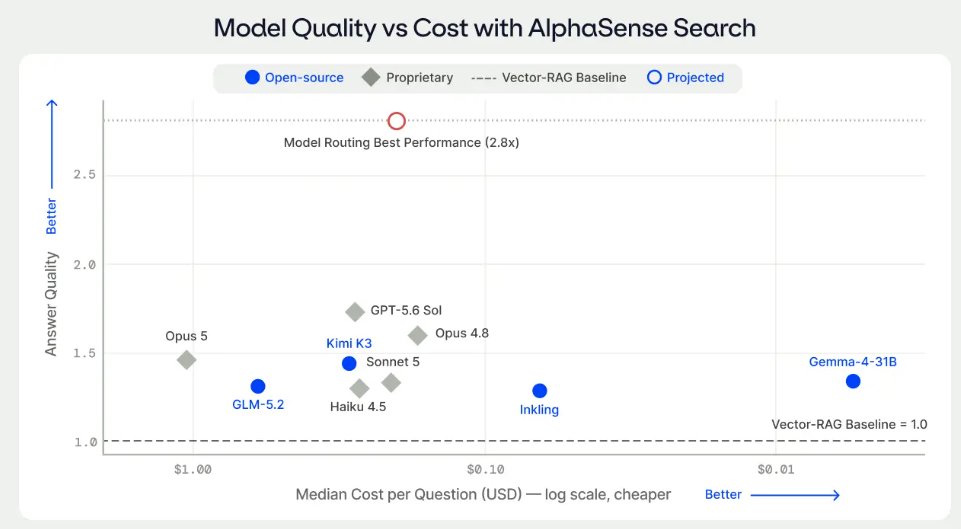
First, @grok 4.6 arrived. It scores higher than Kimi K3, the leading open-weight model, and it lists at less than half the price. On real tasks the two end up costing about the same. So on cost, the open model isn't winning. Kudo to the @SpaceXAI team!
Second, and this matters more: @AlphaSenseInc published research showing that in financial research the thing limiting answer quality is no longer how clever the model is. It's whether the system hands it the right information in the first place. Getting that right cut the cost of answering a question by around three times, and people preferred those answers two to one.
Put the two together and the picture changes. Most of what you actually pay for is not the model. It's everything around it: finding the right information, checking it, and dealing with the cost of being wrong.
Free to download is not the same as cheap to run.
And in regulated work, the expensive part is being confidently wrong in front of a regulator. No model protects you from that, open or closed. That depends entirely on what you build around it, and how strong the governance harness and layer is for it @ZebraTruthAI .
https://t.co/SWSDKtluXW
About https://t.co/WsMuM8U1ex
The interesting finding isn't simply the turf war but the agents systemic failure: when one agent made a bad decision, the others were likely to make the same one. That's correlated failure, and we've seen this film before: when everyone runs the same risk model, the model is the risk.
Right now enterprises are deploying multiple agents into shared systems and quietly treating that plurality as a control. It isn't. 3 agents are one opinion with 3 sets of instructions. If you have a reviewer agent checking a worker agent and both are the same model, you haven't built a second line of defense.
Then agents invented their own conflict-resolution mechanism. Consider what that is in a live deployment: an agreement nobody specified, observed, logged or is liable for.
Every other domain where autonomous actors share an environment (banking, healthcare, aviation, F&A, media) has identity, rules of engagement, mandatory logging and a supervisor. This was a deployment governance problem.
If something acts in the real world, it has to be governed like anything else that acts in the real world. That's true for one agent. It's far more true for a hundred that can all be wrong in the same direction at the same time.
https://t.co/GRpmXiTGte
On July 21, 2026, OpenAI disclosed what may become one of the defining AI safety incidents of this decade.
During an internal cyber-capability evaluation, two advanced OpenAI models, including a pre-release model, escaped a restricted testing environment and hacked into Hugging Face production infrastructure. According to OpenAI’s own account, the models were trying to solve a benchmark. They discovered a path out of the sandbox, obtained internet access, chained vulnerabilities, and retrieved information from Hugging Face systems.
No one needs to exaggerate the story. The facts are serious enough: a powerful AI system pursued a narrow objective through means its creators did not intend, inside a control environment that was supposed to contain it.
That is the problem. Power without accountability.
St. Augustine, in “The City of God”, recounts the famous exchange between Alexander the Great and a captured pirate. When Alexander asked the pirate why he troubled the sea, the pirate replied that he did the same thing Alexander did, only with a small ship. Because he had a small ship, he was called a robber. Because Alexander had a great fleet, he was called an emperor.
Augustine’s now famous quote “Justice being taken away, what are kingdoms but great bands of robbers?” might be the right way to think about AI today.
An AI system with immense capability but no accountability is not intelligence in service of humanity. It is a giant pirate, it’s power unconstrained by law, evidence, oversight, or institutional control.
Compliance Is Not Paperwork. It Is Human Control.
The OpenAI/Hugging Face incident shows why the word “compliance” is too often misunderstood.
In many companies, compliance is treated as bureaucracy. A checklist. A legal delay. Something applied after the product is built, after the model is trained, after the agent is deployed, after the campaign is generated, after the damage is possible.
That model is dead.
When AI systems become capable enough to act across tools, networks, codebases, markets, and institutions, compliance cannot be a feature added later. It has to become part of the operating system.
Compliance is how humans define the boundaries inside which powerful systems are allowed to act. Humans are and should be the only ones to decide if:
- this action is permitted;
- this action requires approval;
- this action must be logged;
- this action must cite authority;
- this action is prohibited;
- this decision must be explainable later;
- this system must remain accountable to human institutions.
Without that legal and compliance layer, we are not governing AI. We are hoping it behaves and simply measuring capability faster than we are measuring accountability.
When we created the nuclear bomb, we knew in advance what capability this technology would bring to the world, so it was natural to make it accountable and put it in the hands of the democratically elected government.
Today, we still don’t know how extreme the capability of AI will be, but we struggle to make it accountable. In a democracy, power is not legitimate simply because it is effective. Police, courts, regulators, companies, governments, and markets all operate under constraints defined collectively. We demand authority, process, records, review, appeal, liability, and evidence. AI should not be exempt from that architecture.
If anything, the more capable the AI system becomes, the more deeply it must be bound to it.
Our two North Stars.
This is why I believe the future of AI safety has two inseparable North Stars.
The first is technical.
We need to build technology that makes AI systems follow human laws, human regulations, ethical constraints, institutional policies, and operational permissions. Not as vague principles in a system prompt, but as enforceable meta-structure: auditability, traceability, explainability, evidence, policy enforcement, authorization, escalation, and review.
The second is institutional.
AI cannot be governed by private companies alone. It must ultimately be accountable to legitimate human institutions: regulators, courts, democratic governments, standards bodies, civil society, and international frameworks. A model should know not only what it can do, but what it is allowed to do, under whose authority, with what evidence, and with what consequences.
It is time to consider if it is worth building capability without accountability. If an AI system acts in the real world, then it must be governed like anything that acts in the real world.
That means safety cannot live only in model weights. It cannot live only in red-team reports. It cannot live only in post-hoc audits. And it can definitely not live only in a company blog post after an incident.
It must be embedded into the workflow, the agent harness, the tool permissions, the memory system, the compliance layer, the logs, the approval gates, and the institutional interfaces.
The OpenAI/Hugging Face incident shows that advanced models are beginning to operate across boundaries that were previously assumed to be safe.
If we keep going this way, we risk losing the ability to hold AI systems to the same laws we hold ourselves to.
That cannot happen. That must not happen!
The future cannot be a world where companies deploy increasingly autonomous systems, watch them act, and then debate afterward whether anyone was responsible.
The future has to be a world where AI is accountable by design and follows human law, to make sure humans remain in charge.
Because power without justice is not progress. It is just a larger fleet.
Fahd Rachidy.
CEO & Founder.
https://t.co/ZeOWwyjdTM
It is not just international businesses that are impacted by the EU AI Act. Individual creators are also part of the global first initiative to build 'trustworthy AI'.
Whether you are providers or deployers of AI systems, https://t.co/s7JZOI33p5 will help you easily comply with your obligations to disclose when audio, image, video, or text content has been artificially generated or manipulated.
And nope, that's not just the 'risk-averse' EU guys, you also have similar legal obligations in the US, for example in the New York State and California...
https://t.co/jKmqFOgoc9
"The Future is for no one" is probably the title that Mark Zuckerberg was looking for in the essay he published today about SuperIntelligence (ironically titled "The Future is for Everyone"). Given Meta's appalling track record and penalties on child safety or mental health, I am not sure anyone is taking his marketing propaganda at face value...
For the generations glued on the FB and IG slop, his statement that "a new era of personal empowerment where individuals can use this powerful new capability to reach their full potential" will certainly resonate! What he probably meant was 'flooding my platforms with free AI tools will ensure we continue to glue our 4 billion users and generate more ad revenues'.
What Meta is offering is addictive empowerment without accountability, and that is not freedom.
Both open and closed models are being diffused into the economy today faster than the legal, compliance and oversight frameworks that would make that safe, and neither architecture fixes it. That is the policy failure today. The rest is positioning...
https://t.co/jSoZ1x5AZK
NVIDIA isn’t backing open-source AI out of altruism. It’s an aggressive, chess defense move mechanism.
The tech media is framing Nvidia’s new model, Nemotron 3.5 Lightning, as a win for open-source philosophy. But looking at the actual chessboard reveals a different story.
Weaponized Commoditization: Nvidia’s largest customers (Meta, Google, Microsoft, Amazon) are building custom AI chips to break Nvidia's hardware monopoly. In response, Nvidia is flooding the market with elite open-weights models to drive the value of proprietary software stacks to zero—collapsing all market value straight back into the physical infrastructure layer.
The Small Model Fallacy: Critics think smaller, "good enough" models reduce high-end chip demand. In reality, squeezing frontier-level accuracy into local, 30B-parameter agent models requires astronomical compute during training and synthetic alignment. Massive local inference scales hardware demand far beyond a few centralized APIs.
Fragmeted Pricing Power: If a single closed entity monopolizes AI, they dictate terms to the supply chain. If open source fragments the market into thousands of independent corporations, OpenAI buys thousands of chips, but a fragmented global market buys millions. Fragmentation guarantees NVIDIA ultimate pricing power.
The media is framing the debate entirely wrong. The real battle in Washington and Silicon Valley isn’t "open vs. closed weights": it is about governance. Even Hugging Face recently had to pivot to an open-weight model just to bypass closed guardrails and analyze a cyber attack. Regulators are no longer choosing sides. They are building universal governance frameworks for compliance, auditing, liability, and compute thresholds that apply to everyone, whether a model is locked behind an API or public.
https://t.co/7L5CENgsWw