🦃 This Thanksgiving we're featuring past Thanksgiving videos. Today's is from 2021-22. We're still working for redistricting reform, still thankful for volunteers, supporters, everyone we've met along the way as passionate as we are about a democracy that works for all of us.
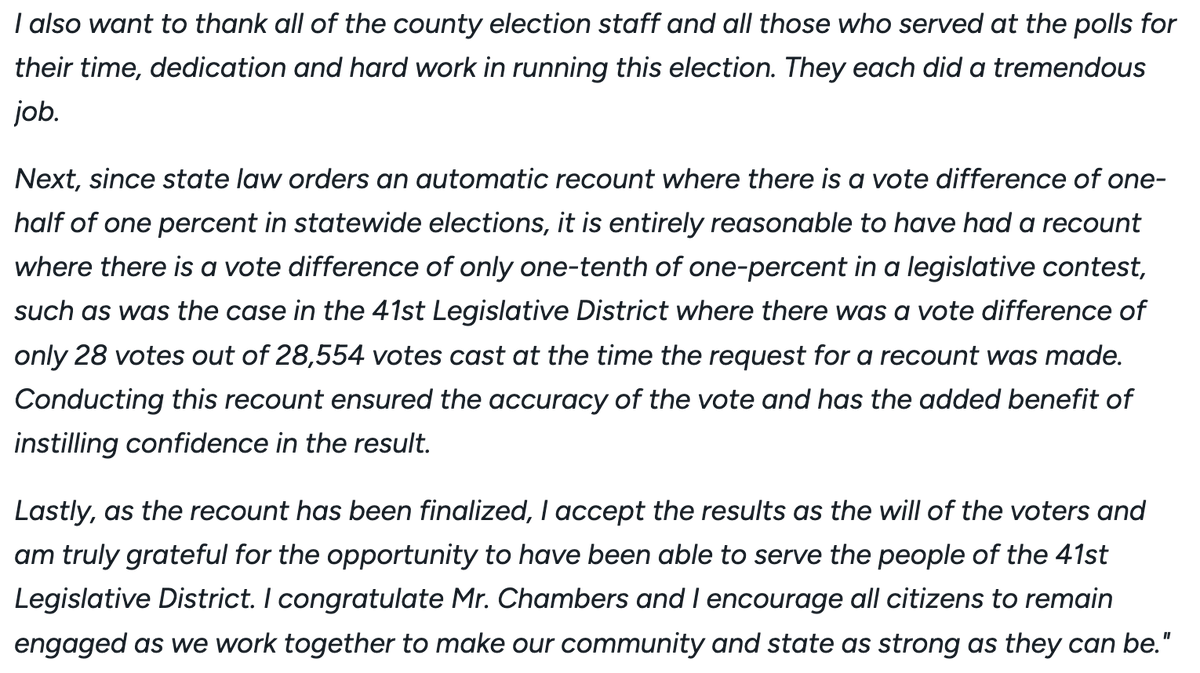
2/Kudos too to Rep. Miller for a classy concession & acknowledgement of the work by @LancasterCounty@LCElections & poll workers.
"Conducting this recount ensured the accuracy of the vote & has the added benefit of instilling confidence in the result."
https://t.co/M6wmgqJwEB
1/Original result for HD41 election: @bradforpa 14,291 to Rep. Brett Miller's 14,263 - a 28 vote difference.
FInal outcome: Brad Chambers 14,295 to Miller's 14,265.
30 vote difference.
Impressive how careful the count was & how close the race was. Kudos.
https://t.co/M6wmgqIYP3
The Senate just passed BAAJA, a sweeping overhaul of how we permit energy projects. Now it's up to the House. After much deliberation, I can't support the bill as written. It asks us to give up protections we may never win back in exchange for gains we may never see.
I've spent my career fighting for clean energy, first as an environmental attorney and now in Congress. I want us to build power lines, solar, and wind faster, and parts of BAAJA would help. It would improve how we plan and build transmission lines, and it would require large data centers covered by the bill to pay their share of grid costs. Many of those ideas are also in the Energy Bills Relief Act that Sean Casten and I wrote, because families shouldn't have to pick up the tab for Big Tech.
I take the bird-in-the-hand argument seriously. BAAJA has already cleared the Senate with bipartisan support. If the House passes it up, we could wait years for another permitting bill that can get through both chambers and be signed into law.
Still, we have to weigh the whole trade.
BAAJA would limit how states protect their own water. It would give agencies less time to look at threats to endangered species. And it would make it much harder for courts to stop a project, even when an agency skipped the environmental review the law requires. By the time that review gets fixed, a wetland could be filled in or a Tribal sacred site destroyed, and that damage can't be undone.
The bill would also make it harder to change or pull back a permit once it's issued, even one that was issued illegally. Congress should make sure agencies can fix their mistakes and prevent serious harm before it happens.
Those limits would be written into law. The clean energy gains and lower bills, meanwhile, depend on what actually gets built, and on who's carrying out the law. Right now that's President Trump, and on clean energy, he can't be trusted. His administration has spent this year canceling offshore wind projects, and he has said he won't approve new wind turbines. Nothing in this bill stops him from slow-walking the clean energy side of the bargain while the rollbacks take effect right away.
Rhodium Group estimates that the provisions it modeled would cut the average household's annual electricity bill by $50 to $78 in 2040. I want those savings. But Rhodium didn't model the permitting certainty provisions, and it didn't assess what BAAJA would mean for water quality or Tribal consultation. Congress has to weigh those consequences too.
I've spent years fighting to keep new offshore drilling away from Southern California. When a federal approval threatens our coast, it matters whether a court can step in before the damage is done. I've also heard from hundreds of constituents about BAAJA, and among those who contacted me, opposition has run roughly two to one.
Here's what would get me to yes.
Keep the transmission reforms and make large data centers pay their share. Make sure the permitting certainty provisions can't block commonsense safeguards or keep a future administration from withdrawing an illegally issued permit. Preserve the ability of states to protect their own water. Keep endangered species decisions grounded in the best available science. Let courts halt projects when an agency skips required environmental or historic preservation review and the harm could be irreversible. And address the concerns Tribal nations have raised about sovereignty and the federal government's trust and treaty responsibilities.
If House and Senate leaders from both parties agree on those fixes, I'll be ready to vote yes.
The Walton family inherited a massive stake in Walmart and has built a fortune worth hundreds of billions.
Meanwhile, Walmart workers are among the Americans relying on food stamps to put food on the table.
One of the richest families in the world owns a company whose workers still struggle to afford basic necessities.
How is that acceptable?
A company shouldn’t be able to build generational wealth for its owners while taxpayers help its employees survive.
Redistricting consultant says "Republicans, who have opposed redistricting reform, should now realize that they lost in this war."
He says gerrymandering harms us all & says: "the best solution would be independent commissions in every state." We agree.
https://t.co/9xxEd61udF
@PAGOP OR look at areas growing vs shrinking.
Maybe lack of investment in rural schools, rural hospitals & rural broadband have made rural PA less attractive for families, retirees & anyone trying to work remotely. Some parts of PA are growing.
Not rural PA. Why won't you represent us?
The election is over but the work for representation continues.
PA still has the most leader-centric redistricting process in the world, 1 of the most leader-centric legislative processes in the country, no safeguards on money in elections.
Let's fix this.
https://t.co/uLhTwsC3Vf
The American people are demanding an end to the dark money that corrodes our political system. We are glad the DNC is discouraging the use of dark money groups and super PACs. It’s a meaningful step toward ending Big Money’s influence in elections.
https://t.co/whlhOHEFfx
There's a reason school vouchers have failed every single time they've been put to a public vote: People understand the folly of taking money from public schools to subsidize wealthy parents that abandoned them. Just ask Greg Abbott, who lost his job over this.
#Arkansas#arpx
7) Related to point 6, and I’m admittedly a ceaseless clanging gong on this issue, the Senate prioritizes the comfort of senators over and above the actual job. Voting late, voting on Fridays, grinding out procedural processes, it’s just too much for them. A lot of them will just leave. They prioritize everything else but the actual job and then demand voters take them seriously when they don’t even take themselves seriously.
In that sense it’s easier to tweet about “what could have been” then to own the fact that you sometimes have to be the guy that makes it real. (Because one senator usually can. They really are power centers in their own right.)
8) Finally, there is the death by a thousand cuts theory. The Senate is actually made to solve problems and that function is pushed along by the institution being a relational body. SO MANY issues used to be solved by senators talking to each other during votes or on the subway or just wandering into each other’s offices or during the conferences lunches.
Now votes are 60+ mins so senators never see each other. The conference lunches are scripted or have outside speakers and never allow for discussion. Senators work 2.5 days a week. Staff work from home or never leave their offices so never meet each other. There isn’t an amendment process to sharpen engagement and negotiation skills. And senators just tweet at each other instead of working out their issues face to face.
Can the Senate be fixed? I think it can be. But rules changes or nuking the filibuster or firing the parliamentarian aren’t going to do it. This isn’t a mechanical problem. It’s a problem of will and desire.
The Senate has a Leader but what it currently lacks is leaders of men.
One benefit to universal healthcare that nobody ever mentions is that it would incentivize the government to do things like make sure our food is safe and our environment is clean.
The election is over but the work for representation continues.
PA still has the most leader-centric redistricting process in the world, 1 of the most leader-centric legislative processes in the country, no safeguards on money in elections.
Let's fix this.
https://t.co/uLhTwsC3Vf
ALL the leaders mentioned in this @SpotlightPA article have cosponsored bills for an independent redistricting commission (IRC), or expressed other support, at some point in the past.
Will that mean new IRC bills move forward in 2027?
https://t.co/vvToN2bbPX
"On November 3rd, roughly 65% of Montana voters approved Initiative 194, known as 'The Montana Plan.' The Montana Plan codifies a simple legal idea: that a corporation isn’t a person. The authors of the initiative recognized that Citizens United never said a state has to give a corporation the power to spend money in politics. So the Montana Plan takes back every power the state has granted to corporations, and then re-grants only the ones needed to run a business. Political spending is not one of them. Corporations can still do business; they just can’t buy elections."
https://t.co/6nupC3Zq5j
Yes voters want gift bans. End to closed primaries. 2 year window for child sexual abuse survivors. Independent redistricting commission.
These would have passed years ago if @PASenateGOP leaders listened to voters.
Now @PaSenateDems have their chance to restore trust. Will they?
@mcall's Bill White wonders if PA political leaders will now act on long-sought good government reforms.
His 1st 2 priorities are also ours.
#1: procedural rules that ensure bills with broad support are brought to a vote.
Check https://t.co/HXccXvQVKu for our views on that.
#2: a constitutional amendment to create an independent redistricting commission.
Bills to do so, with strong bipartisan support, have been blocked for a decade.
"If it’s buried again next session, we’ll have no trouble identifying which party to blame." https://t.co/VOYD67Bp05
@mcall's Bill White wonders if PA political leaders will now act on long-sought good government reforms.
His 1st 2 priorities are also ours.
#1: procedural rules that ensure bills with broad support are brought to a vote.
Check https://t.co/HXccXvQVKu for our views on that.