Prediction markets aren't a hot take—they're a risk barometer.
By putting real money behind collective intelligence, they've outperformed polls on elections and flagged geopolitical shifts before the headlines caught up. When people have skin in the game, the signal gets sharper.
40 identical letters written by the casino industry's lobbyists are not a regulatory consensus.
The @CFTC should weigh it as what it actually is: One industry's message wearing 40 letterheads.
🚨 Sen. Brian Schatz just claimed that trading on Kalshi and betting on apps like FanDuel are "exactly the same." That's just fundamentally false.
Here are the facts:
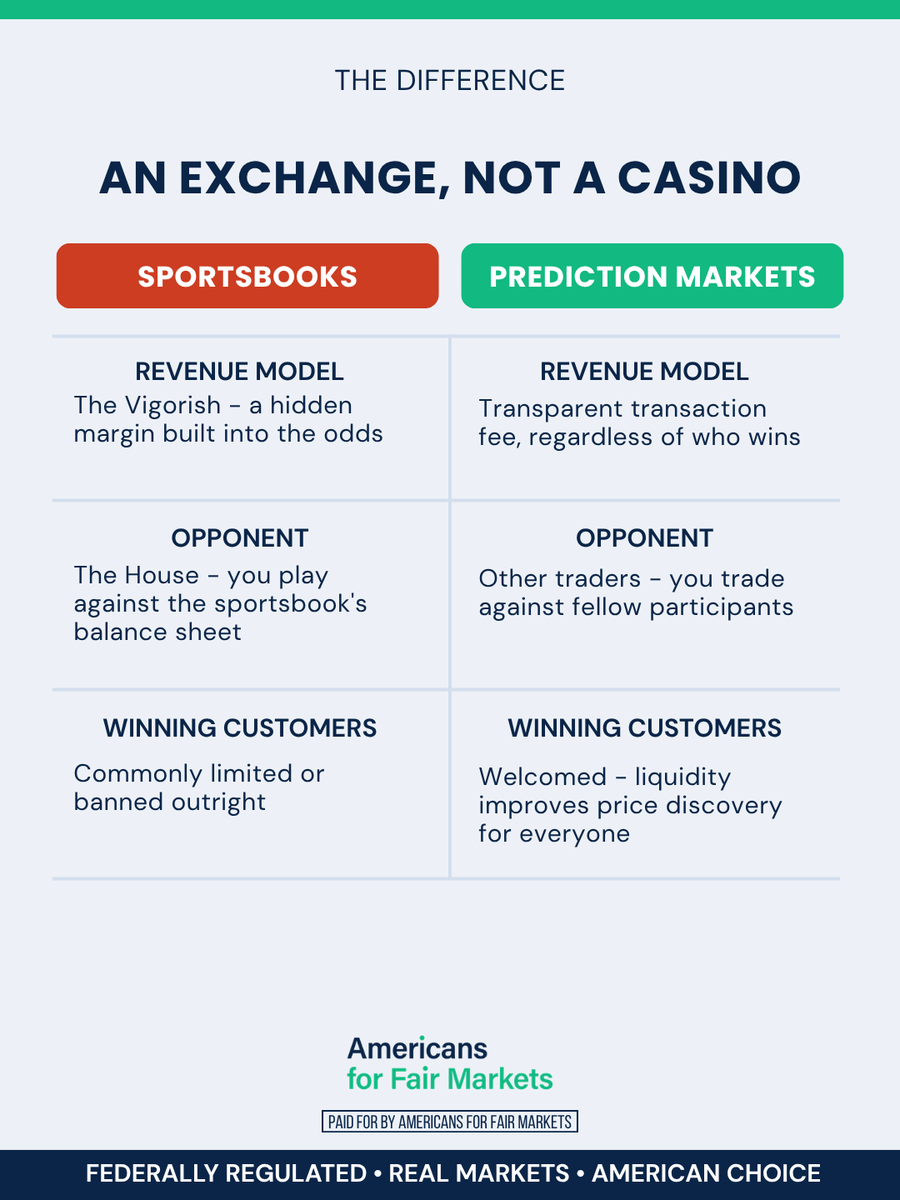
a) On prediction markets, you aren't betting against the House or against a sports book-- you trade against your peers.
b) Apps like Kalshi get a flat fee per trade, whereas sports books like FanDuel profit the more somebody loses.
"It's unique and different. It's not against a casino or a random sports book. This is using real time data against your peers-- not against the House."
This is why Big Casino and Big Gambling are spending millions to lobby state governments to target prediction markets.
Did you know 75% of prediction market users come for the information?
Kalshi's new elections hub is making a play to replace news networks as the voice of election night. One dashboard, every race, with polling, fundraising, and real-time crowd data funneling into a single, spin-free source.
Source: Washington Examiner
Should online sportsbooks like @FanDuel and @DraftKings be allowed to BAN winners while FLEECING the biggest "VIP" losers?
I say no.
Either take bets from everyone on equal terms or take bets from no one at all.
My new essay at @TheHillOpinion:
https://t.co/bgTJ5aAI32
Wow - it turns out Adam Schiff's attacks on prediction markets are exactly what his casino-owning donors demanded.
Coincidence or corruption?
https://t.co/qaeZrOxB0M
So far in 2026, New Yorkers trading on Kalshi have made more than $200 million.
That's not possible with sports books or at casinos because, in gambling, the House always wins.
Prediction markets are fair, transparent, and federally regulated.
No House. Only traders.
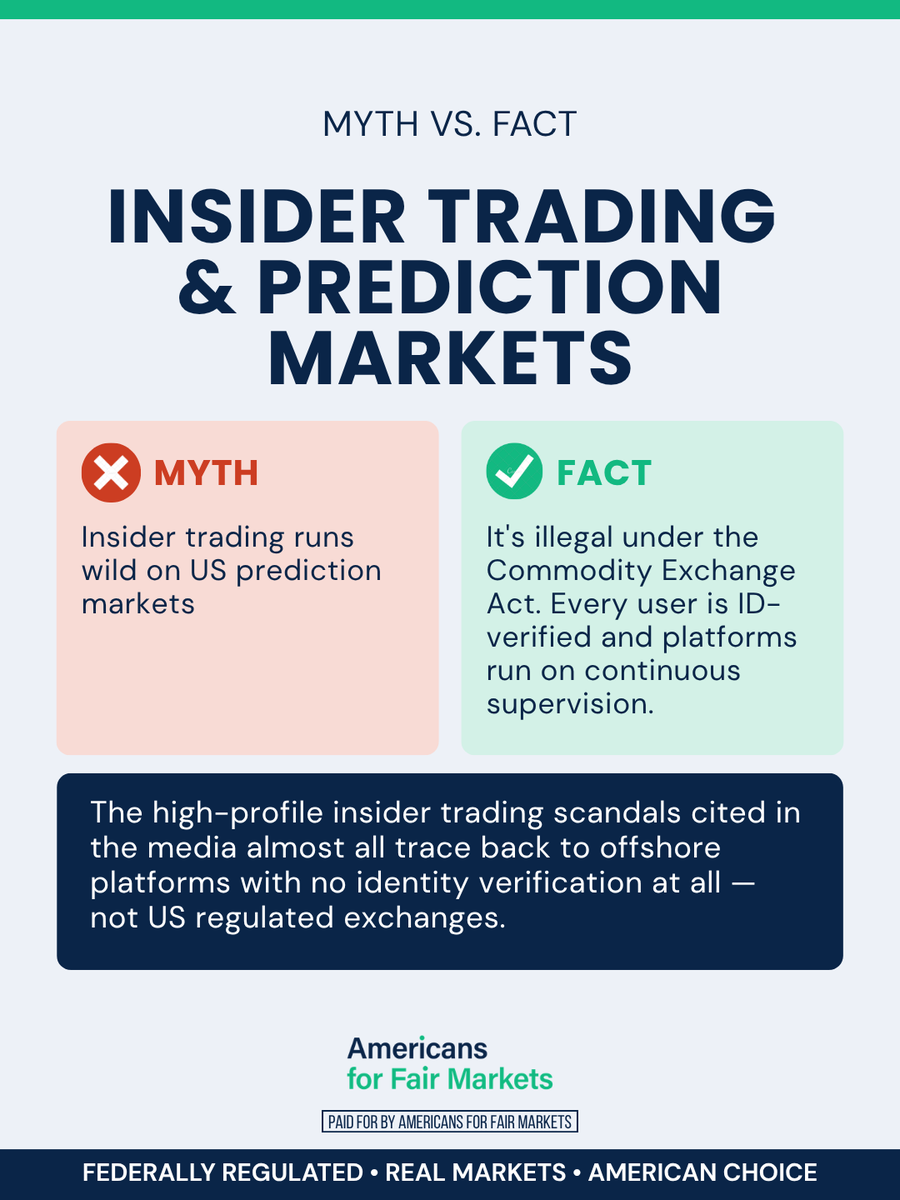
Every time prediction markets make headlines, insider trading gets blamed. The actual rulebook, and the platforms with zero identity verification, tell a very different story.
✅ Forfeited
✅ Fined
✅ Banned
Unlike the claims you see in the media, that's what happens when you decide to insider trade on prediction markets.
https://t.co/wrjK2o1LJm
Such dumb and shallow reporting, surprising no one.
How is it impacting the midterms? Well, an attempted power-grab from WI election officials risks suppressing legal and valid voting in its state.
American-based federally regulated markets are WORKING. Rules against insider trading are being enforced--that's why insider trading allegations have been limited and appropriately referred.
How did we get to this point? Well, CNN employs many lazy, brain dead reporters who lack the integrity or intelligence to properly do their jobs.
How is the explosion in prediction markets scrambling the midterms? How much political insider trading is happening that we don't know about? How did we even get to this point? Great conversation with @jaketapper, @FormerCFTCGC and @ChristyGRomero
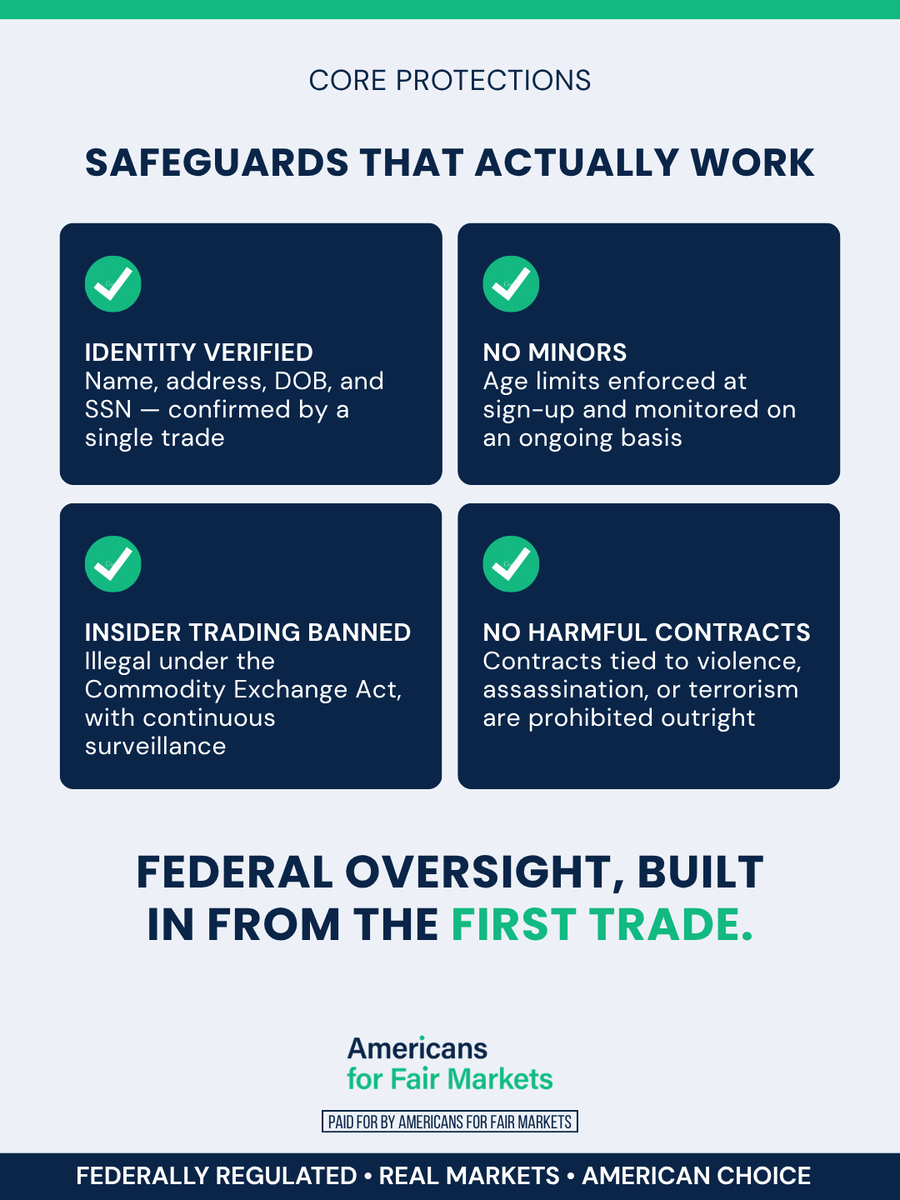
Before you can place a single trade, federal rules are already working behind the scenes. Most people have no idea how much verification happens before the first click to keep prediction markets fair.
This is why casinos and sportsbooks are so inferior to prediction markets: you're playing against the house, and the house wants you to lose. Even when you win, they try to weasel out of it.
Trading with your peers > gambling against the house
A Pennsylvania property manager was playing a slots game on her phone and the screen told her she'd won $100,000. When she went to collect it, the company told her it was a bug and offered her $280 instead.
– Lisa Piluso of Yardley, Pennsylvania, was playing capital Gains, an online slots game made by American Gaming Systems (AGS), on her phone on October 2, 2020.
– Her screen showed a $100,000 jackpot. She took a screenshot.
– When she tried to collect it, AGS told her the win was the result of a bug and offered her $280.
– This keeps happening because a casino is the house. It sets the odds, holds the money, and decides after the fact whether your win counts.
– A prediction market doesn't work that way. There's no house, you're matched peer-to-peer, and your payout comes from the person who took the other side, not a company deciding whether to honor the number on your screen.
– Lisa pushed back and was later told her actual win was closer to $300, but AGS raised its offer to $1,000, telling her they were being "nice people."
– New Jersey gaming regulators investigated and found AGS had a genuine bug in the game that failed to clear old bonus symbols off players' screens, making it look like they'd won far more than they actually had.
– The state's investigation revealed 13 other gamblers had filed the exact same complaint against AGS over the same game.
– AGS was fined just $1,000 by regulators and said it had taken corrective action, but maintained there were no grounds to pay Piluso.
– In November 2021, Piluso sued AGS in federal court in Camden for consumer fraud, breach of contract, negligence, and product liability.
– As of the most recent public reporting, the case remains a matter of record with no confirmed final payout to Piluso.
She had a screenshot of the $100,000 the game itself told her she'd won. The company that built the game called it a bug and tried to close it out for $280.
CNN panelist promotes the nonsense view that bad actors could manipulate election markets to prop up candidates. But reality shows that doesn’t work. When a Kalshi trader placed over $1 million on “Yes” contracts for Spencer Pratt to win the Los Angeles mayoral race, it took all of nine seconds for the market to self-correct the resulting price distortion.
Enough fear mongering!
Another day, another example of casinos and sportsbooks doing everything they can to keep their customers from winning.
This is why prediction markets are superior: you’re not betting against the house. You’re trading with your peers.
A 72-year-old woman hit a $1.27 MILLION casino jackpot. The casino told her she won. Then they refused to pay.
– In February 2024, Roney Beal was spending a weekend at Bally’s Atlantic City with her husband.
– She sat down at a Wheel of Fortune slot machine and started playing.
– Then the machine lights flashed.
– The screen showed a jackpot of more than $1.27 MILLION.
– People around her started cheering.
– A casino employee reportedly looked at the machine and told her:
“Lady, you’re a millionaire.”
– Beal took photos of the winning screen as proof and believed she had just changed her life.
– But minutes later, casino staff told her the machine had suffered a technical malfunction called a “reel tilt.”
– They said the jackpot was invalid under casino rules that void payouts during malfunctions.
– Instead of $1.27 MILLION, Beal was offered just $350 as a goodwill gesture.
– She refused.
– Beal sued Bally’s Atlantic City and the slot machine manufacturer IGT, arguing the machine showed a legitimate win.
– More than a year later, the legal battle is still ongoing.
A woman thought one spin made her a millionaire. Now she’s fighting in court to prove the jackpot she saw on the screen was real.
This is a key difference between sportsbooks and prediction markets: sportsbooks want you to lose. If you lose enough, they’ll even assign you a VIP manager.
Prediction markets flip that dynamic on its head: you're not playing against the house, you're trading with your peers.