Legal Aid: Together, We Laid the Foundation. The Journey Continues
In 2008, LSK and civil society organisations offering legal aid joined other institutions, under the leadership of the Office of the Attorney General, to help develop a national legal aid framework for Kenya. The National Legal Aid and Awareness Programme pilot project tested what was possible. I am glad to have been part of that work as a FIDA Kenya representative.
The 2010 Constitution strengthened the foundation for legal aid, and the Legal Aid Act, 2016 established the National Legal Aid Service (NLAS) to give effect to those constitutional provisions.
Over the years, JSC has continued to advocate for increased funding for the Judiciary’s pro bono programme. Its allocation grew from KSh 63.6 million in FY 2023/24 to KSh 150 million in FY 2025/26.
However, court decisions and persistent concerns raised by the National Assembly regarding NLAS’s statutory mandate to provide legal aid informed the transition of these services to NLAS.
On Wednesday 7th October 2026, I participated in the joint Judiciary–LSK transition committee meeting, where the transition report was shared and members’ concerns discussed.
Having been part of the earlier efforts to build a national legal aid framework, this moment carries special meaning for me.
As these services move to NLAS, our commitment remains clear: outstanding bills must be paid, advocates’ concerns addressed, and those who rely on legal aid supported throughout the transition.
I also urged colleagues to participate in the budget-making processes of JSC, the Judiciary, NLAS and other justice-sector agencies. These are opportunities to shape funding priorities and ensure that the needs of advocates and the people we serve are heard.
Today is World Mental Health Day, a reminder that mental health matters to all of us.
The legal profession can be demanding. Heavy workloads, tight deadlines and everyday pressures can leave us stressed, overwhelmed or burnt out. Findings from the @ABAesq surveys have highlighted the mental health challenges facing lawyers, reminding us that these struggles are real and cannot be ignored.
Over time, I have learnt to cope through debriefing, family time, social media breaks and dancing! 💃🏽
How do you recharge?
Let's support one another. Seeking help is strength.
For support, contact the @LSK_ABA on +254 717 595 006
#WorldMentalHealthDay #MentalHealthMatters
Wakili Tuongee | The Role of the JSC in Judiciary Automation
As technology transforms how justice is delivered, what role does the Judicial Service Commission play?
Join me as I explore JSC’s role in advancing a more efficient, accessible and accountable Judiciary through automation.
Watch, learn and share your thoughts:
What improvements would you like to see in digital court services?
#hotoffthebench
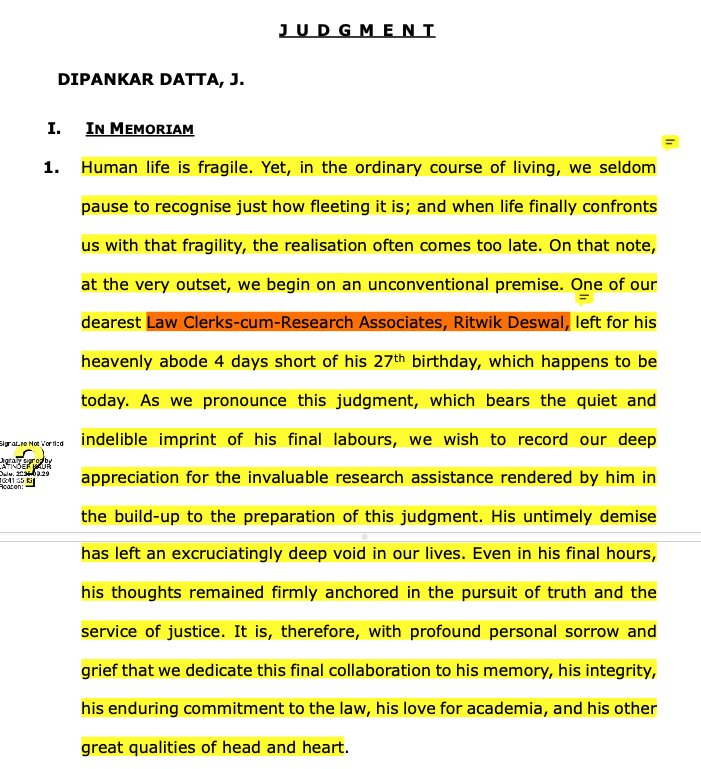
The High Court has quashed the JSC Notices sent to Supreme Court Judges:
1. Failure to conduct a preliminary assessment
2. Omnibus removal complaints
3. Considering Complaints that touch on Judgments . Petitioners should have gone for either review or appeal
🌸 HAPPY NEW MONTH!
Welcome to October! A month to celebrate our heroes and heroines and mark Breast Cancer Awareness Month. 💗
🎥 Introducing WAKILI TUONGEE, a weekly series where we simplify and discuss issues affecting the legal profession.
📅 Every Thursday. Let's learn, share and engage!
Wishing you a blessed October!
DID YOU KNOW?
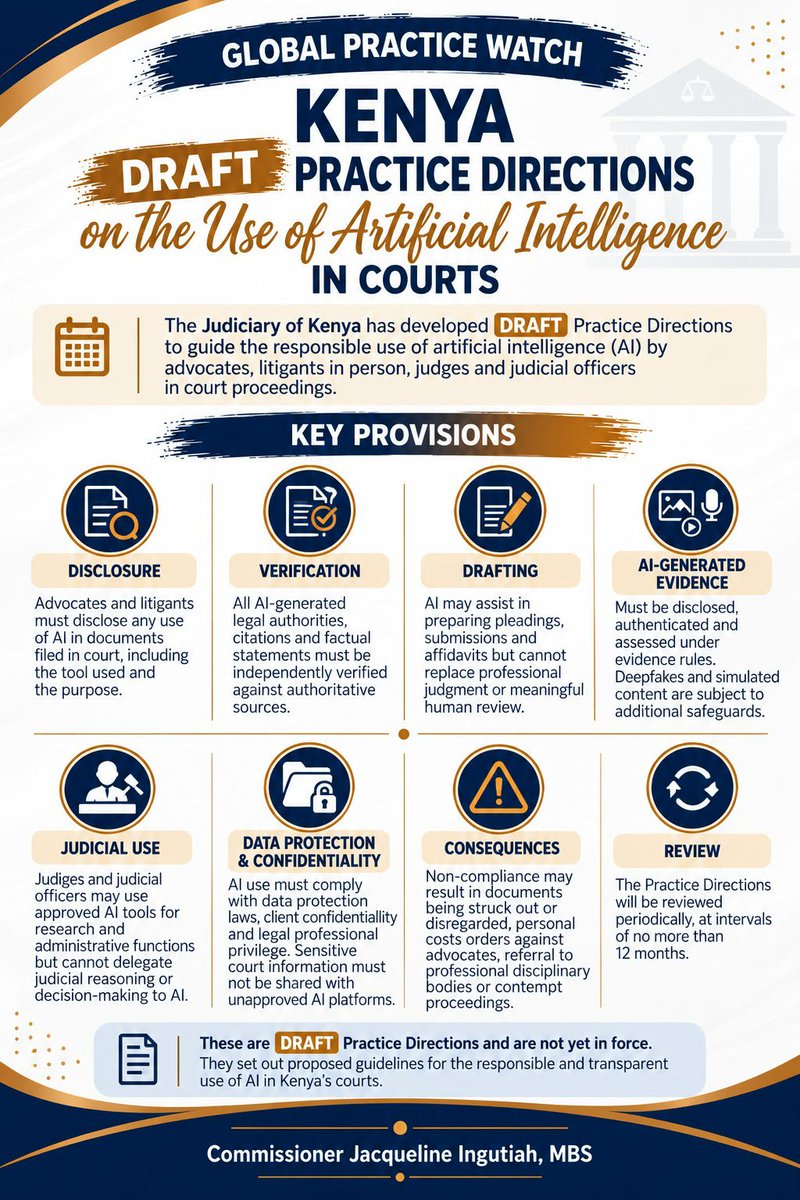
Kenya Judiciary has developed Draft Practice Directions on the Use of Artificial Intelligence in Courts. 🇰🇪⚖️
After approval and gazettement by the Chief Justice, the Practice Directions will guide advocates, litigants, judges, judicial officers and other court users on the responsible use of AI in Kenyan courts.
Key highlights:
* Disclosure: Declare the use of AI in documents filed in court.
* Verification: Independently verify all AI-generated legal authorities, citations and factual statements.
* AI may assist in drafting but cannot replace human judgment.
* AI-generated evidence must be disclosed and authenticated.
* Judges and judicial officers cannot delegate judicial decision-making to AI.
* Safeguard client confidentiality, privileged information and personal data.
* Non-compliance may attract costs, disciplinary action or other court sanctions.
The bottom line: AI can assist, but responsibility remains human.
Are we ready for these proposed Practice Directions?
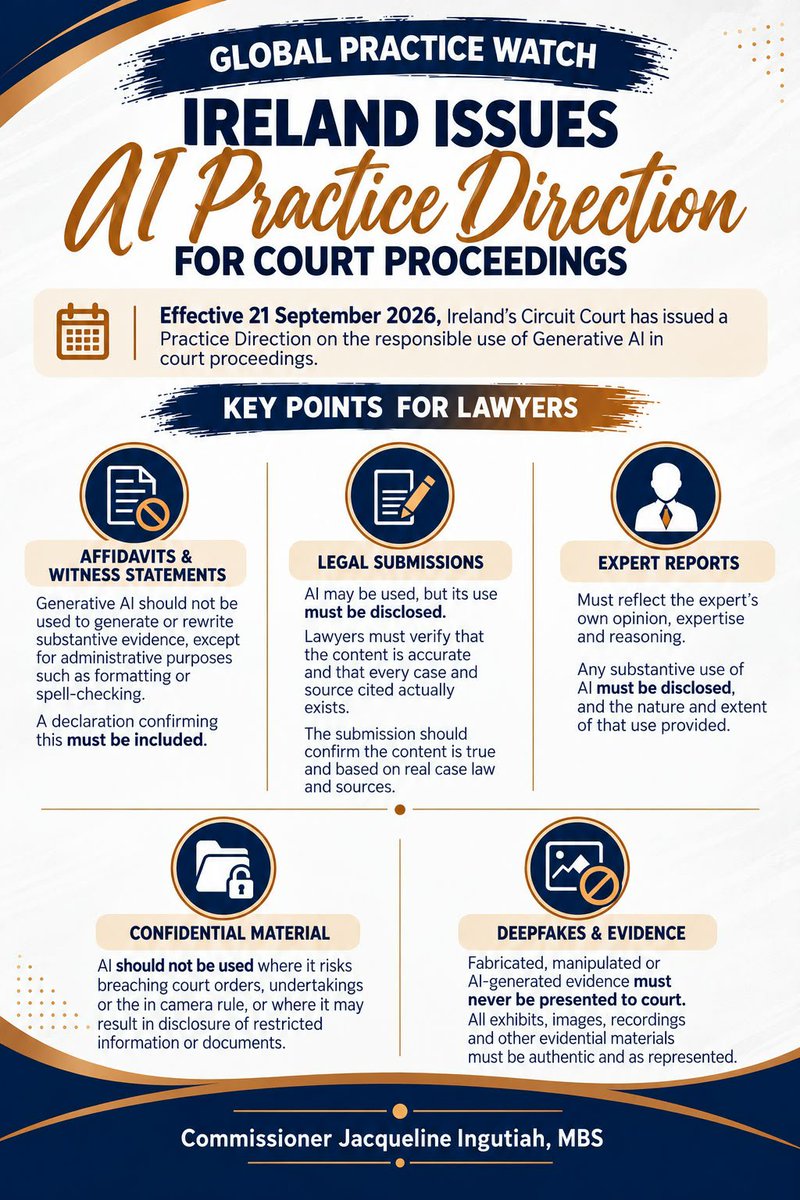
AI IN COURT: IRELAND SETS THE RULES
Ireland’s Circuit Court has issued a new Practice Direction on the use of Generative AI in court proceedings, effective 21 September 2026.
Some key takeaways from the directions:
1. Affidavits & witness statements: AI should not generate or rewrite substantive evidence. A declaration confirming this must be included.
2. Submissions- AI may be used, but its use must be disclosed. A lawyer must verify that the content is accurate and that every cited case and source actually exists.
3. Expert reports: They must reflect the expert’s own opinion and reasoning. Any substantive AI use must be disclosed.
4. Confidential information: AI should not be used where doing so risks breaching court-ordered confidentiality, undertakings or the in camera rule.
5. Deepfakes: Fabricated or AI-manipulated evidence must never be presented to court.
⚠️ The consequences for breach are serious and include; adverse costs, rejection of documents, striking out of a claim or defence, personal costs against a lawyer, and possible referral to the professional regulator.
The message is increasingly clear: *AI may assist the lawyer, but it does not assume the lawyer’s professional responsibility.*
With Kenyan lawyers increasingly using AI for specific aspects of legal practice, should the Hon. Chief Justice consider issuing similar Practice Directions tailored to Kenya’s legal and judicial context?
#AIandLaw #ProfessionalResponsibility #FutureOfLaQ
Congratulations to the 13 LSK members appointed to various tribunals (4 as Chairpersons and 9 as Members). It is always a joy to see our colleagues take up opportunities to serve in these important spaces.
Over the weekend, I shared my thoughts on why Kenya needs to conclude the ongoing tribunal reforms and strengthen tribunals as an avenue for specialised, accessible and expeditious justice.
These latest appointments bring to 89 the number of LSK members from private practice, in-house counsel and academia appointed to serve in various tribunals over the past four years.
For me, this is encouraging on two fronts, more opportunities for our members and, at the same time, a stronger tribunal system that improves access to justice.
To all the appointees, congratulations once again. I wish you well as you take up your new roles. Serve with integrity, independence and distinction.
https://t.co/1WJ3sy5VrH
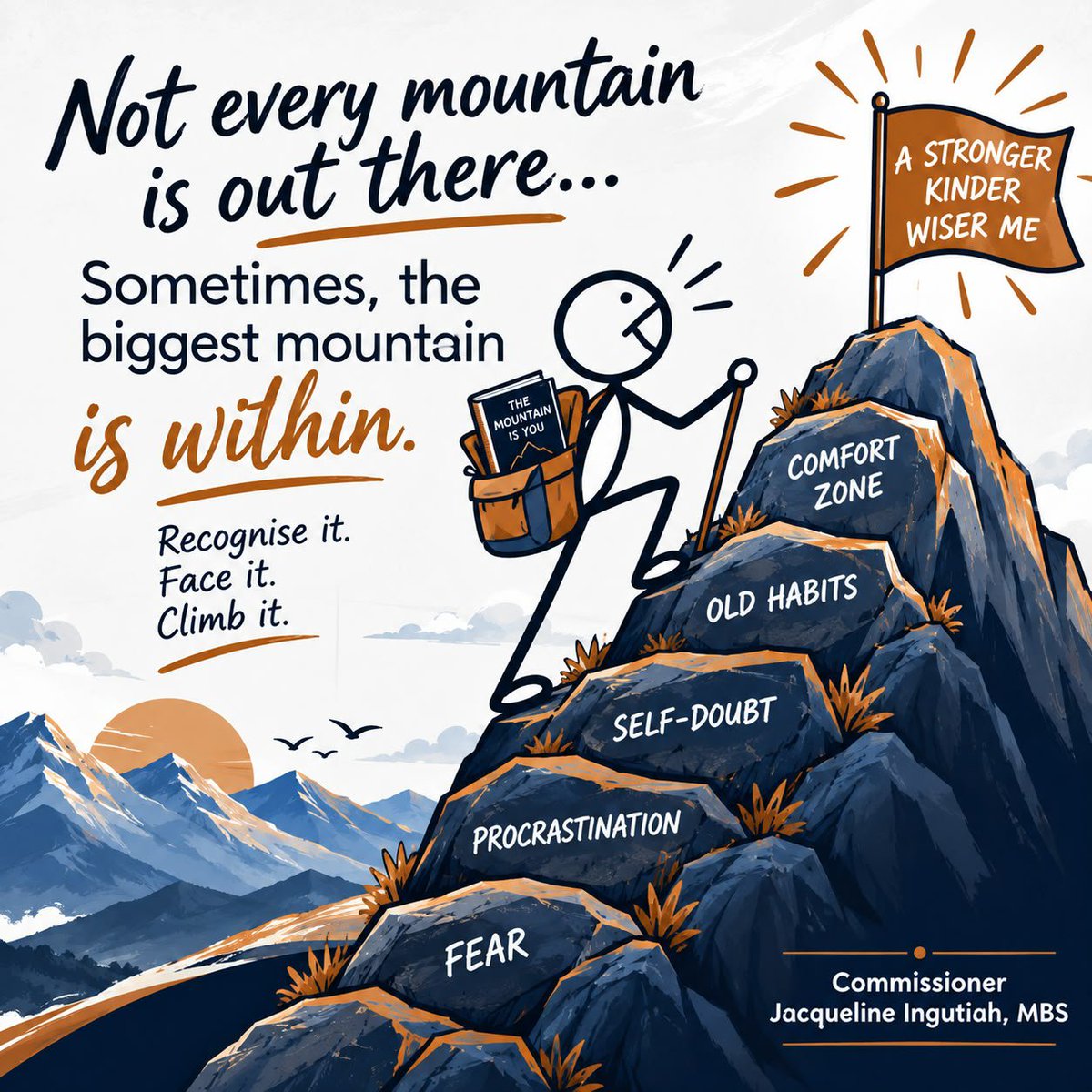
I just finished reading "The Mountain Is You: Transforming Self-Sabotage Into Self-Mastery" by Brianna Wiest.
Its message is simple at times the biggest obstacle in our way is ourselves.
Fear, procrastination, self-doubt, old habits or comfort of the familiar.
As lawyers, we are trained to interrogate and challenge assumptions. Perhaps, every so often, we should turn those skills inward and ask:
What am I doing? or refusing to do that may be standing between me and the person I want to become?
Not every mountain needs to be conquered today. But first, we must recognise which mountain is ours.
Have a reflective weekend, colleagues.