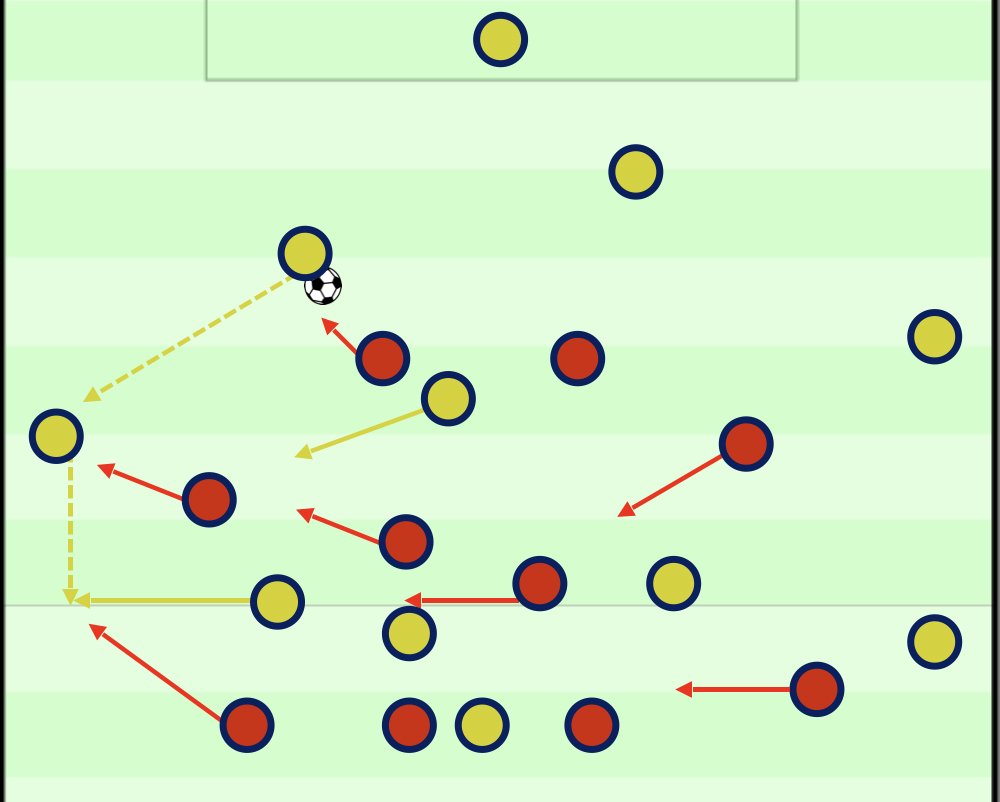
Increased man-orientation on interiors means vertical passes are often defended with immediate pressure on the receiver from behind.
Diagonal entries cut more naturally against the momentum of the retreating backline, creating space for the receiver through deceptive timing.
Dass Kimmich "das Spiel verschleppt" ist ein massives Missverständnis, das ich gerne einmal auflösen möchte.
(Dem sind ja auch schon Toni Kroos und Bastian Schweinsteiger zum Opfer gefallen. Fußballdeutschland nimmt das bei jedem Spielmacher wahr. Weil es System hat.)
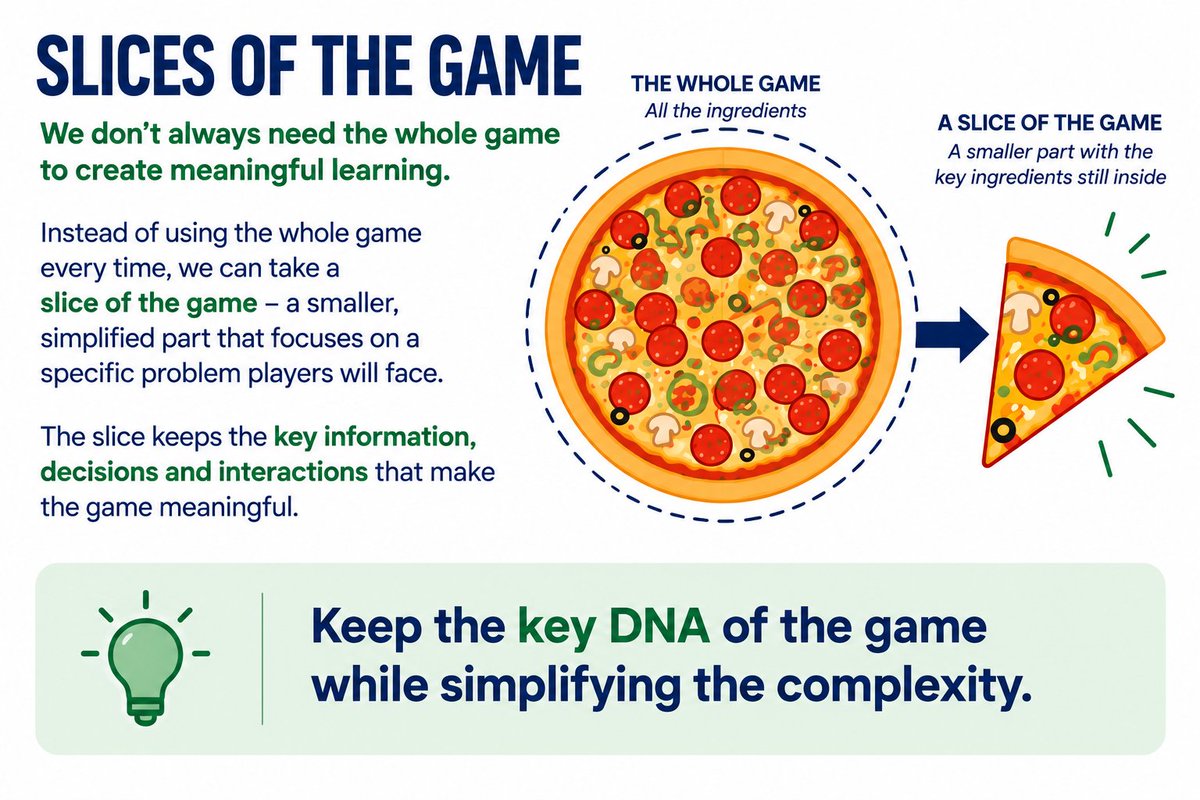
One of the key skills in practice design is being able to take a complex game and create a simpler version without losing what makes it the game.
Think about it as taking a slice of the game
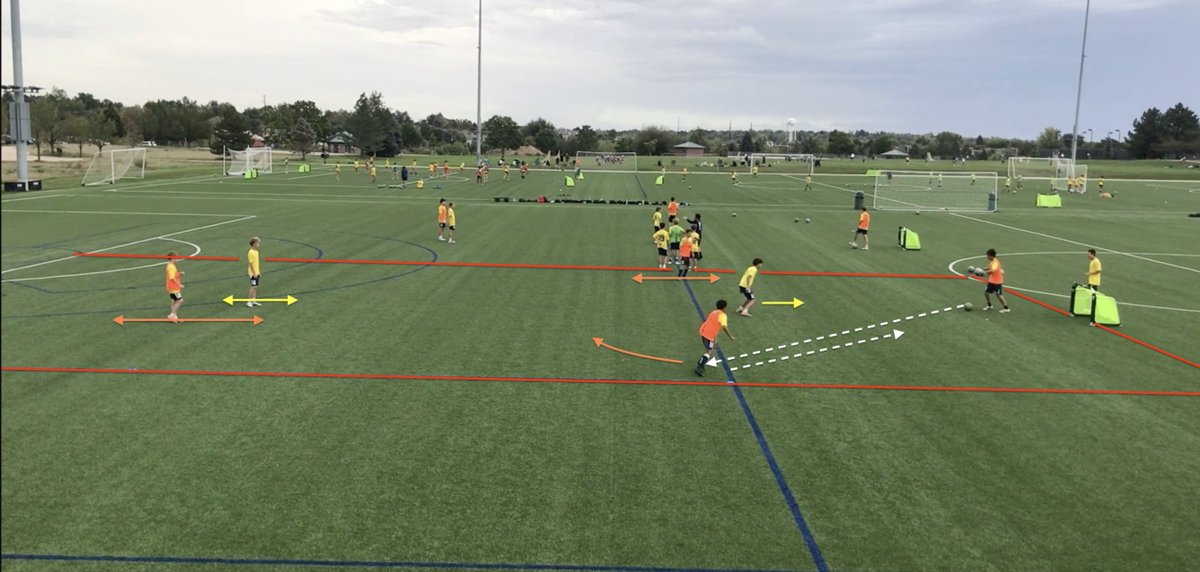
Here are 5 steps I use when designing these activities 👇
I accidentally trained my players to solve the drill instead of solve the game.
The activity was working at first, I wanted the players to recognize a particular moment, bounce the ball back to a teammate, then use the next action to progress, so I added a rule that basically forced the bounce. And for a few repetitions it looked great.
Then the defender figured the game out to be able to win.
Because the bounce was mandatory, the defender no longer had to read the player, they could just anticipate the pass, jump it, and suddenly the activity had become completely predictable.
That was the part I had created.
By telling the attacking players they had to bounce the ball, I had actually removed the decision I wanted them to become better at making.
The rule was creating the action, but it was also removing the information. So I changed it. Now, if the defender jumped the bounce, the player could turn. If the defender pressed, they could bounce it.
Same general situation, but now the behavior depended on what the player perceived rather than whether they remembered the rule.
A constraint can absolutely help guide behavior, but once the player is simply complying with the constraint, rather than reading what the game is giving them, I think you have to ask whether you are still training football or whether you are training the activity.
By simply removing the rule would not have been enough either, I needed to understand what information the rule had removed, then restore the decision the players were supposed to make.
That adjustment then created other solutions I hadn’t necessarily planned for, turning out, third-man actions, different ways of escaping pressure, and from there the activity kept evolving because the players kept revealing things I hadn’t fully anticipated (videos included in link).
That's what's most fun about training design. Not, “What is the perfect exercise?” But, “What is this activity actually asking the players to notice, decide and adapt to?”
I wrote out the full process in the link below, from the original match problem, to the first version of the activity, to the constraint that made it unrealistic, to the adjustments that brought the decision back into the game: https://t.co/pc1vVsWXIp
A simplified activity doesn't need to look exactly like the full game.
But players should still be perceiving relevant information and coordinating their actions in ways that remain connected to performance.
@JvanderB78@david_goigitzer@PicklesJacob I don't think it's necessarily decided in advance.
Judgements about functional info can emerge during coaching.
But I don't think it's possible to coach from somewhere outside your own interpretation of the game.
That doesn't mean all interpretations are equally appropriate.
@PicklesJacob It depends what you mean by prescribed solutions and Game Model.
My proposal is that coaching is concerned with the attunement of attention towards environmental information.
The decision of which information to amplify is not self evident or objective, its largely interpreted.
@PicklesJacob Sure, there needs to be a minimum level of perceptual harmony for the collective to function against opponents.
How that shared understanding is formed is always influenced by the coach’s interpretation of football, with multiple appropriate approaches being available.
one of the smartest ball-carriers in the game.
—understands the (overconfident, cautious + mute) relationship the opposition defenders’ have in 1v2s and can exploit it.
—high awareness + cognitive speed = ability to create the ‘puppet phase’ even in continuous, dynamic 1v1s.
Is the GK really creating a significant advantage in certain zones of the pitch?
Progression depends only on the pass, and often without attracting enough pressure first.
So my question is:
should we always use him… or is there sometimes a better option behind?
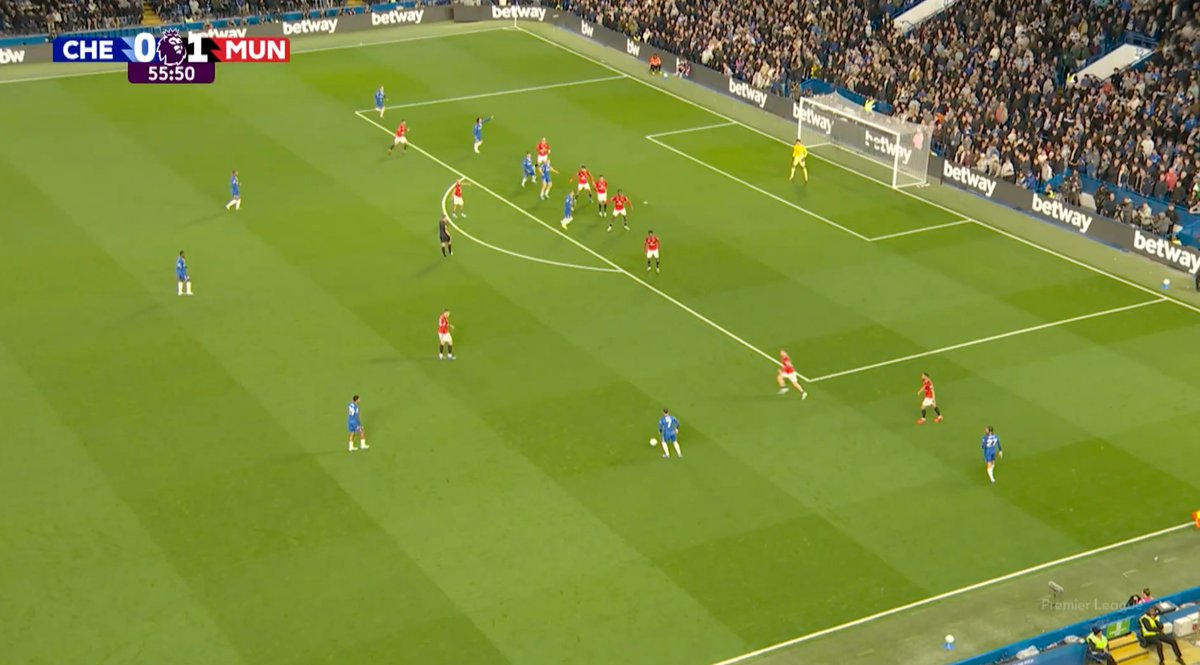
This is how modern football looks like:
-2 or 3 wide players - make space for a winger for inswinger cross - wide combinations mostly to be able to cross or shoot
-overload far-post
-forcing def - 6s or Ws to drop deep to participate in box def
Not creative but effective.