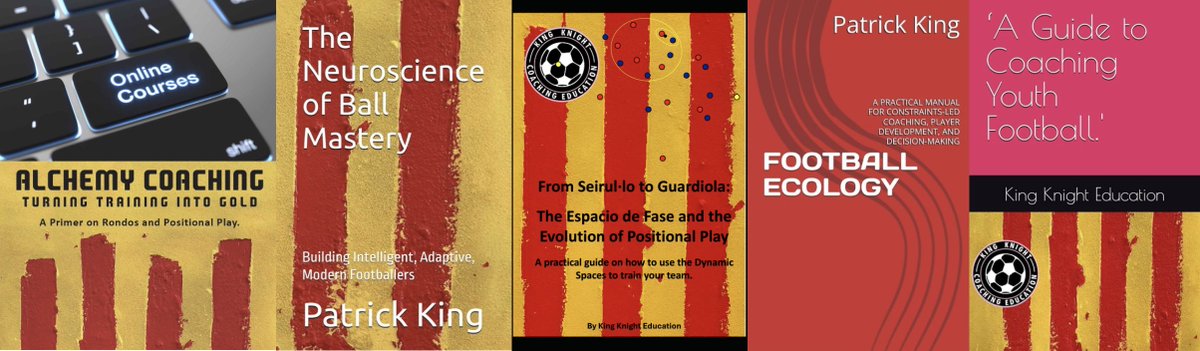
50% off of the Online Positional Play Course.
These books and online courses are used by professional, College and Club coaches all around the world.
Online Positional Play Course: https://t.co/khl8XMFtxA Use this code at checkout: 50% OFF
From Seirul·lo to Guardiola: The Espacio de Fase and the Evolution of Positional Play: https://t.co/wzc0xeI7h0
Football Ecology: A Practical Manual For Constraints Led Approach to Coaching: https://t.co/kETneTcs8j
The Neuroscience of Ball Mastery: Building Intelligent, Adaptive, Modern Footballers: https://t.co/fRTX3Qh6tU
A Guide to Coaching Youth Football: https://t.co/Q0GQRGwyEf
Personally, you need to open tour eyes and expand your horizon. This is one tiny piece of one session and that one session is part of a series of sessions that build in complexity. If you follow us, you understand that scanning is a key tenant of our belief system. This however has nothing to do with scanning. Just the same as putting on cleats or filling up your water bottle is nothing to do with scanning.
All we are showing in this clip is improvement in kinestetic feel, cognitive overload multi lateral limb use, nueroplasticity etc.
Also, if you closely look at his head, he is scanning the appropriate range. Scanning whilst dribbling at high speed is not looking behind you.
I encourage you to watch it again with this in mind not jump to conclusions on what is or is not being worked.
@KingKnightEd I think you've missed what I was getting at. I wasn't suggesting the drill should train scanning. I was talking about ingraining movement behaviours that carry over into real games. Both my comments are absolutely correct btw.
With respect (and this is the mistake a lot of coaches make) this still is removed from mid-long range scanning. He is scanning his immediate environment (2-3 yards) as that is all we are worried about here. Scanning further in this context would be artificial as there is no pass ever coming.
With respect both these comments are incorrect. There is nothing to be gained by slowing them down and this is not the kind of drill to promote scanning (if you follow us you know scanning is a big part of what we believe). The stimulus (cones) are too close together to allow the head to come up. On purpose. This is not a running with the ball activity that then leads to a pass, this is different.
This is my son (just turned 10), who has been working on this stuff for a short time, going from the slow & deliberate movements caused by just adding a tennis ball to the upper body to this, faster, smoother, more dynamic and more control.
https://t.co/Wz6fP84nGH
@PaulSpacey Paul, if you had to outline a way (or few ways) to generate powerful straight (ish) line players (thinking Ronaldinho/OG Ronaldo etc.) what training methods would you implement? Just for clarity I don’t mean the twisty turny sort of players, I mean the one shoulder drop and gone!
All those that have reached out about the conginive neuroscience approach to skill aquisiton: I can’t recommend following @AlphaInMadrid and Forms Academy (Instagram) enough.
Look. What. Is. Possible.
Yip. I work something similar in with my own son.
Juggling a basketball. Tossing a tennis ball up and down. Picking up cones from one pile and putting them in another whilst controlling the ball. Things like this. Then, dribbling with a tennis ball/futsal/Altinha ball etc.
@KingKnightEd Interesting. With my U11 team I throw tennis balls at them to catch randomly to ensure they are dribbling with their heads looking around.
This is my own son. 10 years old. This looks rough, but when he does 30 minutes of this and other related CNS work and then the last ten minutes is just free with a normal ball, you can see the uplift over and above his normal starting point right away. I just wish I had more time to do this with him.
Thats fantastic. Delighted you’re enjoying it. Multi balls could be anything. The work I do with my own son I use little tiny toy bouncy balls, squash balls, tennis balls, size 1 balls, futsal balls, soccer balls and Altinha balls. And we mix them all in.
@KingKnightEd Just purchased and started reading “Football Ecology”
MAN this was exactly what I was looking for!
Question - your chapter on u5-u8 development: do you have any examples of what mixed-ball usage might look like in a practice?
Mot directly in the sense that ‘juggling a tennis ball helps you dribble faster’, but when you had movement and coordination from a different limb set (upper v lower/left v right) it forces neural adaptations that help you with the thing you are focusing on (dribbling).
It’s a definite choice also. In youth soccer if you only have 2 sessions a week, would you prioritize this over team principles or would you take a ‘risk’ with this v the traditional approach to skill acquisition? I think it depends on the bravery of the individual coach.
@KingKnightEd Do you think playing catch (using hands) can translate to football development?
The way I interpreted your book, it was that all movement - including throwing and catching tennis balls, for example - could translate eventually into soccer skills and should be used for young kids
Just found out about @TST7v7
What an interesting concept for working on intensity, insuring offense whilst also prioritizing defense in training. Love it.