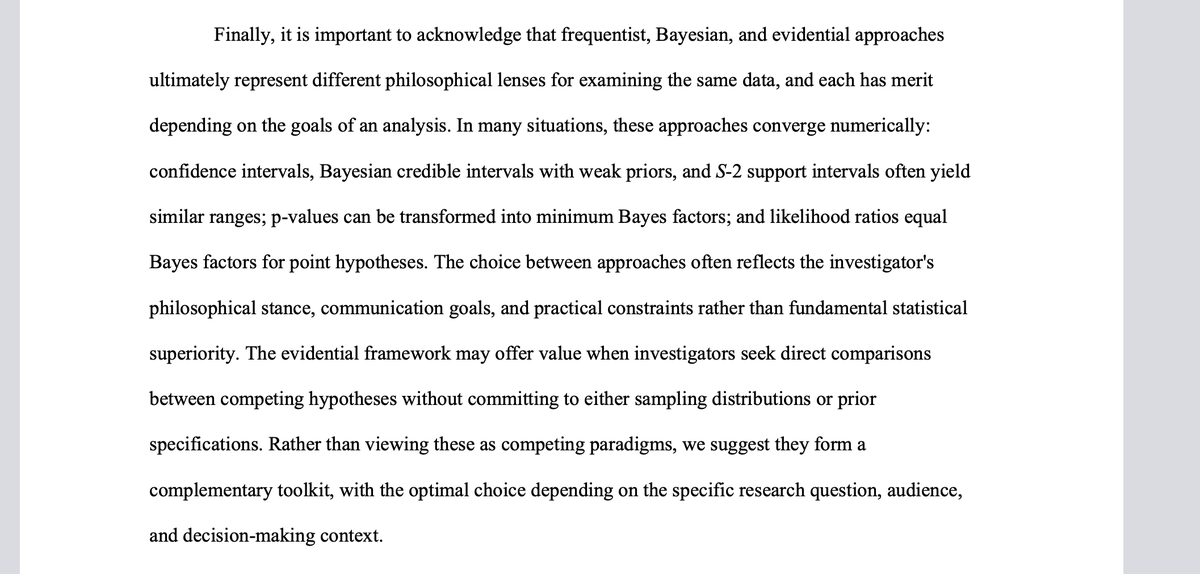
Trial Analysis & Interpretation in Critical Care Using the Evidential (Likelihood) Approach
OA @ATSBlueEditor:
https://t.co/xCmMgHfHaN
Frequentist, Bayesian, & evidential approaches form a complementary toolkit for critical care research.
@f_g_zampieri@FanLi90@nualameyer
At the Center for Methods in Implementation and Prevention Science (CMIPS) at the Yale School of Public Health @YaleSPH, we develop and apply rigorous biostatistical and epidemiological methods to address these gaps and accelerate real-world impact.
"Without any new cures for anything, we could actually prevent and mitigate 80% or more of most of the world's health problems." That's where #ImplementationScience comes in.
Learn more: https://t.co/DvFZKQlCFJ @FanLi90@LDavisMD
https://t.co/la2GovXMv8
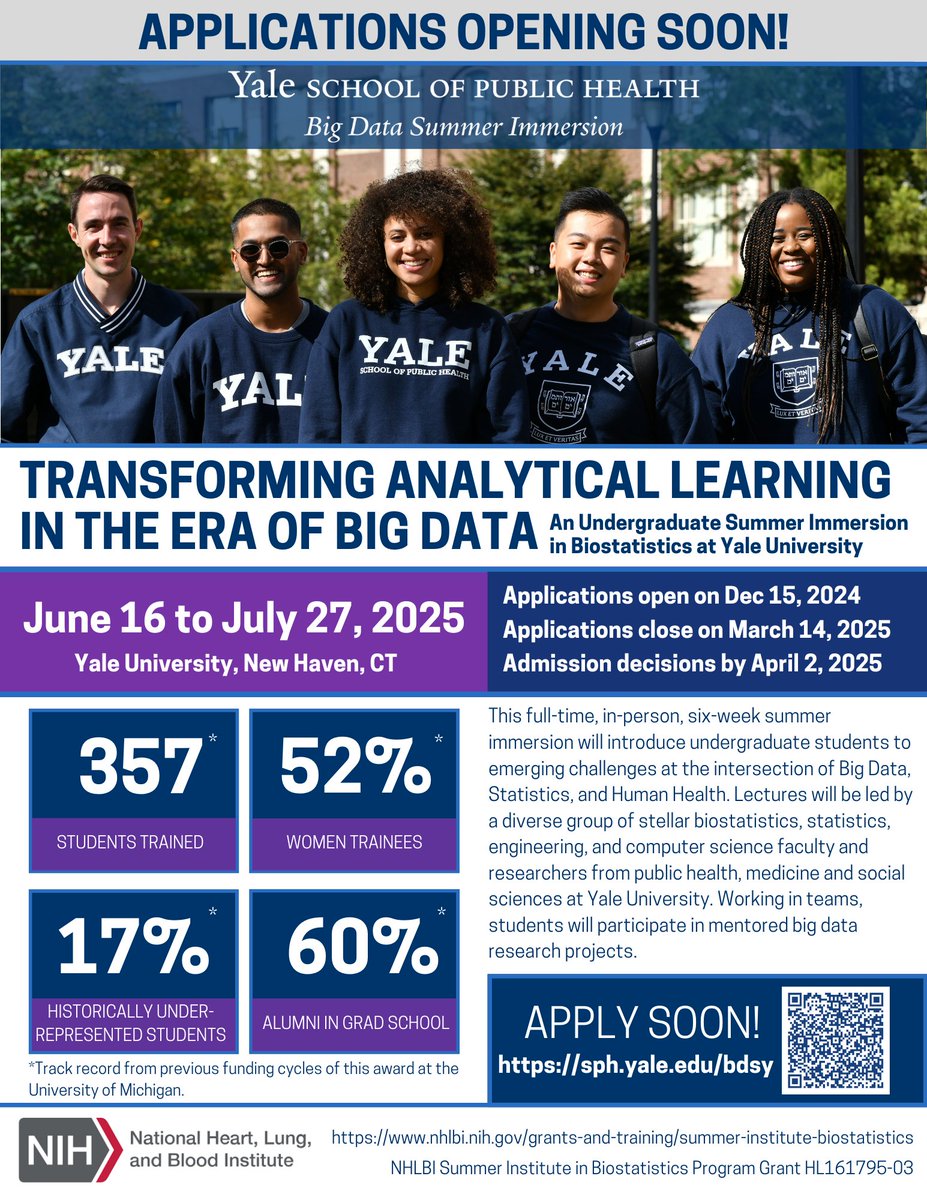
Big data is transforming public health and society like never before.
This summer, we are launching the Big Data Summer Immersion at Yale (BDSY), an interdisciplinary training, research, and professional development program in biostatistics.
1/4
https://t.co/H5DAu275S7
Ready to transform your analytical skills in the BIG data era? Join us at @YaleSPH for the Big Data Summer Immersion program! This 6-week program introduces undergraduate students to cutting-edge challenges in Big Data, Statistics, and Human Health. Applications open on Dec 15.
In this new paper led by @BingkaiWang, we showed that stepped wedge randomization can guard against covariate, random-effects, and error structure misspecifications, though treatment effect structure still requires careful consideration.
https://t.co/fl7jj7nkhk
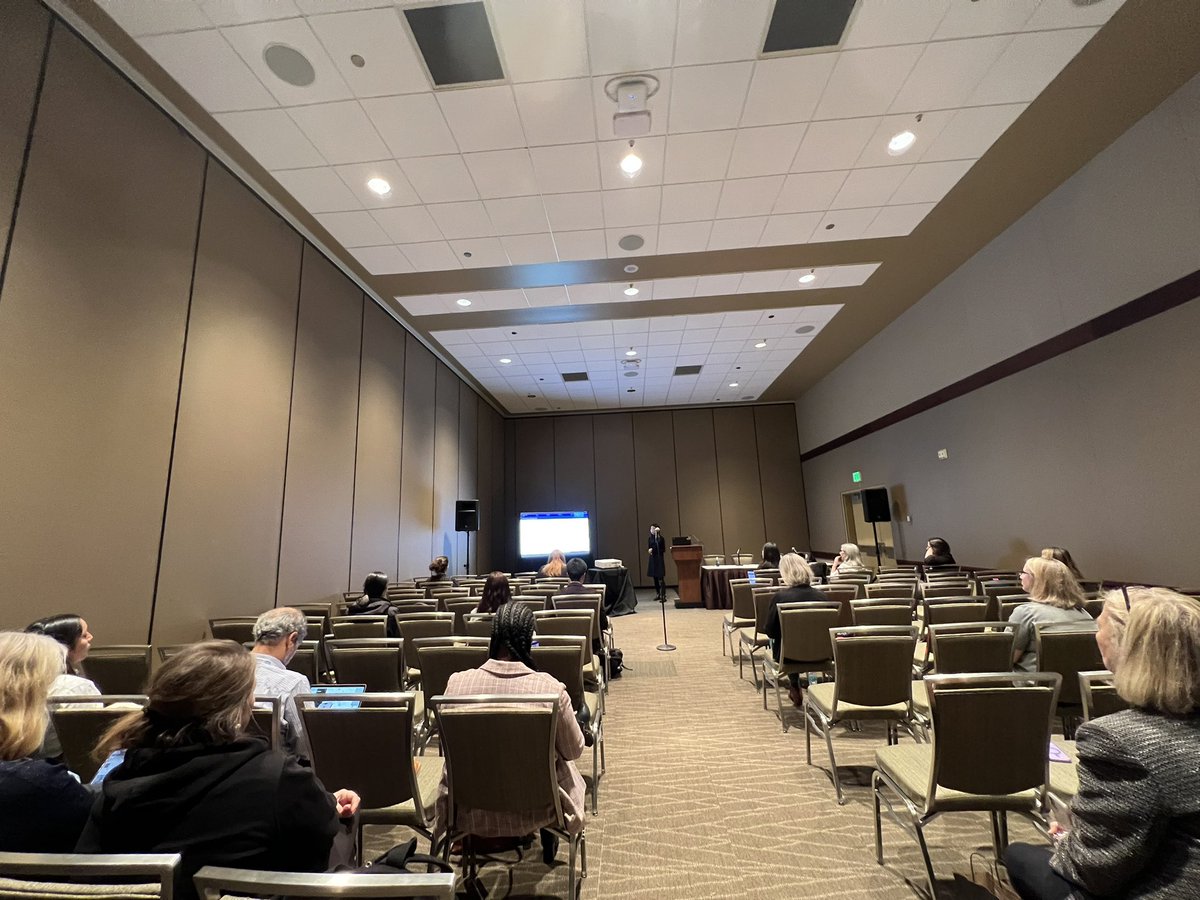
@Nephronette presented her RCT of Early, Individualized Recommendations for Hospitalized Patients With AKI on the big stage at @ASNKidney#KidneyWk as it was being released online in @JAMA_current !
Check it out 👇! Congrats to the whole KAT-AKI Team!
https://t.co/dBaXNN7ltD
Excited to share our new paper in Biometrika! We make quantile causal inference accessible by introducing an inverse estimating equations approach that extends causal estimation from mean potential outcomes to their quantiles. https://t.co/piVhY98jFv
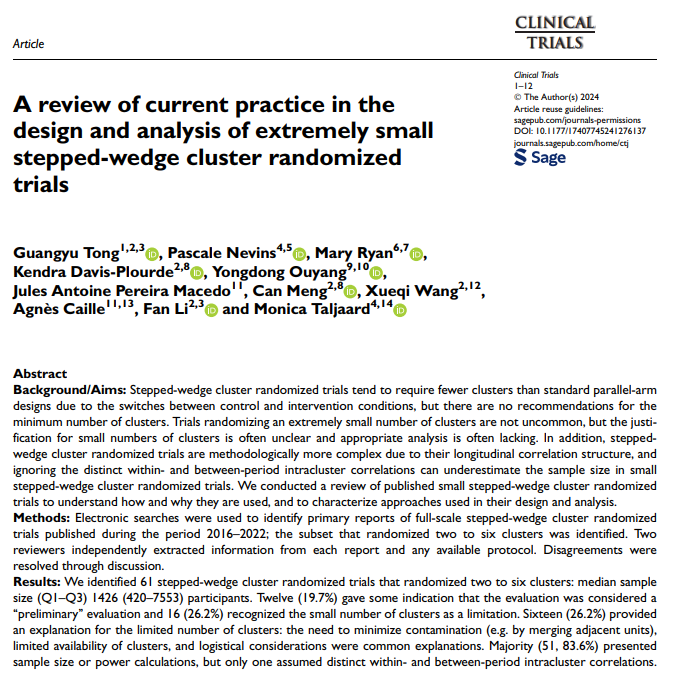
Curious about extremely small stepped wedge cluster randomized trials (SW-CRTs)? Our latest paper, led by @TonyGuangyuTONG, explores the landscape of published SW-CRTs with <= 6 clusters. Take a look at what we found!
https://t.co/OaMouvHvRz
@ColinBBegg@SteppedWedgehog
Excited to announce that @cards_lab is launching the DETECT-AS Study w R01 funding from @NIH/@NIHAging
Details: https://t.co/7JsdNESeQF
- Multicenter RCT of AI-enabled automated detection of aortic stenosis on ECG + POCUS
- precision prognostication w DASSi
Excited to share that our new paper is now online! We formalized average treatment effect estimands in stepped wedge cluster randomized trials and show that linear regression can provide robust & estimand-aligned inference under informative cluster sizes
https://t.co/uxPaC80qud
Members of our Biostatistics and Study Design Core tested the performance of various analytic models for individually randomized group treatment trials in which complex clustering arises from participants interacting with multiple intervention agents.
➡️ https://t.co/90rGtzzaMq
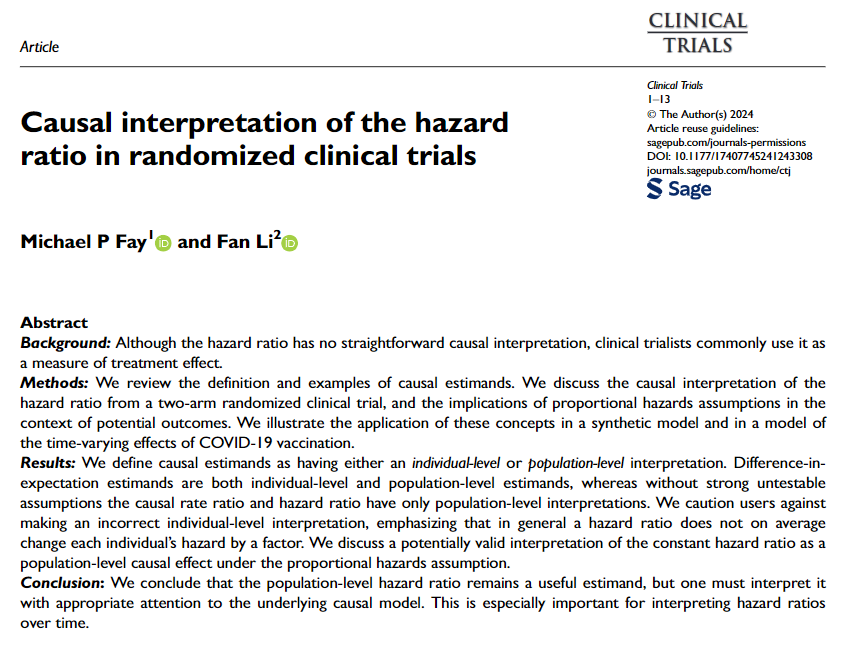
Does the hazard ratio have a causal interpretation? Should Cox modeling be used in analyzing clinical trials? Read all about it in this point-counterpoint of Michael Fay and Fan Li versus Dan Heitjan. @SCTorg@YaleSPH@SouthernMethod@FanLi90
Chao Cheng and colleagues show how to examine causal effects on the survival probability scale in the presence of treatment noncompliance in clinical trials. @FanLi90@YaleSPH@SCTorg#clinicaltrials
📢Abstract deadline extension: the deadline for abstracts to the 10th Annual Meeting on Current Developments in Cluster Randomised Trials & Stepped Wedge Designs (13-14 Nov, Birmingham UK) has been extended to 5th July. Submit as Word/PDF to [email protected].
If you are interested in causal inference with time-dependent treatments beyond the mean, please check out at our most recent paper on marginal structural quantile models. This work is led by my PhD student Chao Cheng, and jointly with @lyhuStatree
https://t.co/yf0cNAUtkM
@statsepi @Brennan_Kahan @Michael_Harhay In Brennan's articles, we provided further interpretation of this statements along with some mathematical formulation.