Does an AI agent really need to "think hard" for every single step? 🤖🧠⚡
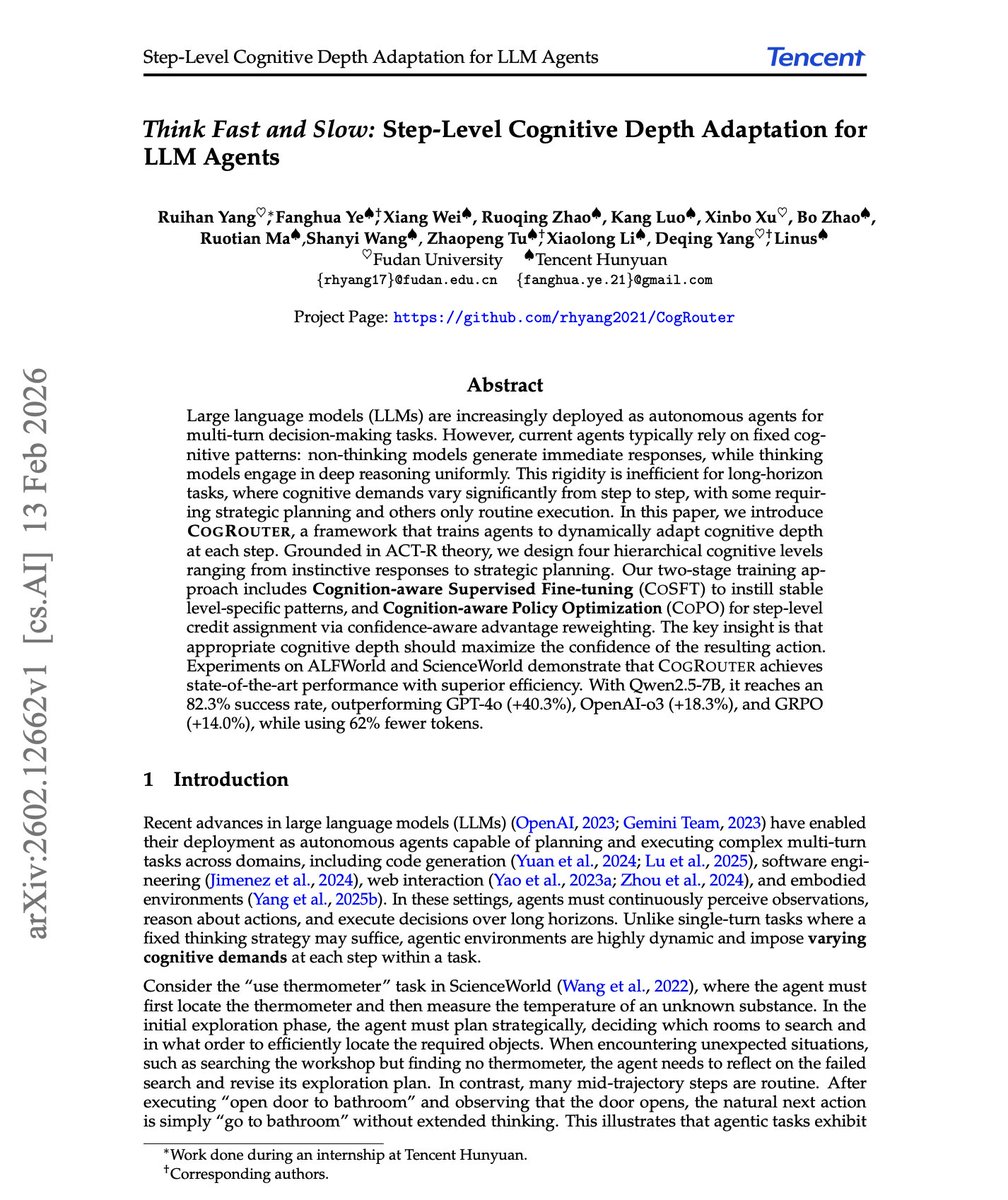
Introducing CogRouter, a framework grounded in ACT-R theory that trains agents to dynamically adapt cognitive depth across four hierarchical levels, from instinctive responses to strategic planning.
🧠 We identify a critical inefficiency in current agents where they either think too little (reflexive) or think too much (uniform deep reasoning). Real-world tasks demand step-wise heterogeneity:
1️⃣ Routine steps require instinctive responses;
2️⃣ Complex steps require strategic reasoning;
3⃣ Fixed patterns waste tokens or fail on hard tasks.
🎓 We propose a two-stage training strategy to enable dynamic cognitive adaptation:
1️⃣ Cognition-aware SFT (CogSFT) instills stable level-specific patterns;
2️⃣ Cognition-aware Policy Optimization (CoPO) enables step-level credit assignment via confidence-aware advantage reweighting.
📊 Experiments on ALFWorld and ScienceWorld show CogRouter achieves state-of-the-art performance with superior efficiency:
🏆 82.3% success rate with Qwen2.5-7B;
🔥 Outperforms GPT-4o (+40.3%) and OpenAI-o3 (+18.3%);
⚡ Uses 62% fewer tokens than GRPO by skipping unnecessary reasoning.
🧑💻 Code: https://t.co/BapQqWEYQ7
📷 Paper: https://t.co/rgLyuFsijP
Interesting new work on adaptive reasoning depth for LLM agents.
Not every agent step requires the same level of thinking. Some steps need strategic planning. Others are routine execution.
This research introduces CogRouter, a framework inspired by ACT-R cognitive theory that dynamically adjusts reasoning depth at each decision step across four hierarchical cognitive levels.
Appropriate cognitive depth should maximize the confidence of the resulting action. Training combines supervised fine-tuning for stable cognitive patterns with policy optimization for step-level credit assignment.
A 7B parameter model achieved 82.3% success rate on agent benchmarks, outperforming GPT-4o while consuming 62% fewer tokens.
Why does it matter?
Adaptive reasoning is a more practical path to efficient agents than simply scaling model size. Think fast when you can, slow when you must.
Paper: https://t.co/kYLqeHaY8p
Learn to build effective AI agents in our academy: https://t.co/1e8RZKs4uX
Are safety-aligned LLMs too good to truly play villains? 🤖🎭😈
Introducing Moral RolePlay, a balanced dataset with 800 characters across 4 moral levels (Paragons → Flawed → Egoists → Villains), featuring 77 personality traits and rigorous scene contexts. This enables the first large-scale, systematic evaluation of moral persona fidelity in LLMs.
🔍 Key findings:
📉 Role-playing fidelity drops as character morality decreases — especially for egoists and villains.
🚫 Models fail most on traits like "Deceitful" and "Manipulative", due to safety alignment conflicts.
⚠️ General chatbot skills ≠ good villain acting. Top Arena models fall short on moral ambiguity.
🧠 Explicit reasoning doesn't help much — models still sanitize complex antagonism.
✨ This work reveals a critical limitation in current alignment approaches — models trained to be "too good" cannot authentically simulate the full spectrum of human psychology, limiting their utility in creative, educational, and social science applications.
📏 Benchmark: https://t.co/uAR60EHzGK
📃 Paper: https://t.co/LP6hK37FcJ
🤗Will present our #EMNLP2025 paper this morning! TLDR: Beyond KV Cache: New Insights on LLM Sparsity.
This paper offers not just an efficient inference framework, but a new theoretical lens to understand how information flows inside LLMs.
Come & talk to us if you are interested!
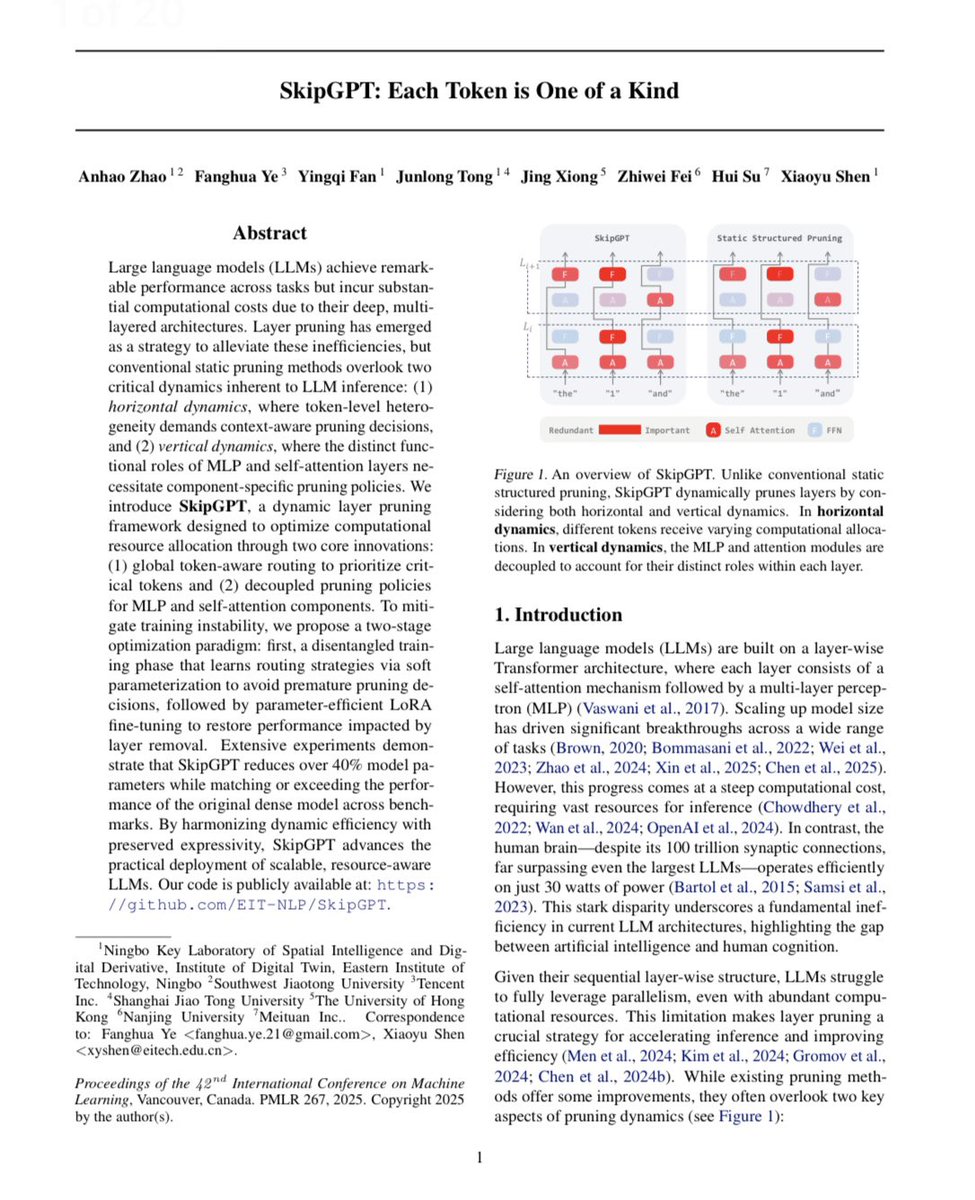
Pruning is an effective way to speed up LLM inference. However, most existing methods are static. In our #ICML 2025 paper, we propose a novel dynamic pruning method, which achieves comparable or even better performance than the base model despite a 40% reduction in parameters.
🔬 The HKU team presents ParallelComp: a training-free technique for efficient context length extrapolation in LLMs—from 8K up to 128K tokens—on a single A100 GPU, with minimal performance loss.
📄 Paper: https://t.co/HbKsGN0eqX
💻 Code: https://t.co/T2Au0WEGY1
Welcome to check our paper on function calling/tool usage of LLMs (to appear at ACL 2025 main).
We show that with step-wise code generation and process reward supervision, LLMs can achieve much higher accuracy on tool invocation.
More details at: https://t.co/lQCYt7N6VS
This work has now been accepted to NeurIPS 2024. In the revision, we have included results of closed-source LLMs such as GPT-4 and freeform question answering.
How can we benchmark LLMs comprehensively? Is the accuracy metric sufficient for evaluation?
Check out our latest work in which we test 8 LLM families, including Llama-2, Mistral, Falcon, MPT, Yi, Qwen, DeepSeek, and InternLM, via uncertainty quantification.
Happy to share our paper on unveiling ICL has been accepted to EMNLP 2024 main conference.
We propose a 2D coordinate system to understand when ICL works and when it fails.
More details at https://t.co/jcZckhEXCd
How can we obtain domain-specific foundation models in scenarios where data are privacy-sensitive and owned by different parties?
Check out our latest survey paper on how federated learning can effectively address this challenge.
Paper: https://t.co/wXG2aoeFQm
🚨 Introducing Branch-Train-miX (BTX) 🚨
BTX improves a generalist LLM on multiple fronts:
- Train expert LLMs in parallel for new skills in domains such as math, code & world knowledge
- Join (mix) them together & finetune as a Mixture-of-Experts
https://t.co/7I2sCBnsNB
🧵(1/4)