We decided to provide more transparency into pretraining progress at OpenAI for the sake of moving toward shared safety bars. In “Perplexity and Intelligence” I argue for common limits based on perplexity and other measurements, with progress beyond them gated on our ability to understand AI behavior.
https://t.co/XX35m5vq89
🖥️ Two years after we introduced OSWorld, frontier models have rapidly advanced in computer use, completing real workflows across the digital world.
🖥️ 🔜 🤖: Physical interaction is the next frontier, where foundation models expand into robot-use agents in the physical world while retaining their general intelligence. Agents like Claude Fable 5.2 already score 65% on RoboDojo. Problem already largely solved?
Not even close.
🚀 Today we introduce RoboWild: Can Frontier Models Generalize to Robot Use in the Wild?
🏠 38 furnished realistic scenes, from homes and stores to workshops and labs
🛠️ 4,480 objects, with operable doors, dials, drawers, and more
🤖 341 diverse tasks across four robot embodiments
📊 Best results: Claude Fable 5.2 reaches the highest accuracy at 13.3% on RoboWild, while GPT-6 Astra is far more token-efficient yet plateaus at 11.6%. No model is close to solving real robot use yet!
🏠 Homepage: https://t.co/unSuwNXnOH
📄 Paper: https://t.co/KGdCpGI7bB
📽️ Slides https://t.co/qQEOti2SVB
💻 Code: https://t.co/w9XUvNd4bB
🤗 Dataset: https://t.co/6ATZVUbmMD
🧵 [1/8]
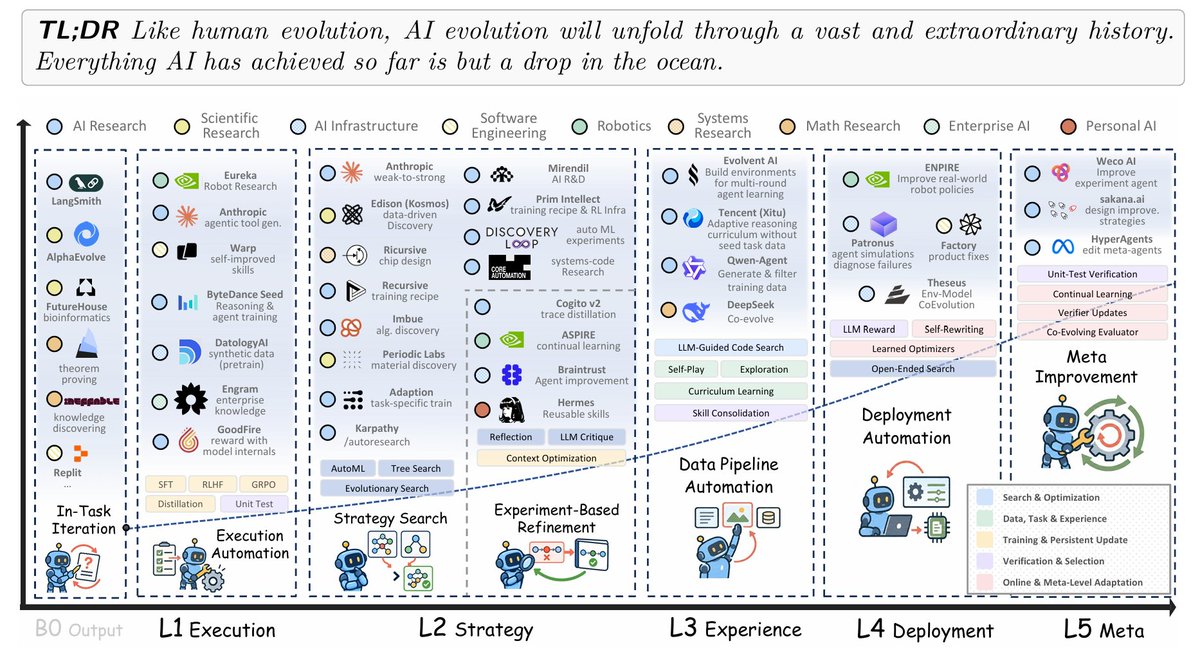
The Last AI Built by Humans: a roadmap to genuine RSI.
Our review of 72 companies & teams shows AI already executes and selects improvements. The next frontier: can AI reliably improve the improver itself? 🧭
Paper: https://t.co/s9oZH0HqDV
Introducing ApprenticeBench: computer use + continual learning on a real job.
We show Fable 5.1 and GPT-6 Astra can now continually learn on a job and surpass human professionals. A decisive step change in AI's job readiness.
No FDEs. Agents deploy themselves into the job. 🧵
new paper: Prefix Sliding for efficient test-time scaling
vanilla full attention OOMs on long tasks & compaction loses important details -- prefix sliding is a simple & fast alternative that can outperform both
📜https://t.co/fUw7yJAN5D
Cool!! building games is a great way to test LLM. It covers reasoning, planning, coding, tool (lib) use, multimdal understanding, and more. But it seems like the community still lacks a standardized benchmark for building games?
We're starting to leave the territory where you'd test an LLM by e.g. "create an svg of pelican on a bicycle". As one idea to generalize it, I was interested what Opus 5 would do if I gave it the first paragraph of the Lord of the Rings, a 1M token budget (~$10) and asked for three js render of it. Opus went off for ~2 hours and wrote 5500 lines of code that (procedurally) rendered the story. It's kind of janky but fun. But it's a bit mindboggling that the LLM has to place and orchestrate various polygon assets in (x,y,z) coordinates and write code that animates it all, and that it even does anything at all.
I also like this kind of examples because no one in their right mind would ever spend the time to write something this custom but LLMs have all the stamina and patience in the world, so it's an example where we go from "no one would ever do this" to "sure, why not, it's ~free". There might be a lot more. But I'm excited about creating hyper custom worlds that you can imagine dropping players into, e.g. here to participate in the LoTR story as a spectator NPC, or one of the characters, or etc. Something like an ephemeral GTA of X on demand.
Last thought is that the domain of worlds/games exposes a weakness in LLMs: they can't easily audit their work because they aren't able to efficiently and natively perceive videos or play games within them. Here, Opus 5 had to very slowly and painstakingly take screenshots at different points, and it messed up a few times and created a bunch of jank. An example of raw capability (multimodal, gameplay) that I think is still quite lacking.