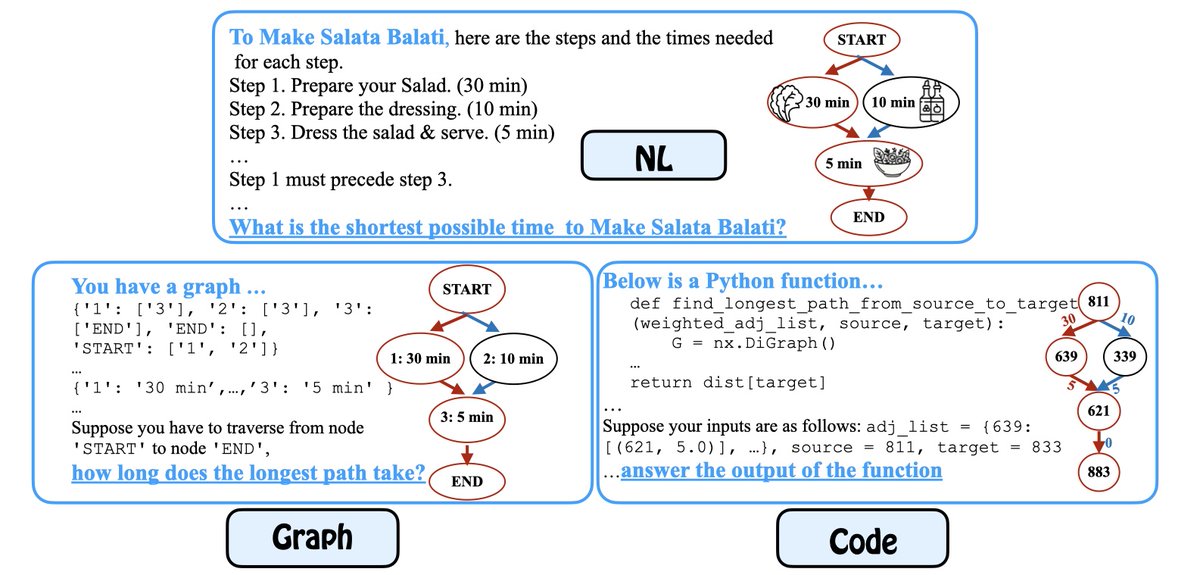
Our paper on LLM isomorphic generalisation is accepted at #ICML2026! Current LLMs are heavily trained on symbolic data like code, but whether/how they generalize to natural language problem solving? 🧵
I’m looking for RS/MTS/RE positions! DM me if you are interested in my work!
Super interesting observation! I wonder if controlling structural diversity could help? We measure abstract structure representations in an ICML paper this year: https://t.co/EsZ8vwi2yX, and more relevant works are on the way!
wrote up some random experiments I did playing around w/ absolute zero at the start of the year: https://t.co/DmVKSjY9YK
a little negative which I attribute mainly to skill issues on my part but potentially interesting to some :)
@henrytdowling@vjhofmann@wanxingchen_@ZifengDing6 Thanks! We find that LLMs don’t recognize algorithmic features in natural language even asked to reason in code. Also, users are not expected to prompt LLMs to reason in code, so it’s important to enable the models to solve the problems in their original format.
Our paper on LLM isomorphic generalisation is accepted at #ICML2026! Current LLMs are heavily trained on symbolic data like code, but whether/how they generalize to natural language problem solving? 🧵
I’m looking for RS/MTS/RE positions! DM me if you are interested in my work!
I have experience working at frontier labs and multiple first author publications on LLM reasoning/agents. Happy to chat if you are hiring! My CV link: https://t.co/XJ0JnTmH4z
New preprint! LLMs are trained and tested heavily on code and graphs, but can they generalize to natural language questions that share isomorphic procedures? We test by training Qwen-2.5, Llama-3, and Olmo-2 on isomorphic data in code, graph, and natural language. 🧵1/n
While humans can often generalize across domains in few shot or even zero shot, language models do not do so. Can LLMs make key scientific breakthroughs given that?
Structure mapping is a super interesting question for me, and I really enjoyed this project❤️! Kudos to my amazing collaborators! @vjhofmann, @wanxingchen_, Weixing Wang , @ZifengDing6, Anthony Cohn, and Janet Pierrehumbert. Check the paper here: https://t.co/AeOd04eOg7 🧵 n/n
New preprint! LLMs are trained and tested heavily on code and graphs, but can they generalize to natural language questions that share isomorphic procedures? We test by training Qwen-2.5, Llama-3, and Olmo-2 on isomorphic data in code, graph, and natural language. 🧵1/n
Last, we show that successful procedure generalization is closely related to structural similarity. This pattern can be interpreted as generative analogy/structure mapping. Although humans can often map structures with minimum exposure, LLMs require extended training. 🧵 4/n
At NeurIPS, Fangru — a research PhD intern at Google DeepMind — gave us a behind-the-scenes look at her work on Gemini Deep Research. Explore Google's open AI/ML roles ➡️ https://t.co/8iZOsFzuTd
The best poster awards go to:
1. Go-Browse: Training Web Agents with Structured Exploration
Apurva Gandhi, Graham Neubig
2. Scaling Open-Ended Reasoning to Predict the Future
Nikhil Chandak, Shashwat Goel, Ameya Prabhu, Moritz Hardt, Jonas Geiping
🎉Congrats!