@bkaellner A little concerning no? I mean this plus Buffetts Stash and it makes you wonder what they are anticipating. And then there’s Burry’s warnings
Food for thought.
Trump, Hormuz and the End of the Free Ride
For half a century, Western strategists have known that the Strait of Hormuz is the acute point where energy, sea power and political will intersect. That knowledge is not in dispute. What is new in this war with Iran is that the United States, under Donald Trump, has chosen not to rush to “solve” the problem. In Hegelian terms, he is refusing an easy synthesis in order to force the underlying contradiction to the surface.
The old thesis was simple: the US guarantees open sea lanes in the Gulf, and everyone else structures their economies and politics around that free insurance. Europe and the UK embraced ambitious green policies, ran down hard‑power capabilities and lectured Washington on multilateral virtue, secure in the assumption that American carriers would always appear off Hormuz. The political class behaved as if the American security guarantee were a law of nature, not a contingent choice. Their conduct today is closer to Chamberlain than Churchill: temporising, issuing statements, hoping the storm will pass without a fundamental reordering of their responsibilities.
Trump’s antithesis is to withhold the automatic guarantee at the moment of maximum stress. Militarily, the US can break Iran’s residual ability to contest the Strait; that is not the binding constraint. The point is to delay that act. By allowing a closure or semi‑closure to bite, Trump ensures that the immediate pain is concentrated in exactly the jurisdictions that have most conspicuously free‑ridden on US power: the EU and the UK. Their industries, consumers and energy‑transition assumptions are exposed.
In that context, his reported blunt message to European and British leaders, you need the oil out of the Strait more than we do; why don’t you go and take it? Is not a throwaway line. It is the verbalisation of the antithesis. It openly reverses the traditional presumption that America will carry the burden while its allies emote from the sidelines.
In this dialectic, the prize is not simply the reopening of a chokepoint. The prize is a reordered system in which the United States effectively arbitrages and controls the global flow of oil. A world in which US‑aligned production in the Americas plus a discretionary capability to secure,or not secure, Hormuz places Washington at the centre of the hydrocarbon chessboard. For that strategic end, a rapid restoration of the old status quo would be counterproductive.
A quick, surgical “fix” of Hormuz would short‑circuit the dialectic. If Trump rapidly crushed Iran’s remaining coastal capabilities, swept the mines and escorted tankers back through the Strait, Europe and the UK would heave a sigh of relief and return to business as usual: underfunded militaries, maximalist green posturing and performative disdain for US power, all underwritten by that same power. The contradiction between their dependence and their posture would remain latent.
By declining to supply the synthesis on demand, and by explicitly telling London and Brussels to “go and take it” themselves, Trump forces a reckoning. European and British leaders must confront the fact that their energy systems, their industrial bases and their geopolitical sermons all rest on an American hard‑power foundation they neither finance nor politically respect. The longer the contradiction is allowed to unfold, the stronger the eventual synthesis can be: a new order in which access to secure flows, Hormuz, Venezuela and beyond, is explicitly conditional on real contributions, not assumed as a right.
In that sense, the delay in “taking” the Strait, and the challenge issued to US allies to do it themselves, is not indecision. It is the negative moment Hegel insisted was necessary for history to move. Only by withholding the old guarantee, and by saying so out loud to those who depended on it, can Trump hope to end the free ride.
@vladtenev I would like to participate in the current Freddie Mac and Fannie Mae bet right now, but @RobinhoodApp doesn’t seem to support those stocks. Can we add them ASAP please. Robinhood is my main brokerage account..
@reesycup@Hilton Diamond member for 3 years at least. Haven’t been upgraded since Covid. And then I hear the new Diamond Reserve tier came out and feel kind of jaded about it. Now, if I want to get upgraded, I’m offered an optional pay to upgrade. Not the same.
Pabrai paints a scenario of $AMR buying back virtually all of the float until it is forced to pay a dividend.
At that point, the company might have ~4m shares outstanding, cashflow of 1bn and a dividend of 250/share.
What's your take?
https://t.co/GXUIVsXx45 via @YouTube
Today @GoogleMaps is getting its biggest upgrade in over a decade. By combining our Gemini models with a deep understanding of the world, Maps now unlocks entirely new possibilities for how you navigate and explore. Here’s what you need to know 🧵
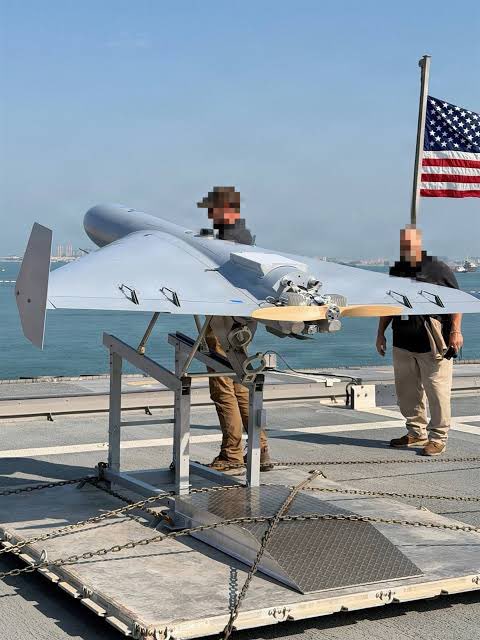
On July 16, 2025, Secretary of Defense Pete Hegseth held up a drone at a Pentagon event. It had a delta wing, a pusher propeller, and a silhouette that anyone who had watched the war in Ukraine would recognize immediately. It was a copy of the Iranian Shahed-136, the kamikaze drone that Russia had fired by the thousands into Ukrainian cities, the weapon Iran distributed to Houthi proxies in Yemen, the airframe that humiliated Western air defense systems through sheer volume and cheapness. Except this one was American. Built by an Arizona startup called SpektreWorks from a captured Iranian airframe.
Seven months later, on February 28, 2026, CENTCOM confirmed that the Low-cost Unmanned Combat Attack System flew in combat for the first time during Operation Epic Fury. Against Iran. The country that designed the original.
CENTCOM’s statement was direct: “Task Force Scorpion Strike, for the first time in history, is using one-way attack drones in combat during Operation Epic Fury. These low-cost drones, modeled after Iran’s Shahed drones, are now delivering American-made retribution.” Task Force Scorpion Strike was established in December 2025 with an explicit mandate. A US official told The War Zone the unit was created “to flip the script on Iran.” On December 16, a LUCAS drone was test-launched from the Littoral Combat Ship USS Santa Barbara in the Persian Gulf. Ten weeks later, the script was flipped.
Here is the economics. A Tomahawk cruise missile costs approximately $2 million. LUCAS costs $35,000. For the price of a single Tomahawk, you can launch 57 LUCAS drones. A Shahed-136 in Russian production costs approximately $80,000 per unit at the Alabuga facility. The American reverse-engineered version costs less than half the Russian licensed copy of the Iranian original. SpektreWorks received a $30 million initial production contract. That buys 857 kamikaze drones for what the Navy spends maintaining a handful of Tomahawks.
But cost is not the real story. The original Shahed-136 navigates by pre-programmed GPS and inertial guidance. It flies to a fixed coordinate and detonates. It cannot be retargeted in flight. It cannot communicate with other drones. It cannot adapt. LUCAS integrates with the MUSIC mesh network, a multi-domain unmanned systems communications architecture that allows each drone to function simultaneously as a strike weapon and a communications relay node. Some units carry Starlink terminals, specifically the military Starshield variant, enabling beyond-line-of-sight satellite communications, real-time human oversight, and autonomous swarm coordination in GPS-denied and electronically jammed environments. The original Shahed is a flying bomb with a coordinate. The American version is a networked intelligence node that happens to explode.
Russian military commentators are already sounding alarms. The integration of Starlink with a mass-producible airframe represents a threat class that existing electronic warfare cannot reliably counter. You cannot jam a mesh network the same way you jam a GPS receiver. The drone that does not reach its target still relays targeting data for the drone behind it. Every unit the enemy shoots down costs the defender more in interceptor ammunition than the attacker spent building it. That is the Shahed math, the logic Iran invented and Russia perfected in Ukraine. The United States just applied it to the country that wrote the equation.
Seven months from Pentagon debut to combat deployment. For context, a traditional major defense acquisition program takes seven years to reach Milestone B. Iran spent a decade refining the Shahed-136.
The United States reverse-engineered it, improved it, networked it, and sent it home in under a year.
https://t.co/BrzGRrU3VW
On a newsworthy morning like this morning, it’s incredibly understated the value of @X and what it provides as the online community town square. In 60 seconds of scrolling, I can quickly gather important news information and self discern what is real and what is biased.
File this under: LONG OVERDUE
The @DeptWar is formally ending ALL Professional Military Education, fellowships, and certificate programs with Harvard University.
Harvard is woke; The War Department is not.
@SawyerMerritt@Starlink Going back to Hawaii with the family this year for vacation. The ease of having internet for the whole family in Hawaiian Airlines was definitely a factor in picking the destination.