Summer holidays. The deal at our house: finish your Hindi writing, then you can ask Claude for whatever game you want.
Yesterday's ask from my son: "𝘊𝘢𝘯 𝘺𝘰𝘶 𝘮𝘢𝘬𝘦 𝘵𝘩𝘦 𝘤𝘰𝘮𝘱𝘦𝘵𝘪𝘵𝘰𝘳𝘀 𝘢 𝘭𝘪𝘵𝘵𝘭𝘦 𝘩𝘢𝘳𝘥𝘦𝘳?"
Claude Code makes them harder. He plays again.
He did not type a line of it. He built the first-person shooter by talking.
Look how far we have come.
This is what child's play looks like now.
Three months in at Heineken with 300 sensors deployed, Simon Jagers and his team realised the data architecture needed voltage measurement too, not just current.
The fix meant redesigning the hardware with one shot of runway left. They took it - and that single decision is why Samotics now owns roughly half the global market for hard-to-reach industrial assets.
In industrial AI, the data architecture decision precedes the model decision by years. Most companies never make it because the financial pressure points the other way. Simon did, eleven years ago, and built the category around it.
Good data is more expensive than gold.
Good data is something earn, by being inside the real workspace.
As Peter Norvig once said, "More data beats clever algorithms, but better data beats more data."
Think about it. Tesla's self-driving edge isn't the model, it's billions of miles of real driving data no competitor has.
Google Search won not because of cleverer math, but because every click made the data better.
If your customers will not pay you, you do not have a business.
You have a hobby.
Simon Jagers, the Co-founder of @Samotics , spent eleven years building one of the world's leading industrial AI companies, now covering roughly half the global market for hard-to-reach machines in steel, oil and gas, mining, and wastewater.
But Samotics did not start with a business model. It did not start with a product. It started with a notion.
The best innovation leaders in 2026 won’t just manage people. They’ll manage agents.
The role shifts from execution management to orchestration. Set the KPIs. Design the workflows. Review the outputs.
Approve the decisions that matter.
That is how AI agents cut burn without cutting judgment.
Hot take: You're probably overpaying for cloud storage.
Redundancy matters for mission-critical data. But ask yourself, does every marketing asset, old log file, and internal draft really need 3 copies across 3 data centers?
If the answer is no, you could be cutting storage costs by 30 to 40%.
Every major AI bias scandal of the last decade traces back to the same root cause: who labeled the data.
Facial recognition, hiring models, medical imaging algorithms. Same failure mode, different decade.
You can't fix a data diversity problem with a centralized workforce. The geography of your labelers becomes the geography of your model's worldview.
Build fast. Talk to users. Iterate. That's the philosophy FastCode was built on.
Too many founders sit in a room and try to imagine what customers want. They sketch, they plan, they polish. Months go by and nothing ships.
The better way is simpler. Find the people who are suffering. Go talk to all of them. Build something rough, fast. Put it in their hands. See if it actually reduces the pain. Then iterate.
And honestly, the hardest part is just starting. Once you climb the first four stairs, you can see the next four. You don't need the whole staircase mapped out before you take the first step.
That's how we build. That's how everyone should build.
The best ML engineers I know started as software engineers. I can’t think of one who went the other way.
That’s shaped how we hire.
Most ML engineers we meet can train a model. Far fewer can ship one. The fundamentals - clean code, testing, scalable architecture, debugging real systems - take years to build, and they’re genuinely hard to teach on the job.
ML is different. You can pick it up by being in the right room.
Our engineers absorb it through osmosis. They work on production systems for clients like Mercedes and Bosch. They go through our AI Masterclass. They sit next to people building cutting-edge ML every day. If the curiosity is there, the skills follow.
So if you’re a strong software engineer who wants to grow into a world-class ML engineer, this one’s for you: 👇🏽
This is Dr. Michael Fausten, recently of Bosch. We spent a morning together in Stuttgart talking about what makes the German Mittelstand so hard to replicate.
A lot of it is teachable. Engineering discipline, process excellence, manufacturing rigor - and at scale, these become replicable with enough capital and time.
What cannot be replicated is a hundred years of institutional intelligence carried inside a company. The decisions made decades ago that still shape how a part is designed today.
The same instinct shows up in how Europe thinks about AI. GDPR, the EU AI Act, human oversight - these aren’t hurdles. They are the result of a society that decided, very deliberately, that people have rights over their own data. That’s not a weakness of the European market. It’s a position more of the world is starting to move toward.
Building here means building to that standard. Which is exactly why we are here.
@AIMasterClass_ Unplugged is back for Round 2! 🚀
You asked, we listened. This time, we’re opening the doors beyond our cohort! Whether you're a current @AIMasterClass_ builder, a student, or an industry pro looking to connect with the people behind the code, this night is for you.
Expect real conversations, a safe space to ask those "silly" questions, a little pool 🎱, and incredibly good vibes. Let's stop just prompting AI and start building it together.
📅 When: May 15, 2026
📍 Where: 7th Floor, Jbr Tech Park, Whitefield, Bengaluru
🎟️ Tickets: Free for Students & Cohort Members | ₹3,000 for Industry/External Guests
Registrations are officially open! Grab your spot before they're gone. 👇
No, PM Is Not a GAN. Stop!
@SchmidhuberAI's Predictability Minimization (1992) and Ian Goodfellow's GANs (2014) both use adversarial objectives. So does every zero-sum game since von Neumann. That's where the similarity ends.
Goodfellow's generator never sees real data. It maps noise to samples and learns the data distribution purely through the discriminator's gradients. That's the whole trick. That's the invention.
Schmidhuber's PM does the opposite - both players sit on top of the same real data, competing to learn independent features. It's representation learning. Nothing is generated. No noise is mapped anywhere. No distribution is learned.
Calling PM a GAN because both use minimax is like calling chess a war because both have strategy.
PM was a smart idea about feature independence.
GANs were a breakthrough in implicit generative modeling.
These are not the same insight, and retroactively collapsing the distance between them doesn't honor prior work - it misrepresents both.
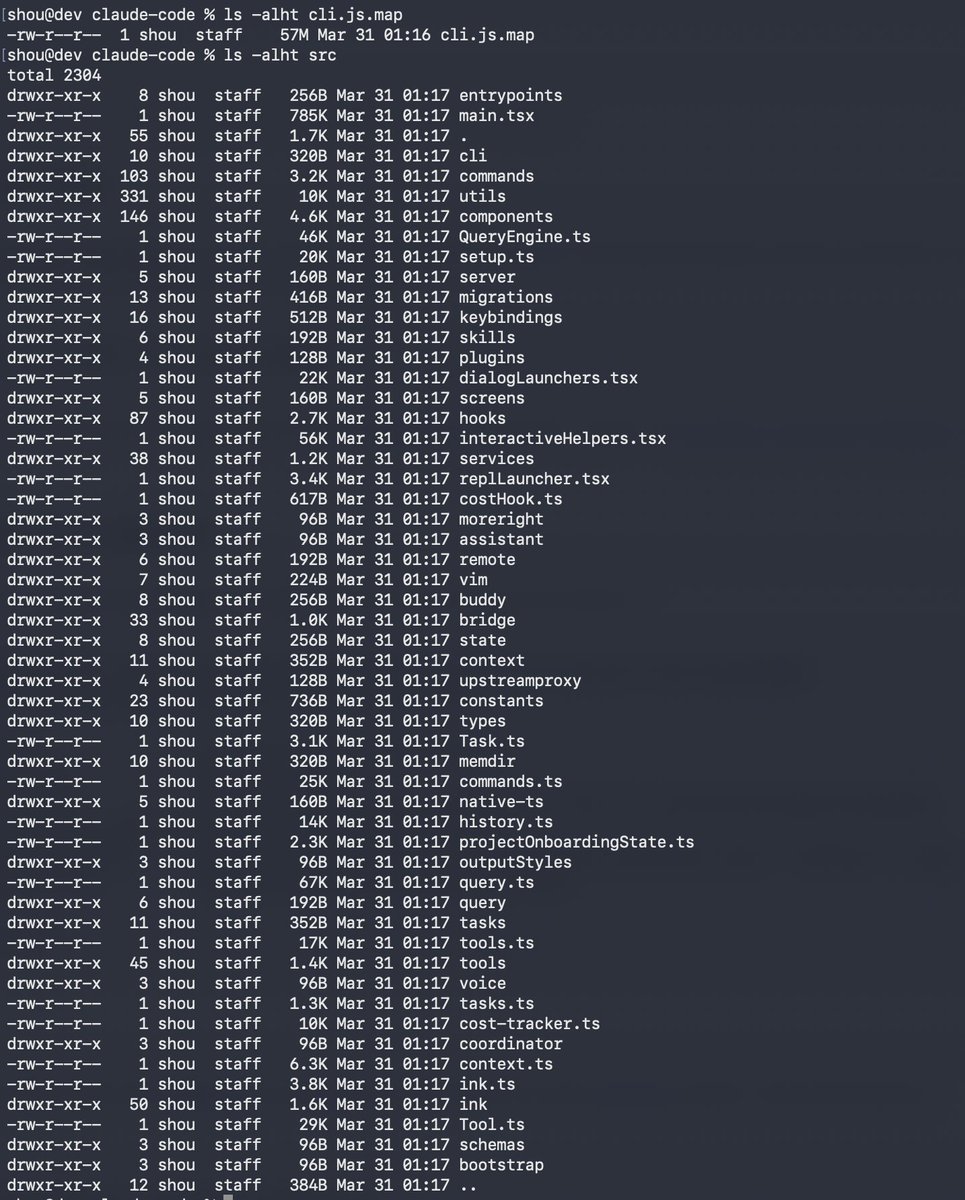
Claude Code's entire source code just leaked... not from a hack, not from an insider, but from a .map file left in their npm package. 💀
500k+ lines. Out in the open. Because someone forgot to add a line to .npmignore.
This is what happens when AI ships AI. @FastCodeAI is human by design - because humans catch what machines forget. 😏