In April 1945, during the closing days of WWII, the rare Lipizzaner horses of Austria’s historic Spanish Riding School, along with hundreds of other thoroughbreds, were trapped in Hostau, Czechoslovakia. Nazi Germany had confiscated the horses to build an experimental "Aryan" equine breed, but as the war drew to an end, the stud farm found itself stranded between the retreating German Army and the advancing Soviet Red Army. Fearing that incoming troops or starving local refugees would slaughter the priceless herd for meat, the farm's German caretakers secretly reached out to American forces to arrange a surrender and rescue.
Recognizing the immense cultural value of the 400-year-old breed, General George S. Patton, a former Olympic equestrian, authorized a high-stakes, covert rescue mission designated Operation Cowboy. He tasked a small unit from the U.S. 2nd Cavalry Group with pushing 20 miles behind enemy lines into Soviet-assigned territory to seize the farm. Given their limited manpower, the American unit took the extraordinary step of enlisting surrendered German Wehrmacht soldiers, as well as liberated Allied POWs, to secure the area and handle the animals.
When fanatical Waffen-SS units launched counterattacks to retake the installation, American GIs and Wehrmacht soldiers stood shoulder-to-shoulder, firing side-by-side to defend the farm. The joint force successfully repelled the attacks, rounded up over 1,200 horses, including 375 Lipizzaners, and safely herded and trucked them past American lines just hours before Soviet forces arrived. Operation Cowboy remains one of only two documented instances in World War II where American and German Wehrmacht soldiers fought as allies against Nazi SS troops.
To secure the surrender before the Soviets arrived, U.S. Captain Thomas Stewart had to engage in a bizarre piece of military theater. When he crossed into enemy lines to negotiate, the commanding German general refused to surrender his garrison to a lone American captain, claiming it would dishonor his men. Capt. Stewart agreed to the general’s terms: he promised to return the following day with a fleet of U.S. tanks. When Stewart rolled back into town with two light tanks and an armored task force, the German general formally surrendered with full dignity, instantly transforming his Wehrmacht troops, liberated Cossack riders, and Polish POWs into a unified defense force to herd the Lipizzaners to safety.
#archaeohistories
Rome handed out free grain to 40,000 citizens in 73 BC. By 46 BC, Julius Caesar found 320,000 people lining up for their monthly ration. That eight-fold expansion happened in under three decades, and it shows you how welfare states actually grow.
No Roman senator stood up and announced a plan to addict a third of the city to government bread. It happened incrementally, through political competition. Each magistrate who wanted votes expanded eligibility. Each expansion normalized the next one. The citizen who once considered the dole shameful eventually expected it, then demanded it, then organized politically to protect it.
This is the core mechanism free market thinkers have identified across every era: once you create a transfer program, you create a constituency for that program. Recipients vote. Administrators build careers. Grain merchants who supply the state develop a stake in keeping the contracts flowing. The political economy locks in.
Caesar, to his credit, actually cut the rolls back to 150,000 through verification audits. It was one of his more economically coherent moves, though the Senate still murdered him. His successors quietly let the numbers climb again.
What did the dole require? Massive grain imports from Sicily, Sardinia, and Egypt, organized through state logistics at state expense, funded by taxation and conquest. When the conquest revenue dried up, the obligation remained. Rome had written a check against future military success, and future military success eventually failed to arrive.
The lesson is not complicated. Distribute a benefit and you distribute dependency. Distribute dependency and you distribute political power to whoever controls the distribution. The grain dole didn't weaken Rome overnight, but it made every subsequent reform politically impossible.
La nouvelle est passée presque totalement inaperçue dans les médias français, en raison du Mondial de foot et des incendies : l’intelligence artificielle a réussi à déchiffrer entièrement un rouleau de papyrus carbonisé d’Herculanum, aussi fragile que de la cendre de cigarette, sans le dérouler et sans même y toucher ! On y a découvert un traité philosophique sur le stoïcisme. Il a fallu des trésors d’ingéniosité et de technologie pour parvenir à ce résultat. Le rêve est donc devenu réalité : bientôt, on pourra lire en un temps record les centaines de rouleaux de cette bibliothèque calcinée par le Vésuve il y a 2000 ans, et la littérature gréco-latine s’enrichira d’autant de textes inédits, de nouvelles tragédies ou épopées peut-être. Dans cet été déprimant, voilà un vrai rayon de lumière. Vive la science !
Between 1837 and 1863, the United States ran no central bank, and prices barely moved. This is no coincidence.
After Andrew Jackson killed the Second Bank of the United States in 1836, America entered what historians call the Free Banking Era. Banks operated under state charters, competed with each other, and issued their own paper notes backed by gold and silver. No Federal Reserve. No lender of last resort handing out cheap money to well-connected institutions.
The result? Average annual inflation sat somewhere around zero. Some years actually saw mild deflation, meaning your dollar bought more over time. Imagine telling that to someone who watched their grocery bill climb 20% between 2020 and 2023.
Free market thinkers have pointed to this period for decades because it demonstrates a fundamental mechanism: competition keeps banks honest. If a bank in Ohio issued more paper notes than its gold reserves could support, people caught on fast and demanded redemption. The bank either held enough gold or it failed. There was no bailout waiting.
Yes, banks did fail sometimes. Free banking critics love bringing that up. But bank failures in a competitive system are exactly how bad actors get flushed out. Depositors learned to check a bank's reputation. Publications like the *Bank Note Reporter* gave people real information on which institutions were solid.
The system wasn't perfect, but it produced something modern central banking has never once delivered: sustained price stability without a government committee deciding what money should cost. The Fed has existed since 1913, and the dollar has lost over 97% of its purchasing power since then.
After their slave revolt, Haiti’s founder ordered the killing of all white people on the island. Soldiers went house to house killing thousands including women and children.
They took full control, purged the population they blamed, and turned the richest colony in the Caribbean into the poorest and most dysfunctional country in the Western Hemisphere.
Today, their descendants demand entry into the West they fought to escape, refuse to return to the mess they and their ancestors created, and are for some reason strongly convinced that borders are racist.
@EDSOnlinedotNet Like my new doctor, seems like a nice guy. First question he asks me: 'You mentioned you were not taking the statin prescribed by a previous doctor last year?'.
ALEXANDER HAMILTON: "To admit foreigners indiscriminately would be nothing less than to admit a Trojan Horse into the citadel of our liberty & sovereignty."
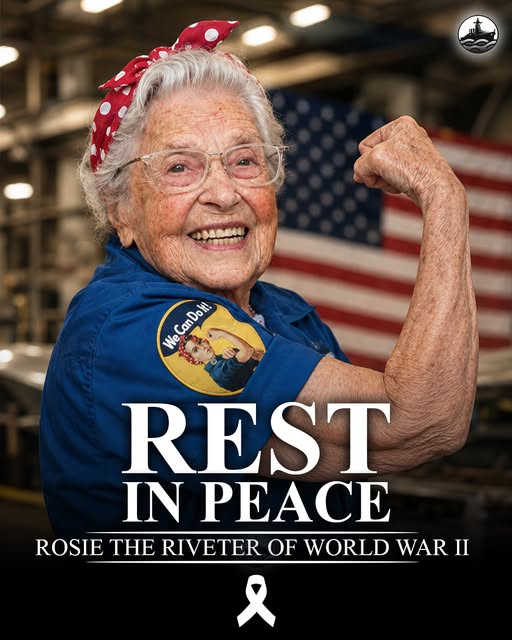
It is with profound sorrow that we bid farewell to Jeanne Gibson, our beloved Rosie the Riveter, has passed away today, July 29, 2026, at the remarkable age of 100. With her passing, we don't simply mourn the loss of a beloved friend, we honor the life of an American hero whose courage, dedication, and unwavering spirit helped shape history, and will continue to inspire generations to come.📷📷
At just 18 years old, Jeanne left her home in Minnesota in the summer of 1944 and answered her nation's call, becoming a welder at Todd Pacific Shipyards in Seattle. With determination and grit, she helped build destroyers that strengthened the Allied war effort during World War II. She later continued her service with the Army Transportation Corps in Juneau, Alaska, embodying the resilience and patriotism of the Greatest Generation.
Yet Jeanne's legacy extended far beyond the war. She earned her Ph.D., dedicated three decades to teaching, earned her private pilot license, and spent the rest of her life proving that courage, determination, and purpose know no age.
In 2024, Jeanne and her fellow Rosies were collectively awarded the Congressional Gold Medal, one of our nation's highest civilian honors, recognizing the extraordinary women whose sacrifices and determination helped secure victory during World War II.
To all of us at Pacific Historic Parks, Jeanne was far more than a Rosie, she was family. She traveled to Hawaiʻi time and again to share her remarkable story with visitors, inspire local students, and ensure that the sacrifices of the Home Front would never be forgotten. Her radiant smile, generous heart, and boundless enthusiasm touched every life she encountered.
She had a special gift for encouraging young girls, reminding them that no dream was too big and no obstacle too great. Through her words and her example, she inspired generations to believe in themselves and pursue lives of courage, service, and purpose.
Jeanne remained a tireless advocate for preserving the legacy of the Rosies, volunteering at Rosie the Riveter WWII Home Front National Historical Park on "Rosie Fridays" and ensuring the stories of the women who helped win the war would continue to inspire future generations.
In one of life's poignant moments, just days before her passing, Jeanne was celebrated with a Wall of Honor banner at the park she loved so dearly and recognized during a San Jose Earthquakes halftime ceremony honoring Bay Area heroes. It was a fitting tribute to a woman whose life was defined by selfless service, quiet strength, and extraordinary grace.
Though Jeanne has taken her final flight, her legacy will never fade. It lives on in every story she shared, every young person she inspired, every life she touched, and in the enduring example of courage she leaves behind.
Our hearts are with Jeanne's family, her fellow Rosies, and all who were blessed to know and love her.
Rest in peace, Jeanne Gibson.
Thank you for answering the call when your country needed you most. Thank you for showing generations what courage looks like. We will remember you always
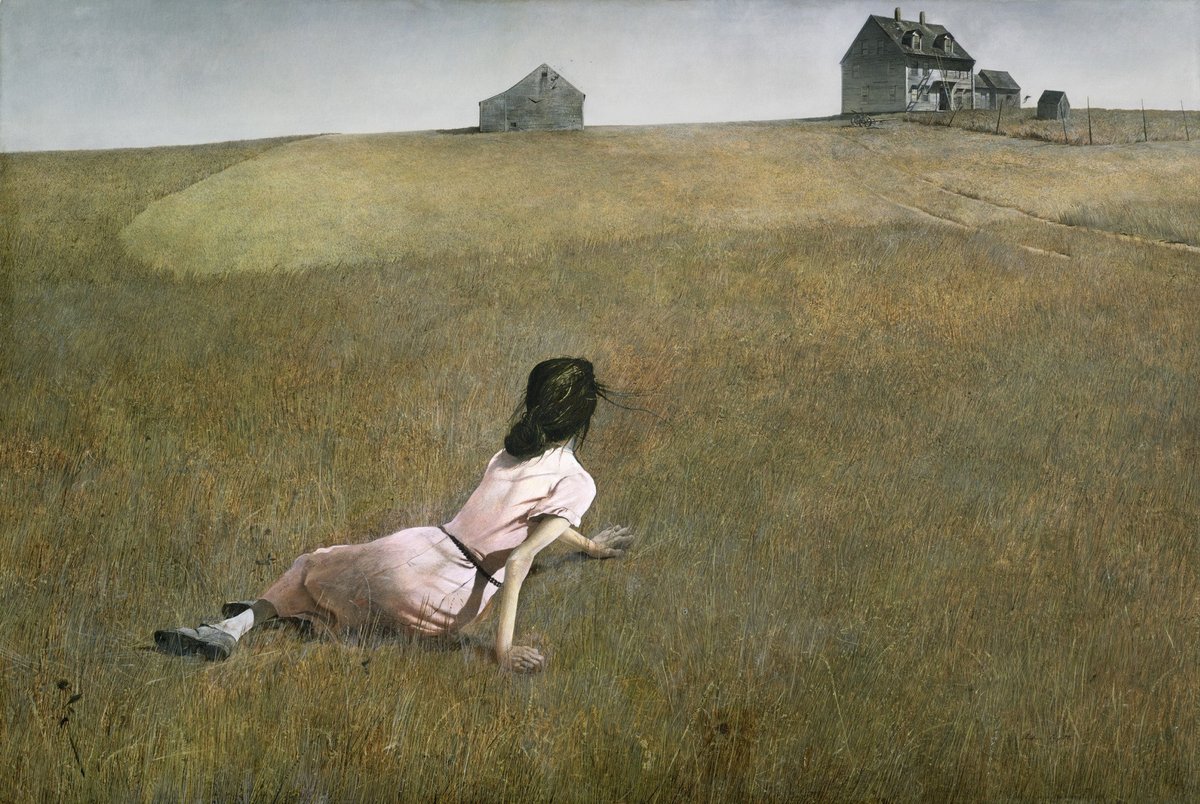
This is one of the most famous paintings in America, and most people have no idea what they are actually looking at...
The painting is Christina's World, made by Andrew Wyeth in 1948, and the woman was real: her name was Anna Christina Olson, Wyeth's neighbour in Cushing, Maine. Since childhood a degenerative condition had slowly taken the strength from her legs, until walking was no longer possible. She refused a wheelchair, and for her entire adult life she chose to drag herself across the ground with her arms instead, going wherever she wanted to go under her own power.
Wyeth saw her one afternoon from an upstairs window, alone in that vast field, crawling slowly toward the house on the hill. He said the painting was an attempt to do justice to her extraordinary conquest of a life which most people would consider hopeless. Her world, he said, was limited physically but by no means spiritually.
That is what turns this painting from a portrait of frailty into one of the most triumphant images ever made...
Look at it long enough and it stops being about what her body took from her, and becomes about what she would not stop doing anyway. The field is enormous and she is small and the house is far away, and still she goes, because the alternative, to be carried, to give up, to let the distance win, was something she simply would not accept.
There is one more thing: Christina loved this painting. Pink was her favorite color, and Wyeth had placed her exactly where she most wanted to be, out in the open, in her own field, under her own sky. Late in her life, when she could no longer even crawl out to that field, she said something that holds the whole meaning of art inside it:
"Andy put me where he knew I wanted to be. Now that I can’t be there anymore, all I do is think of that picture, and I’m there."
Greece announced that it will close 60 mosques throughout the country and deport those who continue to illegally build Islamic religious spaces.
Greece is fighting against the Islamization of Europe.
Greece is right.
🇬🇷
Look at the human body as a weapon. It is embarrassing.
No claws. Fingernails that lose a fight with cardboard.
No fangs. Flat little teeth that struggle with a tough steak.
No armour. Skin a bramble can open.
No fur. Cold kills us in a night.
No speed. A squirrel outruns us. A toddler loses to a goose.
No strength. A chimp half our weight could take us apart.
No venom. No shell. No horns. No wings.
Pound for pound, we are the softest large animal in the field.
And we hunted every one of them to the edge.
Because everything went into one organ instead.
The human brain. Twenty percent of your energy, run by a body that skipped every other upgrade.
And it is built from fat and animal food. DHA from fish and meat. B12 found in no plant alive. Cholesterol, the scaffolding of every brain cell you own.
The ape that started eating meat grew the brain. The brain built the spear. The spear ended the argument with every animal that had the claws and the fangs and the speed.
A soft, slow, clawless creature became the apex predator of the entire planet, on the strength of one organ made of the exact food we are now told to cut out for our health.
We ate our way to the top of the food chain.
Now they want us to eat our way back down.
This painting shows the most heartbreaking reunion in all of literature. To understand it, you have to know who the dog is...
His name is Argos, and he belongs to Ulysses, the Greek hero also known as Odysseus. Before Ulysses sailed away to fight in the Trojan War, he had raised Argos from a puppy, a fast and beautiful hunting dog. Then the war called, and Ulysses left.
He would not come home for twenty years.
When Ulysses finally set foot on his own island again, he came in disguise, dressed as a beggar, so that no one would know him. His house was full of men trying to steal his wife and his kingdom. To survive, he had to remain a stranger in his own home.
No one recognized him. Not his loyal servants. Not the people who had known him all his life. But lying in the dirt by the gate, old and forgotten, covered in ticks, too weak to stand, was a dog. Argos had waited twenty years. And the moment he saw him, he knew. He was the only one. Nearly blind, half dead, he lifted his head and pricked up his ears, and he wagged his tail for the master he had never stopped waiting for.
Ulysses saw him. And because he was in disguise, surrounded by enemies, he could not run to him, could not kneel down, could not say his name. He could only look at his old friend and, turning his face away so no one would see, let a single tear fall.
And then, in Homer's own words, "the dark shadow of death closed down on Argos' eyes, the instant he had seen Odysseus, twenty years away."
He had held on to life for one reason only: he was waiting to see him come home. And the moment he did, he could finally let go...
It is such a beautiful painting, and the look on that dog's face is so universal, so instantly understood by anyone who has ever loved and waited, that it is enough to bring a grown man to tears.
Lin-Manuel Miranda's Hamilton is one of the great disgraces to an American patriot's memory in modern culture. Alexander Hamilton died the way he lived, defending the republic he helped build, taking a bullet from a sitting vice president rather than betray his principles. He wrote most of the Federalist Papers. He built the financial system that let a broke, war-torn collection of colonies become a country that could actually pay its debts and stand on its own. He created the Coast Guard, the national bank, the customs service. This is a man who genuinely believed in the American project and gave everything to it.
And what did we do with that legacy? We turned him into a mixtape. We flattened one of the sharpest constitutional minds this country ever produced into a finger-gun revolutionary who raps about being "young, scrappy and hungry." We took a man whose whole life was an argument for strong institutions, order, and national credit, and sold him to teenagers as an anti-establishment rebel, which is almost the exact opposite of what he actually stood for. The musical skips his elitism, sands down his real politics, and dresses a hard-nosed banker up as a street underdog because it makes a better hook.
And the cherry on top: In the musical, the historical character of Alexander Hamilton and the other founding fathers were white, but they are intentionally portrayed by Black, Latino, and Asian actors. The show’s creator, Lin-Manuel Miranda, designed this deliberate casting to tell "America then, as told by America now," and to emphasize the story of immigrants building a nation. An absolute propagandizing of history that the low IQ masses eat up and believe as fact. In a serious country he would be punished for spitting on the memory of the men who actually built this country. This will only keep getting worse as these tribalistic people elect their own members into our institutions.
That is not a tribute. That is a costume. A real patriot got buried under a soundtrack, and a whole generation now thinks they know him because they memorized the lyrics.
The single richest man in America personally bankrolled the Revolution, kept Washington's army alive with his own money, and then died broke in a debtors' prison. The man who funded the country got thrown in jail for being poor. Meet Robert Morris.
If the United States has a financial founding father, it's this guy, and almost nobody knows his name.
He was born in Liverpool, England, in 1734 and came to America as a 13 year old boy. He got into the shipping business in Philadelphia and was so good at it that by 1775 he was likely the wealthiest man in all of the colonies. Ships, trade, credit, money moving everywhere. He was the money.
Here's the wild part. At first he didn't even want to declare independence. He thought it was premature and voted against rushing into it. But once the decision was made, he didn't hedge. He signed the Declaration of Independence and threw his entire fortune behind the cause.
And thank God he did, because the young country was flat broke. The army was starving, unpaid, falling apart. So Morris did something almost nobody would do. He used his own personal credit and his own personal cash to keep the war going. When Washington needed money to march on Yorktown for the campaign that basically won the war, Morris helped raise it, at times pledging his own name and fortune to cover it. He became known as the Financier of the Revolution, and it's not an exaggeration. He kept the lights on.
He's also one of only two men to sign all three of America's founding documents, the Declaration of Independence, the Articles of Confederation, and the Constitution. When Washington offered to make him the very first Treasury Secretary, Morris turned it down and pointed him to a young Alexander Hamilton instead.
Now the tragedy. After the war, Morris poured everything into massive land speculation, betting enormous sums on the future of the country. The bets went bad. Spectacularly bad. He ended up owing something like three million dollars, a genuinely staggering fortune for the time.
And so, in 1798, the man who had personally financed American independence was locked in a debtors' prison in Philadelphia. He sat in that cell for years. The Financier of the Revolution, penniless, behind bars, while the country he'd funded moved on without him.
He finally got out around 1801, aided by a new bankruptcy law, and lived quietly and broke until his death in 1806.
A man who was richer than anyone, gave it to a nation, and died with nothing.
Robert Morris. He bought America's freedom and went bankrupt doing it.