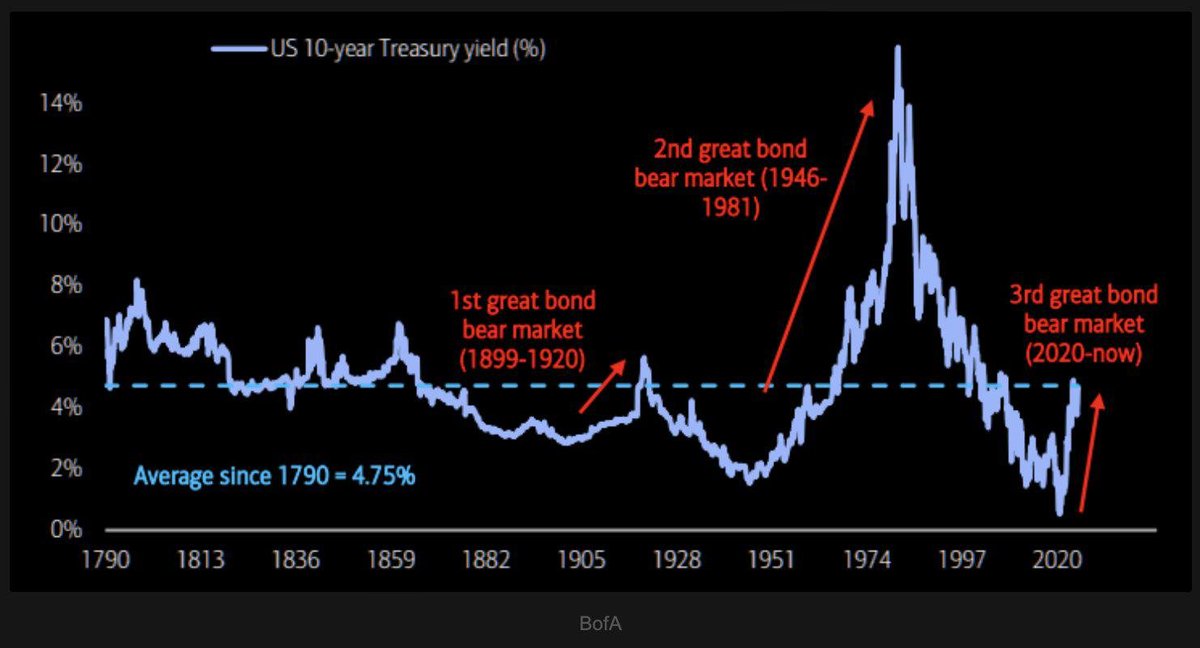
U.S. Treasuries are about to enter the fifth year of the third major bond bear market in 240 years! The latter two lasted 21 and 35 years respectively.
Digital Money should be stable, liquid, digital, and yield-bearing. Bitcoin-backed credit makes that possible. The next wave is not just stablecoins — it is stable-value money with yield, built on Bitcoin. $BTC
NOBODY IS TALKING ABOUT WHAT GOOGLE JUST PREDICTED FOR BITCOIN.
And it changes everything.
Google: Broke 2021 highs. DONE.
Retested breakout zone. DONE.
Entered expansion phase. DONE.
Bitcoin: Broke 2021 highs. DONE.
Retested breakout zone. DONE.
Bounce happening right now. DONE.
One cycle behind.
Same structure. Same setup. Same result incoming.
When Google completed this pattern…
Nobody was ready for what followed.
Bitcoin is next.
Are you positioned?
Standard Chartered's Kendrick: Crypto Winter Is Over; $100K BTC and $4K ETH Year-End Targets Remain
Standard Chartered analyst Geoffrey Kendrick maintained his year-end targets of $100,000 for Bitcoin and $4,000 for Ethereum, saying Bitcoin's drop to around $59,000 likely marked the cycle bottom and the end of the current "crypto winter."
Kendrick cited heavy spot Bitcoin ETF redemptions, liquidity pressure tied to the SpaceX IPO, and easing macro stress as key factors behind the recent selloff. He expects renewed buying and ETF inflows to help confirm the bottom, and said Ethereum may outperform Bitcoin in the near term.
Just did my ETF flow analysis with help from AI , conclusion below, looks like we have at best one more drop and we are done with this bear.
Top panel — BTC Price: Ran from ~$60K (Aug 2024) up to ATH $125K (Oct 2025), now back down to $63K. A full round trip.
Bottom panel — 14d ETF Flow (combined BTC US + ETH US + BTC HK):
- 🟢 Peak inflow: $10.1B — coincided exactly with the run-up to the ATH (institutional FOMO)
- 🔴 Now: -$9.8B — one of the deepest outflow readings in the entire ETF history, matched only by the March 2025 correction dip
- The current outflow intensity = institutions are either capitulating or rotating out aggressively
- Historically these deep red troughs have preceded sharp reversals — same pattern preceded the May 2025 recovery rally
Signal: Current ETF flows are at the bottom 2.5th percentile of the full historical range → BOTTOM signal, consistent with the 20.4/100 cycle score.
The AI buildout is absorbing capital at historic scale, creating temporary pressure across global markets. That does not weaken Bitcoin. It strengthens the case for scarce, liquid, digital capital. Bitcoin remains the premier asset for the long term. $BTC
prenez 2 gamins de 18 ans, un à Shenzhen un à Paris, même cerveau même énergie, même envie de compter, demandez leur ce qu'ils veulent devenir et vous entendez 2 mondes
le premier rêve de monter sa boîte de robotique, de fabriquer des batteries ou de lancer une industrie de véhicules électriques qui conquiert la planète, le second vise un poste en finance ou la vie d'influenceur sur un balcon de Dubaï
la seule différence entre ces deux gosses c'est ce que leur pays leur a soufflé à l'oreille depuis l'enfance, à Shenzhen on lui a dit construis et deviens un héros, à Paris on lui a dit case-toi et surtout sécurise mdr même matière première MAIS 2 logiciels complètement opposés et 30 ans + tard 2 destins de nations
il y a 40 ans la Chine copiait nos produits et la France inventait le tgv, le concorde, le minitel…aujourd'hui c'est l'inverse exact, eux déposent les brevets pendant que les français déposent des dossiers de subvention, l'élève est devenu le maître pour une seule raison, l'un est resté affamé quand l'autre s'est installé dans le confort
et je crois que tout est là, la Chine raisonne en bâtisseur parce qu'elle vient de la pauvreté et regarde vers le sommet, la France raisonne en héritier parce qu'elle vient du sommet et surveille la descente, une nation qui a connu la faim garde l'instinct de construire, une nation rassasiée glisse vers l'envie de garder
comprenez simplement que le confort fabrique des gestionnaires quand la faim fabrique des conquérants
en ce sens, le produit de tout cela donne une culture entière tournée vers l’optimisation de l’existant plutôt que la création du neuf, nos meilleurs cerveaux deviennent gestionnaires de patrimoine, optimisateurs fiscaux, consultants qui rationalisent ce qui existe déjà car l’héritier administre plutôt qu’il invente, il fait fructifier le stock au lieu d’agrandir le gâteau et je vais vous donner une règle simple: un pays qui passe son génie et son temps à mieux découper la richesse d’hier finit par cesser d’en produire pour demain
par ailleurs, comme je l’ai déjà dit à de nombreuses reprises, je suis persuadé que ce qui sépare aussi la Chine du de l’occident de manière générale c’est aussi l’horizon, la Chine joue à 30 ans quand on joue au prochain trimestre et à la prochaine élection, elle sacrifie le présent pour s’offrir l’avenir pendant qu’on sacrifie l’avenir pour s’offrir un présent tranquille et pour moi un pays qui pense court finit toujours par appartenir à celui qui pense long
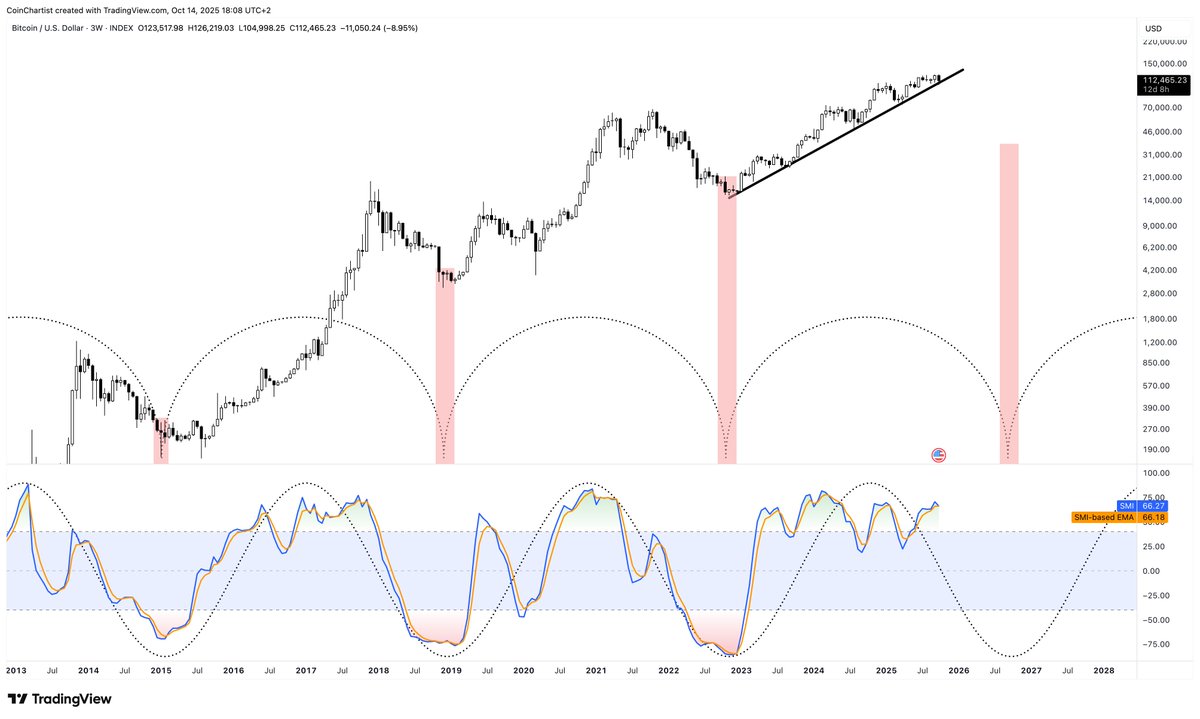
Observing the 6 month chart, $BTC usually prints 2 red 6 month candles before continuing higher.
The current 6 month candle closes in July, 25 days from now.
So, based on this theory, the next 6 month candle should be green, meaning the move down we're seeing right now could actually be the capitulation candle.
Because we topped earlier in this bull cycle (October), Q4 sellers were front run.
If that's the case, it's reasonable to assume Q4 buyers will get front run as well.
$MSTR
Bear markets reveal people faster than anything else.
Saylor has spent over five years evangelizing Bitcoin.
Showing up through every cycle.
Taking the beating from the community more times than most people remember.
These are the same people who were singing his praises when $STRC was pulling in billions. The same ones talking about how incredible the instrument was. The same ones celebrating every buy announcement.
But the second there is weakness in the price, they are the first to reach for the knives.
The first to make snarky comments.
The first to declare it is over.
Those people are revealing themselves right now.
And when the price recovers, as it always does, they will act like they never said a word. They will quietly fall back in line and sing the songs again.
Saylor published something today worth reading carefully.
He describes four ideologies within the Bitcoin community. The Maximalist. The Capitalist. The Technologist. The Fundamentalist.
And his argument isn’t that one of them is right and the others are wrong.
It’s that Bitcoin needs all of them.
Each one protects something important.
Each one can also go too far.
He knows exactly which one he is.
The Capitalist.
The one who believes Bitcoin reaches its full potential by integrating with the global economy. Through companies, banks, credit instruments, capital markets, and billions of people who would never have arrived any other way.
And yet he has never once suggested the Fundamentalist should not exist.
Or the Maximalist.
Or the Technologist.
He has tried to serve every corner of this community while building something that expands it.
The irony is not lost on me.
The people sharpening their knives against him today are often the same ones who claim to protect Bitcoin’s values.
But nothing in Bitcoin’s values calls for turning on the person who has done more to bring attention, capital, and adoption to this asset than almost anyone else in the space.
Bear markets reveal people.
The ones worth listening to tomorrow are those who stayed consistent today.
$BTC $MSTR $STRC
The Iranian navy, which has been destroyed eight times, has apparently closed the Strait of Hormuz again, because the United States, for the seventh time, won the war that wasn’t a war, so now the United States has to open the Strait of Hormuz that was already open before the not-war began.
The not-war began because Iran had uranium that was totally, completely, beautifully obliterated, so they can’t build the nuclear bomb they weren’t building, which is why the United States had to start the not-war it definitely didn’t start.
Now the United States, which has nuclear weapons, is threatening to use nuclear weapons to stop Iran from getting nuclear weapons, because nuclear weapons are far too dangerous for countries with nuclear weapons to allow other countries to have.
If the United States saw the United States doing what the United States does in other countries, the United States would invade the United States to liberate the United States from the tyranny of the United States.
Just read Stephen Perrenod's Substack and I'm blown away! 🤯
He explains why there was no Bitcoin bubble in 2025 and it's not because anything went wrong. It's because most people have been using the wrong model.
The popular "4-year cycle" assumes bubbles repeat on a linear schedule. But Bitcoin is a power law asset, which means time itself should be measured logarithmically.
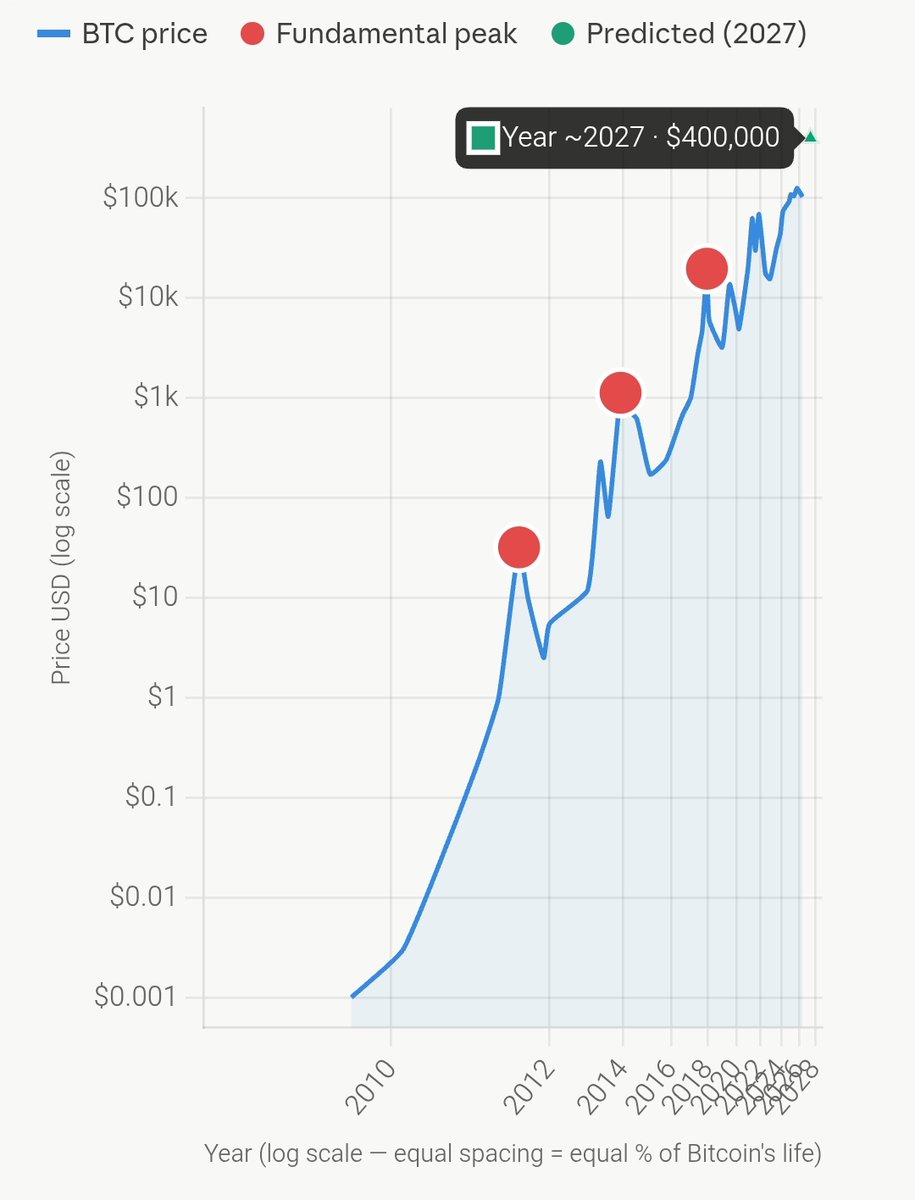
When you do that, the fundamental bubble peaks land here:
6 Jun 2011 👉$32
30 Nov 2013 👉 $1,127
16 Dec 2017 👉 $19,665
NEXT>
May 2027 👉 $300k–$500k?
Each gap is roughly twice as long as the previous one. 2021 wasn't a fundamental peak just a harmonic echo sitting between the real beats.
The maths points to the next major bubble peaking around May 2027, approximately 6,720 days after the Genesis Block of 3 January 2009.
No bubble in 2025 wasn't a failure of Bitcoin. It was the model working exactly as expected. 👀
The chart shows Bitcoin's full price history on a log scale since the Genesis Block, with:
The blue line as actual BTC price.
Red dots for the three fundamental peaks (2011, 2013, 2017)
The green triangle for the predicted May 2027 peak around $400k
Notice how on a log scale the power law is a straight line, and the bubbles are the dramatic spikes above it, each one bigger in price but spaced further apart in time
Full credit to Stephen Perrenod: https://t.co/mqAHJpZWIi
&
@moneyordebt
Thanks Stephen 🙏
Lots of debate about whether we're in a stock market bubble. Good post by @dampedspring below.
In the late 90s, I was also a sell-side trader -- an equity marketmaker on one of the largest desks on the street. We were the "axe" (dominant firm) in many of the names we traded. For a time, I was our marketmaker in AMZN. So I had a good view of institutional and retail sentiment.
By the last year of the 1990s tech bubble, we were clearly in a full-blown national mania. There was zero skepticism or doubt. I'm not sure current sentiment is at that level. Maybe it's 1997-1998 instead of 1999. But I'm older now and not as in touch with daily fast-money sentiment as I was 30 years ago, so I don't have a strong opinion on this.
Even in a late-stage bubble, it's ok to participate as long as you're agile. You can have an oar in the water and an eye on the exit. Dance while the music is playing. The problem is that many traders get whipsawed in the type of market conditions that accompany bubbles -- especially if they’re smart enough to know it's a bubble.
I’ve learned that if you think financial conditions are unsustainable, time (and capital) is better spent focusing on the inevitable policy response to the bust. Example: By 2004-2005, it was clear that a US housing bubble was underway and the eventual fallout would be brutal. So I got bullish on gold around $400. By 2011, after the Fed's policy response to the crisis got traction, gold was $1900.
It’s good to be familiar with that gold cycle. As the financial crisis spread in 2008, gold fell from $1000 to $700. It showed that in a crash, everything gets sold. The key is to have done your research beforehand (and have the capital available to take advantage of it) so you’re positioned for the inevitable policy response.
So maybe it’s 1997-1998. Or it’s late 1999. Regardless, readers know what I think is a good way to be positioned for the inevitable -- whether that’s a shock-and-awe policy response to a bust, or just an elevated inflation regime (out of necessity) that lasts for years.