What changed with linezolid this year? 🤔 ✅ Monitor for serotonin syndrome with serotonergic drugs ✅ Watch for hairy tongue & tongue discoloration ✅ Counsel your patients
Watch the full update 👇 #WAAW2026#AMR#Linezolid#ClinicalPharmacy
Cefepime vs pip/tazo for AmpC-producing bacteria
-Observational study analyzing 728 patients
- Focused on bacteremia caused by E. cloacae, K. aerogenes, and C. freundii
- No difference in 30-day mortality (11% vs 14%) or recurrence (2% vs 3%)
- Resistance emerged during treatment
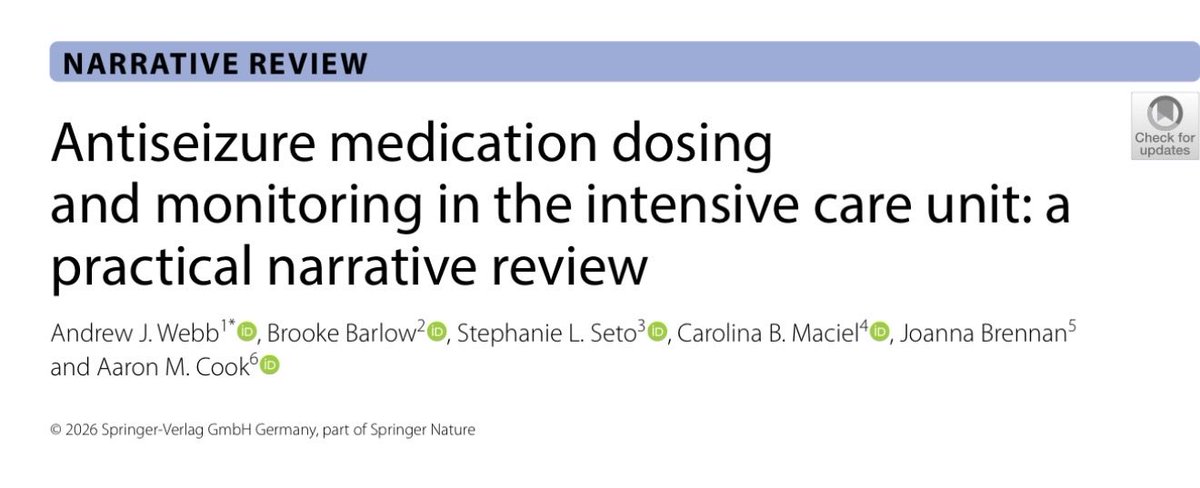
Rowe et al: Guidelines for Seizure Prophylaxis in Patients with Aneurysmal Subarachnoid Hemorrhage: A Statement for Healthcare Professionals from the Neurocritical Care Society
Link: https://t.co/oMNguxkdPh
@neurocritical#neurocritcare
Enteral vs IV Magnesium in the ICU: Cheaper and Greener, but Is It Enough? 💊⚡
IV magnesium is the default replacement in most ICUs, but enteral replacement is cheaper and more sustainable.
A randomized noninferiority trial (360 ICU patients with serum Mg 0.35–0.7 mmol/L) tested whether enteral replacement is good enough:
Primary Outcome:
Serum Mg at 24 h was 0.80 mmol/L with enteral vs 0.92 mmol/L with IV (mean difference −0.12 mmol/L, 95% CI −0.16 to −0.07).
This did not establish noninferiority at the 0.1 mmol/L margin.
Per-protocol analysis (−0.20 mmol/L) suggested enteral was inferior.
Dose vs Response:
1- Enteral patients received about 5× more magnesium in the first 24 h (49.6 vs 10 mmol) yet reached lower levels. This fits enteral bioavailability of roughly 30% or less in critical illness.
2- Mg normalized (>0.7 mmol/L) in 70% with enteral vs 89% with IV (post hoc).
Where Enteral Wins:
1- Less urinary Mg loss (urine AUC 28.9 vs 75.1 mmol·h/L)
2- Lower cost (−6.48 AUD per patient)
3- Less waste (−55)
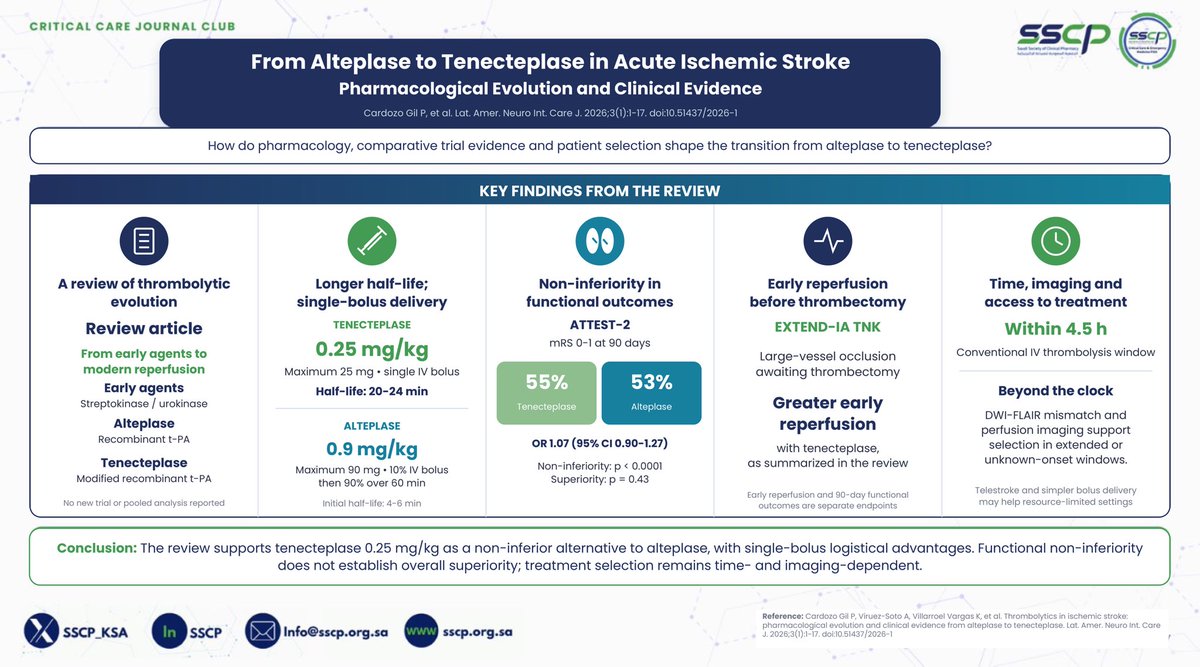
🧠 Alteplase to tenecteplase: when pharmacology changes the logistics of cerebral reperfusion
In acute ischemic stroke, every minute of persistent arterial occlusion increases the risk of irreversible neuronal injury. Yet the evolution of thrombolytic therapy is not simply about developing a more potent fibrinolytic. It is about improving reperfusion while reducing treatment delays, without increasing hemorrhagic complications.
Thus 2026 review examines this evolution, from streptokinase and urokinase to alteplase and tenecteplase.
The pharmacological difference matters.
Alteplase has a short initial half-life of approximately 4to6 minutes, requiring an intravenous bolus followed by a 60-minute infusion.
Tenecteplase incorporates molecular modifications that increase fibrin specificity, resistance to plasminogen activator inhibitor-1 (PAI-1), and plasma half-life to approximately 20to24 minutes. Consequently, it can be administered as a single intravenous bolus.
For acute ischemic stroke, the studied standard dose is 0.25 mg/kg, maximum 25 mg.
This is particularly relevant during interhospital transfers and in hospitals without immediate thrombectomy capability, where infusion preparation and transport logistics can complicate reperfusion pathways.
But does better pharmacology translate into better neurological outcomes?
The accumulated evidence from TRACE-2, TASTE, ORIGINAL and ATTEST-2 supports the noninferiority of tenecteplase compared with alteplase for functional outcomes at 90 days.
ATTEST-2 reported excellent functional outcomes in 55% versus 53% of patients, respectively, without demonstrating superiority.
In patients with large vessel occlusion awaiting thrombectomy, EXTEND-IA TNK demonstrated improved early reperfusion before mechanical intervention.
However, improved early recanalization does not automatically establish superiority in long-term neurological recovery.
The second transformation concerns patient selection.
The traditional 4.5-hour therapeutic window remains fundamental, but advanced neuroimaging increasingly identifies patients with salvageable cerebral tissue beyond conventional time limits.
Diffusion -FLAIR mismatch and perfusion imaging help distinguish irreversibly injured tissue from potentially recoverable penumbra. Extended-window thrombolysis must nevertheless remain restricted to appropriately selected patients.
For Latin America and other resource-constrained settings, this evolution creates an important opportunity.
A single-bolus thrombolytic may simplify treatment delivery, while telestroke networks and accessible imaging protocols can expand specialist decision-making beyond comprehensive stroke centers.
Nevertheless, neither artificial intelligence nor advanced imaging should introduce unnecessary delays in otherwise eligible patients.
Reference 📚
Cardozo Gil P, et al. Latin American Neurointensive Care Journal. 2026;3(1):1–17.
https://t.co/jupSfiSses
#Criticalcare #PharmacyEducation
#CriticalCareUpdate #EmergencyMedicine
#CriticalCarePharmacy #alteplase #Stroke #tenecteplase
Effectiveness of dolutegravir/lamivudine versus bictegravir/ emtricitabine/tenofovir alafenamide in people with HIV with very high viral load (≥500 000 copies/mL)
https://t.co/KOGXISgtQP
ESICM LIVES 2026: VASSPR Trial: When Should We Add Vasopressin in Septic Shock?
Should vasopressin be introduced early during norepinephrine escalation, or should we wait until higher vasopressor requirements develop?
The VASSPR trial, presented by Ithan Peltan, addressed this important question in septic shock management.
Vasopressin is frequently added to norepinephrine to restore vascular tone and reduce catecholamine exposure. However, the optimal threshold for its initiation remains uncertain.
The VASSPR trial investigated whether recommending vasopressin initiation at lower vasopressor doses improves clinical outcomes compared with a higher threshold.
This pragmatic, cluster crossover randomized trial involved 3,959 patients across 13 hospitals, comparing two hospital-level strategies.
The lower-threshold strategy recommended introducing vasopressin when norepinephrine equivalent doses reached 0.1 µg/kg/min, while the higher-threshold strategy recommended initiation at 0.4 µg/kg/min.
What did the trial demonstrate?
At 28 days, all-cause mortality was 31.8% in the lower-threshold group compared with 33.0% in the higher-threshold group.
The adjusted odds ratio was 0.98 (95% CI 0.87-1.06), with an adjusted absolute risk difference of -0.4 percentage points (95% CI -2.7 to 1.3).
Earlier vasopressin initiation recommendations did not demonstrate a mortality benefit.
These findings challenge the assumption that earlier addition of a second vasopressor necessarily improves survival.
From a physiological perspective, vasopressin addresses vascular dysfunction through mechanisms distinct from adrenergic stimulation. Nevertheless, correcting vasoplegia through additional pharmacological pathways does not automatically translate into improved outcomes.
Importantly, VASSPR evaluated hospital-level recommendations rather than mandatory individualized treatment thresholds. It should not be interpreted as evidence that all patients should wait until norepinephrine reaches 0.4 µg/kg/min.
The absence of an overall mortality benefit also does not exclude advantages in selected haemodynamic phenotypes.
For clinical practice, the findings reinforce the importance of individualizing vasopressor therapy according to vascular tone, perfusion, cardiovascular function and the evolution of shock.
The future of septic shock management may depend less on universal vasopressor thresholds and more on identifying which patients benefit from each intervention.
#ESICM #LIVES2026 #SepticShock #Vasopressin #Hemodynamics #CriticalCare #IntensiveCare
🧵 Presented today at #LIVES2026:
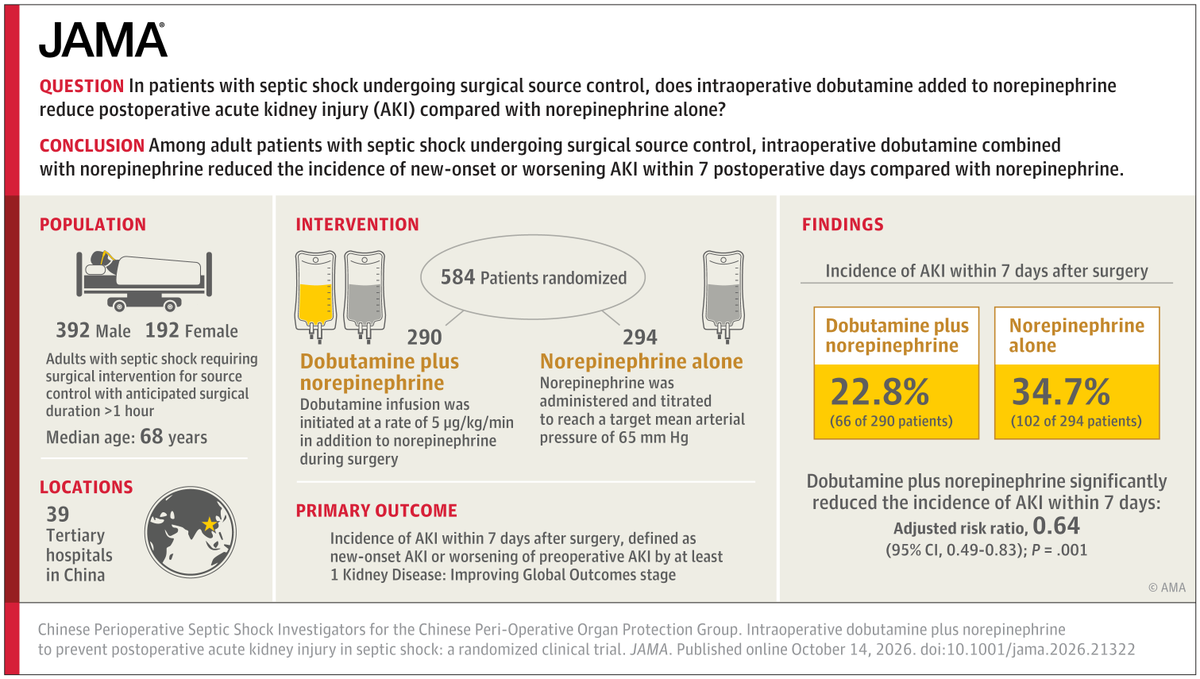
Among patients with #SepticShock undergoing surgical source control, intraoperative dobutamine plus norepinephrine reduced new-onset or worsening #AcuteKidneyInjury within 7 days after surgery compared with norepinephrine alone. These findings support consideration of this intraoperative hemodynamic strategy for reducing postoperative kidney injury in this surgical population.
https://t.co/I8wfhDenMY
Escherichia coli with penicillin-binding protein 3 insertions: implications for newer β-lactam/β-lactamase inhibitor combinations
@ASMicrobiology
https://t.co/YXGbSSNnbe
New #IDSAGuidelines!
IDSA has released updated evidence-based recommendations on the prevention of invasive aspergillosis in adult solid organ transplant recipients: https://t.co/yYl8psAqN0
A new chapter as an R2 resident
اللهم اجعلها بداية خيرٍ وبركة، وسخّرنا لخدمة مرضانا، وأعنّا على هذه الأمانة، وارزقنا العلم والحكمة والرحمة.
اللهم اجعلنا سببًا في تخفيف ألمهم، وطمأنة قلوبهم، وكن لنا عونًا لنكون لهم عونًا.
واجعل لنا في كل مريض أثرًا طيبًا، وفي كل خطوة أجرًا.
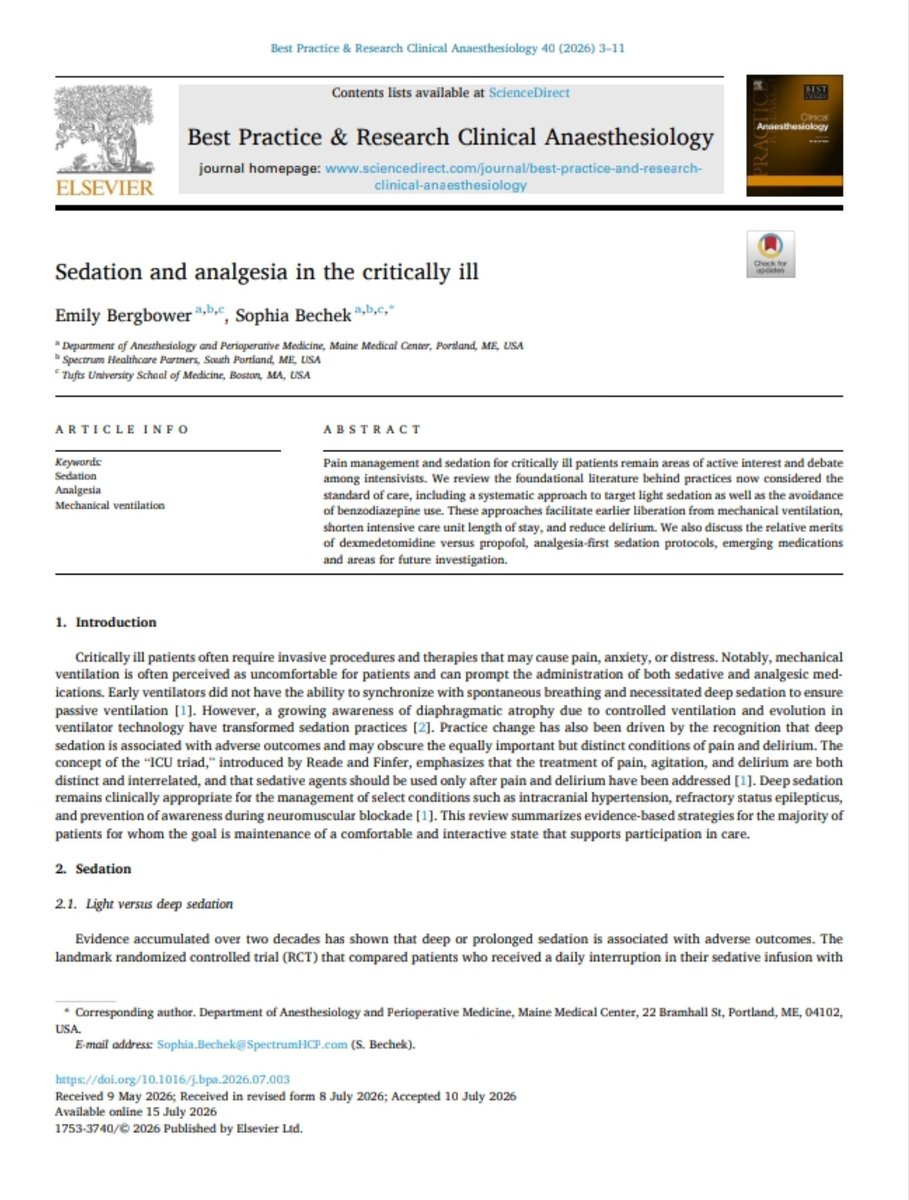
💊🫁Analgesia-Sedación en el Paciente Crítico
🎯Sedación Ligera
📊RASS-SAS
🚫Evitar Benzodiacepinas
💉Propofol-Dexmedetomidina
💊Analgosedación
🔰📚Best Practice & Research Clinical Anaesthesiology 2026
Artículo Completo👇🏻✅🆓
https://t.co/aR5SFK2xfj
📥️ PART 2 of IDSA histoplasmosis guidelines 🚨
L-AmB still preferred, but can consider switching to itraconazole💊 earlier than 7-14 days once clinically feasible. But consider longer induction for 🧠 disease, severe immunocompromise, or slow response
https://t.co/3lkCtG7Dv1