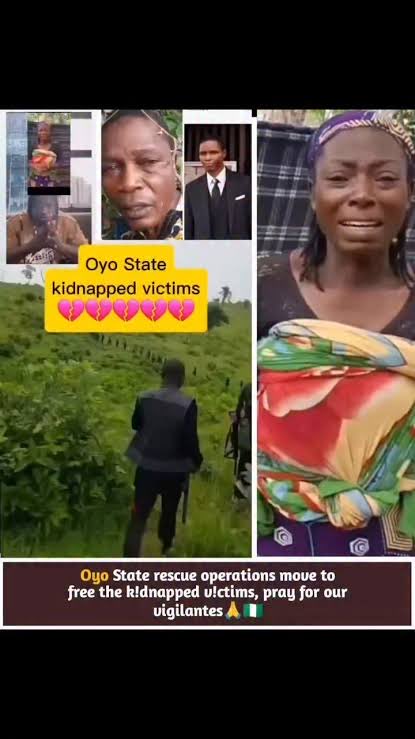
Be honest Nigerians, you’ve actually moved on from this heart wrenching story of Baptist School kidnap victims from Oyo state, right?
It’s almost two months now. Kids as young as 1,2,3 and 5 are among the captives. No clue what has happened to them. But we’re moving on….
Nigeria wants Mazi Nnamdi Kanu out
South East governors want Mazi Nnamdi Kanu out
Supporters of politicians want Mazi Nnamdi Kanu out
ExDOS wants Mazi Nnamdi Kanu out
Gangsters want Mazi Nnamdi Kanu out.
Nigeria supports Iran and Palestine
ExDOS supports Iran and Palestine
This is the new public school in Abia State. 19 others are currently being built.
What they’re doing is transforming already existing schools into this. This is American-standard schooling.
You remember I once criticized their first smart school attempt, which the government later condemned entirely and followed this approach instead.
I’m so impressed with the Abia State Government.
They listen, and they are truly for their people.
Mazi Nnamdi Kanu will be free. The exDOS said let's see how he will be free without DOS. And you started sabotaging his freedom. Today you have been given the opportunity to try your luck in stopping his freedom. But you can't just stop it.
You will hear the news of his freedom and that day will be your worse day. But there is absolutely nothing any of you can do about it.
Elochukwu Ohagi, 2026.
Very unfortunate!!
He called himself His Holiness. He poured petrol on his own church members and set them on fire.
His name is Chukwuemeka Ezeugo, born November 22 1960 in Uga, Anambra State. He founded the Christian Praying Assembly, a Pentecostal church headquartered in Ikeja, Lagos. To his thousands of followers he was known as Reverend King, or simply His Holiness. He preached, he led, he commanded total obedience.
On July 22 2006, Reverend King accused six members of his own congregation of fornication and adultery. He gathered them together at his residence. According to witnesses, he had them beaten with hard objects. Then he made them kneel down. Then he ordered petrol poured over their bodies.
Then he set them on fire.
One of the victims, a young woman named Ann Uzoh, suffered third degree burns over much of her body. She was rushed to hospital, where doctors fought to save her life for eleven days. She did not survive. The other five victims, also doused and set ablaze, suffered severe injuries but lived.
He was arraigned in September 2006 on six counts of attempted murder and murder. He pleaded not guilty to every single charge.
At trial, ten witnesses came forward to testify against him. His defence tried to discredit them by pointing to small inconsistencies in their statements, but it was not enough. On January 11 2007, Justice Joseph Oyewole of the Lagos State High Court found him guilty and sentenced him to death by hanging.
He appealed. In 2013 the Court of Appeal upheld the conviction. He appealed again, all the way to Nigeria's Supreme Court. On February 26 2016 the apex court dismissed his final appeal and affirmed the death sentence. The presiding judge, the late Justice Sylvester Ngwuta, described the facts of the case as something that could have been lifted from a horror film.
And even on death row, the disturbing reports did not stop.
While awaiting his appeal, Reverend King was accused of having sexual relations with female visitors and prisoners, allegations serious enough that prison authorities transferred him between facilities multiple times, from Kirikiri to Kuje in Abuja, then to Kaduna, then to Katsina, partly because of the volume of followers, including notable politicians, who kept visiting him to pray. One woman later said she had been repeatedly involved with him during these visits, became pregnant multiple times as a result, and had to terminate the pregnancies. In his own defence, Reverend King reportedly described what he was doing to these women as a method of teaching obedience.
Through all of it, something extraordinary happened. His church did not abandon him.
Members of the Christian Praying Assembly continued to fill the pews every Sunday. They took out paid newspaper advertorials celebrating his birthday, year after year, while he sat on death row. They read prison letters from him aloud during services, urging the congregation to continue in the faith he had taught them. When rumours spread that his execution might finally be carried out, church leaders stood at the pulpit and warned that Nigeria would boil if anyone touched their Holiness.
A man was convicted by three separate courts, including the highest court in the country, of burning his own church members alive, and was separately accused of sexually exploiting women even from behind prison walls. And thousands of people still called him a man of God.
He remains on death row in Nigeria today. Nigeria has an unofficial moratorium on carrying out executions, so even with his sentence fully affirmed, Reverend King has not been hanged.
Now here is what I want you to think about.
Six people knelt down in front of a man they trusted with their souls, accused of a private sin, and he answered that accusation with fire. One of them never went home again. The institution built around him did not collapse. It defended him. It celebrated him. And even behind bars, his authority over the women in his orbit
In 1803, about 75 Igbo people were captured and sold into slav£ry from present day Southeastern Nigeria.
They attacked and kil!ed the white crew members. The ship went out of control and crashed at the shore of Dunbar Creek.
When they got to the land, they knew that they would be recaptured by the local plantation overseers.
When they got to the land, they knew that they would be recaptured by the local plantation overseers.
So they made a collective choice. They chained themselves back together, marched directly into the deep, marshy waters drowning themselves inside the sea, singing in Igbo: "Mmụọ mmiri du anyị bịa, mmụọ mmiri ga-edu anyị laa." ("The water spirit brought us, the water spirit will take us home.")
They chose to die rather than live as slaves.
This act by the Igbos remain one of the most powerful symbols of resistance in African diaspora history.
Today, that particular place is known as The Igbo landing located at Dunbar Creek on St. Simons Island, Glynn County, Georgia, United States.
Sunday Igbogho threatened to KILL Fulanis in SW over the kidnap of Yorubas.
Yorubas are hailing him for "protecting SW".
NIGERIAN GOVT IS QUIET.
But when Nnamdi Kanu and ESN chased Fulanis out of SE, it was classed as "terrorism".
NIGERIA MUST DIVIDE‼️
Only a matter of time!
I Said No to Nigeria. I Will Not Welcome Nigeria Into Biafra.
I said no to corrupt politicians because I dreamed of a sane society.
I said no to irregularities because I dreamed of a Biafra where the worth of our children would be seen and cherished — without a quota system, without settlements, without the corruption of identity.
I gave my talent to this project. Writing every day. Defending every day. Because I said to myself: I am tired of a society where criminals are treasured and good people are despised.
I left the seminary — a world entirely its own — and began to understand the rottenness of One Nigeria. I saw corruption up close, and I asked myself how those who passed through public universities even survived it. That question answered itself. I decided then that I could not wish Nigeria on my worst enemy. Never.
When I finished my Youth Service, I had no job. An election was coming. I registered as an ad hoc worker, sat through every training, and was promised an allowance to cover transportation and feeding. I believed them. When the training ended, we waited. The money never came. Unknown names had replaced ours. Strangers collected our allowances. That is Nigeria.
When election day drew near, I went to the local government to confirm my name. It was gone. Most of the names on that list belonged to people who were not even present — some were in Abuja, some in Lagos. People were calling them on phone, negotiating replacements. Many accepted. I did not. I said: this is over. I am done. I walked away having lost time, money, and peace of mind.
Nigeria is corrupt in more ways than can be counted. Nigeria is the creation of a criminal enterprise. It drinks the blood of its own citizens. Its government stands with terrorists and prosecutes freedom fighters as though they are the criminals.
So I said no to Nigeria. And I have not looked back.
Then I heard the voice of Mazi Nnamdi Kanu. That voice was harsh — but it was sincere, and it was consistent. I began to listen. I began to see the possibility of a sane society. I said to myself: even if I do not live to enjoy it, my children will. I embraced the struggle. I began to write.
They called us miscreants. They called us jobless. I looked at myself and laughed. Any society that dismisses ten million IPOB members as unemployed vagrants is a society that has lost its mind — and one that dangerously misunderstands what it means for millions of young people to have no future. That is not an insult to be mocked. That is a time bomb. That is a legitimate foundation for a youth uprising.
I did not write all these years — selflessly, consistently, at personal cost — to turn around and welcome into Biafra the same characters I rejected in Nigeria. That will never happen.
If we say we want a sane society but cannot respect the very Code of Conduct we all agreed to, then we are not serious. We are simply recreating Nigeria with a Biafran flag. And if we do that, we would have no moral right to speak ill of Nigeria — because in the end, there would be no difference between them and us.
To everyone supporting the disgraceful conduct of Chinasa Nworu and Chika Edoziem: shame on every one of you. You are proof that there is still enormous work to be done. You are proof that many among us are still carrying a Nigerian mentality into a struggle that demands better. And we will ensure that every single one of you is thoroughly disgraced by history.
We would have failed if we build Biafra and fail to build a sane society.
Don't forget to bless this writer with your following Elochukwu Ohagi Official
Elochukwu Ohagi, Philosopher, Teacher and Activist, 2026
BREAKING: MAZI NNAMDI KANU HAS SPOKEN — THE DISSOLVED REMAIN DISSOLVED!
Today, the 19th of June 2026, IPOB has made it crystal clear to the world what many of us already knew — you cannot suspend the man who holds the authority to suspend you. You cannot dissolve the power from which your own office was born.
Chika Edoziem and the members of the dissolved 3rd DOS Administration have done the unthinkable. After Onyendu Mazi Nnamdi Kanu lawfully, constitutionally, and decisively dissolved their administration and inaugurated the 4th DOS under Mazi Chris Nwaọgụ, these men — in their desperation and shame — turned around and issued a statement purporting to "suspend" the Supreme Leader and the Director of Radio Biafra.
Let that sink in.
Men who no longer hold any office. Men whose authority has been extinguished. Men who are, in every legal and constitutional sense, ordinary members — woke up and attempted to suspend the very leader from whose hands they once received their appointment.
The IPOB Code of Conduct is unambiguous. The power to appoint, suspend, or dismiss principal officers vests exclusively in the Supreme Leader, Onyendu Mazi Nnamdi Kanu. No DOS. No coordinator. No committee. No collective of sacked administrators sitting in a corner of social media can override that.
What Edoziem and his group have done is not politics. It is not resistance. It is not reform. It is rebellion — and a pitiable, legally hollow one at that. Their so-called suspension of the Supreme Leader is null. It is void. It is as meaningful as a man sacked from his job returning the next morning to sack his employer.
IPOB is not a playground. It is a disciplined liberation movement with a governing code and a chain of command that no one — no one — can subvert with impunity.
The 4th DOS is operational. The Supreme Leader's authority is intact. And the era of indiscipline, back-door power-grabbing, and sabotage within our movement is over.
To all genuine family members worldwide: hold your ground. Do not be moved by the noise of the already-dissolved. Remain loyal to the vision. Remain disciplined. Remain focused.
Biafra is coming — and no internal traitor will stop it.
Read the full official IPOB press statement below.
✊🏿 Share this widely. Let the truth drown out the noise.
Follow Elochukwu Ohagi Official and you will be glad you did.
Elochukwu Ohagi, Philosopher, Teacher and Activist, 2026
Sunday Igboho, a civilian gave ultimatum to Fulani households, he equally threatened to come back and kill every one of them if kidnapped children and adults are not released by terrorists. If it was Mazi Nnamdi Kanu, Nigerian Army would be everywhere with Operation Tigbuo Zogbuo.
🚨 Simon Kennedy challenges the widely used "Hausa-Fulani" label, describing it as a misleading concept that blurs the distinct identities of two different ethnic groups.
Please listen and ch£ck again.
Not everyone knows that before Mazi Nnamdi Kanu created IPOB, he was a member of MASSOB. Many people are unaware of this history.
Mazi Nnamdi Kanu served under Ralph Uwazuruike, but there came a time when he could no longer reconcile himself with the direction Uwazuruike was taking the Biafran struggle. Uwazuruike had begun producing vehicle numbers and international passports for a country still fighting for its very existence, selling these items to poor and uneducated citizens. This, among many other things, became something Mazi Nnamdi Kanu could no longer stomach.
What did he do? He resigned from MASSOB and walked away. He did not attempt to remove Uwazuruike. He did not position himself as more MASSOB than its own founder. He did not issue suspensions or make claims to leadership that was never his. He simply walked away and built IPOB from nothing — because he trusted himself. He believed he had what it took to preach this gospel of freedom and that people would listen. And even if they did not, he was prepared to bear that reality rather than compromise his integrity.
He started IPOB, and from a small Radio Biafra in London — with little equipment and even less resources — Mazi Nnamdi Kanu began speaking the gospel of freedom to our people. One by one, people heard his voice. They noticed his sincerity, his dedication, his unrelenting consistency. Millions followed.
I remember a post I wrote around 2013, where I challenged Mazi Nnamdi Kanu to come back to Nigeria if he was truly serious. I was tired of people shouting Biafra from the comfort of Europe. I promised that if he returned, I would know he was serious and would follow him without reservation.
To my greatest surprise, in 2015, Mazi Nnamdi Kanu announced on Radio Biafra that he was returning to Nigeria. I said to myself — only a madman would do that. Not only was he going to walk into the hands of those who would arrest him, he announced it publicly on air. On that faithful day, he kept his word. He boarded a flight to Lagos and landed. The Buhari government arrested him, and he gave three years of his life — three years of illegal imprisonment — for IPOB and for our people. Those three years placed IPOB on the international stage.
He would later secure bail and courageously rallied Biafrans for months — until September 14, 2017, when Nigerian soldiers attacked him at his family home. He narrowly escaped with his life. More than 28 people, including his cousin sister, were killed in that operation. He went into exile, and after a year, appeared in Israel.
Mazi Nnamdi Kanu's kidnap and extraordinary rendition is yet another sacrifice he continues to pay on the altar of Biafran freedom. This is the kind of man we are talking about.
It is therefore deeply unfortunate that those who today claim to have lost faith in him — or believe he is no longer getting things right — have refused to summon the same courage he once summoned when he left Uwazuruike's MASSOB. Instead of walking away and building something of their own, they would rather try to seize what another man bled to create and install themselves as the new leaders.
There is only one reason a man behaves this way — he does not trust himself enough to convince people to follow him. So he tries to take over another man's sweat.
What is happening today is necessary. It had to happen so that we can begin to shape the kind of society we intend to build. We have always said that what we want is a sane society — not a recreation of Nigeria, where everything goes and nothing is sacred. We are building a society of conscience. A nation where the desperate hunger for power will not define the character of our leaders. A nation built on principles. A nation where, when you are removed from office, you leave peacefully — where you finish your tenure and go, without turning back to blackmail, fight, or cause confusion. A man cannot be removed from a position he was appointed into and then refuse to go —
THE LEGAL IMPLICATIONS OF THE LAUGHABLE ExDOS SUSPENSION OF MAZI NNAMDI KANU THE LEADER OF THE INDIGENOUS PEOPLE OF BIAFRA
By Elochukwu Ohagi, Philosopher, Teacher and Activist, 2026.
What the sacked Directorate of State (DOS) of the Indigenous People of Biafra has done on the 18th of June 2026 is not merely an act of insubordination. It is a legally catastrophic miscalculation that will hunt them in the courts of Europe, where IPOB is duly registered as an organisation. Let me, as a non-lawyer but a man of reason and logic, break down what they have done and what awaits them when IPOB lawyers walk into the appropriate court.
FIRST: THE QUESTION OF FOUNDING AUTHORITY
Every registered organisation has a founding structure. That founding structure determines who holds supreme authority over the direction and leadership of the organisation. Mazi Nnamdi Kanu founded and registered IPOB. His name, his vision, and his authority are embedded in the founding documents of that organisation. The DOS are appointees — men and women who were given positions by virtue of the Leader's trust and delegation of authority. They did not found IPOB. They did not register IPOB. They were not there before IPOB. They came into IPOB through Mazi Nnamdi Kanu.
The legal question therefore is simple: Can an appointee suspend the authority of the person who appointed him? The answer in every jurisdiction — whether in Germany where IPOB's global headquarters sits, in the United Kingdom, or anywhere in Europe — is a resounding NO.
An appointee derives his authority from the appointing authority. Once that appointing authority revokes the appointment, the appointee ceases to have any legal standing within the organisation whatsoever. Any action taken by such a person after revocation is legally null and void ab initio — meaning it never existed in the eyes of the law.
SECOND: THEY HAVE COMMITTED WHAT IS KNOWN IN CORPORATE AND ORGANISATIONAL LAW AS ULTRA VIRES ACTS
Ultra vires is a Latin legal term meaning "beyond the powers." What the sacked DOS members have done is act beyond their legal powers. Their document itself, ironically, admits that "no individual of whatever rank or position has the authority or power to dissolve the Directorate of State." But they conveniently forget that the same principle — and a far stronger one — applies to them. If they claim no individual can dissolve the DOS, how then does the DOS, which is merely a directorate, have the power to suspend the founding Leader of the entire organisation?
They have walked into a legal contradiction of their own making. In court, this contradiction alone will be sufficient to invalidate every resolution they have passed.
THIRD: VIOLATION OF ORGANISATIONAL CONSTITUTION AND FOUNDING DOCUMENTS
Every registered organisation in Europe operates under a constitution or articles of association that are filed at registration. These documents define the chain of command, the powers of each body, and the limits of every office. When IPOB lawyers present the founding documents of IPOB before a European court, those documents will show clearly the supreme authority vested in the Leader. The court will then examine the DOS resolution against those founding documents. The result will be devastating for the sacked DOS members.
They will be found to have acted in direct violation of the organisational constitution — an act that exposes them to legal consequences including but not limited to injunctions, removal orders, and potential liability for any damage their illegal actions cause to the organisation and its lawful members.
FOURTH: FRAUDULENT MISREPRESENTATION AND ORGANISATIONAL IDENTITY THEFT
By continuing to issue documents, directives, and press releases in the name of IPOB — an organisation from whose leadership structure they have been lawfully removed — the sacked DOS members are engaged in what could legally be described as fraudulent misrepresentation. They are presenting
June 16, 2011 started like every other day in Nigeria. By 11am, the story changed. It was breaking news. The very first Su!c!de Bømbing in the history of Nigeria had taken place. And the location was no other place than the Louis Edet House Police Headquarters in Abuja, the Federal Capital Territory.
The attacker was later identified as Mohammed Manga, who was better known and addressed by his friends and business associates as Alhaji Manga. He drove to the police headquarters accompanied by a colleague Boko Harãm member who took the last photograph of him grinning before the mission was carried out.
At the entrance to the police headquarters, he was stopped by a traffic policeman. In an attempt to direct him to the car park, the traffic officer joined Manga in the Honda '86 model car.
Getting to the car park, Manga detonated the IED throwing the traffic officer in the air and in tatters.
Manga was originally from Adamawa State but he was born and brought up in Maiduguri, Borno where he embraced the teachings of the late Mohammed Yusuf, whose dæth resulted in Boko Harãm.
Manga, 35, was a fairly well-to-do businessman who had five children (three boys and two girls) with whom he left a will of N4 million. He prepared the will before he embarked on the overnight journey from Maiduguri to Abuja for the mission.
The blast at the police headquarters left five people dæd and many cars burnt.
Manga, a Fulani by tribe, started both as a commercial and private driver at different times in his adult life. A few years before the July 2009 Boko Haram uprising, Manga began to travel to Cotonou in Benin Republic and later Dubai frequently in order to buy all kinds of goods. He was a major contributor to the Boko Haram’s arms build-up, according to Blueprint newspaper.
A Boko Harãm spokesperson, Abu Zaid, also claimed that the attack targeted Inspector-General of Police Alhaji Hafiz Ringim in response to the remarks he made that he would eradicate the Boko Harãm within weeks.
A day before the attack, Ringim had received 10 armoured personnel carriers donated to the police by the Borno State government. In his remark, he had said: “Now that the (general) elections are over, our attention would be concentrated and I want to assure you that the days of the Boko Haram are numbered."
Photos: Manga smiling in his last photo just before he carried out the attack. Other photos are scenes of the incident.
ℹ️Ethnic African Stories
CHIMAMANDA SOUNDS ALARM OVER VANISHING IGBO HERITAGE.
Chief Chimamanda Ngozi Adichie has sounded the alarm over the loss of Igbo history, warning that future generations risk forgetting who they are if archives, historical sites and cultural records are not preserved.
“We must protect our history before it disappears.”
@ChimamandaReal