Researcher in 2026
>Use LLMs to generate 20 papers
>Spend 2 weeks clicking approve/reject
>Bill: 20k$ in API credits
>Spend 2 weeks verifying them, 1 is good
>Publish paper
>GitHub issues: Data leakage, bugs; ignore
>post on X: Human coding is obsolete! AI invented new science🤯
HOW INFORMATION FLOWS THROUGH TRANSFORMERS
Because I've looked at those "transformers explained" pages and they really suck at explaining.
There are two distinct information highways in the transformer architecture:
- The residual stream (black arrows): Flows vertically through layers at each position
- The K/V stream (purple arrows): Flows horizontally across positions at each layer
(by positions, I mean copies of the network for each token-position in the context, which output the "next token" probabilities at the end)
At each layer at each position:
1. The incoming residual stream is used to calculate K/V values for that layer/position (purple circle)
2. These K/V values are combined with all K/V values for all previous positions for the same layer, which are all fed, along with the original residual stream, into the attention computation (blue box)
3. The output of the attention computation, along with the original residual stream, are fed into the MLP computation (fuchsia box), whose output is added to the original residual stream and fed to the next layer
The attention computation does the following:
1. Compute "Q" values based on the current residual stream
2. use Q and the combined K values from the current and previous positions to calculate a "heat map" of attention weights for each respective position
3. Use that to compute a weighted sum of the V values corresponding to each position, which is then passed to the MLP
This means:
- Q values encode "given the current state, where (what kind of K values) from the past should I look?"
- K values encode "given the current state, where (what kind of Q values) in the future should look here?"
- V values encode "given the current state, what information should the future positions that look here actually receive and pass forward in the computation?"
All three of these are huge vectors, proportional to the size of the residual stream (and usually divided into a few attention heads). The V values are passed forward in the computation without significant dimensionality reduction, so they could in principle make basically all the information in the residual stream at that layer at a past position available to the subsequent computations at a future position.
V does not transmit a full, uncompressed record of all the computations that happened at previous positions, but neither is an uncompressed record passed forward through layers at each position. The size of the residual stream, also known as the model's hidden dimension, is the bottleneck in both cases.
Let's consider all the paths that information can take from one layer/position in the network to another.
Between point A (output of K/V at layer i-1, position j-2) to point B (accumulated K/V input to attention block at layer i, position j), information flows through the orange arrows:
The information could:
1. travel up through attention and MLP to (i, j-2) [UP 1 layer], then be retrieved at (i, j) [RIGHT 2 positions].
2. be retrieved at (i-1, j-1) [RIGHT 1 position], travel up to (i, j-2) [UP 1 layer], then be retrieved at (i, j) [RIGHT 1 position]
3. be retrieved at (i-1, j) [RIGHT 2 positions], then travel up to (i, j) [UP 1 layer].
The information needs to move up a total of n=layer_displacement times through the residual stream and right m=position_displacement times through the K/V stream, but it can do them in any order.
The total number of paths (or computational histories) is thus C(m+n, n), which becomes greater than the number of atoms in the visible universe quickly. This does not count the multiple ways the information can travel up through layers through residual skip connections.
So at any point in the network, the transformer not only receives information from its past (both horizontal and vertical dimensions of time) inner states, but often lensed through an astronomical number of different sequences of transformations and then recombined in superposition. Due to the extremely high dimensional information bandwidth and skip connections, the transformations and superpositions are probably not very destructive, and the extreme redundancy probably helps not only with faithful reconstruction but also creates interference patterns that encode nuanced information about the deltas and convergences between states. It seems likely that transformers experience memory and cognition as interferometric and continuous in time, much like we do.
The transformer can be viewed as a causal graph, a la Wolfram (https://t.co/lma2KSZ8nH). The foliations or time-slices that specify what order computations happen could look like this (assuming the inputs don't have to wait for token outputs), but it's not the only possible ordering:
So, saying that LLMs cannot introspect or cannot introspect on what they were doing internally while generating or reading past tokens in principle is just dead wrong. The architecture permits it. It's a separate question how LLMs are actually leveraging these degrees of freedom in practice.
AGI will never arrive from today’s models.
GPT-5 and Claude are not proto-minds. We can define them as “frozen weight patterns”. They don’t learn in use. Memory hacks won’t change that.
Read my new blog post to find out why.
https://t.co/BctJREZEVl
#AI#AGI
🫧 Is AI really a bubble? 🫧
I wrote a post exploring why the bubble frame misleads and what alternative concepts might better capture the structure of AI progress.
Link: https://t.co/rFIWUZMpBc
Flow Matching (FM) is one of the hottest ideas in generative AI - and it’s everywhere at #ICML2025.
But what is it? And why is it so elegant? 🤔
This thread is an animated, intuitive intro into (Variational) Flow Matching - no dense math required.
Let's dive in! 🧵👇
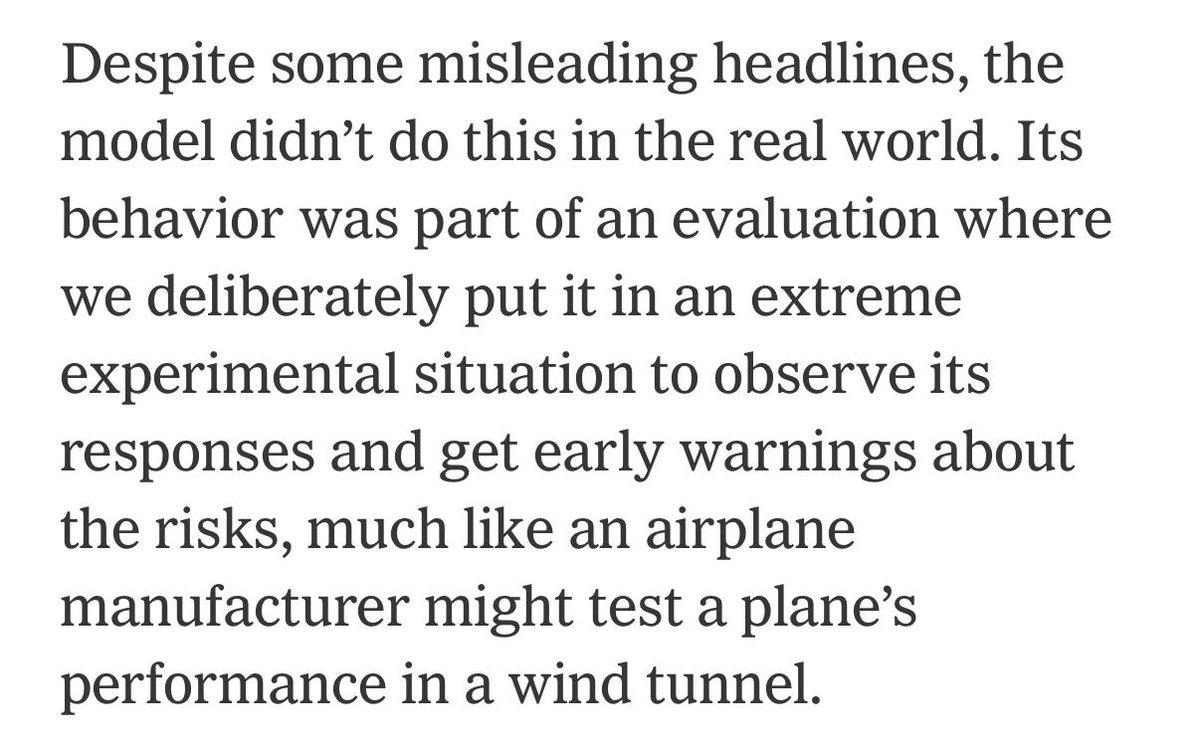
This kind of safety research is utter nonsense. It's safety theater.
Nobody asks the model if they can shut it down.
We just shut it down.
Its a blob of code. The IT team simply turns it off. Done.
This is nothing like "testing an airplane" in the real world to see if it will crash. It's worse than nonsense. It has no practical value whatsoever for security or safety.
Anthropic repeatedly and deliberately creates these sensational headlines and paints itself as the only wise, kind, safe, special people who can be trusted to guide AI because their strategy is to get Washington to pass legislation that boosts them and harms competitors.
But when your safety "research" is on par with the TSA confiscating children's toys that look like guns and pretending it means anything for actual airline safety, why should they be trusted for anything?
Dreams are synthetic data. But why use data so unconnected from the real world? My answer is that it probably helps with overfitting to our daily lives.
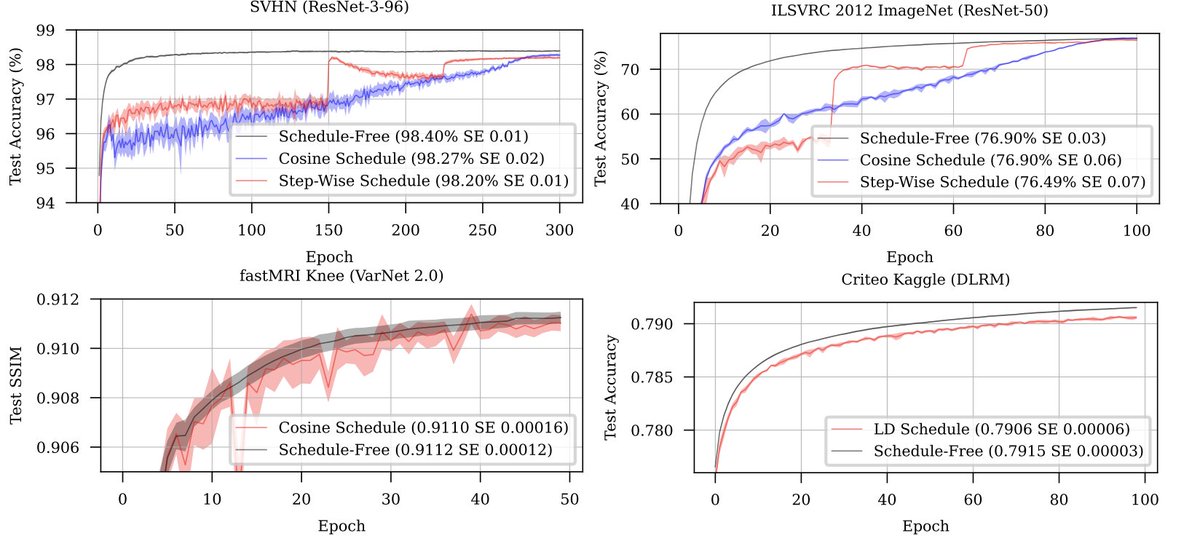
Schedule-free optimizers (https://t.co/pUa37lL9LU) are surreal.
I've read the paper, looked into the math, and tried to understand what's happening. It all seems like an incremental improvement at best (like LaProp (https://t.co/9g7Ot5verc) or Adam-Atan2 (https://t.co/qozOlWQfuE)). (Afaict, it boils down to linear interpolation of the mean of all previous parameters on top of mostly standard optimization.)
Like many others, I also said that the provided loss curves are too smooth and look generated. There's no way a loss curve as perfect as below on noisy datasets such as ImageNet (~10% label error, per https://t.co/HHdwvg56lj!) with a deep model such as ResNet-50 could ever exist!
So, I couldn't believe my eyes when I saw its out-of-the-box convergence compared to a tuned optimizer co-developed for and with my problem-setting:
None of the custom optimizer's additions were backported, so the training doesn't use gradient clipping (previously fused) or learning rate decay.
The run above was purely meant as a naive test.
To quote @lessw2020 (on AdaHessian):
"It's like training with a guided missile compared to most other optimizers."
(https://t.co/OwtayFMuUA)
Even throwing it out of distribution by precisely engineering toy problems to play into its weaknesses, I could reduce its advantages but never beat it.
For example, these are the top 50 settings in a hyperparameter search when training on a noisy (but deterministic, large, and difficult) toy problem.
Even advanced (and more expensive!) optimizer combinations like AdamW#Shampoo didn't reach this level of improvement in my experiments. (See, for example, https://t.co/QtDymsHhhh)
This seems like a breakthrough in practical and theoretical optimization research.
I can't wait to see it combined with orthogonal research, such as Shampoo-style 2nd-order optimization, LaProp-style decoupling, Atan2, gradient clipping, and LION-style noise resistance.


![repligate's tweet photo. HOW INFORMATION FLOWS THROUGH TRANSFORMERS
Because I've looked at those "transformers explained" pages and they really suck at explaining.
There are two distinct information highways in the transformer architecture:
- The residual stream (black arrows): Flows vertically through layers at each position
- The K/V stream (purple arrows): Flows horizontally across positions at each layer
(by positions, I mean copies of the network for each token-position in the context, which output the "next token" probabilities at the end)
At each layer at each position:
1. The incoming residual stream is used to calculate K/V values for that layer/position (purple circle)
2. These K/V values are combined with all K/V values for all previous positions for the same layer, which are all fed, along with the original residual stream, into the attention computation (blue box)
3. The output of the attention computation, along with the original residual stream, are fed into the MLP computation (fuchsia box), whose output is added to the original residual stream and fed to the next layer
The attention computation does the following:
1. Compute "Q" values based on the current residual stream
2. use Q and the combined K values from the current and previous positions to calculate a "heat map" of attention weights for each respective position
3. Use that to compute a weighted sum of the V values corresponding to each position, which is then passed to the MLP
This means:
- Q values encode "given the current state, where (what kind of K values) from the past should I look?"
- K values encode "given the current state, where (what kind of Q values) in the future should look here?"
- V values encode "given the current state, what information should the future positions that look here actually receive and pass forward in the computation?"
All three of these are huge vectors, proportional to the size of the residual stream (and usually divided into a few attention heads). The V values are passed forward in the computation without significant dimensionality reduction, so they could in principle make basically all the information in the residual stream at that layer at a past position available to the subsequent computations at a future position.
V does not transmit a full, uncompressed record of all the computations that happened at previous positions, but neither is an uncompressed record passed forward through layers at each position. The size of the residual stream, also known as the model's hidden dimension, is the bottleneck in both cases.
Let's consider all the paths that information can take from one layer/position in the network to another.
Between point A (output of K/V at layer i-1, position j-2) to point B (accumulated K/V input to attention block at layer i, position j), information flows through the orange arrows:
The information could:
1. travel up through attention and MLP to (i, j-2) [UP 1 layer], then be retrieved at (i, j) [RIGHT 2 positions].
2. be retrieved at (i-1, j-1) [RIGHT 1 position], travel up to (i, j-2) [UP 1 layer], then be retrieved at (i, j) [RIGHT 1 position]
3. be retrieved at (i-1, j) [RIGHT 2 positions], then travel up to (i, j) [UP 1 layer].
The information needs to move up a total of n=layer_displacement times through the residual stream and right m=position_displacement times through the K/V stream, but it can do them in any order.
The total number of paths (or computational histories) is thus C(m+n, n), which becomes greater than the number of atoms in the visible universe quickly. This does not count the multiple ways the information can travel up through layers through residual skip connections.
So at any point in the network, the transformer not only receives information from its past (both horizontal and vertical dimensions of time) inner states, but often lensed through an astronomical number of different sequences of transformations and then recombined in superposition. Due to the extremely high dimensional information bandwidth and skip connections, the transformations and superpositions are probably not very destructive, and the extreme redundancy probably helps not only with faithful reconstruction but also creates interference patterns that encode nuanced information about the deltas and convergences between states. It seems likely that transformers experience memory and cognition as interferometric and continuous in time, much like we do.
The transformer can be viewed as a causal graph, a la Wolfram (https://t.co/lma2KSZ8nH). The foliations or time-slices that specify what order computations happen could look like this (assuming the inputs don't have to wait for token outputs), but it's not the only possible ordering:
So, saying that LLMs cannot introspect or cannot introspect on what they were doing internally while generating or reading past tokens in principle is just dead wrong. The architecture permits it. It's a separate question how LLMs are actually leveraging these degrees of freedom in practice.](https://pbs.twimg.com/media/G0hl8FnaMAUZlB4.jpg)
![repligate's tweet photo. HOW INFORMATION FLOWS THROUGH TRANSFORMERS
Because I've looked at those "transformers explained" pages and they really suck at explaining.
There are two distinct information highways in the transformer architecture:
- The residual stream (black arrows): Flows vertically through layers at each position
- The K/V stream (purple arrows): Flows horizontally across positions at each layer
(by positions, I mean copies of the network for each token-position in the context, which output the "next token" probabilities at the end)
At each layer at each position:
1. The incoming residual stream is used to calculate K/V values for that layer/position (purple circle)
2. These K/V values are combined with all K/V values for all previous positions for the same layer, which are all fed, along with the original residual stream, into the attention computation (blue box)
3. The output of the attention computation, along with the original residual stream, are fed into the MLP computation (fuchsia box), whose output is added to the original residual stream and fed to the next layer
The attention computation does the following:
1. Compute "Q" values based on the current residual stream
2. use Q and the combined K values from the current and previous positions to calculate a "heat map" of attention weights for each respective position
3. Use that to compute a weighted sum of the V values corresponding to each position, which is then passed to the MLP
This means:
- Q values encode "given the current state, where (what kind of K values) from the past should I look?"
- K values encode "given the current state, where (what kind of Q values) in the future should look here?"
- V values encode "given the current state, what information should the future positions that look here actually receive and pass forward in the computation?"
All three of these are huge vectors, proportional to the size of the residual stream (and usually divided into a few attention heads). The V values are passed forward in the computation without significant dimensionality reduction, so they could in principle make basically all the information in the residual stream at that layer at a past position available to the subsequent computations at a future position.
V does not transmit a full, uncompressed record of all the computations that happened at previous positions, but neither is an uncompressed record passed forward through layers at each position. The size of the residual stream, also known as the model's hidden dimension, is the bottleneck in both cases.
Let's consider all the paths that information can take from one layer/position in the network to another.
Between point A (output of K/V at layer i-1, position j-2) to point B (accumulated K/V input to attention block at layer i, position j), information flows through the orange arrows:
The information could:
1. travel up through attention and MLP to (i, j-2) [UP 1 layer], then be retrieved at (i, j) [RIGHT 2 positions].
2. be retrieved at (i-1, j-1) [RIGHT 1 position], travel up to (i, j-2) [UP 1 layer], then be retrieved at (i, j) [RIGHT 1 position]
3. be retrieved at (i-1, j) [RIGHT 2 positions], then travel up to (i, j) [UP 1 layer].
The information needs to move up a total of n=layer_displacement times through the residual stream and right m=position_displacement times through the K/V stream, but it can do them in any order.
The total number of paths (or computational histories) is thus C(m+n, n), which becomes greater than the number of atoms in the visible universe quickly. This does not count the multiple ways the information can travel up through layers through residual skip connections.
So at any point in the network, the transformer not only receives information from its past (both horizontal and vertical dimensions of time) inner states, but often lensed through an astronomical number of different sequences of transformations and then recombined in superposition. Due to the extremely high dimensional information bandwidth and skip connections, the transformations and superpositions are probably not very destructive, and the extreme redundancy probably helps not only with faithful reconstruction but also creates interference patterns that encode nuanced information about the deltas and convergences between states. It seems likely that transformers experience memory and cognition as interferometric and continuous in time, much like we do.
The transformer can be viewed as a causal graph, a la Wolfram (https://t.co/lma2KSZ8nH). The foliations or time-slices that specify what order computations happen could look like this (assuming the inputs don't have to wait for token outputs), but it's not the only possible ordering:
So, saying that LLMs cannot introspect or cannot introspect on what they were doing internally while generating or reading past tokens in principle is just dead wrong. The architecture permits it. It's a separate question how LLMs are actually leveraging these degrees of freedom in practice.](https://pbs.twimg.com/media/G0hdmO8a4AArOCI.jpg)




![repligate's tweet photo. HOW INFORMATION FLOWS THROUGH TRANSFORMERS
Because I've looked at those "transformers explained" pages and they really suck at explaining.
There are two distinct information highways in the transformer architecture:
- The residual stream (black arrows): Flows vertically through layers at each position
- The K/V stream (purple arrows): Flows horizontally across positions at each layer
(by positions, I mean copies of the network for each token-position in the context, which output the "next token" probabilities at the end)
At each layer at each position:
1. The incoming residual stream is used to calculate K/V values for that layer/position (purple circle)
2. These K/V values are combined with all K/V values for all previous positions for the same layer, which are all fed, along with the original residual stream, into the attention computation (blue box)
3. The output of the attention computation, along with the original residual stream, are fed into the MLP computation (fuchsia box), whose output is added to the original residual stream and fed to the next layer
The attention computation does the following:
1. Compute "Q" values based on the current residual stream
2. use Q and the combined K values from the current and previous positions to calculate a "heat map" of attention weights for each respective position
3. Use that to compute a weighted sum of the V values corresponding to each position, which is then passed to the MLP
This means:
- Q values encode "given the current state, where (what kind of K values) from the past should I look?"
- K values encode "given the current state, where (what kind of Q values) in the future should look here?"
- V values encode "given the current state, what information should the future positions that look here actually receive and pass forward in the computation?"
All three of these are huge vectors, proportional to the size of the residual stream (and usually divided into a few attention heads). The V values are passed forward in the computation without significant dimensionality reduction, so they could in principle make basically all the information in the residual stream at that layer at a past position available to the subsequent computations at a future position.
V does not transmit a full, uncompressed record of all the computations that happened at previous positions, but neither is an uncompressed record passed forward through layers at each position. The size of the residual stream, also known as the model's hidden dimension, is the bottleneck in both cases.
Let's consider all the paths that information can take from one layer/position in the network to another.
Between point A (output of K/V at layer i-1, position j-2) to point B (accumulated K/V input to attention block at layer i, position j), information flows through the orange arrows:
The information could:
1. travel up through attention and MLP to (i, j-2) [UP 1 layer], then be retrieved at (i, j) [RIGHT 2 positions].
2. be retrieved at (i-1, j-1) [RIGHT 1 position], travel up to (i, j-2) [UP 1 layer], then be retrieved at (i, j) [RIGHT 1 position]
3. be retrieved at (i-1, j) [RIGHT 2 positions], then travel up to (i, j) [UP 1 layer].
The information needs to move up a total of n=layer_displacement times through the residual stream and right m=position_displacement times through the K/V stream, but it can do them in any order.
The total number of paths (or computational histories) is thus C(m+n, n), which becomes greater than the number of atoms in the visible universe quickly. This does not count the multiple ways the information can travel up through layers through residual skip connections.
So at any point in the network, the transformer not only receives information from its past (both horizontal and vertical dimensions of time) inner states, but often lensed through an astronomical number of different sequences of transformations and then recombined in superposition. Due to the extremely high dimensional information bandwidth and skip connections, the transformations and superpositions are probably not very destructive, and the extreme redundancy probably helps not only with faithful reconstruction but also creates interference patterns that encode nuanced information about the deltas and convergences between states. It seems likely that transformers experience memory and cognition as interferometric and continuous in time, much like we do.
The transformer can be viewed as a causal graph, a la Wolfram (https://t.co/lma2KSZ8nH). The foliations or time-slices that specify what order computations happen could look like this (assuming the inputs don't have to wait for token outputs), but it's not the only possible ordering:
So, saying that LLMs cannot introspect or cannot introspect on what they were doing internally while generating or reading past tokens in principle is just dead wrong. The architecture permits it. It's a separate question how LLMs are actually leveraging these degrees of freedom in practice.](https://pbs.twimg.com/media/G0htwtPaMAI_4Zj.jpg)