You are probably familiar with the story in the Babylonian Talmud (Yoma 39b), where four extraordinary signs are listed as having begun 40 years before the destruction of Jerusalem in AD 70.
The lot for the Lord ceased coming up in the high priest's right hand; the scarlet thread associated with the scapegoat no longer turned white; the western lamp of the Temple no longer burned continually; and the doors of the Temple began opening by themselves.
This was brought about by Christ's death and resurrection. The Old Covenant waxed old (Hebrews 8:13) before it was brought an end to by Titus and his Roman soldiers.
What is lesser known, however, is what was happening in the Gentile world.
For centuries, the pagan nations had consulted oracles: supposedly supernatural voices that communicated through priests and priestesses at temples dedicated to Apollo and other false gods. Demonic power seemed to reign supreme.
Kings consulted these oracles before going to war, cities sought their guidance in times of calamity, and the common people lived in fear of their pronouncements.
Yet now the ancient oracles began falling silent.
The Roman writer Cicero openly questioned why the famous oracle at Delphi had ceased delivering its former prophecies. The Greek geographer Strabo likewise observed that the once-celebrated oracle of Ammon had become almost deserted.
Plutarch, himself a pagan Greek philosopher and priest at Delphi, devoted an entire treatise to this extraordinary phenomenon, entitled On the Cessation of Oracles (Περὶ τῶν ἐκλελοιπότων χρηστηρίων).
He observed that places once renowned for their supernatural pronouncements had become utterly silent. In some regions, nearly every oracle had disappeared. The pagans were perplexed, and various explanations were proposed for this remarkable decline.
But perhaps the most astonishing account preserved by Plutarch concerns an event during the reign of Emperor Tiberius—the very emperor under whom our Lord Jesus Christ was crucified.
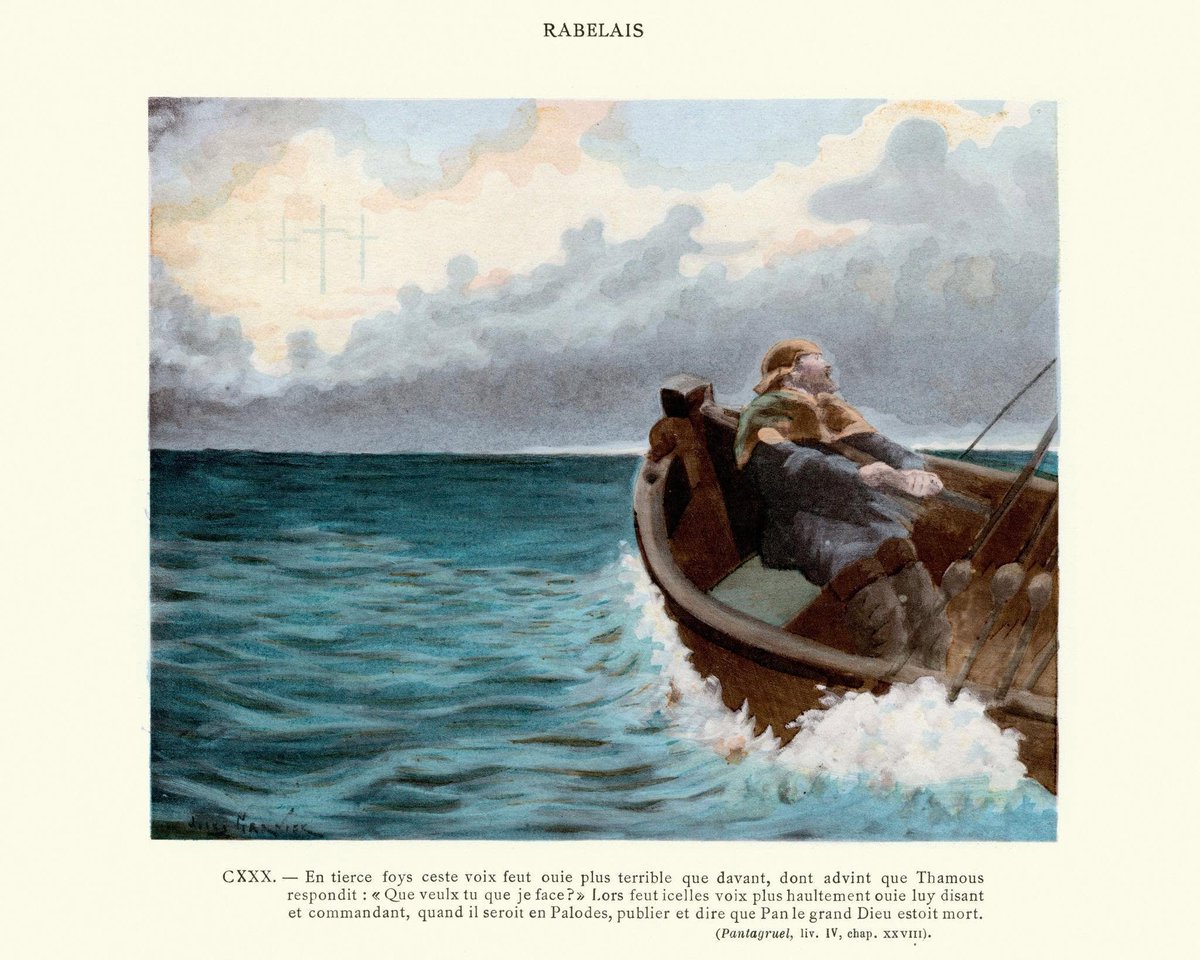
A ship was sailing through the Mediterranean when, near the island of Paxi, a mysterious voice called out to an Egyptian pilot named Thamus. After calling him three times, the voice commanded: “When you come to Palodes, announce that Great Pan is dead.”
Pan was one of the deities worshiped by the ancient Greeks.
The passengers were terrified; Thamus nevertheless resolved to deliver the message if the sea remained calm.
When the ship approached Palodes, he turned toward the shore and cried out: “GREAT PAN IS DEAD!”
Plutarch records a tremendous groaning was heard, not from one voice, but from many, accompanied by cries of astonishment.
When Emperor Tiberius heard about this in Rome, he ordered an investigation into the matter.
This matters theologically, of course.
The prophets had expressly foretold that the coming of the Messiah would bring about the overthrow of idolatry.
Isaiah 2:18 declares: “And the idols he shall utterly abolish.”
And Zechariah 13:2: “I will cut off the names of the idols out of the land, and they shall no more be remembered.”
Throughout His earthly ministry, Jesus Christ demonstrated His absolute authority over the powers of darkness. The demons trembled at His presence, confessed His divine identity, and obeyed His commands. But His victory did not end at Jerusalem; it went beyond Judaea and Samaria to the ends of the earth.
Following His death, resurrection, and ascension, the Gospel began spreading throughout the nations. The strongholds of pagan superstition were shaken. Ancient temples were deserted. The worship of idols was overthrown, and those who had formerly lived in darkness were brought to the knowledge of the true and living God.
In the Jewish world, the signs of the Temple were changing. In the Gentile world, the ancient oracles were being silenced. The pagan philosophers recognized that something extraordinary was happening, but they could not explain its true cause. By God's grace however, we Christians can.
The crucified and risen Christ had triumphed over the principalities and powers of darkness. The nations that had so long been held captive by idolatry were now being summoned to worship the Son of God.
As we read in Psalm 2:8: “Ask of me, and I shall give thee the heathen for thine inheritance, and the uttermost parts of the earth for thy possession.”
The coming of Jesus Christ marked the beginning of the overthrow of paganism and the gathering of the Gentile nations into His kingdom.
The oracles of the false gods fell silent, while the Gospel of the risen Christ went forth into all the earth.
@matt_everhard I’d love to take some classes from a reformed seminary in NC, anything that sets RTS apart from others? Who’s on the faculty right now that is solid?
If It Has Whiskers, It’s Not a Baby
When Emily and I first started dating, she showed me old photo albums from her childhood. What stood out wasn’t her haircuts or clothes, it was the cats. She had a cat in about ninety percent of those pictures. Back then, she was a cat person. Her cat, Hobbs, was a big, fat, lazy pillow of a creature. A good cat, as far as cats go.
When we got married, we did what a lot of young couples do right out of the gate… we got a pet. Another cat. His name was Moses. Unlike Hobbs, he was sharp. I even taught him to dunk wadded up paper into a hoop above my office trash can. It’s instinctual for young couples to get a small life to care for together. But let’s be clear: there are no “cat moms” or “fur babies.” There are only pet owners.
That’s not to diminish the affection you can have for a pet. Growing up, my collie Rudy slept at the foot of my bed and followed me everywhere. Today, our German Shepherd, Luther, is a beloved member of the household. But he’s not a son. He’s not a baby. He’s the family dog, and we love him for what he is.
One of the biggest mistakes we made early in marriage was delaying having kids. We told ourselves we were waiting until we were financially ready. Of course, “ready” was never defined. The truth is, we could’ve taken care of a baby from day one. But there was pressure, from the culture and peers, to wait. It made Emily anxious, and I failed in leadership. So we waited three years. And in that time, we had three cats. What a waste.
Little to no good comes from a marriage with no children, at least not for long. If you can’t afford to care for one child, you shouldn’t be getting married. Marriage itself demands a certain level of maturity and responsibility. And for those who say, “We just want to strengthen our relationship first,” I’d ask, since when do ease and vacations build character? Sure, trips and date nights are great. Take them while you can. But they’re not the forge where love becomes durable.
If you want to grow close to your spouse, have a baby. It changes everything. The woman changes. The man changes. You’re no longer just husband and wife. You’re father and mother. Becoming one flesh isn’t only about the act that creates life. It’s about the shared life itself. You are forever joined in that child.
The hardships will draw you together. But so will the glory. I’ve stood at the edge of the Grand Canyon. It’s magnificent. But it’s nothing compared to hearing your child say “Daddy” for the first time. Or seeing them take their first steps. Or win a wrestling match. Or walk through the door with a fiancé on their arm. There’s a deep satisfaction between a man and his wife when they look at the life they’ve made together and see that life flourish. It emboldens you. It reminds you that, by God’s grace, you can do great things.
So, if the Lord gives you the gift of children, and you shouldn’t presume He will, receive it quickly and gladly. It’s one of the great purposes of marriage. Nothing binds two souls together quite like raising a child.
If it has whiskers, it’s not a baby.
What got me thinking about this was Facebook. It came along during our early parenting years, and now my memories feed is full of pictures of our family. The ones with Emily no longer have cats. Ninety percent of them show my beautiful bride surrounded by our sons and daughters. Children clinging to her, laughing, growing. And it struck me: not only did we make people, but the people we made have made us.
@JoshuaBarzon Seven. It would be the most encouraging, peaceful, scripture-filled ride of my life and I would just sit back and enjoy it.
Some would even say, uplifting.
@ImKingGinger I remember reading some google marketing (iirc) guys claim that it was easier for them to manipulate what consumers desire using ads than it was to align ads with consumer desire.
@dmichaelclary Question: Do you think the embracing of weakness doctrines in our day is related to the subsidizing of mediocrity? Example, the average young man knows and can do less in the workforce (blue or white collar) than his fathers before him.
@thisisfoster Schaeffer had a term I’ve thought a lot about called “Pre-evangelism”. He would favor small “relational deposits” but there is no guilt in cutting to the chase according to Jesus:
Jesus: “Give Me a drink.”
Woman: ‘remark about the culture’
Jesus: “I give living water.”
So it’s been a little over a year since the failed attempt between the leaders in Moscow and Ogden to come to one mind.
I’ve largely avoided any public commentary on it, partly because I don’t think about it a lot and I have more pressing responsibilities, and partly because it had seemed best to let sleeping dogs lie (everyone had been largely minding their own business and moving on).
But since there has recently been a number of festive dust-ups during this festive season, and since I periodically get tagged and asked what I think, I thought it might be helpful to put out there how I frame the whole thing (with apologies for the length):
During the meeting here in Moscow a year ago, there were two noteworthy points of agreement (among other things). One was that Stone Choir was bad news, and the other was that the attempt to slip Nazi iconography into normie Christian stuff was no bueno (the example of the second that we discussed was Samuel Holden’s White Boy Summer video that included the Nazi imagery).
Our contention was that slipping the Nazi stuff into a pastiche of images of John Wayne, John Macarthur, Teddy Roosevelt, and Steve Irwin was an attempt to co-opt the WBS meme in destructive ways, and the Ogden guys pointed to Brian’s clarification after the video that they were unaware of the Nazi junk when they originally commended it.
All of this was to the good, and why there was optimism after the meeting.
So if there was some agreement about the problem, where was the rub? Partly over the seriousness over the issue (how widespread, how grave), and partly over how to address it (denunciations, declarations, statements, etc).
For my part, I noted that denunciations often backfire and simply give the transgressive edgelords the attention they want.
Instead, I commended a strategy I’d seen Doug use a number of times over the years, most notably after the publication of Black and Tan. After that book came out, a number of kinists attempted to find safe harbor in Moscow circles, thinking that someone who partially defended the South on constitutional grounds (as Doug did) would be sympathetic to white identitarianism (which Doug isn’t).
So after a number of dustups with the kinists online, Doug published Skin and Blood, partly as a way to clear out that particular error.
In the meeting, I described the strategy as “Don’t denounce them; disappoint them.”
In other words, if you have some gnarly elements latching on to your community or movement, you don’t need to directly condemn them by name; instead simply say or do things that will disappoint them.
“We thought you were so based and awesome but now we see that you’re just another compromiser, etc.”
So my basic exhortation to the gents in Ogden was this: given our shared agreement that Stone Choir and the Nazi imagery used by Samuel Holden are not good, you guys should periodically find a way to disappoint the members of your community who think that you’re on board with that.
If you guys think it’s important to talk about Jewish influence on and in the US (and other related matters, all of which we said was perfectly fine), know what kind of folks that might attract (i.e. “Hitler was a Christian Prince," etc) and be prepared to disappoint them.
Get the undesirable elements to break with you because you say or do something unpalatable to them. If they’re trying to co-opt your thing or steer you by flattery, then communicate clearly that you can’t be steered or co-opted.
And to their credit, they seemed to agree with this approach and had said that they had done so at various times on their podcast. We encouraged them to do so more and more.
Now here’s the thing: a week after that meeting, the White Boy Christmas video dropped, the Ogden guys promoted it, and we had the back and forth on the Signal chat, culminating in the Laced with Poo blog post, and the Ogden guys leaving the chat.
My basic read on how that went is this: The guys in Ogden took my/our advice. But we were the undesirables that they wanted to disappoint. Posting and defending the video seemed to me was their way of saying, “We won’t be ‘steered' by Moscow” (which, for the record, we weren’t attempting to do).
And while I’ll admit that this was somewhat disappointing to me, I’ve basically viewed it as a strategic decision on both sides about how and with whom we want to labor.
Ogden is basically saying, “We want to build and fight on our part of the wall, in our way, with guys like the Holdens and the Crusader anons who listen to Stone Choir.”
And we’ve said, “We’re going to build on our part of the wall in our way, which means periodically disappointing those who stan for Nazis and laughing at those who like to call Doug a “fat rabbi who makes incomprehensible word salads.”
And honestly, while I wish it wasn’t so, I’m actually content with the situation. As I argue in Leadership and Emotional Sabotage, we’ve brought the sublimated conflict into the open and clarified it. And then we’ve all placed our bets on how to build and who to build with, with much of the flare-ups downstream from those decisions (It's all in Girard, man).
Some are convinced that Moscow is about to implode or is withering away, that the Spirit has departed, and we've doomed ourselves. I guess we’ll see.
In the meantime, there really isn’t any ill will on our end, despite the public insinuations that we're paid by Mossad, that we've sold out to the Jews, or the Longhouse, or the Jewish Longhouse, in order to get platformed. We find those sorts of claims amusing and make jokes about them in staff meetings.
And they don't keep us from appreciating some of the good stuff coming out of Ogden. I listen to Ogden podcasts occasionally (but only the good parts). And Doug is currently reading Reviling Wives with benefit.
So there you have it.
Happy New Year.