HF after TAVR has 5 drivers. Two are on the valve prosthesis factors (pacers, PVL, PPM, dysfunction) and incomplete remodeling. duravr so far: 4.5–6% pacers at 30d, 0% mod+ PVL, 0% severe PPM, LV mass −18% on MRI. Fix what the valve can fix. $AVR
Despite successful TAVR for severe AS, heart failure remains a major challenge. This review highlights its multifactorial mechanisms, predictors, and management strategies to improve long-term outcomes.
By Hideki Kitahara
https://t.co/REmxv4EIHf
#circ_j#CardioX
This thing has my heart rate begging for a beta blocker 😅 #Ferrari#296ChallengeStradale#296Speciale One simply cannot own enough of these track monsters. Can’t decide what color or spec but nevertheless an exciting opportunity to keep my occupied
https://t.co/EFDczIvnqR
$MDT back in tuck-in mode? Meanwhile they already own 16% of $AVR Wheels are greased. 1 yr data on 100 pts drops Sunday.
Let’s go we don’t care how shitty these markets are strategics usually take advantage these times.
$MDT to Acquire Contego for $380M+; Bolsters Carotid Portfolio MDT announced its intent to acquire Contego Medical for $380M plus potential payments, adding Neuroguard IEP Direct to its portfolio and expanding its carotid offering. deal builds on a relationship dating to 2020 $AVR coming ?
Warren Buffett: "Even if a stock drops 50%, there's no need to panic."
Investor: "What should you do when a stock drops 50%?"
Buffett: "First, you need to understand what a stock really is."
Investor: "What do you mean?"
Buffett: "If you buy stocks, you must be mentally prepared for them to fall 50% or even more."
Investor: "But doesn't that mean losing half your money?"
Buffett: "Yes."
Investor: "Wouldn't most people panic and want to sell?"
Buffett: "In fact, Berkshire Hathaway's stock has fallen by roughly 50% on three separate occasions."
Investor: "Really? Even Berkshire?"
Buffett: "Yes."
Investor: "Was there something wrong with the business?"
Buffett: "No. There was nothing fundamentally wrong with the business."
Investor: "Then why did the stock price collapse?"
Buffett: "Because stock prices and business values don't always move together."
Investor: "Even so, a 50% drop is terrifying."
Buffett: "That's exactly why you should never buy stocks with borrowed money."
Investor: "Why not?"
Buffett: "Because when prices fall, you may not be able to handle the pressure."
Investor: "So when is the right time to buy?"
Buffett: "Nobody can predict the bottom. Nobody."
Investor: "So buying today doesn't necessarily mean I've made the right decision?"
Buffett: "Of course not."
Investor: "And you would still invest?"
Buffett: "Because I look at investments with a 20- or 30-year time horizon."
This is something every investor should think about.
Of course, this doesn't mean every stock deserves to be held forever.
If a company's business performance or long-term outlook deteriorates, selling may be the right decision.
But many investors make the mistake of panic-selling simply because the stock price is falling.
The hardest part of investing isn't buying at the bottom or selling at the top.
It's staying rational when the market is falling and knowing whether the businesses you invested in are still worth believing in.
A market crash is where an investor's mindset is truly tested.
( lf this helps you, like + follow + share. )
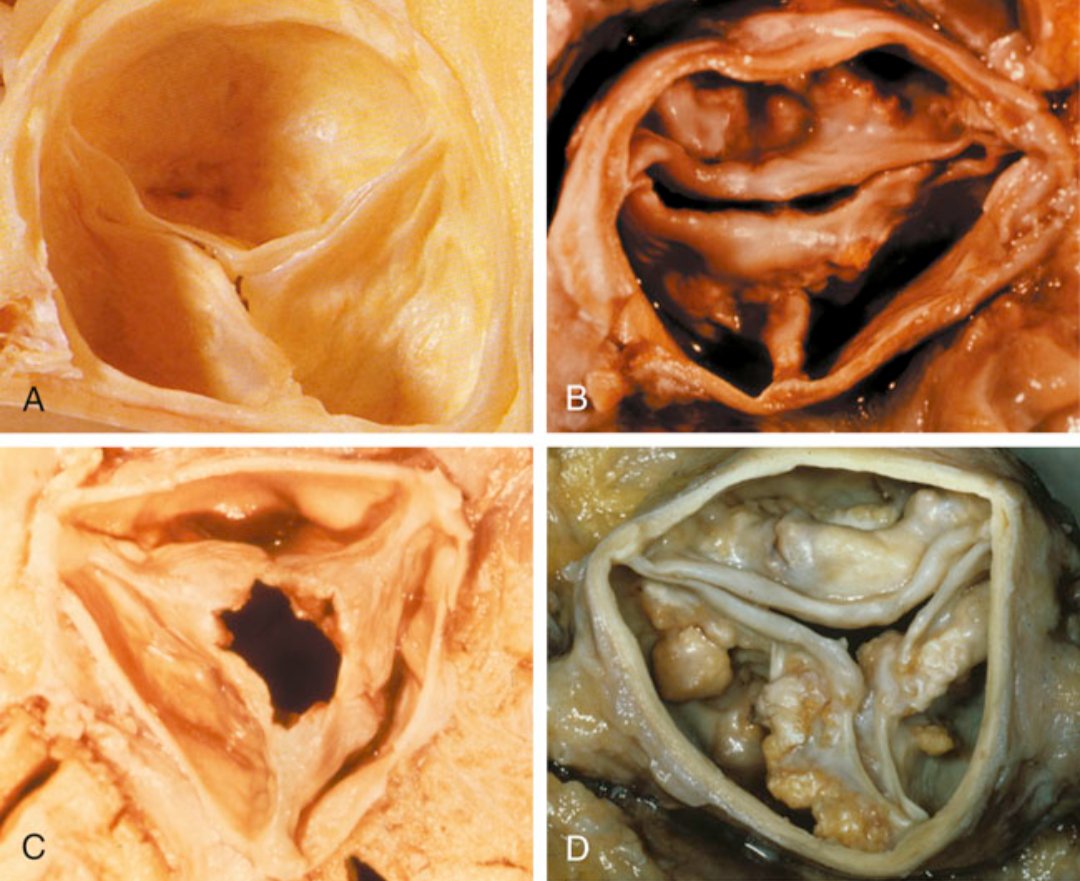
AORTIC STENOSIS: 4 IMPORTANT PATHOLOGICAL FEATURES EVERY CARDIOVASCULAR CLINICIAN SHOULD KNOW
Aortic stenosis (AS) is a narrowing of the aortic valve that obstructs blood flow from the left ventricle into the aorta.
There are three major causes:
1. Congenital bicuspid aortic valve
- The valve has two functional leaflets instead of three.
- Often develops calcification and stenosis earlier in life.
- A common cause of AS in younger patients.
2. Rheumatic aortic stenosis
- Results from inflammation and scarring.
- Commissural fusion and leaflet thickening restrict valve opening.
- May coexist with rheumatic mitral valve disease.
3. Calcific aortic stenosis
- The most common cause in older adults.
- Characterised by progressive leaflet thickening and calcium deposition.
- Can affect a previously normal trileaflet valve or a congenital bicuspid valve.
Aortic sclerosis is not the same as aortic stenosis.
Aortic sclerosis involves leaflet thickening or calcification without significant obstruction.
However, it can progress to stenosis. The source reports an estimated progression rate of approximately 1.8–1.9% per year.
Important epidemiological facts:
- Approximately 1–2% of people aged ≥65 have calcific AS.
- Approximately 12% of people aged ≥75 have calcific AS.
- Severe AS affects approximately 3.4% of people aged over 75.
Why does it matter?
As the valve becomes progressively narrower, the left ventricle must generate higher pressure to maintain forward blood flow.
This increases LV afterload, promotes concentric hypertrophy and may eventually lead to LV dysfunction and heart failure.
CLINICAL TAKEAWAY
When assessing aortic stenosis, remember its three major causes: bicuspid valve, rheumatic disease and calcific degeneration.
Recognising the underlying pathology helps explain the patient's age, associated valve abnormalities and disease progression.
#Cardiology #AorticStenosis
A fantastic new issue ahead of PCR London Valves 2026! 🔥
Packed with state-of-the-art reviews, latest clinical evidence, emerging technologies and challenging cases across TAVI, TMVR and tricuspid interventions.
@PCRonline@EuroInterventio#PCRLV@EIJCaseReports
@FlowFundamental Even a leading TAVR KOL didn't think laminar flow was possible after TAVR: "Could you actually imagine laminar flow? I didn't think you could." Dr. Azeem Latib, EuroPCR 2024
Worth the watch. A gold mine $AVR
https://t.co/hOg58HWEN9
And it's not just the leaflets right? it's the jet. Bicuspid valves fire an eccentric jet into the aortic wall, and 4D-flow MRI ties that wall stress to dilation. Opening the valve is half the job. Restoring central, laminar flow is the other half. $AVR
BICUSPID AORTIC VALVE: MORE THAN JUST A TWO-LEAFLET VALVE
Did you know that the most common congenital aortic valve abnormality affects approximately 1–2% of the population?
A bicuspid aortic valve (BAV) has two functional cusps instead of the normal three.
1. Recognising the anatomy
There are three main cusp-fusion patterns:
- Right–left coronary cusp fusion (RC–LC): The most common pattern, accounting for approximately 70–80%.
- Right–noncoronary cusp fusion (RC–NC): Approximately 20–30%.
- Left–noncoronary cusp fusion (LC–NC): Rare.
A raphe may be present at the line where the two cusps have fused. Its presence can make the valve appear tricuspid when viewed in diastole.
2. Important epidemiological facts
- Prevalence: approximately 1–2%.
- Male predominance: approximately 3:1.
- First-degree relatives: around 9% prevalence.
This highlights the importance of family screening.
3. Associated conditions
BAV may occur in isolation or alongside:
- Aortic dilatation and aneurysm.
- Coarctation of the aorta.
- Other congenital heart defects.
- Genetic syndromes, including Turner syndrome.
4. Major complications
Many patients remain asymptomatic for years. However, BAV can lead to:
- Aortic stenosis, often presenting earlier than in tricuspid valves.
- Aortic regurgitation.
- Infective endocarditis.
- Aortic dilatation and, less commonly, dissection.
BAV is also a major contributor to the need for aortic valve replacement.
5. Why is surveillance important?
The abnormal valve architecture creates altered blood flow and increased leaflet stress, potentially accelerating calcification.
Follow-up should assess both:
- Valve function: stenosis and regurgitation.
- Aortic dimensions: root and ascending aorta.
Echocardiography is central to assessment, with CT or MRI used when further aortic imaging is needed.
CLINICAL TAKEAWAY
When you diagnose a bicuspid aortic valve, do not stop at describing the two cusps.
Assess the valve function, identify the fusion pattern, examine the entire thoracic aorta and consider screening first-degree relatives.
BAV is a valve disease and an aortopathy.
"non-laminar, turbulent flow post-TAVI may limit the reduction in LV afterload and cardiac remodelling." duravr is named as the biomimetic platform aiming for physiological flow $AVR
Transcatheter heart valve design, hemodynamic performance and durability are key considerations in contemporary aortic valve replacement. This review examines current evidence and approaches to valve assessment, highlighting differences across platforms, challenges in performance interpretation, limitations of comparative studies and future perspectives. https://t.co/tjxSgzCO8x
NEW ISSUE ONLINE - PCRLV edition 🚨
- A State-of-the-Art on bioprosthetic THV performance; - Designing interpretable procedural trials;
- Midterm outcomes of valve-in-valve TAVI;
- Anterior mitral leaflet modification in TMVR;
- Trisol Study;
- TTVR after failed T-TEER;
- Early right ventricular response after TTVR;
- BAV phenotypes and TAVI feasibility;
- The "crack-LLAMACORN" technique;
- Case volume and hospital mortality in TAVI;
- Biventricular pressure-volume responses to TTVR;
and more
https://t.co/Ap3ZwzSZNu
@PPibarot@VDelgadoGarcia@DaijiroTomii@G_Tarantini01@rafa_romaguera@PradeepYadavMD@amin_polzin@KP_Kresoja@CurioJonathan@tartagliafra@drgocchipinti@AnderRegueiro
🚨 BREAKING:
Morgan Stanley says it's time to go "max overweight" on stocks.
The last 2 times they called this was in October 2008 and December 2011 for emerging markets.
Here's what happened next:
October 2008: Emerging markets crashed -46% in 2 months.
December 2011: Emerging markets went sideways for 9 years.