We're giving 30 creators $5,000 each in platform credit to launch their pools.
Use it all on one pool or spread it across several. When a pool graduates, you earn trading fees on the position your credit funded.
Apply below.
Mainnet is arriving this September and the window to participate in the "Gno and Tell" content competition is wide open (ends in a day).
Whether you are breaking down the elegance of GnoVM or pitching a revolutionary on-chain use case, now is the time to put your insights to work and claim your share of the $1,000 $GNOT prize pool.
So Dive into the docs, build your thesis, and let’s show the world what happens when millions of Go developers finally get a platform built for them⚛️.
@_gnoland $GNOT #Gnoland #GnoWhatMatters
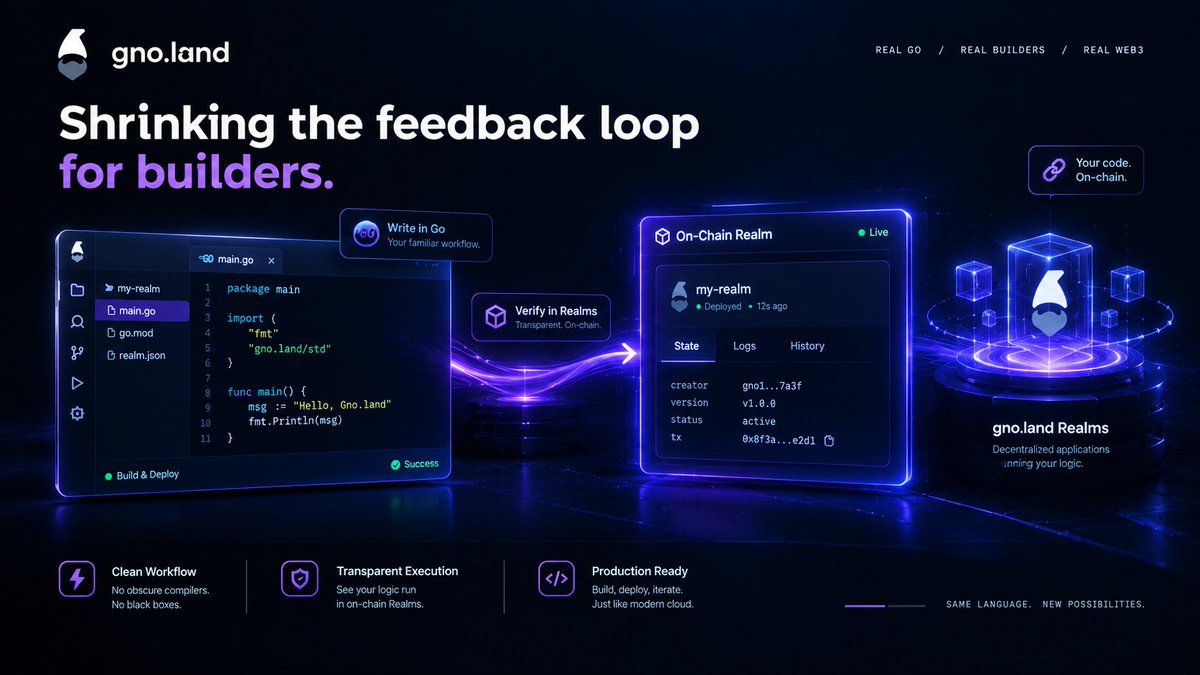
The ultimate competitive advantage here is how drastically it shrinks the feedback loop for builders.
In traditional Web3 development, a massive chunk of engineering time is wasted fighting the compiler, auditing bespoke syntax quirks, or dealing with opaque deployment errors unique to niche L1s!
But with @_gnoland, your workflow looks identical to building a modern cloud microservice: write your code, verify the logic within transparent on-chain Realms, and deploy.
No guessing games, no black-box bytecode, just pure and structured backend logic executing securely on a high-performance decentralized ledger🚀🚀.
Let's dive deeper into the mechanics of execution efficiency and why the architecture matters...
Because GnoVM interprets source code directly without bogging down the developer with heavy compilation pipelines, and because it runs on top of a re-engineered Tendermint2 consensus engine, builders get lightning-fast finality paired with a battle-tested type system.
Go's clean syntax and predictable concurrency models mean you can architect robust, scalable distributed systems without wrestling with obscure virtual machine edge cases. It brings the performance and predictability of enterprise-grade backend infrastructure straight into a trustless execution environment⚡.
THE CORE THESIS.
Instead of forcing developers to abandon everything they know to learn hyper-specific, error-prone languages like Solidity or Rust, @_gnoland introduces a smarter paradigm.
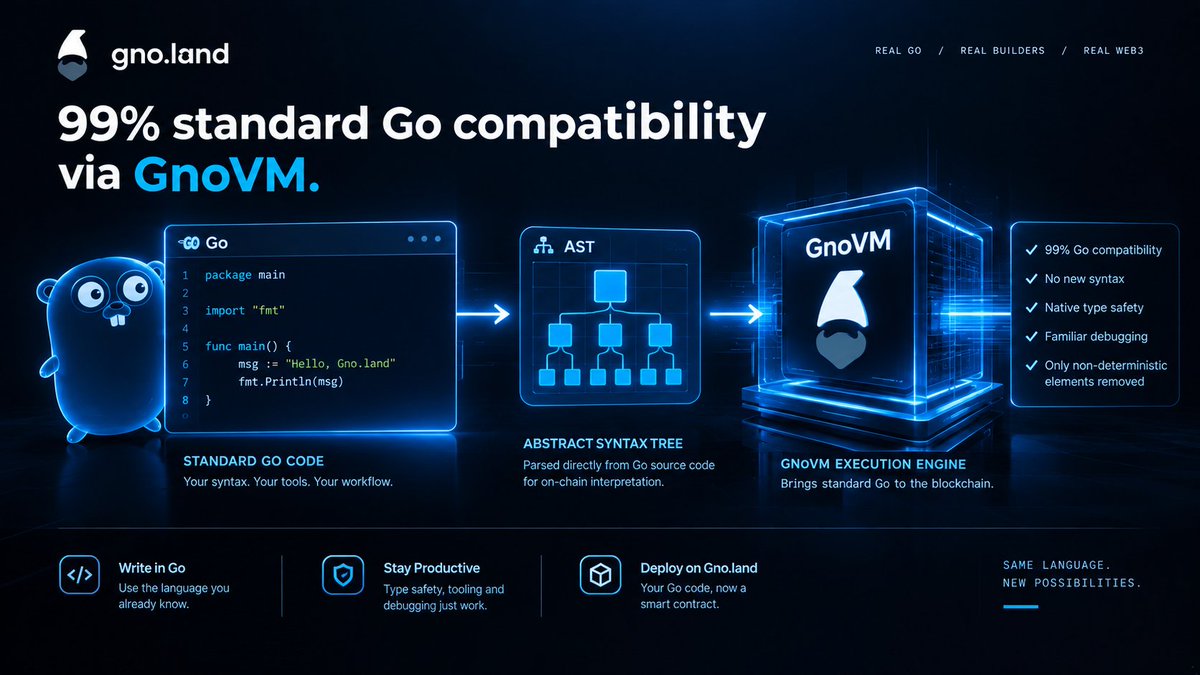
At its core is GnoVM : a powerful execution engine that parses standard Golang source code directly into an Abstract Syntax Tree (AST) for on-chain interpretation.
You get roughly 99 percent compatibility with standard Go; meaning your syntax, type safety, and debugging intuition carry over seamlessly, while stripping out only the non-deterministic elements that break consensus.
You aren't learning a brand-new syntax from scratch; you are simply writing native Go that happens to live on a decentralized Layer 1. 🔍📉
Web3 has a massive distribution problem that the industry refuses to talk about;
Globally, there are roughly 20 million are roughly 20 million JavaScript/Go/Python developers globally; Yet, less than one percent of them ever write smart contracts.
Why?
Because the barrier to entry is artificially inflated by niche, highly restrictive languages and fragmented toolchains that treat developer experience as an afterthought.
@_gnoland is fundamentally rewriting that equation at the protocol level, bridging the gap between mainstream enterprise software and decentralized systems just in time for its September mainnet.
Here is a deep-dive look into why its tech stack changes the game for builders everywhere in the world! 🧵👇
$GNOT #Gnoland #GnoWhatMatters