Stanford researchers tested people’s DNA, then lied to them about the results.
Those told they had better genes found exercise easier and produced more of a fullness hormone after the same meal.
Their genes stayed the same. Their bodies did not 🧵1/8
What a beautiful read!
Makes me wonder how humanity will address these issues. More optimal brains are more happy brains -- in which ways will this happen? Eugenics? AI as an enhancer of cognition?
Will brains of future minds have visual cortices in the frontal lobe?
🔥Our opinion piece with @DuncanAstle on “why we might be better off accepting and embracing the fact that the brain’s connectivity profile is in no way optimal” is now out on @TrendsCognSci. There, we discuss implications for Neuro-AI and psychopathology.
https://t.co/ysXhg7gT2A
Your brain is not shaped by a single decision. It is shaped by thousands of exposures accumulating across decades.
Every night of poor sleep.
Every chronic stress cycle.
Every city you lived in.
Every relationship.
Every hormone fluctuation.
Every period of cognitive overload.
Neuroscience now refers to this as the exposome.
The total environmental and biological load acting on your brain across your lifespan.
What most people experience as “intuition” or “mental sharpness” is often the visible output of invisible exposures interacting with neural architecture for decades before the moment arrives.
Your cognitive performance did not emerge in isolation.
It was built.
Omega-3s may be one of the most powerful dietary tools for resolving inflammation and slowing biological aging
In a 3-year randomized trial of healthy older adults, omega-3 alone slowed epigenetic aging, while vitamin D and resistance training alone did not
But the biggest effect came when all three were combined: omega-3, vitamin D, and resistance training slowed biological aging by about 3.8 months
That may sound small, but it reflects a slower pace of aging that could compound over time
The combo was also linked to ~40% lower pre-frailty and 61% lower invasive cancer incidence
Turns out, dressing the part might change how you think.
Wearing a lab coat improved attention… but only when people believed it was a doctor’s coat, not a painter’s coat.
Clothes are not just style, they are cues for your brain.
The Knowledge Mapper is an interactive tool designed to visualize the entirety of human understanding by mapping every fact a user knows.
https://t.co/HC8BbLmRVs
What an exciting task for future generations!
This content tsunami requires us to select whats relevant. Sadly, we don't have all the time to select the best content
The way may be via trusted people (content selectors) or well known stories (India's recreation of Forest Gump)
Stanford neuroscientists Dr. David Eagleman says AI will have a problem with selection
AI is massively creative. The part of creativity that AI can’t do right now is selection… meaning, it can generate 100 pictures, but it doesn’t know which one to pick.”
“It doesn’t know which one is going to be the most appealing to you, but it can remix beautifully.”
“When it generates the pixels, it’s doing this magical stuff under the hood where it’s deciding which pixels and how they diffuse together to make the image.
But it doesn’t know how to read that image… it’s not seeing the image except as a bunch of pixels.”
Sci-Hub is an evil website that pirated 85M+ research papers and made them freely available
And now they've added AI to their database to make Sci-Bot.
It answers your questions using latest, full-text articles.
But DO NOT use it. We should all try to make billion-dollar academic publishers richer.
I'm putting the link below so you know how to avoid it.
@hubermanlab@AliaCrum@Stanford How do you find the balance?
Tracking sleep can help find better rhythms. But it can condition how one feels about their sleep and lead to nocebo effect. Even worse, however, is to accumulate sleep deficit, no matter how much of a golden retriever one feels about it.
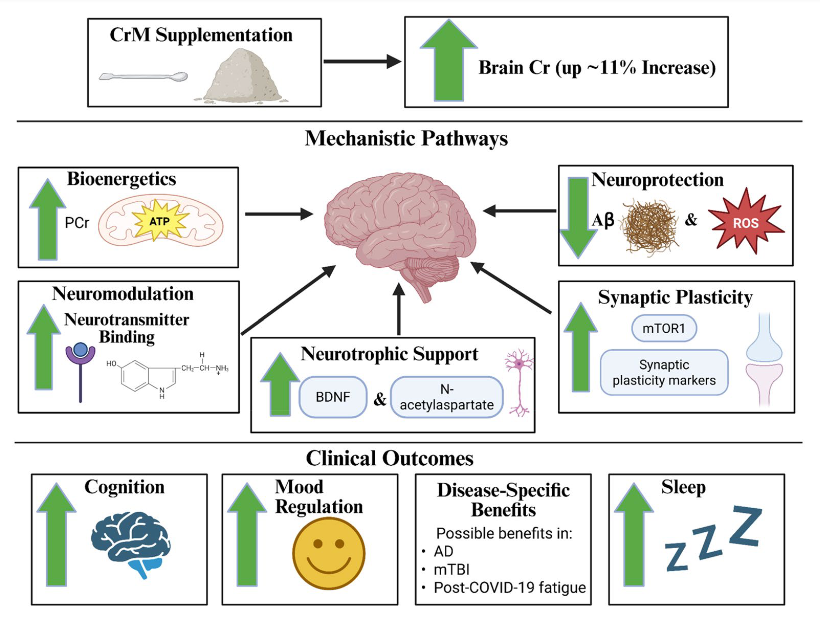
We just published the largest review of creatine for brain health.
Increased brain creatine levels may function as a buffer to metabolic stress leading to neurological benefits.
Doses >5g/day are likely required for brain benefits.
After a few years of tending to your sleep & eating well, exercising regularly, minimizing or eliminating alcohol, it becomes 2nd nature. People would have you think that it’s going to consume your life, but it opens up time and energy for all sorts of things that bring meaning.
@bitacorabeagle Cual es tu opinion al respecto de esta nueva regulación?
A mí me ha recordado a la frase de Jordan Peterson: "The right amount of rules for freedom is not zero". (El número correcto de reglas para ser libre no es zero).