A new psychology study reveals that minor musical keys evoke the sublime, major keys predict beauty, and visual elements heavily dominate our overall aesthetic responses when we experience audio and visual media simultaneously. dlvr.it/TVjRJm
We can measure what part of the shelf gets customer attention without any additional hardware. Just your normal CCTV cameras and a digital twin made with the phone in your pocket.
@CactusXR will absolutely revolutionize how well stores can do their merchandising.
@AllampardBlue Alonso desse geito com tempo para trabalhar com media 2 gol por jogo nao da fora 5 jogos na Premier tomando 5 gols de bola parada defesa um buraco completo e dos caras precisando deixa Neto em campo e Estêvão nada Afonso muito fracoooo
With microplastics and the chemicals associated with them, avoidance remains the best strategy. But even the most diligent among us will be exposed. We live in a plastic world.
So, what can we do to support the body’s own “detoxification” systems?
Three promising strategies:
- Dietary fiber adds bulk and moves material through the gut, and may trap microplastics and other compounds, limit their reabsorption, and increase fecal elimination.
- Sulforaphane activates NRF2, which turns on phase 2 detoxification enzymes that make compounds easier to excrete in urine.
- Oat beta-glucan may interrupt the recycling of PFAS ("forever chemicals") between the liver and gut, promoting their removal through stool.
Blood-filtering procedures such as apheresis are another intriguing approach, but they're also invasive, expensive medical procedures.
Reduce exposure first, then support the body’s natural clearance pathways with the above strategies, which are promising, albeit still with limited human evidence at the moment.
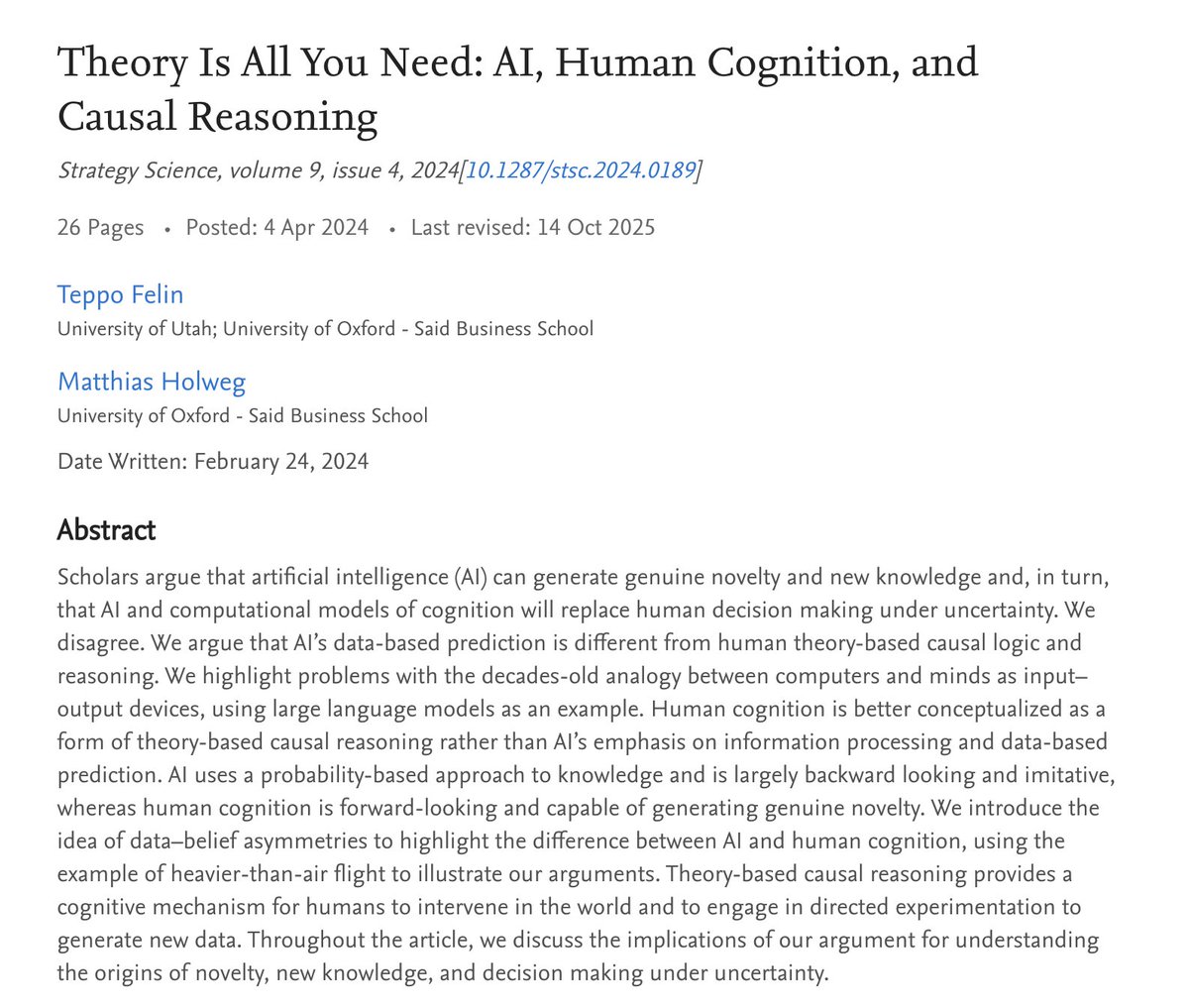
Oxford researchers argue that LLMs can never invent anything.
It is mathematically impossible.
They published a paper called “Theory Is All You Need" and it argues against the claim that computational models can generate genuine novelty or new knowledge.
They analyzed the limits of generative ai, and the results are a brutal reality check for the idea that ai will replace human decision making under uncertainty.
Here is why AI is stuck and human cognition wins:
backward-looking vs forward-looking.. llms are probability machines that look backward at existing data. human cognition is forward-looking and capable of generating genuine novelty. human cognition operates theoretically "top-down" rather than "bottom-up" from data.
the "data-belief asymmetry".. the researchers use the invention of "heavier-than-air flight" to illustrate this concept. an ai relies on data-based prediction, which is largely imitative. humans, however, use theory-based causal logic that allows them to hold beliefs that go beyond existing data.
the intervention gap.. humans don't just process information; we use theory to practically "intervene" in the world. we engage in directed experimentation to generate entirely new data. ai-based models are theory-free and place primacy on existing data and prediction.
tldr?
AI uses a probability-based approach to knowledge and ia largely imitative. It can process data and make predictions, but human cognition relies on theory-based causal reasoning.
The decades-old analogy comparing human minds and computers to mere "input-output" devices is fundamentally flawed.
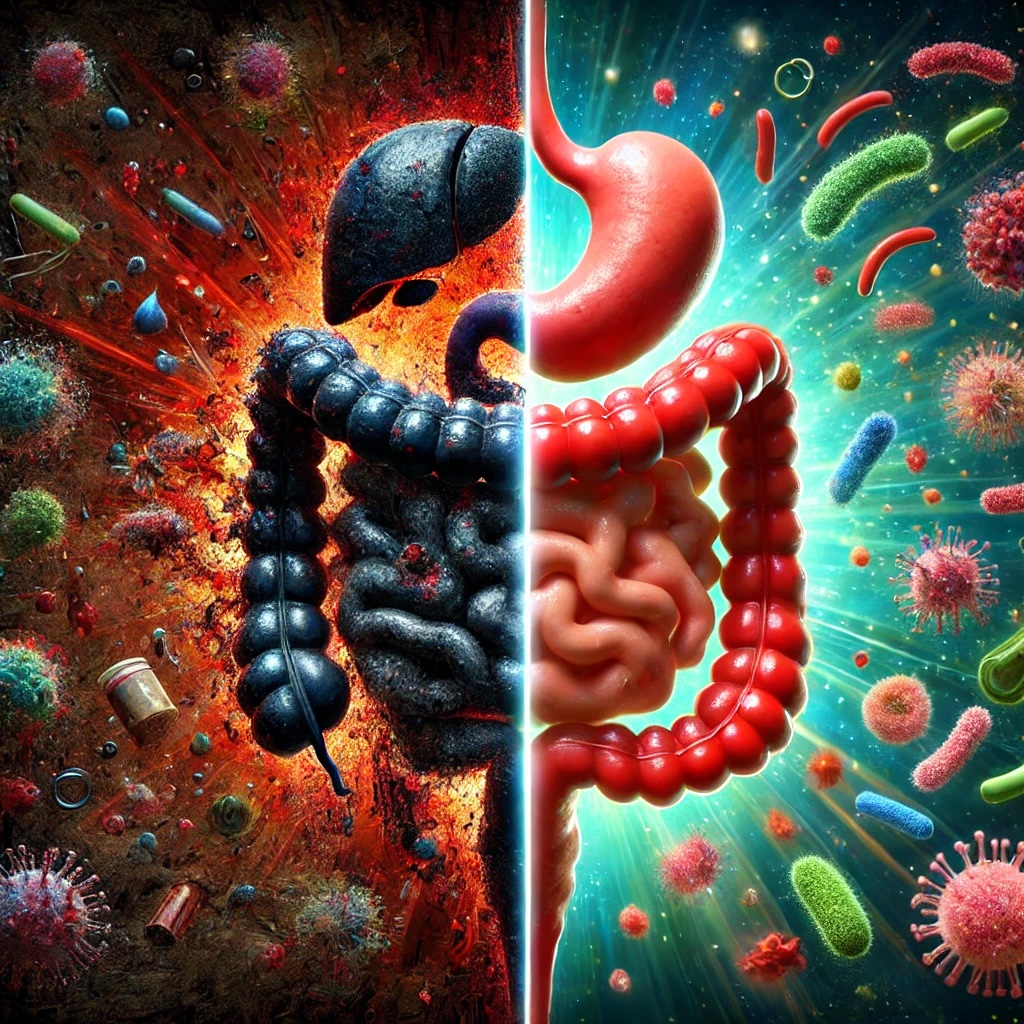
READ THIS IF YOU WANT TO FIX YOUR GUT.
If you have IBS, bloating, gas, poor bowel movements or brain fog, you NEED to see this.
This is a comprehensive DEEP dive into fixing your digestive health:
You’re spending hundreds on
supplements…
Then taking them at the worst time.
D3/K2 = with fat during the day.
B vitamins = before caffeine.
Creatine = after workout.
Collagen = before workout.
Electrolytes = before coffee.
Magnesium = away from high-fiber.
Omega-3s = with fat, away from iron.
Absorption matters just as much as
what you take.
If you eat bacon, ham, salami, or hot dogs, this is for you.
A new paper published last week in the Journal of Theoretical Biology mapped out what actually happens in your stomach when you eat processed meat, and offers something practical you can do about it.
Cured meats contain sodium nitrite, added as a preservative and to fix the pink color. In your stomach, that nitrite meets stomach acid and turns into a reactive form. That reactive form attacks proteins from the meal and produces a class of compounds called nitrosamines. NDMA, NDEA, and NMBA are the most studied. They are the same compounds that triggered the FDA recalls of valsartan, ranitidine, and metformin in recent years. The International Agency for Research on Cancer classifies them as probable human carcinogens, and they are a leading hypothesis for why processed meat consumption tracks with elevated risk of stomach and colorectal cancer in large epidemiologic studies.
Vitamin C disarms this reaction. It converts the reactive nitrite compound back into nitric oxide, which is harmless and diffuses away. This chemistry has been known since the 1970s, which is why the meat industry already adds ascorbic acid during processing. The question is whether you can do anything on your end, after the meat is already in your gut. That is what the new model addressed.
McNicol, Basu, and Layton at the University of Waterloo built a mathematical model that tracks how nitrite, vitamin C, and the resulting chemistry move through saliva, stomach, and intestine over the hours after a meal. They ran simulations across realistic dietary patterns and found two things.
First, when vitamin C is naturally present in the meal, as it is in leafy greens and most fruits and vegetables, the protective effect is substantial. The vitamin C is right there when the chemistry happens. This is likely why dietary nitrate from vegetables does not track with cancer risk the way nitrite from processed meats does.
Second, for meals where vitamin C is not naturally present, like a bacon sandwich or a charcuterie board, taking vitamin C after the meal produced a moderate predicted reduction in nitrosamine formation. Not transformative. Measurable.
A few important things to know. This is a modeling study, not a clinical trial. The model is calibrated against decades of published chemistry, but no trial has yet measured nitrosamine biomarkers in people randomized to take vitamin C after meals versus placebo. Treat the predicted effect as a reasonable hypothesis backed by mechanism, not as proven outcome.
Practical version. If you regularly eat vegetables with your meals, the vitamin C is already there and you are doing most of the work. If you eat cured meats without vegetables in the same sitting, taking 200 to 500 mg of vitamin C with water 30 to 60 minutes after the meal has a defensible mechanistic basis and a modest predicted effect. The dose matters less than the timing. Above about 200 mg in a single oral dose, absorption efficiency drops sharply, so megadoses are not the answer.
The bigger idea is that a meal is a chemical environment you can shape. The same food can be a problem or a non-event depending on what else is in the gut at the same time, and when.
McNicol et al., J Theor Biol, 2026
Tannenbaum & Wishnok, Am J Clin Nutr, 1991
Hord, Tang & Bryan, Am J Clin Nutr, 2009
🤖 Introducing RoboTok, the “TikTok for robots.”
Just as TikTok recommends videos to people, RoboTok recommends relevant human demonstrations for robot learning.
Robot learning needs broad and diverse demonstrations, but collecting robot data is expensive. RoboTok is an internet-scale data engine that uses web video as a scalable and continuously growing source of demonstrations for dexterous manipulation learning.
Given one human demonstration video as a query, RoboTok retrieves other web videos with similar underlying manipulation motions.
Rather than matching videos by labels or visual appearance, RoboTok compares how the hands move over time.
💡 The key idea is to represent each video with canonicalized 3D hand trajectories. Each trajectory is expressed in an estimated actor-centered reference frame, so the movement is described relative to the person rather than the camera. This makes similar manipulation behaviors easier to compare across different viewpoints and scenes, even when the actor is partly occluded.
In our experiments, RoboTok retrieved more manipulation-relevant demonstrations than existing robot-data retrieval methods. When those videos were used to guide robot training, the simulated robots completed manipulation tasks more successfully.
I’m sincerely grateful to Howard Qian and Kaiyu Hang for leading this project. I also want to thank Yiting Chen, Kejia Ren, Podshara Chanrungmaneekul, Gaotian Wang, Bowen Wen @bowenwen_me, and Chen Wei @_Chen_Wei_ for their guidance and collaboration.
Project site: https://t.co/v43CCf0040
Paper: https://t.co/WZGwQLhDTK
Code: https://t.co/MfYLTxHopH
Data and models: https://t.co/i0s7RcrXvX