@sleenastevens@Mandlbaur@FeynmansGhost2@vivissiah@MaytheforcebeM@DavidRu31988626 In Mandlnarnia only torque can increase rotational energy. John concluded this from flywheels which need torque to change RKE. The problem: Flywheels have constant J, so according to the relation Erot=L²/2J RKE can only change with torque - for J=const.
@sleenastevens@Mandlbaur@FeynmansGhost2@vivissiah@MaytheforcebeM@DavidRu31988626 He still maintains his old fairy tale that you can insert torque via a central force. It took me a while why he thinks that: In Mandlnarnia you need torque to change the rotational energy, therefore Erot (and not a.m.) is conserved in the absence of torque.
@Mandlbaur@FeynmansGhost2@sleenastevens@vivissiah@MaytheforcebeM@DavidRu31988626 We also did measurements with a 36 g mass. It wobbled the 67 kg steel plate and made the floor of the lecture hall vibrate. Therefore we reduced the mass.
BTW: Where did your textbook mention any masses? CoAM should work for any mass if there is no torque.
@Mandlbaur@DavidRu31988626@sleenastevens@FeynmansGhost2@vivissiah@MaytheforcebeM But certainly not for a handheld ball on the string pulled in to 1/10. Only an uneducated university dropout with no experience in experiments would think that there is no friction involved, not to speak about the effect of an unstable axis.
@Mandlbaur@sleenastevens@FeynmansGhost2@vivissiah@MaytheforcebeM@DavidRu31988626 It was not the arm length, it was the distance between the dumbbells which was different between his assumption and reality. And the Labrat with his "getting 2" was meanwhile addrssed often enough. He had a factor 3 after 5 turns and 2 after 8 - this is certainly NOT conserved.
@Mandlbaur@FeynmansGhost2@sleenastevens@vivissiah@MaytheforcebeM@DavidRu31988626 Ok, then I have something to predict for you: A 10 g ball is pulled in from 84 cm and 1 rps to 30 cm and then kept at that radius for 0.5 s, then pulled again for 0.5 s and kept 0.3 s, before it was slowly pulled. What happens with forces (pull and centrifugal force) and energy?
@FeynmansGhost2@Mandlbaur@sleenastevens@vivissiah@MaytheforcebeM@DavidRu31988626 In fact this was his original idea: Getting free energy by reducing the radius of a curved motion. First he didn't understand tat you have invest it, second he expected a system like marble tracks to conserve a.m. (it conserves kin energy) and third friction spoiled his dreams.
@Mandlbaur@sleenastevens@FeynmansGhost2@vivissiah@MaytheforcebeM@DavidRu31988626 They were indeed a reaction to the somewhat questionable estimation of the moment of inertia in Lewin's demonstration. A direct dynamical measurement for each individual student is much faster and gives reliable results. A stable scaffold and using Phyphox improved it as well.
@Mandlbaur@sleenastevens@FeynmansGhost2@vivissiah@MaytheforcebeM@DavidRu31988626 Dr. Young clearly said that there is no INSERT of torque possible via the string, he didn't mention braking torque decreasing a.m. which was el documented by Scotty Dilson. The Labrat mentioned the energy losses, see https://t.co/FsLdu0Ktvy
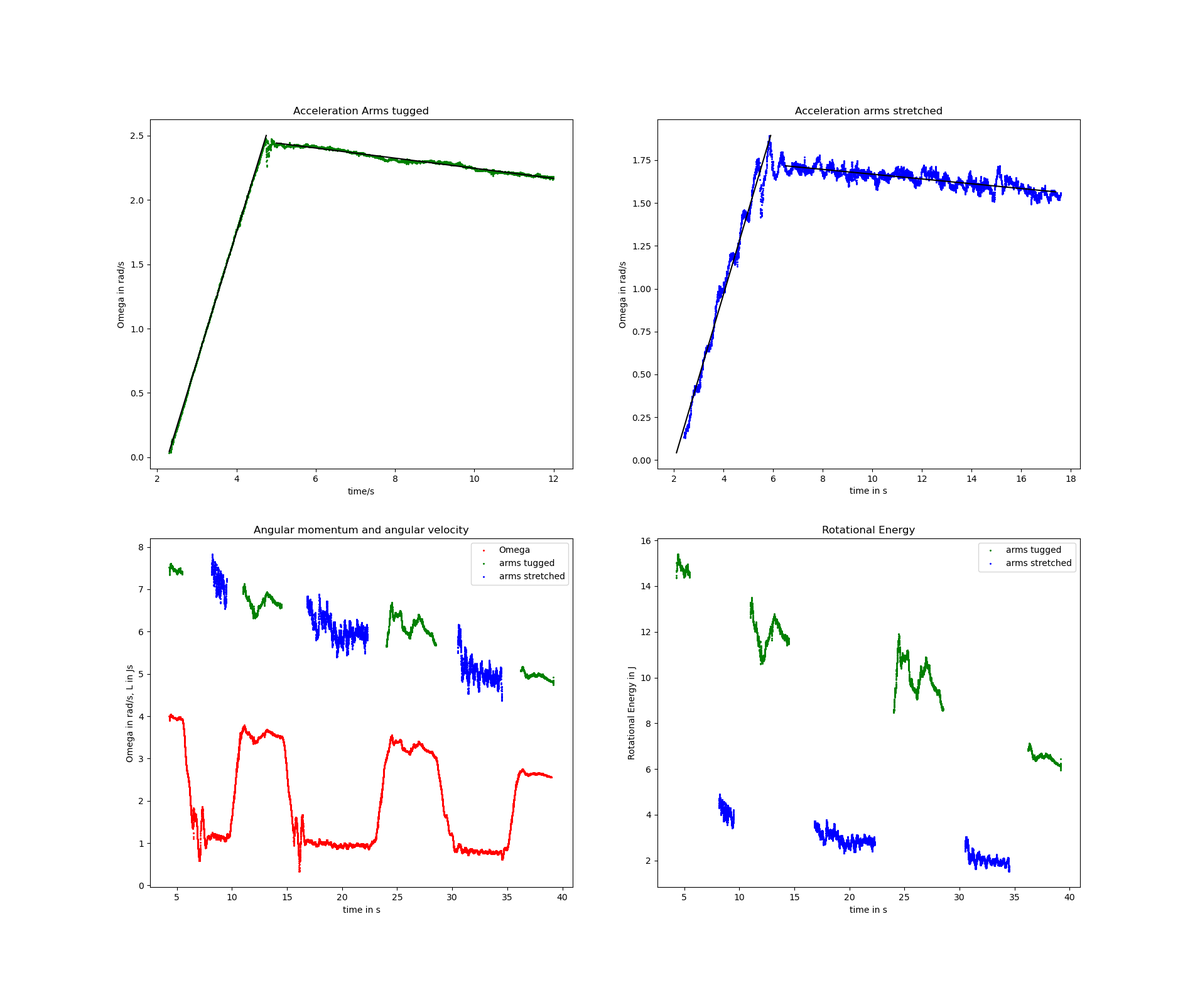
@sleenastevens@Mandlbaur@FeynmansGhost2@vivissiah@MaytheforcebeM@DavidRu31988626 It is also clearly seen in such an experiment. L drops continuously by 1/3 over a time of 40 s, as seen in the upper curve of the lower left diagram. But the changes of J (arms tugged /stretched) have no influence on L, whereas omega and Erot change: