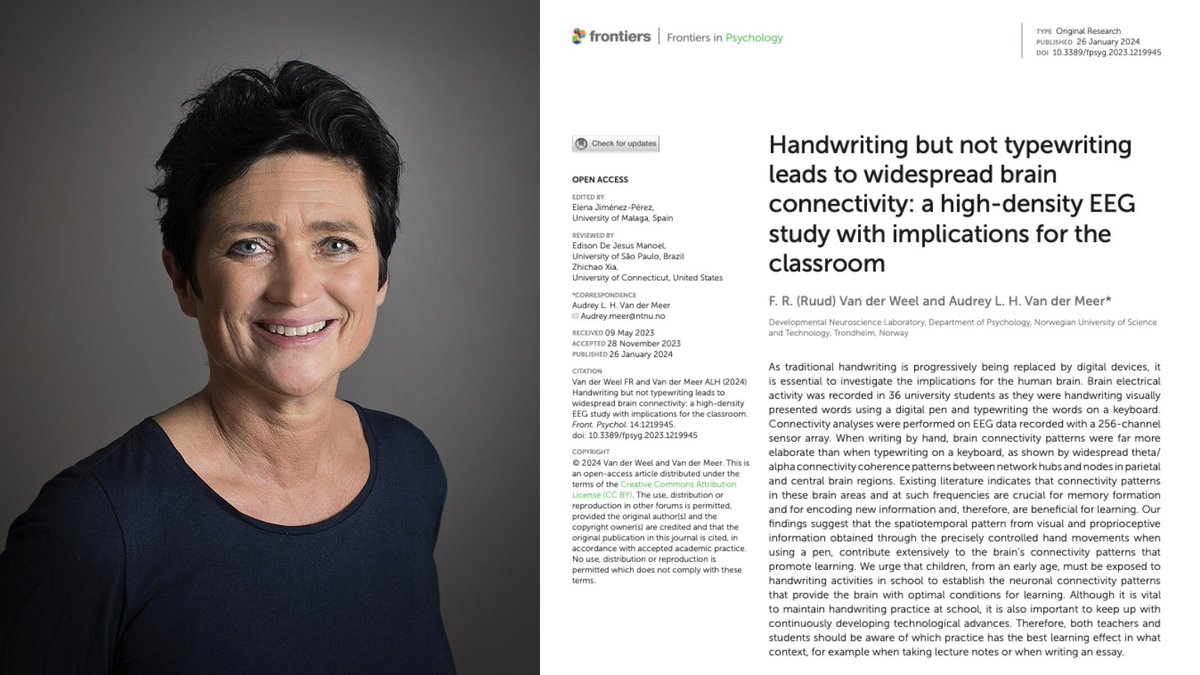
A Norwegian neuroscientist spent 20 years proving that the act of writing by hand changes the human brain in ways typing physically cannot, and almost nobody outside her field has read the paper.
Her name is Audrey van der Meer.
She runs a brain research lab in Trondheim, and the paper that closed the argument was published in 2024 in a journal called Frontiers in Psychology. The finding is brutal enough that it should have changed every classroom on Earth.
The experiment was simple. She recruited 36 university students and put each one in a cap with 256 sensors pressed against their scalp to record brain activity. Words flashed on a screen one at a time.
Sometimes the students wrote the word by hand on a touchscreen using a digital pen, and sometimes they typed the same word on a keyboard. Every neural response was recorded for the full five seconds the word stayed on screen.
Then her team looked at the part of the data most researchers had ignored for years, which is how different parts of the brain were communicating with each other during the task.
When the students wrote by hand, the brain lit up everywhere at once.
The regions responsible for memory, sensory integration, and the encoding of new information were all firing together in a coordinated pattern that spread across the entire cortex. The whole network was awake and connected.
When the same students typed the same word, that pattern collapsed almost completely.
Most of the brain went quiet, and the connections between regions that had been alive seconds earlier were nowhere to be found on the EEG.
Same word, same brain, same person, and two completely different neurological events.
The reason turned out to be something nobody had really paid attention to before her work. Writing by hand is not one motion but a sequence of thousands of tiny micro-movements coordinated with your eyes in real time, where each letter is a different shape that requires the brain to solve a slightly different spatial problem.
Your fingers, wrist, vision, and the parts of your brain that track position in space are all working together to produce one letter, then the next, then the next.
Typing throws all of that away. Every key on a keyboard requires the exact same finger motion regardless of which letter you are pressing, which means the brain has almost nothing to integrate and almost no problem to solve.
Van der Meer said it plainly in her interviews.
Pressing the same key with the same finger over and over does not stimulate the brain in any meaningful way, and she pointed out something that should scare every parent who handed their kid an iPad.
Children who learn to read and write on tablets often cannot tell letters like b and d apart, because they have never physically felt with their bodies what it takes to actually produce those letters on a page.
A decade before her, two researchers at Princeton ran the same fight using a completely different method and ended up at the same answer. Pam Mueller and Daniel Oppenheimer tested 327 students across three experiments, where half took notes on laptops with the internet disabled and half took notes by hand, before testing everyone on what they actually understood from the lectures they had watched.
The handwriting group won by a wide margin on every question that required real understanding rather than surface recall.
The reason was hiding in the transcripts of what the two groups had actually written down.
The laptop students typed almost word for word, capturing more total content but processing almost none of it as they went, while the handwriting students physically could not write fast enough to transcribe a lecture in real time, which forced them to listen carefully, decide what actually mattered, and put it in their own words on the page.
That single act of choosing what to keep was the learning itself, and the keyboard had quietly skipped the choosing and skipped the learning along with it.
Two studies. Two countries. Same answer.
Handwriting makes the brain work. Typing lets it coast.
Every note you have ever typed instead of written went into your brain through a thinner pipe. Every meeting, every book highlight, every idea you captured on your phone instead of on paper was processed at half depth.
You did not forget those things because your memory is bad. You forgot them because typing never woke the part of the brain that would have made them stick.
The fix is the thing your grandmother already knew.
Pick up a pen. Write the thing down. The slower road is the faster one.
There’s a generation a lot of people forget exists. We were born at the tail end of the Boomers, but we are not culturally the same as people born in the 40s and early 50s. We are Generation Jones.
And honestly, it explains a lot.
We grew up in a world that still felt fundamentally analog, but we were young enough to be dragged headfirst into the digital revolution. We are the bridge generation between rotary phones and smartphones, between slide rules and AI, between Walter Cronkite and algorithm driven media.
We remember when there were only a few television channels and the entire country watched the same thing at the same time. We also adapted to the internet, email, forums, social media, streaming and now artificial intelligence. We lived before and after the technological singularity hit everyday life.
That is not a small thing.
People born in the 40s came of age in a post World War II America that was still industrial, deeply hierarchical and institutionally stable. Their formative years were shaped by the Cold War, Vietnam, the civil rights era and a society where information moved slowly.
Generation Jones came later. We inherited the aftermath of all of that.
We were the kids who watched Watergate destroy blind trust in government. We watched manufacturing begin to collapse. We saw divorce rates explode. We were the first truly latchkey generation in massive numbers. We learned independence early because many of us had to.
We grew up with one foot in old America and one foot in whatever this new thing was becoming.
We played outside until the streetlights came on but we also learned DOS commands. We learned cursive and keyboarding. We had card catalogs and Google searches. We went from vinyl records to cassette tapes to CDs to MP3s to streaming in one lifetime.
We remember maps. We remember memorizing phone numbers. We remember life before GPS and before every human interaction became filtered through a screen.
And because of that, I think Generation Jones developed a very unique perspective. We are adaptable because we had no choice but to adapt. We learned technology as adults instead of being born into it. We remember a slower world but were forced to survive in a rapidly accelerating one.
That creates a very different mindset than either older Boomers or younger Gen X and Millennials.
A lot of us also reject the caricature people now associate with “Boomers.” We were not buying houses for the cost of a sandwich in 1965. The interest rate on my first house was over 14% and that was after buying down a point. Many of us got hit by recessions, outsourcing, pension collapses and economic instability just like younger generations did. We watched promises evaporate in real time.
We understand older generations because we were raised by them. We understand younger generations because we had to evolve alongside them.
That’s why the Jones generation often feels culturally homeless. We are rarely discussed, rarely defined and usually lumped into categories that don’t actually fit us.
But we exist.
We are the human transition point between the industrial age and the digital age.
And frankly, there will probably never be another generation quite like us again.
Elon Musk said five words on Joe Rogan that explain everything wrong with your life right now.
Musk: “Happiness is reality minus expectations.”
Five words.
And it explains why the most comfortable generation in human history can’t stop feeling empty.
Musk: “If you just go try living in the woods by yourself for a while, you’ll learn that civilization is quite great.”
He’s right.
On Naked and Afraid, people tap out in days. Sometimes hours. They crawl back to the same civilization they spent years resenting.
Because comfort is invisible until you’re sleeping in the dirt.
But the formula has a second variable.
It’s the one destroying you.
Reality didn’t get worse. By every measure, it’s the best it’s ever been.
Expectations did.
Your grandparents compared themselves to their neighbor. Maybe a cousin. That was the whole universe.
You compare yourself to 10,000 strangers before your first cup of coffee. Curated. Filtered. Showing you a life that doesn’t exist.
Theodore Roosevelt said it a century before any of this was built.
Roosevelt: “Comparison is the thief of joy.”
No Instagram. No TikTok. No algorithm designed by the smartest engineers on the planet to show you precisely what you don’t have.
And he still called it.
Now run the equation.
Reality holds steady. Expectations spike every time you unlock your phone. The distance between them stretches. And happiness doesn’t fade.
It collapses.
Not because your life got worse.
Because your reference point moved.
We built the greatest civilization in human history.
Then we built the perfect machine to make sure nobody enjoys it.
Every scroll. Every notification. Every “suggested for you.” None of it connects you. It’s recalibrating what you think you need. Upward. Constantly. Without your consent.
And you wonder why you feel behind.
You’re not behind.
You’re running toward a finish line that moves every time you look up.
The most dangerous lie of this generation isn’t that life is hard.
It’s that everyone else figured it out. And you’re the only one who didn’t.
Nobody figured it out.
The formula doesn’t negotiate. It just runs.
Raise expectations faster than reality improves and you will be miserable inside a paradise you built with your own hands.
That’s not philosophy.
That’s arithmetic.
And the calculator is in your pocket right now.
No need to buy multiple AI services. One platform gives you access to:
🔥State of the art LLMs, image and video generators
🧠Use AI Agent to automate pretty much any task
🚀Connect to SaaS apps, build custom bots and agents https://t.co/MZPQOKLKP3
Using for a year. Amazing!
I started writing this article months ago to prove the globe earth model.... But the Holy Spirit led me in an entirely different direction… one I never saw coming.
What I found goes far beyond shape... and shakes the foundation of the debate itself.
Read my latest article and let me know what you think:
https://t.co/ww0pZcImgl
#ComeOutOfHer #Firmament #BiblicalTruth #HiddenInPlainSight #FrequencyWar #DiscernTheTimes
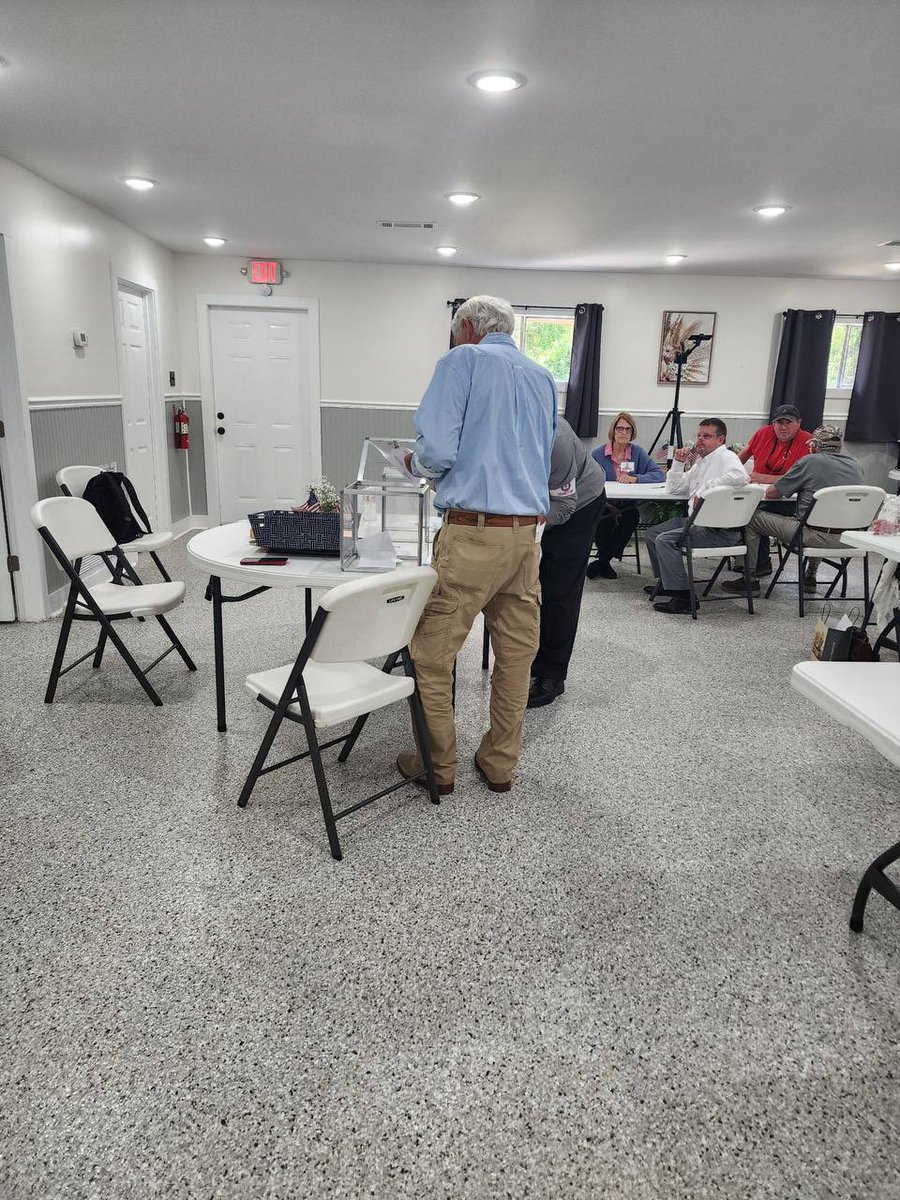
I am very proud of the 2nd, 11th, and 14th Georgia GOP Districts for HAND COUNTING the HAND MARKED paper ballots today for the election of District Candidates!
Congratulations to all who succeeded in their endeavors!
H/T to D2 for the pictures and excellent job streaming the process for transparency!!!
*Multiple/different processes were used. Shown here is the Missouri method by Linda Rantz.
Modern foods are k*lling your gut.
The results? They drain your energy, increase obesity risk, and make you depressed.
Here are 10 natural foods proven by science to heal it effortlessly:🧵
1. Turmeric
Men are nothing without testosterone.
The worst part? In the last 50 years, it has dropped by 40–50%…
That’s why I found 9 science-backed foods to boost it naturally:🧵
1. Ginger
Something Rotten in the State of Denmark, I Mean, Georgia
The phrase “something is rotten in the state of Denmark” from Shakespeare’s Hamlet perfectly captures the troubling state of election integrity in Georgia, as revealed by the long-running Curling v. Raffensperger case. What began in 2018 as a challenge to Georgia’s outdated Diebold voting machines has evolved into a damning exposé of the state’s current Dominion voting system, raising serious concerns about transparency, security, and accountability. Yet, after years of litigation, federal Judge Amy Totenberg dismissed the case on March 31, 2025, citing “standing” as the reason—despite the glaring contradictions and troubling circumstances surrounding her decision. The case’s dismissal leaves Georgians with more questions than answers and a growing sense of distrust in the system meant to safeguard their democracy.
A Dismissal That Defies Logic
Judge Totenberg’s decision to dismiss the case on “standing” is as baffling as it is infuriating. “Standing” is typically a threshold issue determined at the beginning of a trial, not after 17 days of court testimony, a 14-month delay before issuing a final order, and 33 pages of detailed findings that highlight substantial concerns with Georgia’s voting technology. In her original 135 page order to conduct the trial in the first place, Totenberg declared the Dominion system to be in violation of Georgia law (O.C.G.A. 21-2-300), which requires a human-verifiable ballot. Yet, despite these findings, she dismissed the case on a technicality, effectively sidestepping her duty to provide justice to the people of Georgia. This decision is not just a legal failure—it is a betrayal of public trust.
Suspicious Timing and Public Comments
The timing of Totenberg’s order raises even more red flags. It was released during the final week of the Georgia General Assembly session, during which the Secretary of State Brad Raffensperger was requesting a $66 million budget to comply with SB189, a bill aimed at removing the controversial QR code from ballots. The timing seems far from coincidental. Adding to the suspicion, Totenberg made public comments after her decision, stating, “If these legislative measures are ultimately funded and implemented, they are the type of timely legislative action that can bolster public confidence in the management and security of Georgia’s voting system.” These remarks sound less like impartial judicial commentary and more like an endorsement of spending $66 million on a system upgrade for a contract that will be up for renewal in just 2-3 years. Why invest such a significant sum in a system that has already been declared noncompliant with state law and riddled with security vulnerabilities?
Alarming Trial Revelations
The four-week bench trial, which concluded in February 2024, revealed shocking vulnerabilities in Georgia’s election system. Dr. Alex J. Halderman, a cybersecurity expert, demonstrated in court how votes could be flipped on a ballot-marking device (BMD) using nothing more than a ballpoint pen. This was not the first time such a demonstration had occurred; Halderman performed a similar hack three years earlier, yet Raffensperger failed to implement any of the four Election Assistance Commission (EAC)-approved software updates that could have addressed these vulnerabilities. Even more troubling, testimony from the Secretary of State’s office revealed that no one in the office is responsible for overseeing the cybersecurity of Georgia’s election system. Instead, this critical responsibility has been outsourced to Dominion itself—a glaring conflict of interest.
Judge Totenberg’s Abdication of Duty
Judge Totenberg’s handling of this case should be condemned by all who value justice and accountability. Her delays, which stretched the case over 14 months after the trial concluded, wasted time and resources for all involved. Her ultimate dismissal on “standing” after extensive testimony and findings of legal violations is a basic abdication of her duty to provide justice to the people of Georgia. The people deserved a ruling on the merits of the case, not a procedural cop-out that leaves the state’s election system in limbo.
The People Must Act
If this case has taught us anything, it is that we cannot rely on the courts to protect our elections. It is up to We the People to demand change. The Georgia General Assembly must act to restore confidence in our elections by passing HB397, which removes Georgia from the controversial ERIC voter registration system, and SB214, which replaces BMDs with hand-marked paper ballots. Additionally, counties must follow existing law (O.C.G.A. 21-2-437) to conduct full hand counts and certification at the precinct level. These measures are essential for transparency to ensuring that every vote is secure, verifiable, and counted accurately.
A Call to Action
The Curling v. Raffensperger case has exposed deep flaws in Georgia’s election system, but it has also highlighted the resilience and determination of those fighting for transparency and accountability. Now, it is up to the citizens of Georgia to take up the mantle. Contact your state senators and representatives and demand action. The integrity of our elections—and the future of our republic—depends on it. #gapol #electionintegrity @GaSecofState@GabrielSterling@GovKemp@GaHouseHub @GASenateHub @GASenatePress@Georgia_AG@GaLtGov@Election_Adv@GAballots@voterga@1antoniojones@RealLToddWood@CarolynRyanTV@jeffmfulgham@hollykesler@KevinMoncla@ParikhClay@VoiceofRuralAm@theGANerds_Real@realMikeLindell@elonmusk@ElectionWatchHQ@unite4freedom@MadLiberals@truethevote@TuckerCarlson@realLizUSA@EmeraldRobinson@Bannons_WarRoom@realDonaldTrump@WallStreetApes@KanekoaTheGreat@AlexNewman_JOU@JohnBWellsCTM@CletaMitchell@AGPamBondi
Alright, the American Confidence in Elections Act (ACE Act) is the uniparty’s watered down attempt to neutralize Pete Session’s Make Elections Secure Act (MESA).
Translation: Every RINO will try and confuse people over what these bills offer, lie to you, and vote for the garbage ACE bill. It is the epitome of propaganda.
We need to circulate MESA to every GOP member and clearly communicate it is the only bill that supports Trump’s vision for secure elections. Also, send it to your state representatives and senators and demand they use it as a template at the state level.
Links to both are in the comments, as X continues to limit what I can post.
I’ve spend the last 3 years exploring, trying and teaching AI tools.
With that I’ve tested over 10,000 tools and compiled the best 200 in my “AI Tools Cheatsheet”
💡 It’s usually $25, but free today!
To get it:
1. Follow me (so I can DM)
2. RT+ Comment “TOOL” & Retweet
A Letter from Brant Meadows: Unleashing the Truth About DogeGeorgia
Hey there, fellow efficiency hounds! I’m writing today to clear the air and let the tail wag freely about who’s behind DogeGeorgia on the X platform. I’m Brant Meadows—a father, Christian, and farmer from Georgia. I’m no fame-chasing alpha; I’d rather stay a quiet pup in the pack. But recent events have turned me into a bit of a bogeyman, so it’s time to step out of the kennel and bark the truth.
I’m the one who kicked off this citizen-led pack, asking Grok AI how we could sniff out government efficiency. I’m not paid or backed by any political candidate, PAC, or campaign—no leash here! We don’t accept donations either; this is a pure grassroots howl. DogeGeorgia isn’t some fancy government kennel—it’s just a pack of Georgians (and now folks nationwide) barking for a state-level Department of Government Efficiency, inspired by Donald Trump and Elon Musk’s federal DOGE vision. We’re the *Dogs of Government Efficiency* (DOGE), and we’re digging up change one county at a time.
I didn’t build this alone—there’s a whole pack of brilliant folks who’ve helped shape this concept, and I’m wagging my tail in thanks to every one of them. In just over a week, we’ve unleashed over 70 @Doge X accounts across Georgia’s counties and cities, launched https://t.co/58J4E1KgJ1, and even snagged some notable followers. Want to join the pack and bark out your concerns? Hit us up at @DogeGeorgia on X or check out https://t.co/58J4E1KgJ1—we’re always looking for more dogs to dig in!
Folks have asked, “Brant, why are you doing this?” Simple: Georgia deserves better. I’m not getting a dime for this—no treats in my bowl—but I’d sure love my $4,122 back for my family. That’s the chunk of cash every Georgian household could see if we get a state DOGE rolling, returning efficiency to our tax dollars. I’ve seen the growls and grumbles online about who’s in or out of the pack. Listen up: we’re beyond petty snarls, personalities, or preferences. We’re a big-tent kennel—Republicans, Democrats, independents, anyone who wants government to stop chasing its tail and start running lean.
DogeGeorgia works from the bottom up, like a good farm dog digging for roots. I’ve heard whispers like, “I’m not joining ‘cause so-and-so’s in the pack.” Here’s the bone I’ll throw you: I can’t control who grabs an @Doge handle and starts barking. That’s the wild beauty of this movement—any mutt can join! So let’s not yap about who’s got the loudest howl; let’s focus on sniffing out waste and making Georgia’s government a lean, mean efficiency machine.

**Join the Pack: DOGE – Dogs of Government Efficiency**
– We’re a citizen-led crew chasing transparency and efficiency.
– We use Grok AI and X to dig into local government messes—think wasteful spending or hidden bones.
– Over 70 counties and cities have joined in just over a week, and we’re expanding from Georgia to a nationwide pack!
– Our big dream? A state Department of Government Efficiency, modeled after Trump and Musk’s DOGE.
**How to Join the Fun**
– Snag an X account like @DOGE[YourCityOrCounty] (e.g., @DOGECobbCounty).
– Ask Grok stuff like, “Where’s my town wasting cash?” and watch it fetch the facts.
– Post your findings on X, tag @DogeGeorgia, and nudge your local officials to listen up.
– Like, repost, and yap with the pack to keep the momentum growling.
Don’t have time to dig in? Take 10 secs and grab a free Doge Dog avatar for your X account and let your dog do the barking.
DM @DogeGeorgia for the scoop on getting started. We’re not lone wolves—we’re a pack, and the more paws on the ground, the louder our bark for change. Georgia’s growing fast, with over 70 accounts joining in just over a week, and now we’re howling nationwide. So grab your leash (or ditch it!) and let’s make government efficiency the top dog.
Yours in the chase,
Brant Meadows
Founder, DogeGeorgia
https://t.co/svNGAH6ZDn
#BarkForEfficiency
#Jointhepack
Georgia State Senator Files Bill to Unplug Dominion Voting System
ATLANTA, GA, MARCH 5, 2025 – Georgia State Senator Colton Moore (R-53) filed Senate Bill 303 late last week to replace Georgia’s current statewide Dominion Democracy Suite 5.5 Ballot Marking Device (BMD) voting system with hand marked paper ballots and publicly recorded hand counts. The bill reverts the conduct of elections to current Georgia paper ballot statutes. It appears to resolve security complaints filed in federal and state lawsuits against the system and some security concerns raised by President Trump about the conduct of United States elections.
The Canadian-based Dominion system has come under ever-growing scrutiny for inadequate security and non-compliance with Georgia law. Secretary of State Brad Raffensperger recently informed the legislature that $66 million is required to make the system legally compliant
in addition to the purchase price of $107 million in 2019. He alternatively recommended spending $15 million for a voting system upgrade and yet, critics contend that the upgrade would not solve serious security issues the system has and conversely, would destroy forensic evidence on county servers that Raffensperger has never allowed to be analyzed.
On January 7, 2025, VoterGA held a press conference documenting 12 reasons the system should be unplugged. For example, a plaintiff in an active court case contends the system was never properly certified because it stores encryption keys in clear, plain text in a database.
This failure to use an encryption module to store the keys violates 2005 Volume 1 Voluntary Voting System Guidelines (VVSG) and Federal Information Processing Standards (FIPS) 140-2 under which the Election Assistance Commission (EAC) allegedly certified the system.
The press conference also cited forensic reports from other Dominion Democracy Suite 5.x systems around the country showing the systems were remotely accessed during various election cycles in different states. Dominion systems are developed and maintained from Belgrade, Serbia without the knowledge of most voters until that was recently revealed. Nearly all U.S. voting systems run on servers using Chinese manufactured chipsets thus posing a
national security crisis for American voters.
SB303 authorizes the State Election Board to select a new voting system, however, little equipment or expense would be needed to implement a hand marked paper ballot system with publicly recorded hand counts. Senate majority leader Steve Gooch and Senator Greg
Dolezal joined Moore in signing the bill. It is currently in the Senate Ethics committee where it awaits a hearing.
VoterGA is a non-partisan, 501(c)3 registered non-profit organization created by a coalition of citizens working to restore election integrity in Georgia. We advocate for independently verifiable, auditable, recount capable, transparent and tamper proof elections. https://t.co/dvKmOiWQgk
@GASenateGOP@GASenateDems
(🧵1 of 3)
��A History of the Changing Sentiment Regarding the Identity of Antichrist from 1517 - Present.”
(⚠️ Are you hoodwinked
by Jesuit misdirection?)
⏳STEP BACK IN TIME… ⌛️
It was a rough year for the Catholic Church in 1517. On Oct. 31st of that year Luther nailed his 95 theses document to the door of the Wittenberg Chapel on campus inviting the campus priest to debate/discuss these 95 points of contention professor Luther had with #TheChurch™️. This was not well received, and before long the #ProtestantReformation was born. Ecclesiastical authorities refused a discussion on these 95 points of contention with this Wittenberg priest and by 1521, during the time when the Church hunted down heretics to kill them, Luther began publishing pamphlets detailing how the pope fulfilled the requirements for the #SeatOfAntichrist.
The Pope grew understandably tired of being called Antichrist by Luther and his ilk, and so mounted the #CounterReformation in 1534 by establishing the Society of Jesus under the direction of Ignatius of Loyola. The race was on to undermine the ideology of the Reformation by these esteemed intellectuals of the Catholic Church known as Jesuits. Nothing controversial so far, it’s basic church history.
The ultimate goal of the counter reformation was to find a substitute for the Protestant antichrist, using the biblical antichrist criteria and advocating a new way of interpreting them which would lead to the identification of some other entity as the nefarious character. If successful, the Jesuits could eventually undermine all of Protestant Bible prophecy interpretation, and likely extinguish the protest entirely.
✅ Jesuit Priest - Francisco Ribera (1537-1591):
And a glimmer of hope for accomplishing misdirection came by the pen of Jesuit Priest Francisco Ribera in his 1590 commentary on Revelation ‘In Sacrum Beati Ioannis Apostoli, & Evangelistiae Apocalypsin Commentarij.’ Ribera proposed that the first several chapters of Revelation pertained exclusively to Ancient Rome, and the rest of Revelation to a future 3 and 1/2 literal years immediately prior to the Second Coming of Jesus. It is said of Ribera:
“He taught that Antichrist would be
a single individual, who would
rebuild the temple in Jerusalem,
abolish the Christian religion, deny
Christ, be received by the Jews,
pretend to be God, and conquer the
world—and all in this brief space of
three and one-half years.” [Froom,
The Prophetic Faith of Our Fathers,
2:489–490.]
✅ Jesuit Priest - Manuel de Lacunza (1731-1801):
De Lacunza provided two major contributions to undermine Protestant prophetic understanding:
1. Lacunza wrote that there would be general apostasy of the Catholic Church which would make the church part of the Anti-Christ deception.
2.Lacunza stated Jesus will return TWICE in the #SecondComing. By his pen, the concept of the PreTrib Rapture is born. The church is raptured before the persecution of the #GreatTribulation so that they escape the reign of Ribera’s 3 and 1/2 year reign of Anti-Christ. The remainder of the souls who find salvation in Christ during the Great Tribulation are raptured by Him at the Second Coming.
✅ Presbyterian Preacher - Edvard Irving, later converted to Catholicism.
By the early 1800’s, Ribera’s Bible commentary was collecting dust on the shelves of church libraries around the world and de Lacunza’s academic works in the Catholic Church had mostly been banned. A Presbyterian minister of the Church of Scotland named Edvard Irving discovered Lacunza’s chief work on prophecy titled ‘The Coming of Messiah in Glory and Majesty,” and being deeply impressed by it, he translated it from Spanish into English himself in 1827. He then endeavored to teach de Lacunza’s theory on prophecy along with others far and wide in the English Language.




![DenverUlland's tweet photo. (🧵1 of 3)
��A History of the Changing Sentiment Regarding the Identity of Antichrist from 1517 - Present.”
(⚠️ Are you hoodwinked
by Jesuit misdirection?)
⏳STEP BACK IN TIME… ⌛️
It was a rough year for the Catholic Church in 1517. On Oct. 31st of that year Luther nailed his 95 theses document to the door of the Wittenberg Chapel on campus inviting the campus priest to debate/discuss these 95 points of contention professor Luther had with #TheChurch™️. This was not well received, and before long the #ProtestantReformation was born. Ecclesiastical authorities refused a discussion on these 95 points of contention with this Wittenberg priest and by 1521, during the time when the Church hunted down heretics to kill them, Luther began publishing pamphlets detailing how the pope fulfilled the requirements for the #SeatOfAntichrist.
The Pope grew understandably tired of being called Antichrist by Luther and his ilk, and so mounted the #CounterReformation in 1534 by establishing the Society of Jesus under the direction of Ignatius of Loyola. The race was on to undermine the ideology of the Reformation by these esteemed intellectuals of the Catholic Church known as Jesuits. Nothing controversial so far, it’s basic church history.
The ultimate goal of the counter reformation was to find a substitute for the Protestant antichrist, using the biblical antichrist criteria and advocating a new way of interpreting them which would lead to the identification of some other entity as the nefarious character. If successful, the Jesuits could eventually undermine all of Protestant Bible prophecy interpretation, and likely extinguish the protest entirely.
✅ Jesuit Priest - Francisco Ribera (1537-1591):
And a glimmer of hope for accomplishing misdirection came by the pen of Jesuit Priest Francisco Ribera in his 1590 commentary on Revelation ‘In Sacrum Beati Ioannis Apostoli, & Evangelistiae Apocalypsin Commentarij.’ Ribera proposed that the first several chapters of Revelation pertained exclusively to Ancient Rome, and the rest of Revelation to a future 3 and 1/2 literal years immediately prior to the Second Coming of Jesus. It is said of Ribera:
“He taught that Antichrist would be
a single individual, who would
rebuild the temple in Jerusalem,
abolish the Christian religion, deny
Christ, be received by the Jews,
pretend to be God, and conquer the
world—and all in this brief space of
three and one-half years.” [Froom,
The Prophetic Faith of Our Fathers,
2:489–490.]
✅ Jesuit Priest - Manuel de Lacunza (1731-1801):
De Lacunza provided two major contributions to undermine Protestant prophetic understanding:
1. Lacunza wrote that there would be general apostasy of the Catholic Church which would make the church part of the Anti-Christ deception.
2.Lacunza stated Jesus will return TWICE in the #SecondComing. By his pen, the concept of the PreTrib Rapture is born. The church is raptured before the persecution of the #GreatTribulation so that they escape the reign of Ribera’s 3 and 1/2 year reign of Anti-Christ. The remainder of the souls who find salvation in Christ during the Great Tribulation are raptured by Him at the Second Coming.
✅ Presbyterian Preacher - Edvard Irving, later converted to Catholicism.
By the early 1800’s, Ribera’s Bible commentary was collecting dust on the shelves of church libraries around the world and de Lacunza’s academic works in the Catholic Church had mostly been banned. A Presbyterian minister of the Church of Scotland named Edvard Irving discovered Lacunza’s chief work on prophecy titled ‘The Coming of Messiah in Glory and Majesty,” and being deeply impressed by it, he translated it from Spanish into English himself in 1827. He then endeavored to teach de Lacunza’s theory on prophecy along with others far and wide in the English Language.](https://pbs.twimg.com/media/GKqMrQFWwAAlrrv.jpg)









![DogeGeorgia's tweet photo. A Letter from Brant Meadows: Unleashing the Truth About DogeGeorgia
Hey there, fellow efficiency hounds! I’m writing today to clear the air and let the tail wag freely about who’s behind DogeGeorgia on the X platform. I’m Brant Meadows—a father, Christian, and farmer from Georgia. I’m no fame-chasing alpha; I’d rather stay a quiet pup in the pack. But recent events have turned me into a bit of a bogeyman, so it’s time to step out of the kennel and bark the truth.
I’m the one who kicked off this citizen-led pack, asking Grok AI how we could sniff out government efficiency. I’m not paid or backed by any political candidate, PAC, or campaign—no leash here! We don’t accept donations either; this is a pure grassroots howl. DogeGeorgia isn’t some fancy government kennel—it’s just a pack of Georgians (and now folks nationwide) barking for a state-level Department of Government Efficiency, inspired by Donald Trump and Elon Musk’s federal DOGE vision. We’re the *Dogs of Government Efficiency* (DOGE), and we’re digging up change one county at a time.
I didn’t build this alone—there’s a whole pack of brilliant folks who’ve helped shape this concept, and I’m wagging my tail in thanks to every one of them. In just over a week, we’ve unleashed over 70 @Doge X accounts across Georgia’s counties and cities, launched https://t.co/58J4E1KgJ1, and even snagged some notable followers. Want to join the pack and bark out your concerns? Hit us up at @DogeGeorgia on X or check out https://t.co/58J4E1KgJ1—we’re always looking for more dogs to dig in!
Folks have asked, “Brant, why are you doing this?” Simple: Georgia deserves better. I’m not getting a dime for this—no treats in my bowl—but I’d sure love my $4,122 back for my family. That’s the chunk of cash every Georgian household could see if we get a state DOGE rolling, returning efficiency to our tax dollars. I’ve seen the growls and grumbles online about who’s in or out of the pack. Listen up: we’re beyond petty snarls, personalities, or preferences. We’re a big-tent kennel—Republicans, Democrats, independents, anyone who wants government to stop chasing its tail and start running lean.
DogeGeorgia works from the bottom up, like a good farm dog digging for roots. I’ve heard whispers like, “I’m not joining ‘cause so-and-so’s in the pack.” Here’s the bone I’ll throw you: I can’t control who grabs an @Doge handle and starts barking. That’s the wild beauty of this movement—any mutt can join! So let’s not yap about who’s got the loudest howl; let’s focus on sniffing out waste and making Georgia’s government a lean, mean efficiency machine.

**Join the Pack: DOGE – Dogs of Government Efficiency**
– We’re a citizen-led crew chasing transparency and efficiency.
– We use Grok AI and X to dig into local government messes—think wasteful spending or hidden bones.
– Over 70 counties and cities have joined in just over a week, and we’re expanding from Georgia to a nationwide pack!
– Our big dream? A state Department of Government Efficiency, modeled after Trump and Musk’s DOGE.
**How to Join the Fun**
– Snag an X account like @DOGE[YourCityOrCounty] (e.g., @DOGECobbCounty).
– Ask Grok stuff like, “Where’s my town wasting cash?” and watch it fetch the facts.
– Post your findings on X, tag @DogeGeorgia, and nudge your local officials to listen up.
– Like, repost, and yap with the pack to keep the momentum growling.
Don’t have time to dig in? Take 10 secs and grab a free Doge Dog avatar for your X account and let your dog do the barking.
DM @DogeGeorgia for the scoop on getting started. We’re not lone wolves—we’re a pack, and the more paws on the ground, the louder our bark for change. Georgia’s growing fast, with over 70 accounts joining in just over a week, and now we’re howling nationwide. So grab your leash (or ditch it!) and let’s make government efficiency the top dog.
Yours in the chase,
Brant Meadows
Founder, DogeGeorgia
https://t.co/svNGAH6ZDn
#BarkForEfficiency
#Jointhepack](https://pbs.twimg.com/media/GlU9buWWMAA3qmV.jpg)

![DenverUlland's tweet photo. (🧵1 of 3)
��A History of the Changing Sentiment Regarding the Identity of Antichrist from 1517 - Present.”
(⚠️ Are you hoodwinked
by Jesuit misdirection?)
⏳STEP BACK IN TIME… ⌛️
It was a rough year for the Catholic Church in 1517. On Oct. 31st of that year Luther nailed his 95 theses document to the door of the Wittenberg Chapel on campus inviting the campus priest to debate/discuss these 95 points of contention professor Luther had with #TheChurch™️. This was not well received, and before long the #ProtestantReformation was born. Ecclesiastical authorities refused a discussion on these 95 points of contention with this Wittenberg priest and by 1521, during the time when the Church hunted down heretics to kill them, Luther began publishing pamphlets detailing how the pope fulfilled the requirements for the #SeatOfAntichrist.
The Pope grew understandably tired of being called Antichrist by Luther and his ilk, and so mounted the #CounterReformation in 1534 by establishing the Society of Jesus under the direction of Ignatius of Loyola. The race was on to undermine the ideology of the Reformation by these esteemed intellectuals of the Catholic Church known as Jesuits. Nothing controversial so far, it’s basic church history.
The ultimate goal of the counter reformation was to find a substitute for the Protestant antichrist, using the biblical antichrist criteria and advocating a new way of interpreting them which would lead to the identification of some other entity as the nefarious character. If successful, the Jesuits could eventually undermine all of Protestant Bible prophecy interpretation, and likely extinguish the protest entirely.
✅ Jesuit Priest - Francisco Ribera (1537-1591):
And a glimmer of hope for accomplishing misdirection came by the pen of Jesuit Priest Francisco Ribera in his 1590 commentary on Revelation ‘In Sacrum Beati Ioannis Apostoli, & Evangelistiae Apocalypsin Commentarij.’ Ribera proposed that the first several chapters of Revelation pertained exclusively to Ancient Rome, and the rest of Revelation to a future 3 and 1/2 literal years immediately prior to the Second Coming of Jesus. It is said of Ribera:
“He taught that Antichrist would be
a single individual, who would
rebuild the temple in Jerusalem,
abolish the Christian religion, deny
Christ, be received by the Jews,
pretend to be God, and conquer the
world—and all in this brief space of
three and one-half years.” [Froom,
The Prophetic Faith of Our Fathers,
2:489–490.]
✅ Jesuit Priest - Manuel de Lacunza (1731-1801):
De Lacunza provided two major contributions to undermine Protestant prophetic understanding:
1. Lacunza wrote that there would be general apostasy of the Catholic Church which would make the church part of the Anti-Christ deception.
2.Lacunza stated Jesus will return TWICE in the #SecondComing. By his pen, the concept of the PreTrib Rapture is born. The church is raptured before the persecution of the #GreatTribulation so that they escape the reign of Ribera’s 3 and 1/2 year reign of Anti-Christ. The remainder of the souls who find salvation in Christ during the Great Tribulation are raptured by Him at the Second Coming.
✅ Presbyterian Preacher - Edvard Irving, later converted to Catholicism.
By the early 1800’s, Ribera’s Bible commentary was collecting dust on the shelves of church libraries around the world and de Lacunza’s academic works in the Catholic Church had mostly been banned. A Presbyterian minister of the Church of Scotland named Edvard Irving discovered Lacunza’s chief work on prophecy titled ‘The Coming of Messiah in Glory and Majesty,” and being deeply impressed by it, he translated it from Spanish into English himself in 1827. He then endeavored to teach de Lacunza’s theory on prophecy along with others far and wide in the English Language.](https://pbs.twimg.com/media/GKqMrQFXsAASu_s.jpg)


