@0xJonnyDee It is an unprecedented level of coordination honestly. This kind of alignment to contain risk and support each other is what hopefully prevents lasting damage to DeFi as a whole.
DeFi is testing its own version of “too big to fail”
without a central bank.
DeFi United is a new experiment, a coordination layer forming around Aave and LayerZero, showing how the ecosystem backstops systemic risk when it matters.
But the root cause sits upstream.
The incident involving KelpDAO highlights a broader failure:
LayerZero DVN ops failed under attack, within a 1-of-1 setup that created a known single point of failure.
Such configurations can exist (e.g. testing, MVP), but the primary verifier operator must be fully conscious of the risk and responsibility it assumes.
By operating as sole verifier, it is effectively taking the role of a central point of failure.
This is also a consequence of DeFi’s connectivity and composability.
A few infrastructure and liquidity layers become quasi-monopolistic, and their failure propagates widely.
That creates a “too big to fail” dynamic, where the survival of the broader ecosystem can depend on a handful of actors, forcing others to coordinate and step in.
Contract security in DeFi is relatively mature compared to operational security, which is not yet at the same level, as reflected in several recent incidents.
Frameworks like SOC2 or ISO27001 add value, but leave gaps specific to DeFi, such as verifier redundancy, adversarial data assumptions, and safe failure under uncertainty.
Aave is my life's work and we're working nonstop to find the best possible outcome for users.
I’m personally contributing 5000 ETH to DeFi United as we continue working together with partners on formalizing more commitments. I’m working to see this resolved and market conditions normalized as soon as possible.
DeFi United.
This is not an LST.
No staking, no security provision, and buyback-based revenue distribution turns sPENDLE into a dividend-like token. That’s exactly what ve models were meant to avoid.
A liquid wrapper with unlock penalty + DAO-delegated voting for emissions would have preserved the abstraction without creating cash-flow claims.
The worry is that fast-growing stablecoins can pull a meaningful chunk of deposits out of banks. Those deposits are already lent out across the real economy, so sudden withdrawal pressure forces banks into liquidity stress while the money flows into stablecoins that sit in T-bills and money-market instruments. That structural shift, not crypto risk, is what the ECB fears. Over time, banks may end up issuing their own stablecoins backed by their loan books just to stay competitive.
@StarScreamBB@monad@Ledger Beware of crypto scams @StarScreamBB. Send your ticket on Discord or through Ledger website. Ignore comments of supposed Ledger support employees trying to DM or call you on X and/or Discord. Stay safe.
Agree. M&A in web3 has clearly accelerated this year (see @CryptoRank_io). The gap, however, remains huge between VC money chasing token upside and the lack of true private equity capital willing to buy and operate real web3 businesses. Until that asymmetry closes, many solid products will keep shutting down instead of being acquired and scaled.
@longpratas Good product design. It seems like @MagmaStaking team understood perfectly how to accommodate the need of institutional stakers and DeFi users.
@longpratas@edeldotfinance BlackRock & S&P estimate that by Dec 2024, over $40T of assets were available for lending, with $2.5T on loan daily.
Imagine this moving onchain: lending stocks to earn interest while fueling short positions. https://t.co/lu3Uj3u12x
@bailsecurity Can confirm from experience with @bailsecurity. Their audit quality is excellent and their ethical approach is rare in this space. Fair quotes and true focus on security. 🔒
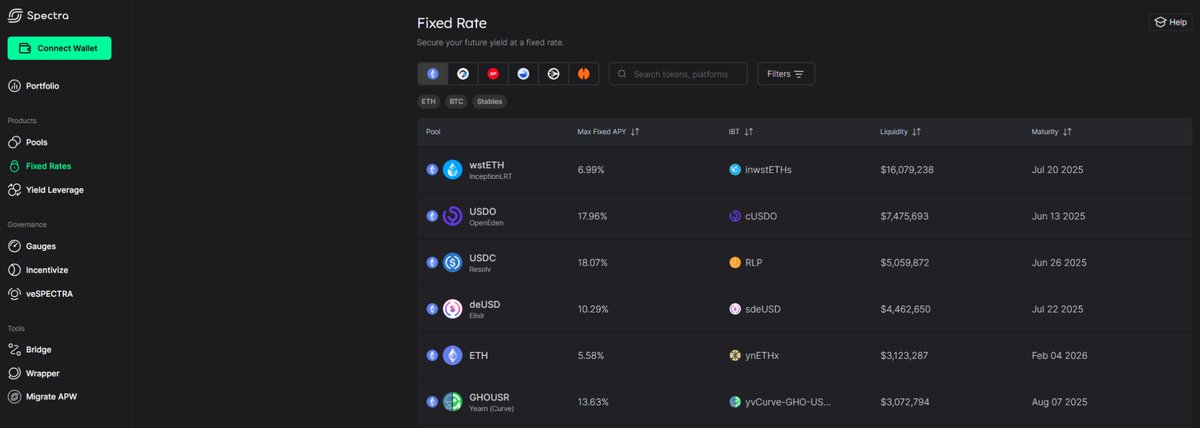
Note: The PT of inwstETHs does not include wstETH staking rewards (~2.9% APY).
You would need to add it manually to reflect the real APY of the PT position.
How much is network security worth?
If 3 players dictate how 80% of security is allocated, they're the ones setting the price.
At TOKEN2049 Dubai, @FilipeDeFi explained why curator diversity is crucial for an open shared security marketplace ↓
@pseudotheos@pauljlei@ConejoCapital Yes, and enabling restaking curation is what makes @symbioticfi the greatest shared security protocol with the highest level of flexibility for capital providers when distributing economic security to networks.