O comentarista suíço David Lemos, encerrou a transmissão resumindo com precisão os problemas desta Copa do Mundo, ele foi perfeito.
🗣️"Não há dúvidas de que esta foi a Copa do Mundo mais comercial da história e também uma das mais politizadas."
"Não esqueceremos os preços que pessoas sem grande poder aquisitivo tiveram de pagar para viver sua paixão pelo futebol."
"Em alguns casos, sequer puderam entrar no país por causa de sua nacionalidade, fossem torcedores, jornalistas ou até árbitros, como o somali Omar Artan."
"Também lembramos do tratamento inaceitável dado à seleção do Irã, que não pôde defender suas chances de forma adequada durante o torneio."
"E há ainda o caso de Folarin Balogun. Vimos um presidente se vangloriar de ter ligado para o presidente da FIFA para conseguir retirar a suspensão de um jogador."
"A política se infiltrou no coração do futebol, embora a FIFA afirme querer mantê-la acima de tudo. Fica claro que isso só vale até certo ponto."
"Foi uma Copa do Mundo em que todas as partidas foram disputadas em quatro tempos, e cuja final teve um intervalo de quase 30 minutos."
"A crise tem dois nomes: dinheiro e poder. Hoje existe uma crise de confiança entre muitos dos envolvidos no futebol e a FIFA."
"Nas próximas semanas, muito dinheiro será distribuído a diversas federações e a muitos agentes do futebol, que serão educadamente convidados a permanecer em silêncio."
"Esperamos que tudo isso seja levado em consideração e que não volte a acontecer."
Squats = brainpower! 🏋️♂️🧠
Sitting for 20 minutes straight is a drain on your executive function. But here's the good news:
A 2023 study in the Journal of Applied Physiology found that:
One minute of half-squats every 20 minutes rescues cerebral blood flow from a sedentary slump.
This movement reoxygenates your prefrontal cortex, the portion of your brain involved in focus and decision-making.
The Result of a 60-second "Interrupt":
🧠 Preserved blood flow to the brain.
⚡️ Sharpened executive function.
📈 Spiked concentration levels.
📉 Reduced mid-day mental fatigue.
Action plan:
The 20/1 Protocol:
Set a timer for 20 minutes of focused work. When it pings, drop into 10-12 controlled half-squats.
It’s the cheapest nootropic you'll find.
Source:
Exercise during Prolonged Sitting on Executive Function." Journal of Applied Physiology, vol. 135, no. 6, 2023, pp. 1421-30.
#BrainHealth
#MovementSnacks
There are a lot of reasons to exercise, and new research just confirmed an especially powerful one: It is as effective in halting depression as medication or therapy. Here's why. https://t.co/XGXP2oh0Z9
How effective are quick workouts?
A large UK study found that 60 seconds of vigorous effort offered similar longevity benefits to 93 minutes of low‑intensity exercise,
Yes, even a minute of intense movement reduced the risk of early death, heart attacks, and type 2 diabetes.
That’s the kind of return on investment you don’t ignore.
Action Plan:
Pick one moment to move with intention today.
It might be the stairs, a brisk uphill walk, a vigorous set of jumping Jacks, or a fast bike sprint.
And then push hard for 60 seconds.
Your heart will remember it.
#HeartHealth
#Fitness
Source:
Biswas et al., Nat Commun 2025 (UK Biobank): 1 min vigorous activity ≈ 53–94 min light activity for major health outcomes.
Squats = brainpower! 🏋️♂️🧠
Sitting for 20 minutes straight is a silent drain on your executive function. But here's the good news:
A 2023 study in the Journal of Applied Physiology found that one minute of half-squats every 20 minutes rescues cerebral blood flow from the "sedentary slump." It re-oxygenates the prefrontal cortex, the seat of your focus and decision-making.
The Result of a 60-second "Interrupt":
🧠 Preserved blood flow to the brain.
⚡️ Sharpened executive function.
📈 Spiked concentration levels.
📉 Reduced mid-day mental fatigue.
Action plan:
The 20/1 Protocol: Set a timer for 20 minutes of focused work. When it pings, drop into 10-12 controlled half-squats. It’s the cheapest 'nootropic you'll find.
Source:
Horiuchi, Masahiro, Alice Pomeroy, Yoko Horiuchi, Keeron Stone, and Lee Stoner. “Effects of Intermittent Exercise during Prolonged Sitting on Executive Function, Cerebrovascular, and Psychological Response: A Randomized Crossover Trial.” Journal of Applied Physiology 135, no. 6 (December 1, 2023): 1421–1430
#BrainHealth
#MovementSnacks
Parisian monument to L'Abee de L'Epee, the Enlightenment-era priest who observed deaf children signing, invented his own sign language, and founded the first free school for the deaf (still standing, and the site of the memorial). His language was too cumbersome to catch on outside the school (the community evolved its own French Sign Language), but he deserves credit for the recognition, formal education and enfranchisement of the deaf in France and from there, around the world.
Even toddlers experience the joy of giving.
Evidence: When kids under 2 share a snack with a puppet, they exude enthusiasm. They actually smile bigger and laugh more after giving a treat than getting one for themselves.
Kindness is a fundamental source of happiness.
There's a version of mindfulness that sounds passive, just noticing whatever shows up. But present-moment awareness as I think about it is more active than that. It involves choosing what to attend to, which is actually one of the more demanding things a mind can do.
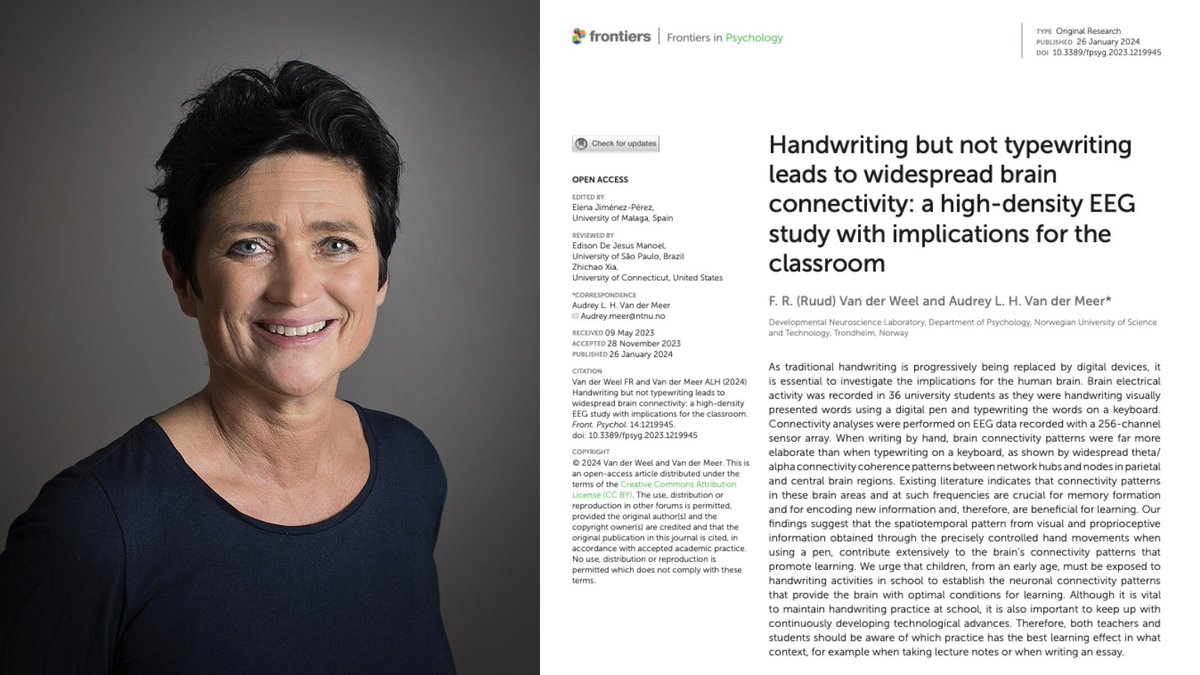
A Norwegian neuroscientist spent 20 years proving that the act of writing by hand changes the human brain in ways typing physically cannot, and almost nobody outside her field has read the paper.
Her name is Audrey van der Meer.
She runs a brain research lab in Trondheim, and the paper that closed the argument was published in 2024 in a journal called Frontiers in Psychology. The finding is brutal enough that it should have changed every classroom on Earth.
The experiment was simple. She recruited 36 university students and put each one in a cap with 256 sensors pressed against their scalp to record brain activity. Words flashed on a screen one at a time.
Sometimes the students wrote the word by hand on a touchscreen using a digital pen, and sometimes they typed the same word on a keyboard. Every neural response was recorded for the full five seconds the word stayed on screen.
Then her team looked at the part of the data most researchers had ignored for years, which is how different parts of the brain were communicating with each other during the task.
When the students wrote by hand, the brain lit up everywhere at once.
The regions responsible for memory, sensory integration, and the encoding of new information were all firing together in a coordinated pattern that spread across the entire cortex. The whole network was awake and connected.
When the same students typed the same word, that pattern collapsed almost completely.
Most of the brain went quiet, and the connections between regions that had been alive seconds earlier were nowhere to be found on the EEG.
Same word, same brain, same person, and two completely different neurological events.
The reason turned out to be something nobody had really paid attention to before her work. Writing by hand is not one motion but a sequence of thousands of tiny micro-movements coordinated with your eyes in real time, where each letter is a different shape that requires the brain to solve a slightly different spatial problem.
Your fingers, wrist, vision, and the parts of your brain that track position in space are all working together to produce one letter, then the next, then the next.
Typing throws all of that away. Every key on a keyboard requires the exact same finger motion regardless of which letter you are pressing, which means the brain has almost nothing to integrate and almost no problem to solve.
Van der Meer said it plainly in her interviews.
Pressing the same key with the same finger over and over does not stimulate the brain in any meaningful way, and she pointed out something that should scare every parent who handed their kid an iPad.
Children who learn to read and write on tablets often cannot tell letters like b and d apart, because they have never physically felt with their bodies what it takes to actually produce those letters on a page.
A decade before her, two researchers at Princeton ran the same fight using a completely different method and ended up at the same answer. Pam Mueller and Daniel Oppenheimer tested 327 students across three experiments, where half took notes on laptops with the internet disabled and half took notes by hand, before testing everyone on what they actually understood from the lectures they had watched.
The handwriting group won by a wide margin on every question that required real understanding rather than surface recall.
The reason was hiding in the transcripts of what the two groups had actually written down.
The laptop students typed almost word for word, capturing more total content but processing almost none of it as they went, while the handwriting students physically could not write fast enough to transcribe a lecture in real time, which forced them to listen carefully, decide what actually mattered, and put it in their own words on the page.
That single act of choosing what to keep was the learning itself, and the keyboard had quietly skipped the choosing and skipped the learning along with it.
Two studies. Two countries. Same answer.
Handwriting makes the brain work. Typing lets it coast.
Every note you have ever typed instead of written went into your brain through a thinner pipe. Every meeting, every book highlight, every idea you captured on your phone instead of on paper was processed at half depth.
You did not forget those things because your memory is bad. You forgot them because typing never woke the part of the brain that would have made them stick.
The fix is the thing your grandmother already knew.
Pick up a pen. Write the thing down. The slower road is the faster one.
Hungary’s parliament sings “Ode to Joy” — the anthem of Europe — after Péter Magyar is sworn in as prime minister.
Hungary is once again a proud member of the European Union.