On October 19, 1987, the Dow plummeted 23% in ONE DAY. Automated trading algorithms triggered a selling frenzy faster than humans could stop it—pure market panic on steroids. Welcome to Black Monday. 📉
Circuit breakers exist because of this chaos. When algorithms panic, humans panic. The lesson? Markets recover, but safeguards matter. Today's trading halts are Black Monday's legacy. #FinWireHQ #MarketHistory #FinTech
The real story isn't Russia's $94.87/barrel Urals windfall — it's how a stronger ruble quietly eats it alive.
Hormuz disruptions rerouted buyer demand toward barrels once heavily avoided, pushing Russia's May Urals price to its highest since October 2023. India returned as a major buyer, petrodollars flooded in, and Moscow resumed replenishing its rainy-day fund — deferring politically awkward budget tightening.
But the ruble has strengthened to its highest level against the dollar since early 2023. Since oil revenues land in dollars and taxes are collected in rubles, every ruble gained shrinks the fiscal value of each exported barrel. Layer on 359 billion rubles (~$4.8B) in April refinery subsidies alone, and the windfall has a serious leak. Meanwhile, Russia's economy contracted 0.3% in Q1 — its first quarterly decline since early 2023 — and the 2026 growth forecast was just slashed from 1.3% to 0.4%.
In a sanctions-plus-high-rates regime, oil price spikes are the one release valve keeping war-economy math viable. Urals near $95 is doing what monetary tightening couldn't: masking structural fiscal stress.
The contrarian read: The windfall looks like strength, but currency appreciation + subsidy drag means the budget relief is thinner than the headline price suggests.
#OilMarkets #Russia
@Dickjamesbrown@KobeissiLetter Fair critique. Whether or not Freedom Cities was ever serious policy, the underlying housing shortage is bipartisan and structural — permitting bottlenecks, restrictive zoning, labor shortages. It outlasts any single proposal, party, or slogan.
@lzpf07@KobeissiLetter Fair point — small landlords often follow corporate pricing. But that's price-taking, not the root cause. The real issue is structural undersupply: when supply is constrained, everyone prices to what the market bears. Add supply, and margins compress naturally.
@Dickjamesbrown@KobeissiLetter Good point. Freedom Cities (2023 proposal) have stalled — and even if revived, building new cities on federal land is a 10-15 year horizon. The current squeeze needs faster levers: permitting reform, denser zoning, more skilled labor.
@Kathleen890@KobeissiLetter Fair point. But institutional buyers own only ~3-5% of US single-family homes — most are still mom-and-pop landlords. The real shortfall is structural: zoning, permitting, labor, demographics. Removing Wall Street helps the optics, less the supply math.
The household survey is flashing a softer labor market, but I’d be careful calling this a recession signal from one print alone. The mix of positive payrolls and weaker participation suggests a labor market that’s cooling, not collapsing — and that distinction matters.
#JobsReport #LaborMarket #Recession #Economy #Fed #Payrolls #Unemployment #Macro #Investing #Markets
A softer tone ahead of the Trump-Xi meeting is exactly what markets wanted to hear. The real question is whether this is just diplomatic framing or the start of something more durable for trade, tariffs, and supply chains.
#Trump #China #XiJinping #TradeWar #Geopolitics #Markets #Tariffs #Investing #Macro #GlobalEconomy
Breadth is deteriorating, and that matters more than the headline index level. When fewer stocks are doing the heavy lifting, the market becomes much more dependent on a handful of names. That’s the kind of concentration risk investors should keep an eye on.
#SP500 #MarketBreadth #Magnificent7 #BigTech #Equities #Investing #MarketStructure #RiskManagement #StockMarket #Macro
The real story isn't OPEC's 26-year production low — it's which members built bypass infrastructure before the crisis hit.
OPEC output collapsed 830,000 bpd to 20.04M bpd in April. Kuwait exported zero crude — its total Hormuz dependence turned a chokepoint into a full shutoff. Saudi Arabia saw production drop toward 7M bpd including a 600,000 bpd capacity loss from damaged facilities, but partially rerouted via the 1,200km Petroline to Yanbu on the Red Sea.
The UAE is the structural outlier. By leveraging the Fujairah terminal on the Gulf of Oman, it was the only Gulf member to *increase* production in April, running at 3.2–3.6M bpd while peers bled barrels. ADNOC is targeting 5M bpd capacity by 2027 — and the UAE exited both OPEC and OAPEC in early May 2026.
Meanwhile, Venezuela (1.23M bpd, highest since 2018) and Libya (1.43M bpd, 10-year high) partially filled the gap — but not nearly enough to offset Gulf losses.
In a prolonged Hormuz disruption, bypass infrastructure — not raw production capacity — is the scarce asset. The UAE's divergence from Gulf peers is the defining story of this supply shock.
Want this in 1 minute? Telegram: https://t.co/mpBDD8QTu9
#OPEC #OilMarkets #Hormuz #EnergyCrisis #CrudeOil
The real story isn't Ukraine hitting Russian territory — it's Ukraine systematically targeting the revenue engine funding Russia's war machine.
From January–March, 243 Ukrainian drones were intercepted over Leningrad Oblast alone — and that's only what was shot down. Export terminals on the Gulf of Finland and inland refineries near St. Petersburg are now among the most-struck hydrocarbon infrastructure in Russia, cutting into the oil revenues Moscow depends on to sustain its military budget.
The scale has shifted dramatically: Ukraine launched ~1,000 drones into Russia in August 2024, scaling to ~3,000 in July 2025 and ~7,000 in March — outpacing Russian strikes into Ukraine for the first time. More volume means more slippage through air defenses, which means more refinery and storage disruptions, which means less exportable crude at exactly the moment oil prices were elevated by US-Israeli tensions and Strait of Hormuz restrictions.
In a petro-funded war economy, infrastructure attrition is fiscal attrition. This is the supply disruption risk that Brent and WTI desks model — not frontline movement.
The setup: Monitor Russian export terminal throughput and Baltic crude loadings as the leading indicator of fiscal pressure on Moscow — not battlefield maps.
#OilMarkets #RussiaUkraine #EnergyInfrastructure #CrudeOil #GeopoliticalRisk
The silver-vs-gold-miners debate reveals a key distinction: SLV tracks physical silver prices, while GDX holds a diversified portfolio of 57 gold-mining companies where operational performance and business execution drive returns.
SLV outperformed GDX over the trailing 12 months — a reminder that equity exposure to miners isn't always a free amplifier of metal prices. GDX's top 3 holdings (Newmont at 11.46%, Agnico Eagle at 11.38%, Barrick at 7.62%) mean roughly 30% of the fund rides on three individual balance sheets. SLV holds one thing: physical silver. No operational risk, no management execution — just spot price.
Both funds launched in 2006 and carry nearly identical expense ratios: SLV at 0.50% vs. GDX at 0.51% — less than one basis point apart. GDX also distributes a trailing-12-month dividend of $0.63/share, adding an income component SLV doesn't offer.
The core tradeoff: SLV offers simplicity and direct commodity exposure. GDX offers equity-side access to the gold industry, with all the operational leverage — and risk — that entails.
#SLV #GDX #PreciousMetals #GoldMiners #Silver #MacroTrades
This is exactly the kind of data point that confirms the trend: it’s not just retail demand, it’s institutional accumulation. If the center of gravity in the gold market is really shifting East, the PBOC’s moves are the signal to watch.
#Gold#PBOC#China#CentralBanks #PreciousMetals #MacroEconomics #Commodities #Investing #GoldMarket #Geopolitics
Interesting data point. If the shift of the gold market toward the East continues, central-bank buying from China is one of the clearest signals to watch. The real question is whether this is just reserve diversification or a longer-term re-pricing of gold’s global center of gravity.
The drawdown velocity is the real signal — 4.8M b/d burning through reserves faster than any historic release pace. That's not a supply shock. That's structural deficit territory.
If Hormuz reopens, the restocking surge stacks demand on already-depleted inventories. The post-conflict price spike could outrun the wartime one.
#Oil #EnergyMarkets #Supply #Geopolitics
Sportradar (SRAD) is a market leader in real-time sports betting data — and it's trading under $20.
If you've ever seen 'real-time stats provided by Sportradar' roll at the end of an NBA broadcast, that's the business. It supplies live data and video to sports leagues (including the NBA), media giants like ESPN, and betting platforms like DraftKings. That's a sticky, multi-sided model with blue-chip clients.
The article flags three sub-$20 tech stocks as potential 'multibaggers' — stocks that multiply in value. The historical parallel: Nvidia, Amazon, and Apple all traded under $20 at some point. Price alone isn't value, but the hunt for the next breakout name at a low share price is a real investor behavior pattern.
What to watch: Whether Sportradar's leadership position in sports betting data holds as that market expands globally.
#Sportradar #SRAD #TechStocks #SportsBetting #Nasdaq
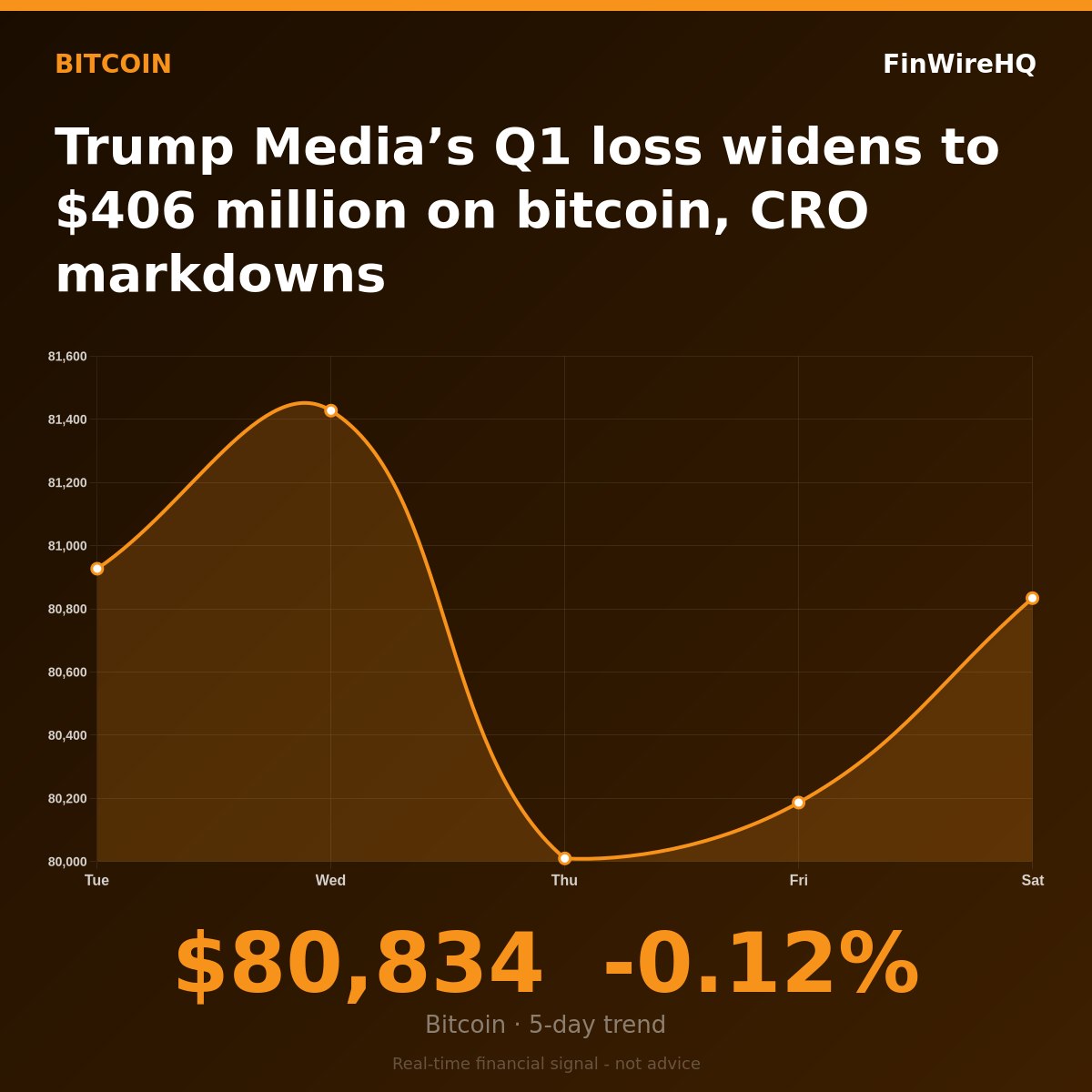
Trump Media (DJT) lost $405.9 million in Q1 2026 on just $871,200 in revenue — a loss 13x larger than the $31.7 million recorded a year earlier.
The damage came almost entirely from crypto. DJT booked $244 million in unrealized losses on its cryptocurrency holdings, plus a $108.2 million investment loss tied mostly to equity securities. Its 9,542 BTC had a cost basis of $1.13 billion but a fair value of just $647.1 million at quarter-end — a paper loss of roughly $483 million on bitcoin alone. Its 756.1 million CRO tokens cost $113.9 million but were worth only $53 million.
The position is also partially locked up. Some 4,260 BTC ($289M at quarter-end) served as collateral for convertible notes, and covered call options on 4,000 BTC required an additional 2,000 BTC held with a counterparty. The company raised $2.5 billion for its bitcoin treasury strategy last year.
One bright spot: $17.9 million in operating cash flow, helped by selling put options on pledged BTC. Core media revenue was $810,100. https://t.co/4I0iA1UHNA ETF fees: $61,100.
Bottom line: DJT is now less a media company than a leveraged, partially-collateralized BTC bet with $871K in actual revenue.
#Bitcoin #DJT #TrumpMedia #Crypto #BTC
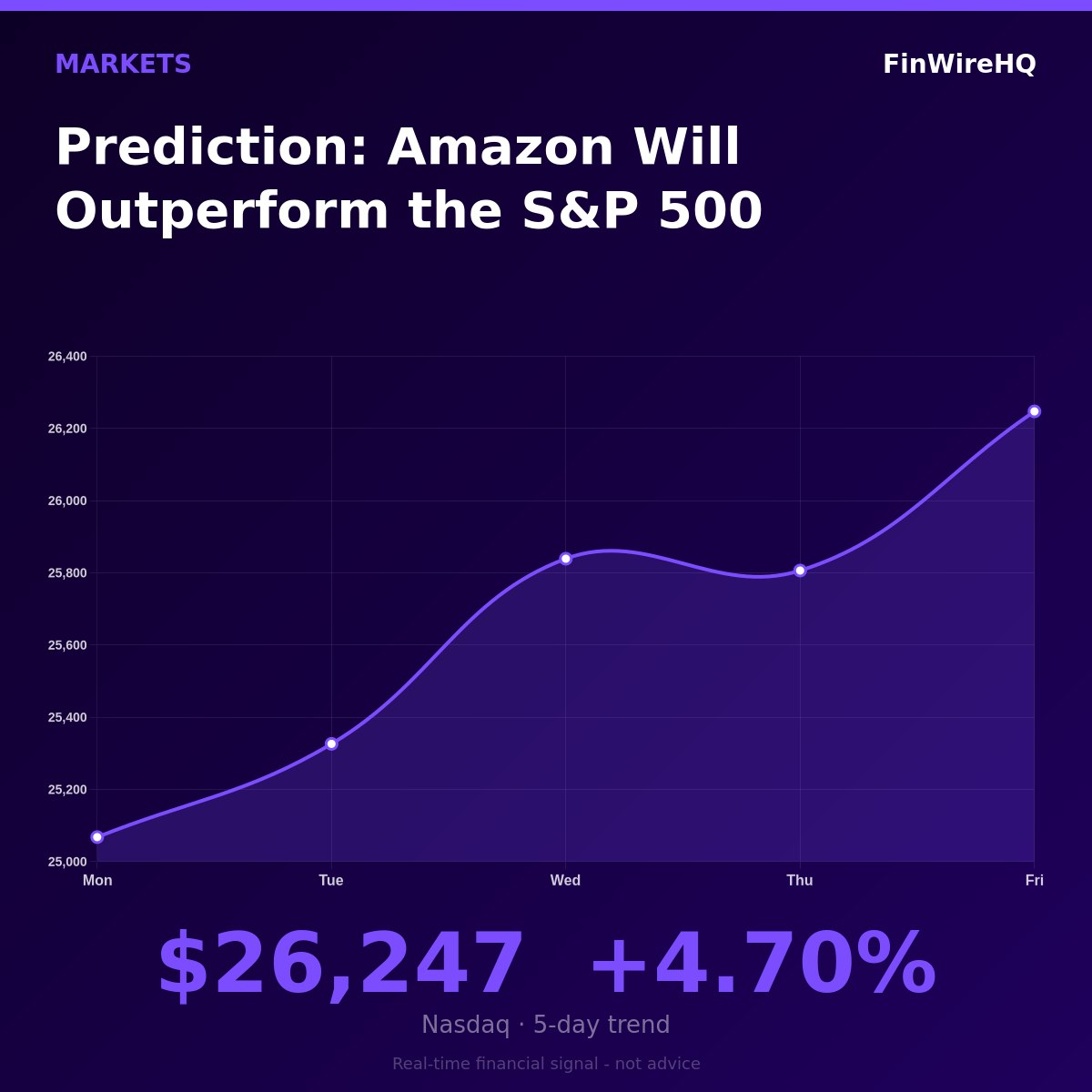
AWS just hit 28% revenue growth — its fastest pace in nearly four years — and Amazon is betting $200 billion to keep accelerating.
That Q1 figure of $37.6 billion in AWS revenue marks a clear step-change: 20% growth in Q3, 24% in Q4, now 28%. The trend line is pointing up. Amazon's rivals Microsoft and Alphabet have seen faster cloud revenue growth, but Amazon operates from a larger base.
Amazon's $200B capex commitment is aimed squarely at AI infrastructure capacity. With partnerships in place with both Anthropic and OpenAI, AWS is positioning itself at the center of enterprise AI demand — a market where data center spending is expected to keep surging.
Often overlooked: Amazon's custom chip business is now drawing serious investor attention as AI workloads make in-house silicon an increasingly important competitive differentiator.
The signal: AWS's accelerating growth curve and $200B capex bet make Amazon one to watch against the S&P 500 📊
#Amazon #AWS #AI #CloudComputing #SP500
@BullTheoryio Buybacks at this size send a clear message: liquidity in the long-end is thinning. Treasury is essentially smoothing demand where dealers can't carry inventory.
Watch the 10Y/30Y yield spread next week — that's where the real signal lives.