Profitability is found in the work you're avoiding.
Backtesting, journaling, reflecting.
I would make a bet that less than 10% of the trading population actually journals their trades.
Not saying you have to do it forever.. but how do you know how well you're doing, or what to improve on, if you have no books.
Traders have to come to terms with the fact that a major part of trading is the non-stop process of building, breaking, rebuilding, rising, falling, getting back up, shaping, reshaping, learning, unlearning, relearning; rinse, repeat, etc...
It's not for everyone which is why having a mentor(s) to guide you through it is so vital.
This is why the real traders who have truly been through this arduous process tend to be humble in nature.
What the hell is happening to the Indian stock market?
Dear @SEBI_India & @NSEIndia@BSEIndia
How many times do you expect traders to rebuild their entire business?
> December 2020 – 50% leverage removed
> March 2021 – 75% leverage removed
>September 2021 – 100% leverage removed
We adapted.
Yes, leverage is a double-edged sword. But thousands of genuine traders with smaller capital were affected. Still, we adapted.
> September 2023 – Bank Nifty expiry was shifted from Thursday to Wednesday, while BSE launched Sensex weekly expiry on Friday. Suddenly, we had expiries almost every trading day.
Many traders, especially algo and 0-DTE traders, redesigned their entire systems.
We adapted.
> November 2024 – Weekly expiries of FinNifty, Bank Nifty and other indices were removed. Only Nifty and Sensex weekly expiries remained.
Again, thousands of traders had to change their strategies.
We adapted.
> February 2025 – Expiry-day margin benefit was removed.
STBT traders were hit badly.
We adapted.
> 1st September 2025 – Nifty expiry shifted from Thursday to Tuesday.
Again...
We adapted.
> Jane Street reportedly made billions of dollars from Indian markets over the years. Later, regulatory action was taken, and subsequently trading restrictions were lifted after payment of regulatory dues/settlement.
How exactly did all of this benefit Indian retailers?
Meanwhile...
- Option STT has increased massively over the last few years.
- Bid-ask spreads have widened.
- Slippage has increased.
- Global volatility has increased.
- Transaction costs keep rising.
We adapted to everything.
And now...
Closing Auction Session (CAS).
Seriously?
Every few months there's another structural change.
Every few months traders are forced to rebuild their systems.
Every few months liquidity takes another hit.
You say these changes are for retail investor protection.
Then please show us the data.
Can you show even one report proving that retail trading losses have actually reduced because of all these interventions?
If not, then what exactly are these constant changes achieving?
Instead of making markets more efficient, you're making trading more expensive, more complicated, and pushing serious traders towards crypto and international markets.
As a full-time trader, my inner soul genuinely cries today seeing the direction our markets are heading.
We survived leverage removal.
We survived daily expiries.
We survived removal of daily expiries.
We survived expiry changes.
We survived removal of expiry margin benefits.
We survived higher STT.
We survived wider spreads and slippage.
Now we are expected to survive CAS as well?
Enough is enough.
I request SEBI and the exchanges to reconsider this rule.
Before implementing such major structural changes, consult the trading community. There should be proper communication, public discussion, and representation from active traders.
I also request every trader to raise their voice through the proper channels. If you genuinely believe these changes are hurting market participants, please send your feedback or complaint to SEBI through its official grievance mechanism. And if anyone from the industry has a direct channel to the exchanges or regulators, please help convey the concerns of the trading community.
Please Retweet this so our voice reaches the right people.
Enough of silent adaptation. It's time the trading community is heard.
@AnilSinghvi_@_anujsinghal@SarangSood@PRAFULKULKARN18@adigitalblogger@iarjuntandon@JayneshKasliwal@sunilgurjar01@piyushchaudhry@SantoshPasi@RakeshPujara1@TanmayKurtkoti@justnottamomma@AshishGupta325
The derivatives market was right to ignore the 24,775 print.
It did not behave like a genuine 200-point repricing of Nifty.
The move from 24,574 to 24,775 was 201 points, or about 0.82%. A genuine move of that size in the auction-derived value of the Nifty basket should have produced an immediate response in futures and option premiums before F&O closed at 3:40 PM.
What should have happened
From 3:15 PM onward, NSE was meant to show two different index values:
NSE’s own FAQ explicitly says that during CAS it will disseminate both values. For CAS stocks, the “actual index” continues using their last continuous-session prices, while the indicative close uses their auction equilibrium prices.
Therefore:
24,574 freezing at 3:15 PM was normal.
From 3:20 PM onward, an indicative closing Nifty should have moved as auction orders entered.
Once the auctions completed, the final official index close should have been calculated from the auction closing prices.
Futures and options remained freely tradable until 3:40 PM.
The important point is that Nifty spot does not “reopen” at 3:30 PM.
The index itself is not traded. It is a calculation based on its constituents. What appeared at 24,775 was a newly calculated or newly published index value—not an executable Nifty spot trade.
What would have happened if 24,775 were genuine
Suppose the cash basket genuinely discovered an auction close near 24,775.
That would mean the weighted auction prices of Nifty constituents had collectively moved the index approximately 201 points above its 3:15 PM value.
In that situation, between 3:20 PM and 3:30 PM we should have seen:
The indicative closing index gradually moving towards 24,775.
Nifty futures moving upward towards the new basket value.
Calls gaining and puts losing through delta.
Synthetic futures constructed from calls and puts also moving.
Futures basis adjusting sharply.
The F&O extension to 3:40 PM gives derivatives ten minutes after the auction specifically to digest the completed cash closing process. F&O closing prices themselves continue to use their existing methodology: a VWAP from 3:10 PM to 3:40 PM, rather than automatically adopting the CAS-derived cash close.
What appears to have actually happened
The 24,775 number was probably the wrong index state being displayed
At the same time, the Sensex was only around 0.7% higher, creating an unusual divergence between the two benchmark displays.
On a normal non-expiry day, the new spot close also does not create an immediate settlement obligation for the options. Therefore, there was no forced repricing mechanism.
This is why the options market effectively said:
“We do not believe that 24,775 represents current executable Nifty fair value.”
Derivatives was agan right!
🚨The ONLY INDICATOR Every Trader Should Master. ‼️
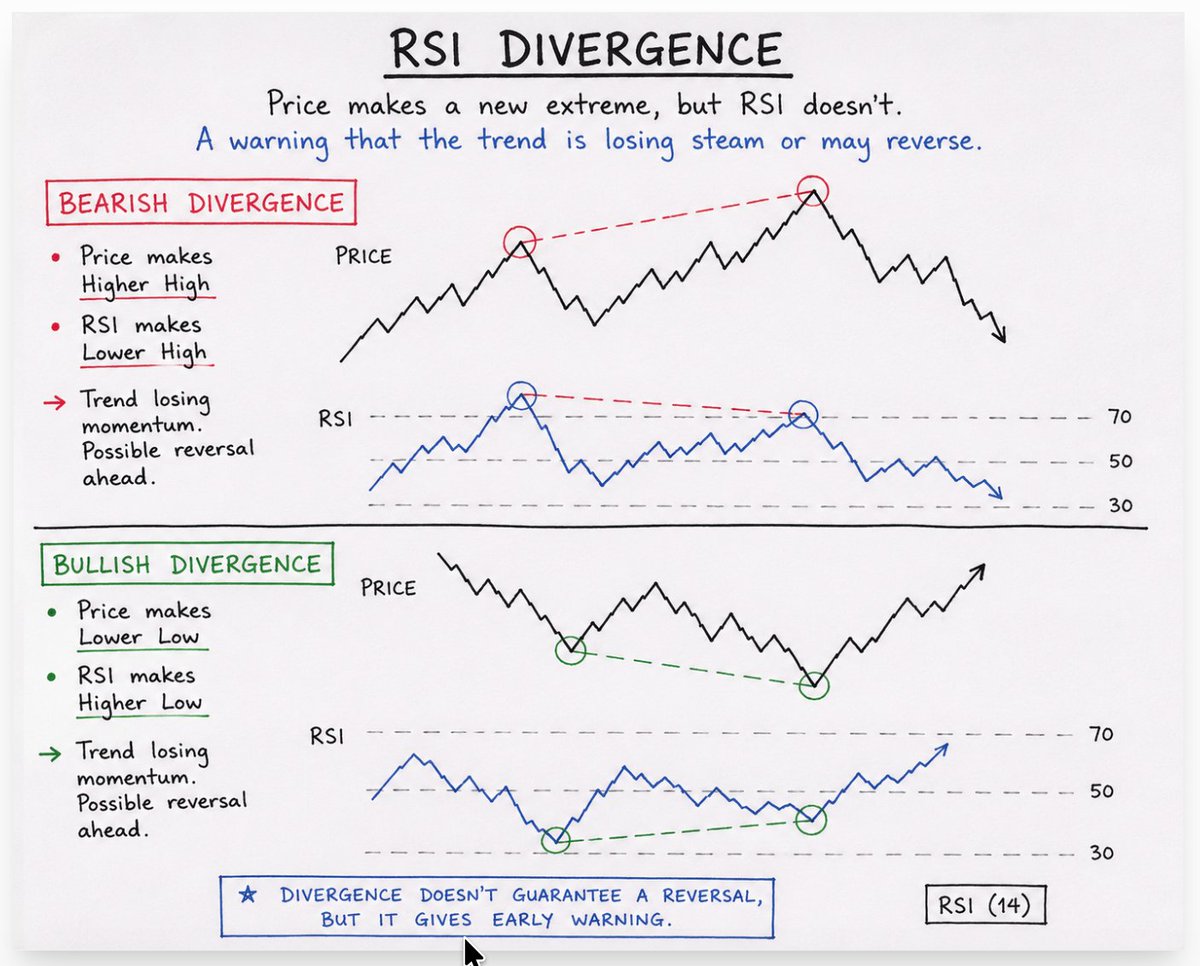
Its the RSI , but not the TYPICAL 70/30 overbought oversold type...but the 'RSI DIVERGENCE'
That is how many experienced traders use RSI
When price makes a fresh high but RSI doesn't, the market is often telling you that the trend is running out of steam.
That's often an early sign that the trend is losing momentum, and sometimes, a reversal follows.
It is not a guarantee of a reversal - but it is a signal 👍 worth paying attention to.
✔️RSI is the only indicator I keep on my charts.
Master RSI DIVERGENCE not just the overbought and oversold.
#RSI #Trading #TechnicalAnalysis #NiftyThat i
Advise to beginners
When I started Trading I used to put 4-5k per stock
then 10-15k per stock then 50k per stock
now I put 1L - 2L per stock .
Probably after few years I may have confidence to allocate 5 - 10L per stock
Learning to trade is a lengthy process .
Even if you have small amount , start today because this start will lead to making money you have dream't of !
India ranks at the top in...
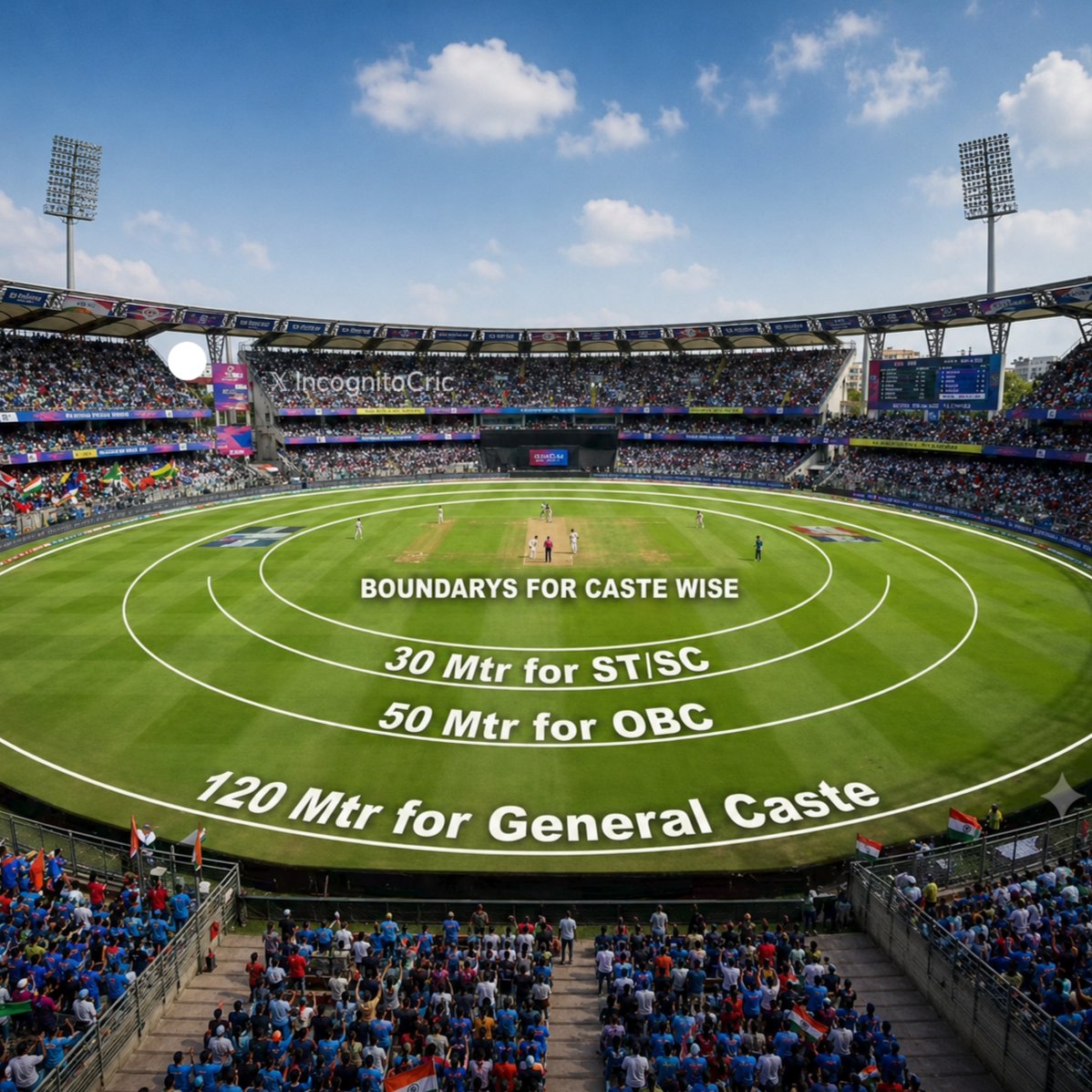
1. Army - - - - - No Reservation
2. ISRO - - - - - No Reservation
3.DRDO - - - - - No Reservation
4. Cricket - - - - No Reservation
India ranks the lowest in....
1. Education - - - - 60% Reservation
2. Medical - - - - - 60% Reservation
3. Gov work - - - - 60% Reservation
So make India great again end reservation.
#EndReservation
Every option premium is two numbers pretending to be one.
Suppose if NIFTY is at 24,850.
The 24,700 CE trades at 260.
Break it apart:
• 150 → Intrinsic Value. Real value. It already exists.
• 110 → Time Value. The market's price for uncertainty.
Here are 5 things beginner traders never truly understand:
Option sellers never earn intrinsic value.
Intrinsic simply transfers between buyer and seller at expiry. Every rupee sellers make comes from time value decaying.
An OTM option is 100% time value.
Zero intrinsic. Zero real value. You're paying entirely for the possibility that it becomes valuable before expiry.
Time value peaks at ATM.
Why? Because that's where uncertainty is highest. Move deeper ITM or further OTM, and uncertainty—and therefore time value—shrinks.
"Time value" is actually uncertainty value.
It reflects time, volatility, interest rates, and market expectations. That's why an option's time value can increase even as time passes—if volatility expands faster than theta decays.
Deep ITM puts in India can trade below intrinsic value.
₹100 of intrinsic might trade at ₹97. Since they're European-style options, you can't exercise early, so the market discounts the wait until expiry.
The next time you look at an option premium, don't see one number.
See two.
One is fact.
The other is opinion.
And opinions have an expiry date.
I always cherish staying out of low breadth times when market wipes out 2 weeks of gains in 3 days
But now im looking actively to try a few swing attempts in ipo bases
New ipo bases are looking good holding up strong even in this market
This market rewards buying when indices are weak and stay in cash when indices are ar highs.
For the longest time, I believed that larger capital was the solution to profitability.
I thought more capital would give me more flexibility, more opportunities, and the ability to do things that were simply not possible with a smaller account.
But in equities, I realised that the opposite can often be true.
In equity investing, smaller capital can actually be a significant advantage.
Someone managing a few crores may have more opportunities than a mutual fund managing thousands of crores. Similarly, someone managing a few lakhs may be able to explore a much wider universe than someone managing several crores.
The reason is simple: as capital increases, liquidity becomes a major constraint.
Your investible universe begins to shrink. You can no longer freely enter smaller or relatively illiquid companies without affecting the price or facing difficulty while exiting. You are gradually forced to operate within a limited basket of large, highly liquid stocks.
With smaller capital, however, many more companies have sufficient liquidity to accommodate your position. This allows you to explore opportunities beyond the obvious large-cap universe.
Ironically, many traders still believe that small capital should automatically be deployed in options because options offer leverage and the possibility of higher returns.
I disagree.
For capital below approximately ₹5–10 lakh, I personally feel that actively trading options may not be worth the effort and risk. Placing 20–30 orders a day, paying brokerage, STT, exchange charges and slippage, while continuously developing and executing strategies, can significantly reduce the returns.
The same time and effort spent researching options strategies could instead be used to study equities, where the opportunity set may be much broader and the overall cost of execution considerably lower.
And by equities, I do not mean simply investing passively in the Nifty. There is an entire universe of active equity strategies, momentum investing, factor-based investing, small- and mid-cap opportunities, sector rotation and systematic stock selection that can be explored.
Larger capital is certainly valuable, but it does not automatically create a greater edge.
In equities, smaller capital often gives you something extremely powerful: flexibility.
Something I've simply trained myself to do before every trade is to ZOOM OUT and ask a few simple questions:
> what's the personality of this chart?
> what's the overall market doing?
> what are its peers doing?
> what group is it in?
The majority of stocks don't move in isolation. Strong groups tend to lift strong stocks, and weak groups tend to drag even good charts down.
The more pieces of the puzzle that line up, the more conviction I have.
It all flipped for me once I stopped looking at charts in a vacuum + started focusing on context first.
🚨 THE SAME SIGNAL THAT STARTED THE 2023 SMALLCAP BULL MARKET RALLY IS BACK.
Three years ago, in July 2023, the ROC (Rate of Change) indicator moved from negative to positive and the Smallcap Index rallied from 11,000 to 19,000 — a 73% move.
So what is ROC?
Think of ROC like a car’s accelerator pedal. It doesn’t tell you how fast the car is moving it tells you whether the driver has started pressing the accelerator again. Once momentum returns, price often follows.
This month, ROC has once again turned positive with the index near 19,000.
If history even comes close to repeating itself, 27,000 before 2028 looks achievable to me so an upside of roughly 42% from current levels is due in next 15-20 months
Momentum has returned. Now let’s see if price follows once again.
One simple observation from NIFTY historical data:
• First 5-minute candle matched the day's direction 61.7% of the time.
• First 15-minute candle improved it to 63.8%.
• When both pointed the same way, accuracy jumped to 65.7%.
The longer the open commits, the more likely the day follows through.
This Nifty data has really surprised me:
Since 2000, Nifty has grown nearly 15x.
But if you had missed just the:
• Best 5 trading days → returns drop to 9.3x
• Best 30 trading days → returns fall to 2.4x
• Best 50 trading days → you're left with almost no returns.
That's less than 1% of all trading days doing almost all the heavy lifting.
The interesting part? Many of these biggest rallies came right after sharp sell-offs, when most participants had already exited.
That's why I show up to the market with a clean setup every single day. You never know when one of those days arrives.
If you've followed me for any length of time, you already know...
I'll happily let everyone else fight over the left side of the V.
Give me the right side every single time.
I made this graphic back in January to better illustrate exactly what I mean: