Man spent five hours filling his bucket with fish, until he woke up to find every single one gone.
On May 20th, a man was fishing off a dock when he started having one of the best days he’d had in weeks.
For hours, he kept pulling fish in and dropping them into his bucket, until it was almost full. Eventually, he got tired, sat back in his chair, and left his fishing line out just in case another fish bit while he rested.
A little while later, he woke up and looked down. The bucket was empty. At first, he thought he was losing his mind. He knew he had caught fish. He remembered putting them in the bucket. But now there wasn’t a single one left.
He started getting upset, thinking someone had taken them, until the dock camera footage finally showed what really happened.
His dog had been quietly taking each fish from the bucket and dropping them into the water for a dolphin waiting beside the dock.
The dog wasn’t stealing. He was feeding him.
The man said he couldn’t even stay mad after seeing the video, because his dog does the same thing at home, whenever the baby cries, he tries to bring over pieces of his own kibble like he’s helping.
He thought his fish had been stolen, but his dog had just found someone he thought needed them more.
⚡️The middle class is where the system hides its extraction because the middle class still believes obedience will be rewarded.
The poor are visibly dependent.
The rich are structurally insulated.
The middle class is trapped inside the moral contract of responsibility.
Work hard. Pay taxes. Buy insurance. Save for retirement. Don’t cheat. Don’t default. Don’t complain. Don’t take too much. Don’t fall behind. Keep your credit clean. Keep your kids on track. Keep your career moving. Keep the mortgage paid. Keep smiling.
Then the system taxes that obedience.
The middle class is easy to extract from because its income is visible, its behavior is predictable, and its fear of falling is powerful.
W-2 income can be captured before it ever reaches the bank account.
Property taxes attach to shelter. Healthcare attaches to employment. College aid disappears once income crosses thresholds. Tax credits phase out. Professional licensing, insurance, childcare, commuting, housing, and retirement all become toll booths.
The rich escape through structure.
The poor survive through assistance.
The middle pays retail.
That is why it feels like the most expensive place to live. It is the zone where you make enough to be denied help and not enough to buy freedom. You are too “successful” for sympathy and too exposed for security.
This is also why the middle-class anger is going to grow. These people are the stabilizing class. They follow rules, raise kids, pay bills, fund municipalities, staff companies, buy homes, carry insurance pools, and keep institutions functioning. When they start realizing the bargain no longer compounds, political trust breaks hard.
The deepest betrayal is that income stopped being the path to safety. Asset ownership became the path to safety. The middle class earns income to buy assets, but asset prices keep moving away because monetary policy, debt, housing restriction, financialization, and investor demand pushed the ladder higher. So the worker runs faster while the asset-owner floats.
That is the hidden class split.
The middle class is not poor enough to receive the system’s mercy and not rich enough to command its architecture. It is the payer class. The compliance class. The full-price class.
Bottom line:
The middle class is expensive because it is where responsibility gets monetized.
The system extracts most efficiently from people who still believe playing by the rules will save them.
It is the day after #GigglevTickle and I haven’t woken up believing that men can be women. You can try & punish me for not believing it, but you can never make me believe it.
Men cannot be women.
If you live in South Africa, you need to read this. Your family might be in danger.
The South African government wants to hand criminals a comprehensive shopping list of every citizen who owns Bitcoin, gold, or other valuable assets.
This is not hyperbole. This is not paranoia about government overreach. This is what happens when bureaucrats create centralized databases of wealth while operating cybersecurity systems that cannot protect government servers from ransomware attacks, insider leaks, and just plain old corruption.
France provides the blueprint for disaster. So far in 2026, French criminals kidnap one crypto holder every two and a half days. Forty-one cases this year alone. One hundred and thirty-five incidents since 2023. The victims include an eleven-year-old boy kidnapped with his mother in Burgundy while criminals demanded four hundred thousand euros from the father's crypto holdings. David Balland, co-founder of hardware wallet company Ledger, lost a finger when kidnappers severed it and sent it to his associates as part of their ransom demand.
How do French criminals select their targets? Government data leaks.
A French tax official used government systems to identify wealthy crypto holders and sold that information directly to criminal networks. She worked inside the system designed to protect citizens and instead fed their personal data to the people who showed up at their homes with knives and demands for Bitcoin transfers.
Waltio, a French software company providing tax services, was hacked and exposed fifty thousand users' portfolio information on dark web marketplaces. Government employees selling data represents something far worse than mere cybersecurity incompetence. It reveals the inherent corruption that emerges when governments collect detailed wealth information about their citizens.
Pavel Durov warns that expanding government data collection on crypto holders expands the pool of kidnapping targets. Telegram's founder said the platform would rather exit the French market than hand private user data to French authorities.
South Africa's cybersecurity record makes France look competent by comparison. Hackers put 3.6 million Gauteng Provincial Government files up for sale on the dark web for twenty-five thousand dollars. Statistics South Africa suffered a breach in January 2026. Cell C leaked two terabytes of data belonging to 7.7 million customers. The Department of Justice lost control of over 1,200 confidential files in a ransomware attack that crippled systems for weeks.
These same people now demand that every South African declare their Bitcoin, gold, and alternative asset holdings within thirty days. Name, ID number, portfolio amounts. All stored in government databases operated by the same institutions that cannot even secure their own local servers.
The regulations extend beyond Bitcoin. Gold holders face the same mandatory disclosure requirements. Alternative investments fall under identical rules. The government wants comprehensive records of every citizen who owns assets outside the traditional banking system.
Free market economists understand why governments crave this information. Capital controls require detailed knowledge of citizen wealth. Currency restrictions need enforcement mechanisms. Confiscation demands target lists.
But the immediate threat comes from criminals. French kidnappers prove that government wealth databases become criminal targeting systems. The data will leak. Government employees will sell access. Hackers will breach the servers.
South African criminals will adapt French tactics to local conditions. Home invasions already plague wealthy neighborhoods. Adding detailed cryptocurrency and gold holdings data transforms random crime into precision targeting. Why rob houses blindly when government databases provide exact wealth information and home addresses?
The regulatory framework creates perverse incentives for corruption. Tax officials gain access to detailed wealth information about every compliant citizen. The temptation to monetize this data through criminal networks will prove irresistible for some percentage of government employees. France shows this corruption is inevitable, not theoretical.
Compliance rewards criminals while punishment awaits honest citizens. Those who declare their holdings create detailed target lists for kidnappers. Those who refuse face government penalties. The regulations trap law-abiding citizens between criminal violence and state punishment.
The solution involves rejecting the entire framework. No government database. No mandatory declarations. No centralized records of citizen wealth in Bitcoin, gold, or alternative assets. The French kidnapping epidemic demonstrates exactly why financial privacy matters for physical safety.
South African crypto holders should study French headlines carefully. Today's regulatory compliance becomes tomorrow's kidnapping victim list. The government promises protection while operating systems that guarantee data breaches.
Act now, or your family will be in danger.
https://t.co/o4xEomRIr2
If ever you weren't sure if South Africa was a vassal state to the globalist agenda, here is our president simping for money from BlackRock.
BlackRock are the funding arm for globalists, with over $13 trillion of other people's money to use for nefarious purposes - under the guise of fund management.
Your salary is taxed. Your purchases are taxed. Your investments are taxed. Your property is taxed. Your inheritance is taxed. And every year inflation taxes whatever is left. You are not a citizen. You are a revenue stream.
South Africa’s new regulations are an attack on Bitcoin.
You must declare your holdings, get permission to use your crypto, and hand over your private keys on demand.
Here’s everything you need to know - and how to fight back.
"Of all tyrannies, a tyranny sincerely exercised for the good of its victims may be the most oppressive. It would be better to live under robber barons than under omnipotent moral busybodies. The robber baron's cruelty may sometimes sleep, his cupidity may at some point be satiated; but those who torment us for our own good will torment us without end for they do so with the approval of their own conscience." - C. S. Lewis
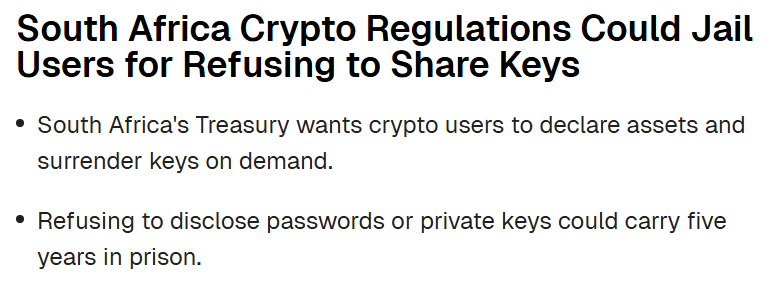
The South African government published draft regulations that would criminalize self-custody of Bitcoin. Border agents could demand your private keys. Treasury could force you to sell your Bitcoin back to rand. All holdings must be declared within 30 days. This happened by ministerial decree without a parliamentary vote.
Murray Rothbard described the state as nothing more than a gang of thieves writ large, legitimized through the mythology of democratic consent. South Africa's National Treasury demonstrates this perfectly. They are using a 93-year-old law from 1933 to regulate technology that didn't exist until 2009, overriding court rulings that said crypto assets fall outside exchange controls. The rand has lost 90% of its value in thirty years, and now they want to trap you inside their sinking currency.
They are doing this because of what economists call the Impossible Trinity. Any government can only maintain two of three things: stable exchange rates, free capital movement, or independent monetary policy. South Africa chose capital controls plus monetary independence, sacrificing your freedom to move money. Bitcoin breaks that equation. When you can custody your own wealth outside their system, their capital controls become meaningless.
Eleven million South Africans remain unbanked. For them, self-custodied Bitcoin is their bank. The same government claiming to care about financial inclusion just moved to criminalize the only viable savings technology these people can access. Bastiat would recognize the paradox: what is seen is "investor protection," what is unseen is the destruction of the only escape route from monetary theft.
The comment window closes May 16th. They are betting you won't notice until it's too late.
why Bitcoin?! 🤔💭
in a single generation the South African rand lost roughly 75% of its buying power
food prices, fuel, electricity, housing & medical aid keeps skyrocketing
only 21 million Bitcoin will ever exist & 95% is already mined⚡️⚡️
not everyone will get a piece 🍰
South Africa's National Treasury draft regulations to "control" crypto assets is archaic, deeply flawed & highlights a HUGE gap in basic crypto literacy
SA cannot lose the digital asset adoption race because of terrible policy!!
we will submit constructive policy feedback!!🚀🚀
States are slowly waking up to a terrifying new reality: “Wait… people can actually transact directly with each other and we have zero control over it?! Quick - tax it, ban it, persecute the users, and make damn sure this never gets big.”
Well, the smarter states (like the US) have already realized they can’t win this fight the old-fashioned way with brute force and outright bans. So instead, they’re trying to lure Bitcoin holders into giving up self-custody. That way they keep at least some control… and maintain a convenient “Plan B” (ehm ehm… confiscation… ehm ehm) just in case the current system completely collapses. Which, let’s be honest, it eventually will.
This is sad news for the South African Bitcoin community, but honestly, no one is surprised given the country’s latest developments. 📉