@paulbsqt Thanks for sharing! I am surprised I haven't come across the @PhilippeGC and Klieber paper, which examines the preprint of the QJE Bilal and Kanzig paper. They make some similar points as us, but their analysis of the LPs is much more thorough. Will add this to the next version.
This is why economics is simultaneously fascinating & frustrating. On the relatively simple question of whether the US or the EU is better off, we can't find consensus because of nuances around PPP, consumer surplus in GDP, product quality, etc...
Some reflections on the @lgaricano and @paulkrugman discussion. The key question in terms of numbers is -- how do u think about the value of goods whose price declines (a lot). Paul Krugman argues that in ppp at today's prices, the US-EU gap is not a big deal; Luis highlights
@alexjlockie@mattyglesias@GaryWinslett 1 cord/acre * 4 cords/home * 300k homes = 1.2 million of the state's 4.5 million acres of forestland... maybe borderline feasible?
I agree with @noahqk here.
I don't like the title either (which was not written by Roger), but @RogerPielkeJr raises some important points in his WSJ piece about how research evolves, and how policymakers should pay more attention to the nuances and updates, with examples from climate damage estimates, RCP8.5, and hurricane data.
As Noah rightly says, climate economics as a whole is an important and rigorous field, which has generated lots of important insights, and is full of smart, honest, and rigorous people. @FinbarCurtin's and my paper simply raises questions about the feasibility of one (important) project in that field: estimating marco-scale damages from time-series data (a project that has been carried out by smart, honest, and rigorous people, whether our critique is right or wrong).
Climate economics is a broad subfield with terrific scholars and useful insights on topics from climate risks to mitigation pathways.
This article raises a narrower (but important) issue: our inability to produce policy-relevant estimates of total climate damages.
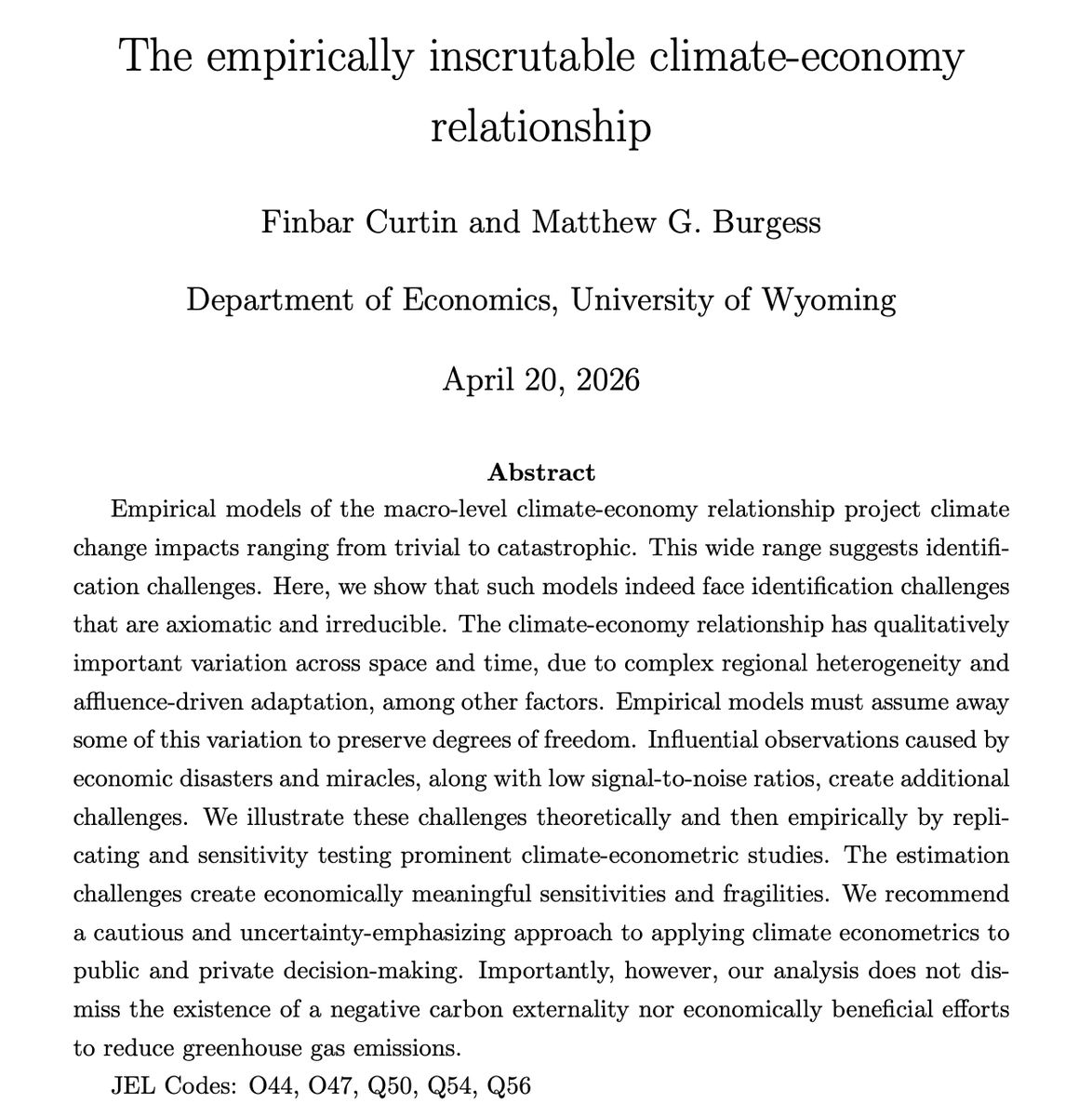
This is a critical takeaway from our paper "The empirically inscrutable climate-economy relationship". We emphasize uncertainty; that does *not* mean carbon is externality-free, and it does *not* mean climate change is harmless.
@Electroversenet The paper explicitly states it does not dismiss the negative externality or benefits of emission reductions. Methodological uncertainty does not negate the economic case for mitigation.
@BruceTTCalvert If reduced-form temperature-GDP estimations are fragile, then my prior would be that it would be difficult to ever confirm the numerous assumptions necessary for damage transmission in CGE models. But I'm not as well read in this department, so happy to hear arguments otherwise!
20/n) There is no SCC or projection of climate damages that is “the answer.” (An “answer” which seems to change depending on who is in the White House.) Climate damages are deeply uncertain, and policy makers should truly grapple with decision making under deep uncertainty.
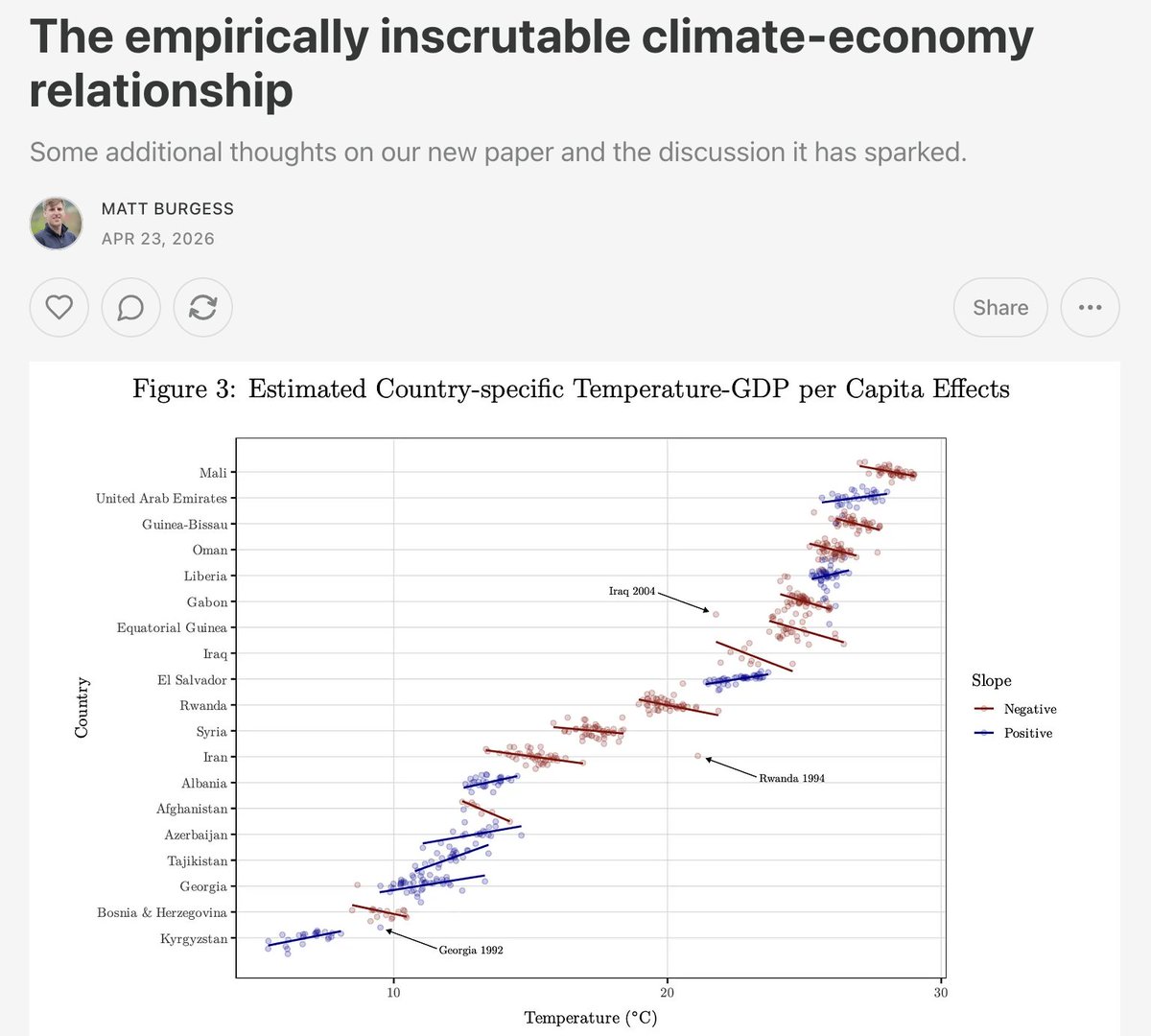
I have a new Guided Civic Revival post on some of the feedback we have received so far on @FinbarCurtin's and my paper "The empirically inscrutable climate-economy relationship". Thanks everyone! Keep it coming (both positive and critical).
I am a big fan of this paper and have learned about the robustness of my co-authored paper's estimates as a function of outlier observations. Macro/climate regressions are historical benchmarks and shouldn't be used to predict the future. Lucas Critique, Lucas Critique!!
@VincentGeloso Well put! The climate vulnerability generated by frail institutions (and poverty) is a huge motivator for me to focus on climate change in the developing world. Definitely an area I look towards next, so thanks for sharing the papers.
@BruceTTCalvert We briefly discuss this in our introduction, but our intuition is that these types of models are likely less reliable because they 1) cannot account for all possible sectors and 2) cannot sufficiently capture complex interactions/spillovers between sectors.
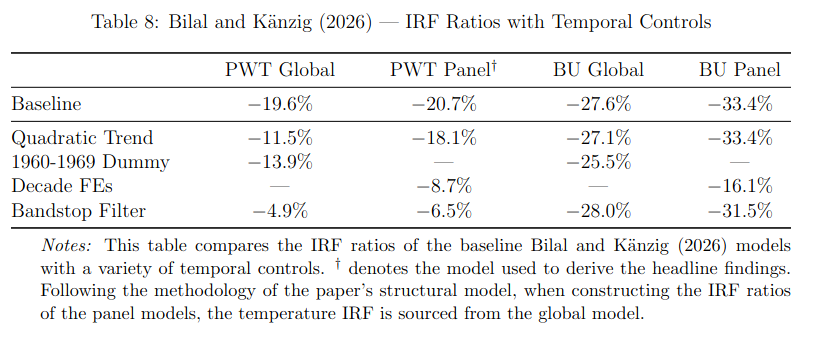
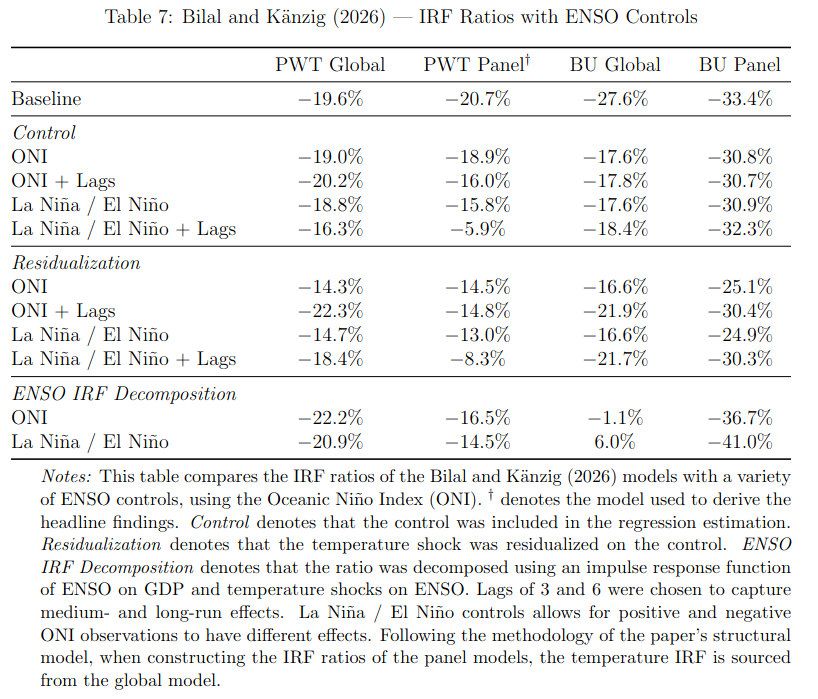
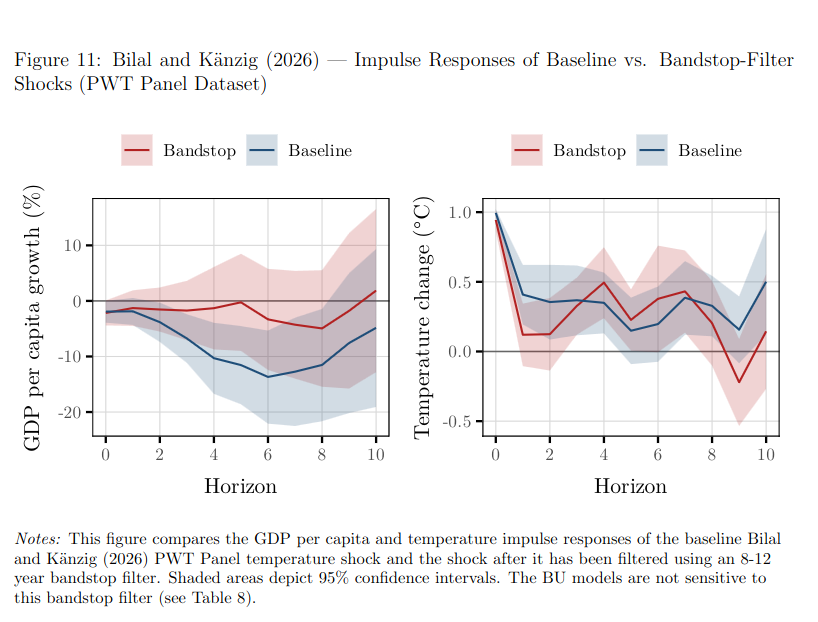
17/n) Bilal and Känzig (2026) use two datasets (PWT and BU). PWT results (used to calibrate their damage function) are ENSO-sensitive.
They are also sensitive to a bandstop filter and long-run controls.
@hagertynw Exactly, we are on the same page. There is a wide menu of SCC and damage estimates to choose from, and it is policy makers who ultimately decide the "answer" to use in public decision making.
23/END) We thank the authors of these papers, as well as colleagues at the University of Wyoming and University of Colorado-Boulder, for their thoughts and suggestions.
We welcome any feedback for improvements!
22/n) Importantly: we are *not* claiming that climate change is economically harmless. We're arguing that the magnitude of damages is deeply and irreducibly uncertain, and trillion-dollar decisions need to stop being made as if it isn't.