@abhiisshhek Behakau means offered cash ...!? What a shame ,they will do anything for cash!? What a family owned business 🤔🤔no investment only profit and instant fame🤗
@TheRakesh_IND Heard some thing like that girl is minor...just go to court and produce the proof there ends the matter. SCI given clear direction to let go all minor children.. why this stage drama by @TOIIndiaNews can't say this to their 😈😈
@TheRakesh_IND Who is this person with covered face... What is they/them are saying! want more funds. This is the price for leting out our dignity for Rent to go ranting on the roads
@piyush_trades If may I ask what is the total capital deployed and monthly ROI... Just curious as am not able to hold on buying side and relaying on pure selling. Your inputs may help me understand how to go about buying.BTW are you going for intraday or swing trades on buying!? Thank you
Don't worry ma'am very soon we will have STCG 30% LTCG 20% and F&O income will be treated as slab rate for their long-term business growth... Anyway,for their regular income they have STT ,gst x,y,z , basically for their pocket money 🤑🤗
Dear @NSitharaman,
If share trading is someone’s only source of income and they make ₹8 lakh profit in a year through short term trading:
STCG tax: 20%
₹8,00,000 × 20% = ₹1,60,000
4% cess = ₹6,400
Total tax = ₹1,66,400
This feels unfair for people who depend only on trading.
A salaried person earning ₹12 lakh pay zero income tax, while a trader making just ₹8 lakh profit has to pay ₹1.66 lakh in tax.
WOWOWOW.
Nusense value been heard everywhere,our institutions are no different. Genuine traders who keeps the Market dynamics alive and paying huge chunk of taxes to government,yet no one cares for retailers. 🙂↕️
What the hell is happening to the Indian stock market?
Dear @SEBI_India & @NSEIndia@BSEIndia
How many times do you expect traders to rebuild their entire business?
> December 2020 – 50% leverage removed
> March 2021 – 75% leverage removed
>September 2021 – 100% leverage removed
We adapted.
Yes, leverage is a double-edged sword. But thousands of genuine traders with smaller capital were affected. Still, we adapted.
> September 2023 – Bank Nifty expiry was shifted from Thursday to Wednesday, while BSE launched Sensex weekly expiry on Friday. Suddenly, we had expiries almost every trading day.
Many traders, especially algo and 0-DTE traders, redesigned their entire systems.
We adapted.
> November 2024 – Weekly expiries of FinNifty, Bank Nifty and other indices were removed. Only Nifty and Sensex weekly expiries remained.
Again, thousands of traders had to change their strategies.
We adapted.
> February 2025 – Expiry-day margin benefit was removed.
STBT traders were hit badly.
We adapted.
> 1st September 2025 – Nifty expiry shifted from Thursday to Tuesday.
Again...
We adapted.
> Jane Street reportedly made billions of dollars from Indian markets over the years. Later, regulatory action was taken, and subsequently trading restrictions were lifted after payment of regulatory dues/settlement.
How exactly did all of this benefit Indian retailers?
Meanwhile...
- Option STT has increased massively over the last few years.
- Bid-ask spreads have widened.
- Slippage has increased.
- Global volatility has increased.
- Transaction costs keep rising.
We adapted to everything.
And now...
Closing Auction Session (CAS).
Seriously?
Every few months there's another structural change.
Every few months traders are forced to rebuild their systems.
Every few months liquidity takes another hit.
You say these changes are for retail investor protection.
Then please show us the data.
Can you show even one report proving that retail trading losses have actually reduced because of all these interventions?
If not, then what exactly are these constant changes achieving?
Instead of making markets more efficient, you're making trading more expensive, more complicated, and pushing serious traders towards crypto and international markets.
As a full-time trader, my inner soul genuinely cries today seeing the direction our markets are heading.
We survived leverage removal.
We survived daily expiries.
We survived removal of daily expiries.
We survived expiry changes.
We survived removal of expiry margin benefits.
We survived higher STT.
We survived wider spreads and slippage.
Now we are expected to survive CAS as well?
Enough is enough.
I request SEBI and the exchanges to reconsider this rule.
Before implementing such major structural changes, consult the trading community. There should be proper communication, public discussion, and representation from active traders.
I also request every trader to raise their voice through the proper channels. If you genuinely believe these changes are hurting market participants, please send your feedback or complaint to SEBI through its official grievance mechanism. And if anyone from the industry has a direct channel to the exchanges or regulators, please help convey the concerns of the trading community.
Please Retweet this so our voice reaches the right people.
Enough of silent adaptation. It's time the trading community is heard.
@AnilSinghvi_@_anujsinghal@SarangSood@PRAFULKULKARN18@adigitalblogger@iarjuntandon@JayneshKasliwal@sunilgurjar01@piyushchaudhry@SantoshPasi@RakeshPujara1@TanmayKurtkoti@justnottamomma@AshishGupta325
2020 COVID Crash: 160 trading days
2022 Inflation & Fed Tightening: 100–120 days
2026 IRAN war: From March till date 120 days
what next let's dig deep most effected sectors during the same period? what are the sectors that led the recovery #niftycrash#market
Major Stretches Below 200 DMA (2006–2026)
2008 Global Financial Crisis:
Longest continuous stretch in the past 20 years.220–240 trading days
2011 Eurozone Debt Crisis:~150–170 trading days
2015–2016 Commodity & China Slowdown:
~120–150 days
State Bank of India
Sun Pharmaceutical
NTPC
Axis Bank
Titan
Oil & Natural Gas Corporation
Bharat Electronics
*Coal India
JSW Steel
Bajaj Auto
Tata Steel
Hindalco Industries
Shriram Finance
Eicher Motors
Apollo Hospitals
Dr Reddys Laboratories
Even in the current uncertain market conditions — with the Nifty Index down nearly 12% from its recent swing high of 26,341 to 23,112 — the following Nifty50 stocks have remained resilient, maintaining strong price structures.
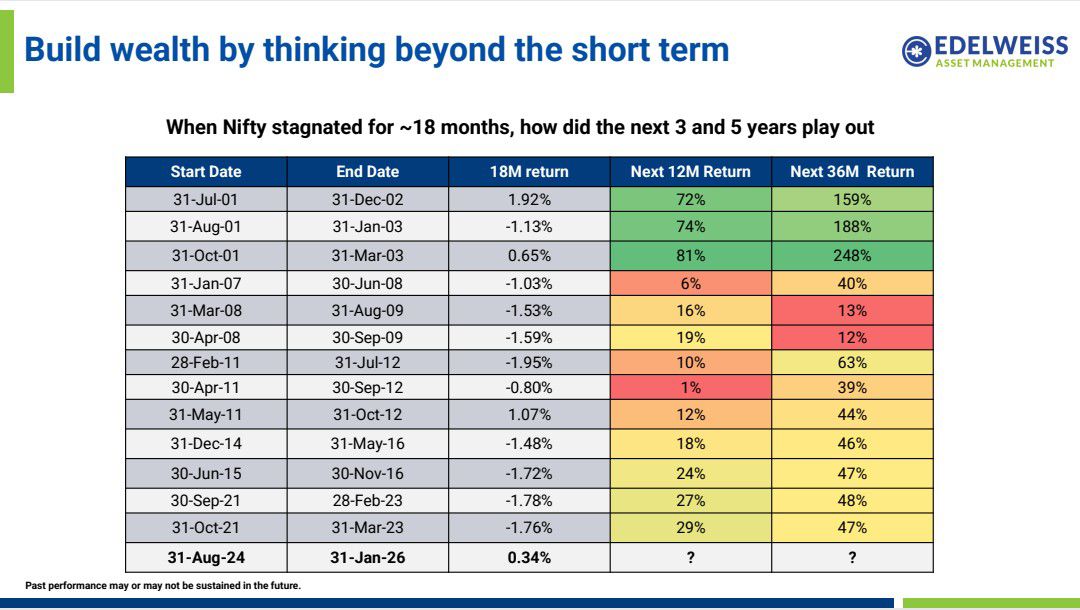
Despite historical patterns, future returns are unpredictable due to factors like geopolitical tensions, wars, and tariffs. Past performance offers reference but does not guarantee a rebound. JUST FOCUS ON QUALITY, STAY PUT WITH UR LT BETS
Insights & Extremes: The highest 1-year gain was 81% (Oct 2001–Mar 2003), while the lowest was just 1% (Apr 2011–Sep 2012). Similarly, 3-year returns ranged from 12% to 248%, highlighting potential long-term recovery.