Seeking asymmetric edges in quality growth & tech.
Thoughts on markets, compounding, and rational investing amid noise.
NFA 👇
Follow for clarity, not hype.
One of the most expensive myths I believed early on:
“Entry price doesn’t matter if you have long-term conviction.”
I acted on it. Results were mixed at best.
Yes, I caught a few early winners. But I also took a few painful hits.
The math is simple: if a stock drops 50% from where you chased it, it needs a 100% gain just to get you back to breakeven.
Buying at the wrong price creates a hole that takes years to dig out of.
In this volatility, chasing extended names is usually a tax on impatience.
When a stock runs, let it go.
There is always another opportunity around the corner.
$NBIS and $AAOI already ran hard.
But plenty of solid companies are still trading 40-70% below their highs with intact fundamentals.
Patience pays.
Entry price still matters.
A lot.
Who else stopped chasing and started waiting for better entry points?
The numbers presented by @danielkoss are impressive.
So is Nebius’ execution. They’re doing a fantastic job and, in many ways, have become the standard-bearer of the neocloud movement.
The stock price reflects that success - up more than 200% YTD, an incredible run.
My question to both $NBIS shareholders and those following the company:
Would you buy at today’s price, or would you wait for a better entry point?
Many of you agreed with my previous point:
Just because you have long-term conviction doesn't mean it's a good idea to buy at the top.
So let's challenge another investing myth:
"Never sell your winners."
Hear me out.
If a stock is trading at what you believe is an extreme valuation, and you wouldn't buy it today because it's too expensive...
...shouldn't you at least consider selling?
Under my previous post, many of you said:
"Don't chase winners. Wait for a pullback and add then."
Fair enough.
But if you wouldn't buy the stock at today's price, why are you so comfortable continuing to hold it?
Why not sell and buy it back after a correction?
Here's the interesting part:
We often find it much easier to watch gains evaporate in a stock we've already made money on than to buy a stock at an all-time high and immediately sit through a decline.
But economically, aren't these the same thing?
Imagine a stock:
Starts at $100
Rises to $200 (its ATH)
Option A: You already own it and keep holding.
Option B: You don't own it and decide to buy at $200.
The stock then falls to $150.
Most investors are far more comfortable with Option A than Option B.
Yet both investors end up in exactly the same place.
That's the paradox.
To be clear, I'm not saying you should always sell your winners.
I'm simply wondering why we tend to evaluate the exact same exposure differently depending on whether we already own it or not.
Honestly, this is one of the mistakes I catch myself making most often.
A mental trap?
What do you think?
$AMPG reported its Q2 2026 results last week, and today released an update that, in my view, clears up some of the uncertainty.
But more on that in a minute.
First, the earnings.
The market reaction? Brutal.
The stock dropped more than 30% in a single session.
Why?
Management withdrew its previous ~$50M revenue outlook after customers pushed back deployment schedules.
Importantly, management said the orders have not been cancelled. The timelines simply changed, with some revenue potentially moving into 2027.
What do I think?
For a company like $AMPG, revenue is naturally lumpy. The business depends on large contracts, which can result in big one-off revenue contributions.
So I have no problem with revenue being pushed out.
The problem, in my opinion, was how management communicated it.
I think management made a fairly big mistake. They tried to be too conservative and transparent by simply pulling the guidance, but in doing so, they also made it look like they had less control over the business than they actually do.
What should they have done?
What many other companies do: put the numbers into context.
Break the opportunity down into:
→ contracted revenue
→ potential orders / LOIs
→ broader pipeline
Then show how much of that pipeline historically converts into revenue and over what timeframe - for example, how much could be recognized within 12 months vs. 12–24 months.
They would still be telling the exact same truth, but investors would have a much better picture of the opportunity.
Instead, the company focused almost entirely on the near term. They didn't sugarcoat anything, but they also left out a lot of the bigger picture.
And this is where today's update changes quite a bit, in my view.
$AMPG currently has ~$17M in backlog and has already shipped more than $17M of ORAN products since the program began.
More than 2,000 radios are deployed with a Tier-1 MNO.
And then there's the pipeline:
→ additional MNO evaluations underway
→ a Tier-1 telecom infrastructure RFP potentially worth tens of millions of dollars
→ some Asian deployments pushed into 2027, but the orders remain active
→ management still expects 2026 revenue to exceed 2025
→ target of positive EBITDA in 2027
And all of this is happening in a market where ORAN Radio Units are expected to grow at roughly 20.7% CAGR, reaching $10.8B by 2033.
The technology is no longer just a story. It has been deployed and validated.
The next question is whether $AMPG can turn that validation into a scalable, higher-margin business.
So in a way, management is now correcting its earlier mistake by giving investors a much better view of the company's potential over the coming months and years.
And that potential is exactly what we were valuing when we invested in $AMPG in the first place.
So what do I see from here?
I don't expect fireworks in 2026. This may actually be a good time to reduce the position.
At the same time, I think 2027 could be a very important year for $AMPG, which is why I haven't made a final decision yet.
If I don't find a better opportunity, I'll probably just hold the shares and watch how this plays out.
Because at this point, I don't think the $AMPG story is broken.
It's simply been pushed further out.
As someone who is very bullish on $IREN, I was initially excited when I saw below comparison.
However, after thinking about it for a moment, I realized the numbers are quite misleading.
The calculation uses the full contract values while mixing contracts with different durations - for example, 2-year and 5-year contracts.
That’s a mistake.
The values should be normalized based on the contract duration.
This kind of comparison can lead to a misleading narrative.
In my opinion, this analysis should be done much more rigorously - primarily by converting the contracts into annualized revenue (ARR) before comparing them.
$PENG at today Rosenblatt Tech Conference
Some new points that stood out to me:
> ClusterWareAI covers deployment, 24/7 monitoring and AI-driven auto-remediation.
Kubernetes/Slurm get you much closer to deployment, but don’t solve the full operational layer.
> Enterprises are moving from AI experiments to production.
Think claims processing, fraud detection, drug discovery and integrations with ERP, healthcare and customer databases.
> Haein is now running at 100% capacity on a fully sovereign Neo Cloud setup. Penguin’s team is actively managing the cluster in South Korea.
> Sovereign AI is not only a government requirement. Penguin is seeing enterprises wanting private AI infrastructure inside their own network boundaries.
> The “own vs rent” argument is becoming more relevant. If AI workloads run 24/7, owning infrastructure can make more sense than renting capacity indefinitely.
> Beyond Dell, CDW, SK and NVIDIA, Penguin also works with WWT on systems integration.
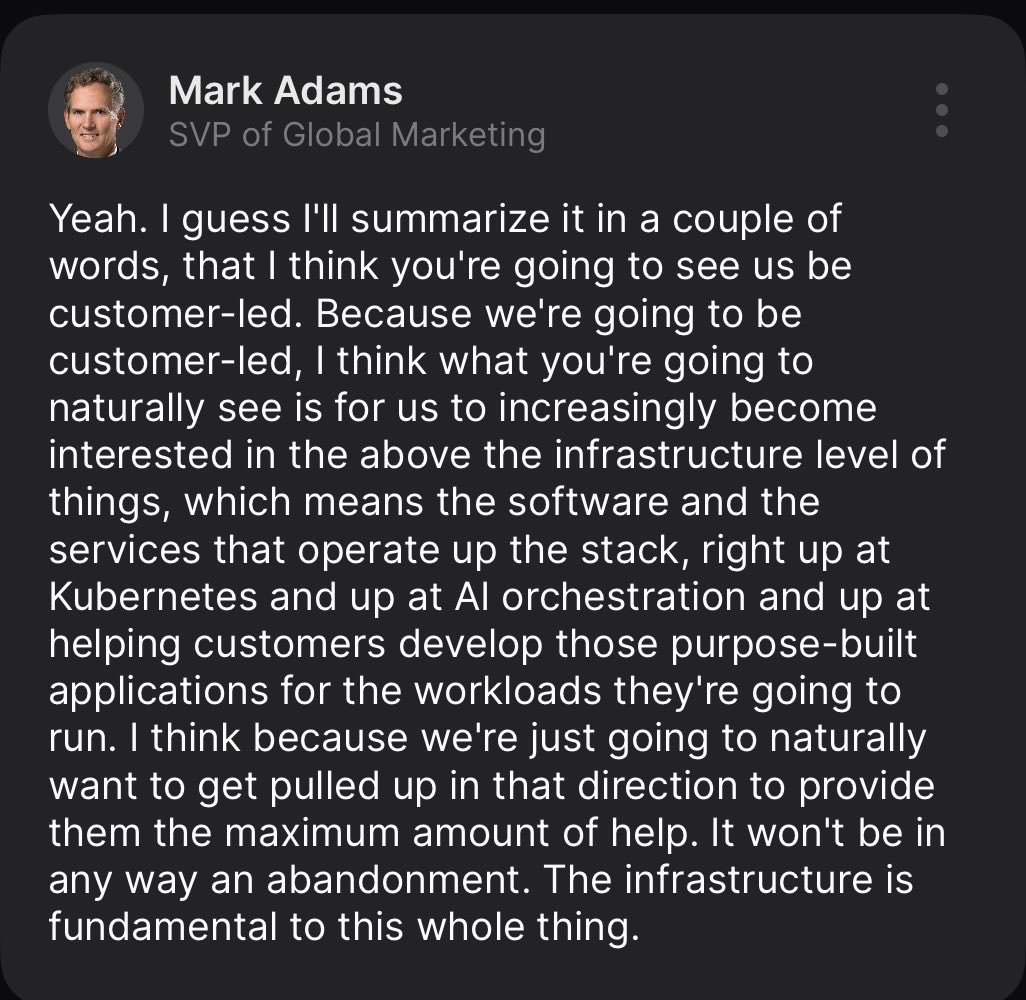
> The next 2–3 years could see Penguin move further up the stack into Kubernetes, orchestration and applications.
That last point is probably the one I’ll watch most closely.
Infrastructure is the foundation.
Moving up the stack is where the margin expansion could come from.
This feels like the beginning of an interesting new chapter in my life.
The company I currently work for has been sold by its private equity owner and acquired by a much larger competitor. Over time, we'll likely be integrated into the new organization.
There are a lot of changes ahead. It's not the easiest situation to process, and what I'll miss the most are the people I work with every day.
At the same time, change often creates opportunity.
Over the coming months, I'll have some important decisions to make about my future. Whether that means staying in the industry, relocating with my family, or pursuing something entirely different, I'm keeping an open mind.
What's interesting is that while one chapter may be coming to an end, another seems to be just beginning.
Back in January, I started an account on X and began sharing my thoughts on markets, technology, and companies. I had no expectations.
Since then, I've connected with incredible people, spoken with CEOs and analysts, and found opportunities I never would have imagined just a few months ago.
One thing is certain: this will be a year of change.
Sorry for the personal post, but I felt like sharing.
HBM demand is expected to grow from 6-7EB in 2027 to 12.5EB in 2028 that's roughly +85% YoY.
You can't stop this.
Long memory.
$SKHY $MU https://t.co/ePZk3Q77ee
I've noticed that more and more people have been looking into $ASYS lately.
A 2 months ago, I wrote a short article covering the company.
I'll probably refresh and update it at some point, but if you're interested in learning more about the business today, feel free to give it a read.
Very busy day today.
Barely had any time to be here.
Market is red.
And when I finally found a moment to write something, the internet decided to go down.
I’m not even bothering with the hotspot.
No coincidences. Just signs.
Time to log off. See you tomorrow. 👋
The energy bottleneck for AI today is the grid.
This is an important point we often forget.
It’s not just that getting access to the grid is taking longer. Lead times for turbines and generators have also increased significantly.
Over the next few years, companies that have secured grid access and locked in power-generation capacity could have a major advantage.
Which company do you see as the biggest beneficiary of this trend?
$GOOGL just locked in a major custom chip deal with $MRVL, giving us a clear look at how hyperscalers are securing their hardware supply chains for the long haul.
Under the agreement, Marvell will develop a wide range of custom silicon for Google’s TPU ecosystem - spanning AI inference accelerators, storage controllers, and memory interfaces.
What makes this deal particularly interesting is how it's structured:
> Equity Incentive:
Google receives warrants to buy up to 58.97 million Marvell shares at $206.58 each.
> Tied to Real Spend:
Beyond a small time-based portion (~1.36 million shares), the remaining warrants only vest as Google actually buys hardware.
Specifically, one tranche unlocks for every $500 million in revenue Marvell generates from these custom products through fiscal year 2033.
Instead of just buying off-the-shelf components, big tech companies are aligning financial incentives directly with their chip partners.
By giving Google an equity stake tied directly to sales volumes, Marvell secures long-term demand while Google gets custom-tailored silicon designed specifically for its own data centers.
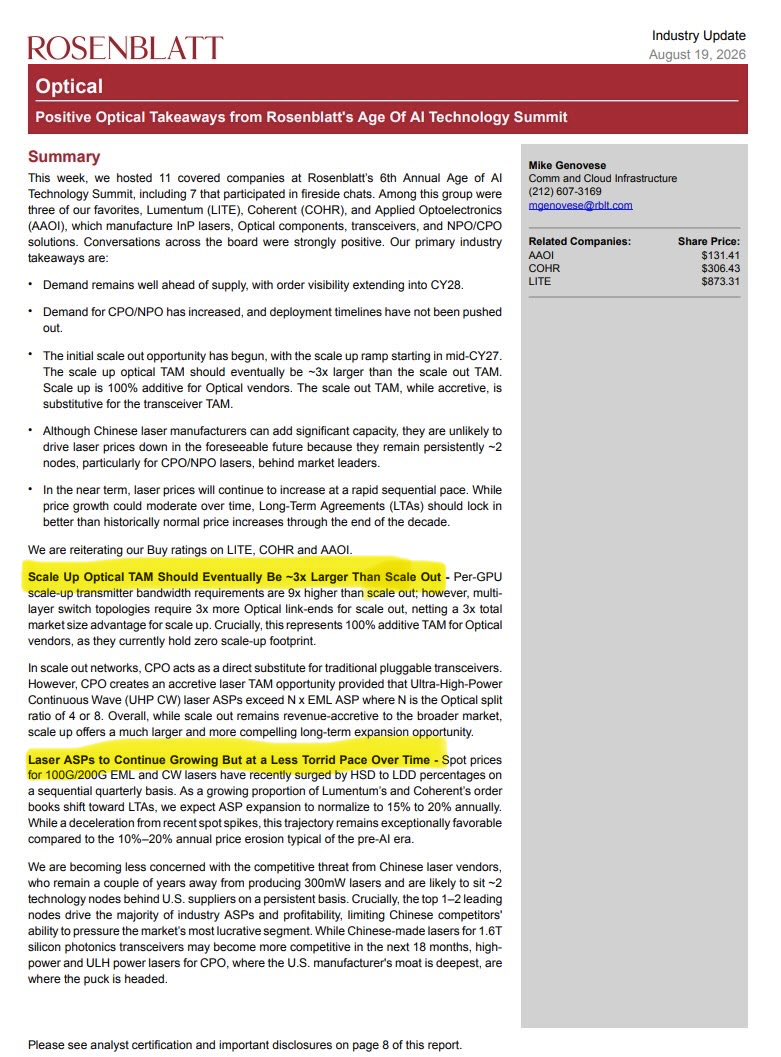
Optical Update: What Rosenblatt’s AI Summit Revealed About CPO, Photonics, and InP
Looking through the latest Rosenblatt report from the Age of AI Summit, it is hard to shake the feeling that a quiet revolution is unfolding in computing infrastructure.
For months, investors have focused on processor chips, but pure raw compute power is no longer the main bottleneck.
The real challenge is moving massive volumes of data between those chips without melting them.
Traditional electrical interconnections are hitting a physical wall.
At higher frequencies and distances, heat generation and signal degradation become insurmountable barriers.
This drives an aggressive shift toward photonics and materials like Indium Phosphide (InP), as light does not generate heat the way electric current does in silicon.
The most fascinating insight lies in the distinction between two architectures: Scale Out and Scale Up. Most of the market focuses on Scale Out - connecting separate servers using traditional pluggable modules.
However, the real financial windfall is hidden in Scale Up, which interconnects processors directly within a single rack.
Per-GPU transmitter bandwidth requirements in Scale Up are nine times higher than in Scale Out.
Multi-layer switch topologies mean the total addressable market for inside-the-rack optical solutions will eventually end up three times larger than the external interconnect market.
While Co-Packaged Optics (CPO) in Scale Out largely replaces existing modules, Scale Up opens a brand-new, 100% additive revenue stream.
Market anxiety regarding margin pressure from Chinese optical manufacturers is overblown.
Chinese vendors easily produce simpler laser designs around 70mW, but scaling to the 300mW or 400mW high-power lasers required for CPO demands a complete redesign of the laser architecture and mastering Indium Phosphide substrates.
Asian competitors remain roughly two technology nodes behind Western leaders, offering a safe competitive moat for two to three years.
When you piece these facts together, the individual players stand out clearly:
$LITE emerges as the absolute category leader, operating at maxed-out capacity with order book visibility stretching into CY28.
Their plans to double Optical Circuit Switch revenues while transitioning to 6-inch InP substrates show a clear path toward massive cash flows.
$AAOI displays incredible momentum thanks to vertical integration.
Manufacturing their own laser diodes onshore in the US and shipping 300mW CPO laser samples to five major customers positions them to expand market share from low single digits toward 10–20%.
$COHR anchors its footprint on hard-to-replicate component moats like optical isolators and polarization-maintaining fibers, with margins expected to converge toward Lumentum’s levels over the next two years.
Historically, the optical components industry suffered an annual price erosion of 10–20%.
Today, backed by Long-Term Agreements and relentless demand, average selling prices are expanding at double-digit rates annually.
This structural shift puts photonics suppliers in a dominant position for the rest of the decade.
Look, optical chips fix the speed problem, but everyone is ignoring the giant power wall we are about to hit.
Switching from copper to light with CPO lets us cram insane compute power into a single szafa.
The catch?
Light needs electricity. Remember that.
These new optical clusters pull a ridiculous amount of current.
Data centers don't look like clean IT rooms anymore.
They are straight-up becoming heavy industrial foundries.
A single rack now pulls so much juice that new campuses are asking for gigawatts of continuous power.
The power grid simply can't handle it.
Waiting 5 to 10 years for a local utility connection is a non-starter.
Plus, any random voltage dip can fry millions in hardware instantly.
This is why the smart money is moving from just buying chipmakers to backing the guys who build heavy power and cooling hardware:
$VRT: Liquid cooling for racks that get way too hot for basic fans.
$ETN & $POWL: Heavy-duty switchgear and transformers to handle massive electrical spikes.
$GEV: Gas turbines and grid hardware for massive on-site power generation.
$BE: Fuel cells that generate power right next to the data center so you can skip the grid line completely.
Optical tech unlocks crazy speeds, no doubt.
But without a dedicated power plant sitting right outside the building, those shiny new chips are just expensive paperweights.
Goldman Sachs projects AI infrastructure spending to rise from $765B in 2026 to $1.64T by 2031, with more than $7.6T in cumulative spending over that period.
This isn’t a one-year spending spree.
And it’s not just another cycle.
We’re witnessing a massive technological revolution that will reshape the global economy.
Believe in it or not.
But as an investor, one thing is clear:
There is an enormous amount of money to be made here.
The question is - will you be positioned for it?
Agree or disagree?
When $NBIS hit its peak after those killer earnings, a lot of you reached out saying you were passing on buying at the top.
You preferred to wait for a dip to load up.
So, what's the move now?
Are you buying here, or are you still holding out for a lower entry price?
If you're waiting, what's your target level
$PENG is up over 20% in pre-market, and honestly, it’s wild to watch. 🚀
Everyone’s asking if there’s some massive new catalyst or breaking news.
I’ve dug through everything, and the short answer is: no.
In my view, this is just the market finally waking up to the massive potential I’ve been calling out since few weeks.
The "smart money" is finally connecting the dots.
Yesterday, @pennycheck (one of the first to spot this transformation) shared the latest Rosenblatt report on $PENG.
Is there anything groundbreaking in it?
Not really-it mostly confirms the thesis I’ve laid out here multiple times:
➡️CXL MemoryAI™ KV Cache Server:
This is the ultimate fix for the memory bottleneck in LLMs.
Penguin isn't just selling hardware; they’re selling the efficiency that everyone in the inference space is desperate for.
➡️Celestial AI & The Optical Shift:
As an early investor in Celestial AI, Penguin is perfectly positioned to capitalize on the new optical products Marvell is rolling out.
They didn't just wait for this tech; they helped shape it.
Even with the Rosenblatt report out, I still feel it missed a few crucial details that I covered in my deep-dive article (link below ⬇️).
It’s great to see investors I truly respect joining the fold: @BlackPantherCap , @michaelsikand , @CKCapitalxx , and of course @pennycheck
…and probably many others that I’ve overlooked.
The stock is vertical today, and we'll see where this rally settles.
But with the pivot to a high-margin model looking as strong as they do, the long-term upside still feels massive.
What’s your take - do you see $PENG as a legitimate long-term infrastructure play, or just another hype-driven pump?👇
This is not investment advice, but I see real potential here and I plan to hold the stock long term (as long as the company keeps delivering).
$EOSE: Is this the $FLNC "Breakout" Repeat?
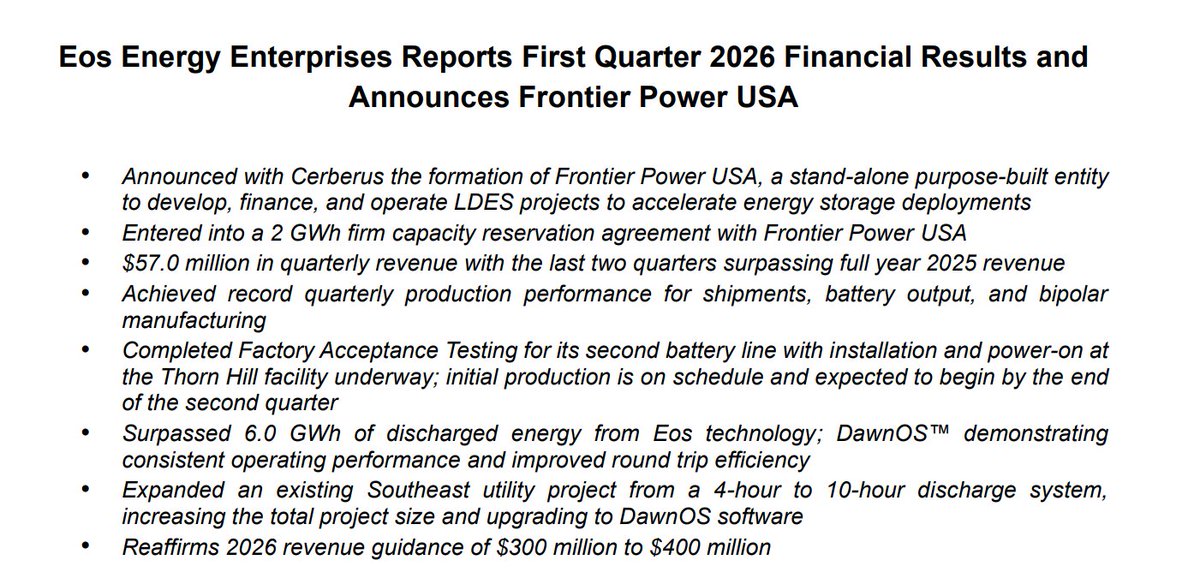
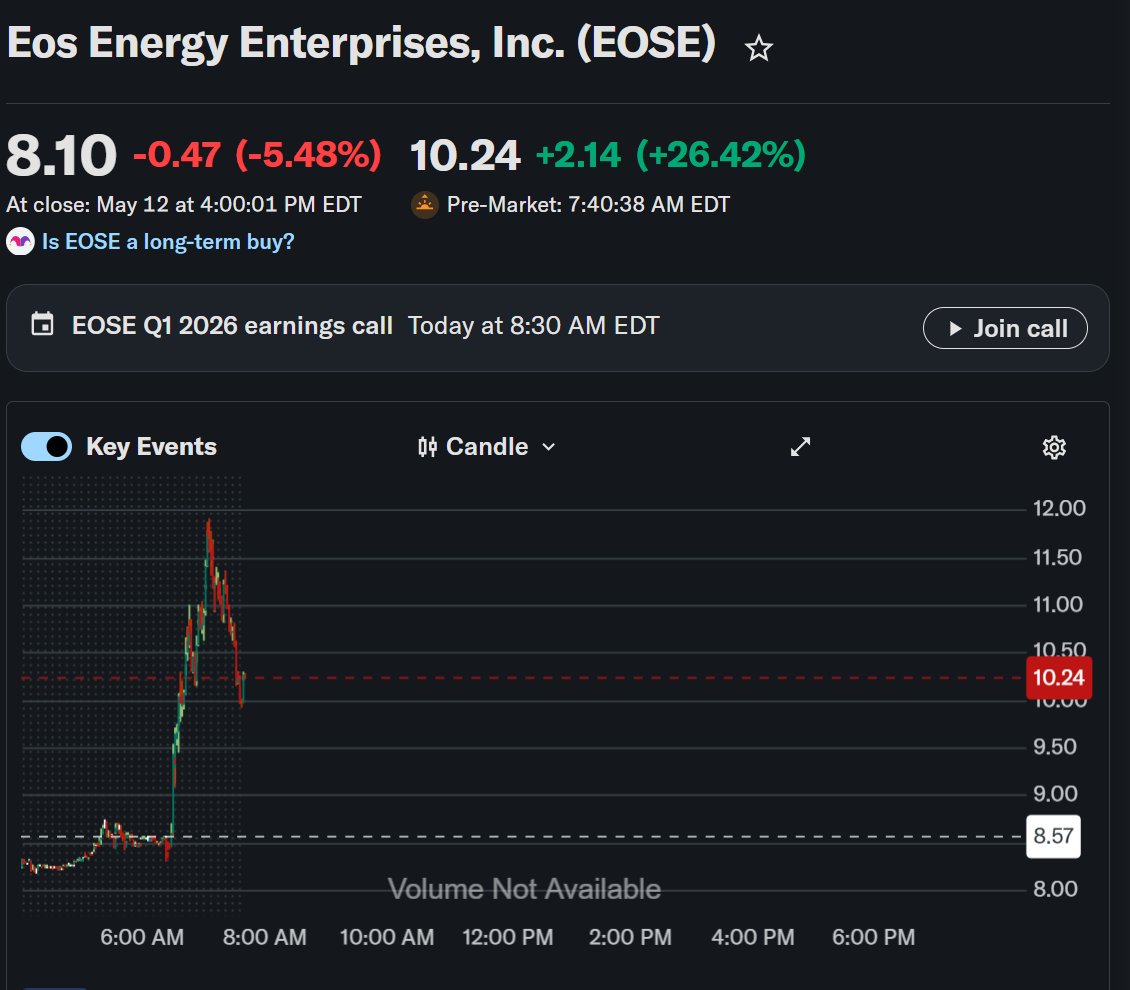
The Q1 2026 earnings confirm that Eos Energy has transitioned from promise to industrial scale.
1⃣The Hard Numbers (Actuals vs. Estimates):
➡️Revenue:
$57M (Beating the $54M estimate).
This represents a 445% YoY surge - proof that new production capacity is finally hitting the top line.
➡️EPS:
$0.12 (Beat estimate of -$0.22).
Crossing into profitability is the "institutional green light" the market was waiting for.
➡️Backlog:
$645M.
A massive safety net that guarantees operational stability for the coming years.
➡️FY26 Guidance:
Raised to $350M (vs. $304M consensus).
Management is signaling high confidence in their delivery schedule.
2⃣Comparative Analysis: $EOSE vs. $FLNC
Fluence ($FLNC) dominated the market by winning the lithium-based short-to-medium duration race.
$EOSE is positioning itself as the leader in LDES (Long-Duration Energy Storage) - specifically the 10+ hour window required for grid stability.
3⃣Why the Frontier Power USA (Cerberus) deal is the catalyst:
➡️Off-Balance Sheet Growth:
The $100M equity commitment from Cerberus allows for project deployment without diluting current shareholders through debt or equity raises.
➡️Capacity Security:
A 2 GWh reservation ensures the Pennsylvania factory's output is spoken for well into the future.
➡️Supply Chain Advantage:
The Z3 Zinc technology eliminates "thermal runaway" (fire) risks and bypasses the volatility of the lithium supply chain.
4⃣Research Takeaway:
Historically, Eos's bottleneck was manufacturing speed.
The completion of Line 2 FAT (Factory Acceptance Testing) proves they can now build automated production lines reliably.
If gross margins continue to improve with this automation, $EOSE is following the exact trajectory $FLNC took after it hit operational breakeven - moving from a single-digit stock toward a much higher valuation floor.
⬇️Key Risks:
Monitor DOE loan timelines and grid interconnection speeds, though the current backlog significantly de-risks the 2026-2027 outlook.
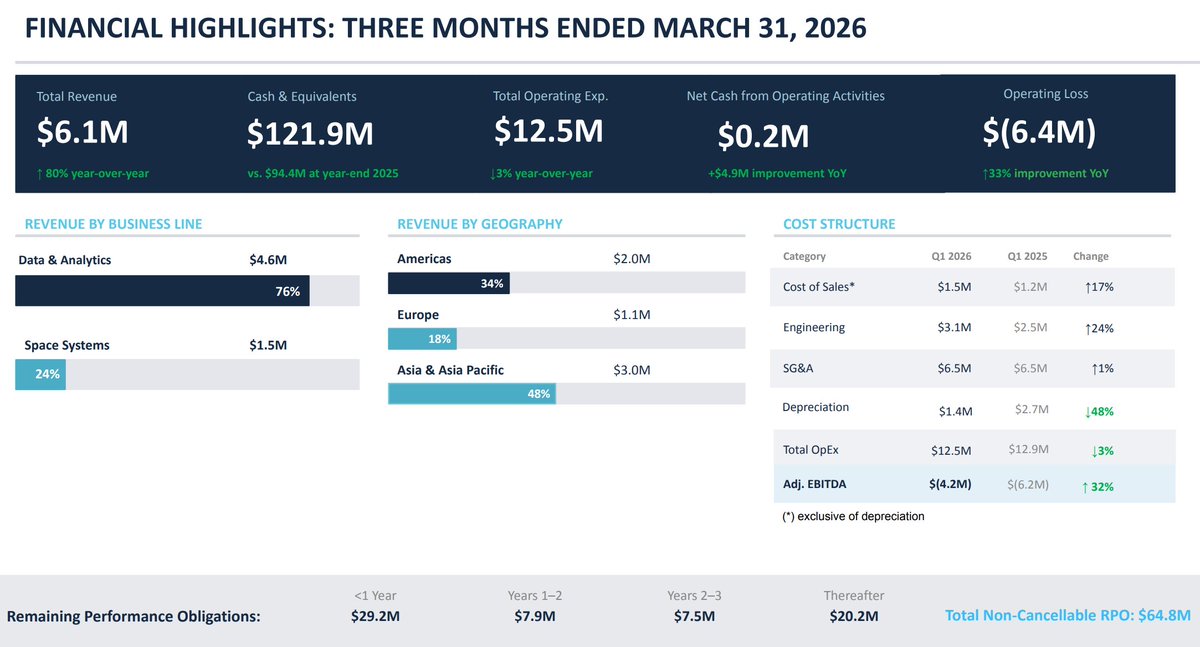
$SATL Satellogic Q1 2026: The Inflection Point Market Bears are Missing
The post-earnings sell-off in Satellogic (SATL) is a classic example of "headline fatigue."
While casual observers saw a massive net loss and hit the sell button, a deep dive into the 10-Q filing and the earnings call reveals a business that has finally hit its operational stride.
For retail investors, the signal is clear: Satellogic is transitioning from a high-burn startup to a scalable data infrastructure play.
1⃣The "Holy Grail" of Space-Tech: Positive Operating Cash Flow
The most critical line item wasn't revenue - it was the Cash Flow from Operations (CFO).
For the first time as a public entity, Satellogic generated $0.2M in CFO (compared to a $4.7M burn in Q1 2025).
In the capital-intensive NewSpace sector, crossing into positive operational territory is the ultimate de-risking event.
It proves that the "Satellite-as-a-Service" model can actually sustain itself without constant trips to the equity markets.
2⃣Revenue Velocity: +80% YoY Growth
Revenue for Q1 hit $6.1M, driven by two distinct engines:
➡️Data & Analytics (+53%):
High-margin recurring revenue from their 19-satellite NewSat constellation.
➡️Space Systems (+275%):
A massive spike driven by "Sovereign Lab" contracts - effectively selling dedicated satellite capacity and infrastructure to national governments.
3⃣Deconstructing the $118M "Loss"
The headline net loss is an accounting ghost.
Approximately $113M of that figure is a non-cash adjustment related to the fair value of warrants and convertible notes.
➡️The Irony:
Because SATL’s stock price performed well in previous months, accounting rules require the company to "mark to market" these liabilities, resulting in a paper loss.
➡️The Reality:
Adjusted EBITDA (the metric that actually matters for operations) improved by 32%, showing a manageable loss of only $4.2M.
🧠 Key Takeaways from the Earnings Call
The "hidden gems" from the call center around Satellogic's role in the broader tech ecosystem:
➡️The AI Feeding Frenzy:
Management doubled down on the "Edge AI" narrative.
They aren't just selling pictures; they are providing the high-revisit temporal data required to train specialized AI models for climate tracking and global logistics.
➡️Vertical Integration as a Shield:
While other optical component manufacturers are struggling with supply chain bottlenecks, Satellogic’s high-throughput plant allows them to keep satellite production costs at roughly $1.3M per unit.
This cost leadership is their primary moat.
➡️Backlog Execution:
The $64.8M RPO (Remaining Performance Obligations) is the number to watch.
The call suggested a focus on converting this "paper money" into recognized revenue through 2026 as more launch windows with SpaceX open up.
⬇️
Satellogic is currently the healthiest player in the Earth Observation (EO) sub-sector.
With $121.9M in cash and a path to GAAP profitability, they have enough runway to ignore the "noise" of the broader market.
The current dip is a valuation reset after a 400% run, not a fundamental breakdown.
For those looking for exposure to the "data layer" of the space economy, the risk/reward profile hasn't looked this good in years.