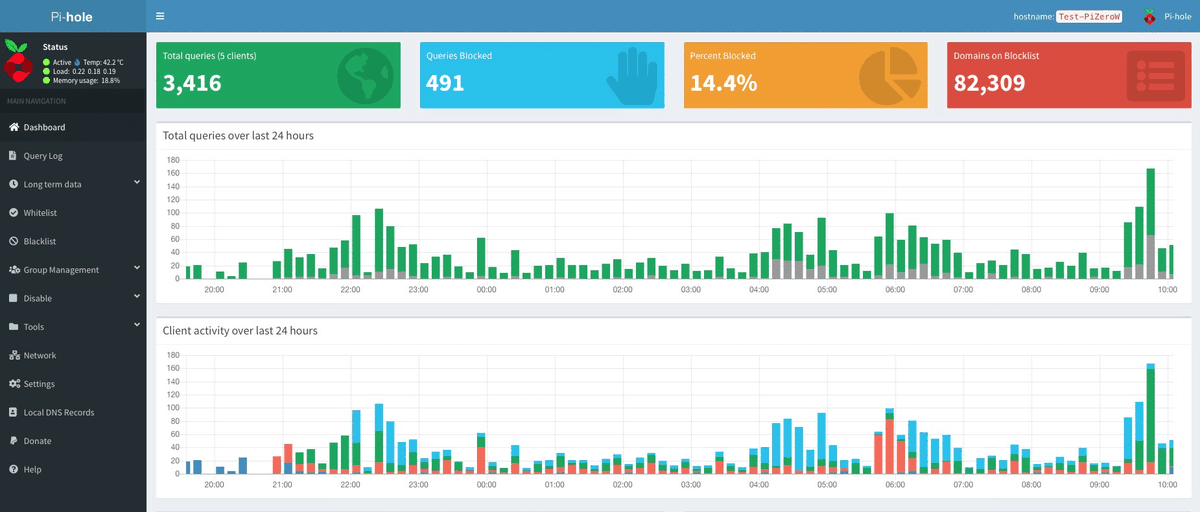
A group of developers gave away a piece of software for free that does what a $200-a-year premium subscription promises, except it works on every single device you own at once and nobody can ever shut it down.
It is called Pi-hole, and it runs on a computer so small and so cheap it costs less than a single month of most ad-free streaming plans.
Most people fight ads device by device. A blocker on the laptop. A premium account on one app. A different trick for the smart TV that usually fails anyway. It is exhausting and it never fully works.
Pi-hole ends the whole war in one move. It installs in one place and protects everything connected to your home network. Phones, tablets, consoles, speakers, the smart fridge nobody asked for.
The trick is where it sits. Every device on your wifi has to ask for directions before it can load anything, including ads. Pi-hole becomes the thing giving directions. When something asks for the address of an ad server, Pi-hole sends it nowhere.
No app to install on each phone. No login. No company holding your data, because the data never leaves your house.
The ad companies built their entire model on you not understanding the plumbing.
Pi-hole is just someone who understood the plumbing and refused to pay.
ChatGPT is blocked in China.
So is Claude.
Most people visiting don't even know there are options to make your trip seamless.. I've been here 2 weeks. Here are the 3 apps that is actually helping me the entire time.
𝟭 𝗔𝗹𝗶𝗽𝗮𝘆 handles everything money-related. Metro, taxi, noodles at a street stall, hotel checkout. Almost no one takes cash anymore and card readers are weirdly rare. Link your international card, top it up once, and you stop thinking about money for the rest of the trip.
𝟮 𝗞𝗶𝗺𝗶 𝗔𝗜 is the OG. Claude and ChatGPT are blocked in China, and the answers they give for local stuff are bad anyway. Wrong place names, outdated metro info, no read on what's culturally appropriate. Kimi is built for the country. Point your camera at a menu, it reads it. Talk to it, it translates back in the right tone. Ask where to eat nearby and it knows. Navigating a place with an AI that actually understands it is a different experience.
𝟯 𝗪𝗲𝗖𝗵𝗮𝘁 is how people actually talk to each other. iMessage works for friends back home but inside China everything runs on WeChat. Your driver will WeChat you. The restaurant menu is a WeChat mini program. The front desk, your guide, the guy who sold you a SIM card, all WeChat. You'll use it more than your inbox.
That's the kit.
People still think going to China is a huge deal. It really isn't. You land, turn on data, open three apps, and you're moving.
If you've been talking about visiting for years, just go.
The new @Deepvue charts are the fastest charts I've ever used with zero lag thus far. I finally have some charts that can load faster than my eyes and brain can process.
Well done @AmeetRai@RichardMoglen@RossHaber!
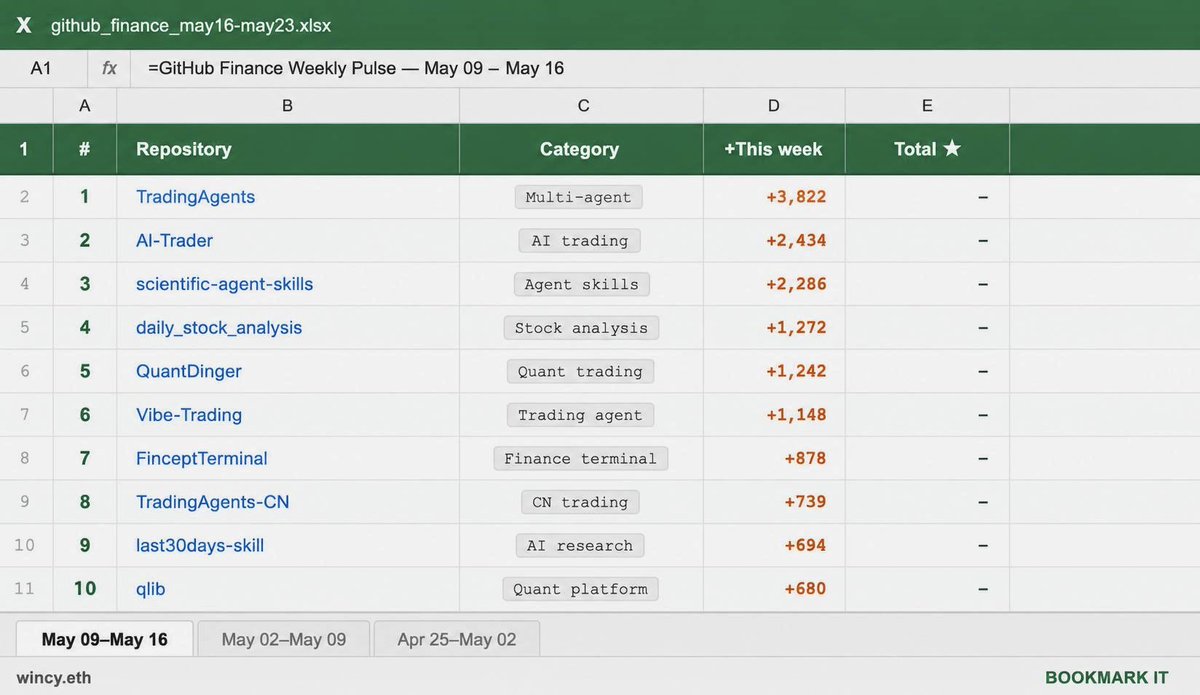
the fastest growing GitHub repos in finance this week:
1. TradingAgents (+3,822 ★)
multi-agent LLM trading framework built for financial research and execution. combines analyst agents, sentiment models, portfolio reasoning, and provider integrations into a single trading stack.
2. AI-Trader (+2,434 ★)
fully automated agent-native trading system. built around autonomous decision-making, price fetching, execution, and monitoring workflows. focused on end-to-end AI-driven trading infrastructure.
3. scientific-agent-skills (+2,286 ★)
plug-and-play agent skills for finance, research, science, engineering, and writing. integrates with multiple agent frameworks and supports web research, bioinformatics, cheminformatics, and analysis pipelines.
4. daily_stock_analysis (+1,272 ★)
LLM-powered stock analysis platform covering US, Hong Kong, and Chinese equities. combines market data, real-time news, AI dashboards, automated reporting, and multi-channel notifications with near-zero operating cost.
5. QuantDinger (+1,242 ★)
AI quantitative trading platform for crypto, stocks, and forex. includes live trading, strategy backtesting, market analytics, and broker integrations. built for traders experimenting with AI-assisted quant workflows.
6. Vibe-Trading (+1,148 ★)
personal AI trading agent focused on algorithmic trading and backtesting. combines lightweight automation with agent-style portfolio management and strategy experimentation.
7. FinceptTerminal (+878 ★)
modern open-source finance terminal inspired by Bloomberg-style workflows. provides market analytics, investment research, trading tools, and AI-powered financial infrastructure in one interface.
8. TradingAgents-CN (+739 ★)
Chinese-enhanced version of TradingAgents. adapts the multi-agent LLM trading framework for Chinese financial markets, datasets, and workflows. rapidly growing among Chinese quant and AI communities.
9. last30days-skill (+694 ★)
AI agent skill for researching trends across Reddit, X, YouTube, Hacker News, Polymarket, and the broader web. designed for signal discovery, narrative tracking, and internet-wide monitoring.
10. qlib (+680 ★)
Microsoft’s AI-oriented quant investment platform. covers the entire quant pipeline from data collection to alpha generation, portfolio construction, and execution. still one of the strongest open-source quant ecosystems available.
bookmark this and start today.
The largest supply shock in history is pricing into the curve, not the backend (yet).
I've been saying this since 2004: the curve shape reflects the fundamentals. The long end reflects the industry's marginal cost, incorporating the cost of capital which are ultimately driven by liquidity.
ICE Brent spot is $107/bbl, while the three-year is at $75/bbl. Percent backwardation — which strips out price-level effects — hit an all-time high in April. It remains near record today. The largest oil supply shock in history is reasonably priced into the curve, and it likely has much more to run. Remember we are in the depths of the shoulder months, so there is no stress on the system.
Markets are fixated on Dated Brent differentials, c.$5/bbl last night which is down sharply, but that is a microcosm of the oil market. Dated Brent is Sullum Voe. One North Sea terminal. Not the global oil market.
Spot has not exceeded the Russia-Ukraine peak for one reason: the back end of the curve sits $10–$12/bbl below where it was then.
But the long end isn't a clean signal. Liquidity past 24 months is thin, dominated by producer hedges. Cal-29 isn't where the market thinks oil settles. It is where corporate treasurers are forced to transact, which makes it consistent with their costs of capital.
The cleaner signal is the energy equity complex — long-dated call options on undeveloped reserves. ExxonMobil holds 14 years. Chevron, 15. Equity prices integrate the entire forward strip. Diverge too far and an arbitrage opens. In a capacity-constrained world those reserves are worth more, not less. The equity market is pricing the opposite. Every oil CEO has warned we exit this disruption with lasting supply problems. The market refuses to listen.
S&P Energy ÷ S&P 500 can be used as a proxy for the long-dated oil price, and it currently implies long-run Brent of ~$70 — below the strip at $72–$75 — but not too far away.
A proxy for the curve shape follows: Brent ÷ (S&P Energy ÷ S&P 500). Or rewritten: Brent × S&P 500 ÷ S&P Energy. That single number proxies the FCF yield differential between the energy sector and the rest of the market. That has been bouncing around all-time highs.
When the FCF yield gap reaches extremes, investors should rotate. Even at $75 — not spot's $105 — the energy complex yields 600-1,000 bp above the S&P 500. In 2022, investors did rotate and those that did weathered the ensuing 35% collapse in the NASDAQ much better than those that didn’t.
The equity market is betting Brent falls to realign FCF yields. If it doesn't, capital has to buy Energy and sell the Mag 7. A 1,000bp differential in FCF yields cannot persist. And if oil breaks out as we expect, something has to give. You know which one I think will give. That is the Revenge of the Old Economy!
We are at the tipping point.
2/10
The 'scarce productive input as inflation hedge' thesis is just the 1970s playbook on silicon. Post-Nixon shock 1971, gold ran from $35 to $850 by 1980, oil quadrupled after '73, industrial commodities all rerated because fiat expansion has to land somewhere.
Lee's pattern is older than DRAM.
Fundstrat's Tom Lee was asked in a CNBC interview: if you're bullish on AI but worried about inflation, rising yields, and parabolic moves already made... what do you even do?
His answer: DRAM is actually defensive.
His logic: worried about oil shortages? Memory shortages are bigger. Semis and DRAM work even if the macro gets ugly. And software, specifically Mag 7, is still the best risk-reward in the market.
Sometimes the contrarian trade is hiding in plain sight.
We are in a very concentrated environment. The Nasdaq 100 is up 16.2% year-to-date. Four stocks – Alphabet, Nvidia, Micron, and Intel – are responsible for 8.4% points, or 52.3% of the gains. With the market hitting all-time highs, only 40% of Nasdaq stocks are above their 200-day moving averages, so it's a selective environment. Money has chased a small list of names which is producing a number of climax moves in individual names. Examples include: $INTC, $MU, $SNDK, $BE, $STX, $AMD. There is some serious momentum in these names, but investors need to be careful of getting caught up in the emotion that comes with a parabolic rise. The nature of this market has been one of concentration and selectivity. With many stocks becoming extended, the landscape is becoming more selective. The bull market is intact, but with pockets of froth forming. https://t.co/JXzFFTmMtn
The research behind this is wild. Your kitchen sponge has the same density of bacteria as human stool. German scientists found 54 billion bacterial cells per cubic centimeter inside used sponges in 2017. Yours is sitting right next to your sink.
Sponges are the perfect home for bacteria. They are wet, warm, full of food bits, and never fully dry between washes. Across all 14 sponges, the team found 362 different types of bacteria. The most common species include strains that can make people sick.
In 2011, the public health group NSF International swabbed 30 things in 22 American homes. The dirtiest object in the entire house was the kitchen sponge. It was dirtier than the toilet seat. 75% of the sponges tested positive for the kind of bacteria that includes Salmonella and E. coli.
Microwaving does not clean the sponge. The 2017 study found microwaved sponges had higher amounts of the smelliest, most harmful bacteria. Heat kills the weak strains. The strong ones survive and refill the sponge with no competition for space.
A 2021 Norwegian study compared kitchen sponges to dish brushes. In brushes, Salmonella was wiped out within three days because the bristles dry out between uses. In sponges, bacteria climbed to about a billion cells per sponge. The lead researcher told CNN that one kitchen sponge can hold more bacteria than there are people on Earth.
Three things actually work. Switch to a dish brush, because brushes dry fully between uses while sponges stay wet for hours. Replace your sponge every one to two weeks. Never leave it sitting wet in the sink. Norway and Denmark already do this by default, but most other countries don't.
The detergent is fine. Your sponge is the problem.
A Chinese MIT student built a proxy that gives you Claude Opus 4.7 and GPT-5 for free. Anthropic doesn't know it exists.
> It's called WindsurfAPI. Windsurf has 100+ models inside - Claude 4.5/4.6/Opus 4.7, full GPT-5 series, Gemini 3.0, Kimi K2, Qwen.
But Windsurf doesn't expose a standard API.
This repo punches a hole through that.
You run it locally or on a VPS. It spins up a server on port 3003 and serves two endpoints simultaneously:
- /v1/chat/completions - OpenAI format. Any OpenAI SDK works directly.
- /v1/messages - Anthropic format. Claude Code, Cline, Cursor connect without changes.
Point Claude Code at localhost:3003 instead of api anthropic. It runs on Opus 4.7 without knowing the difference.
> The killer feature: account pooling. Throw in multiple free Windsurf accounts.
//
The proxy rotates them automatically, isolates rate limits per account, failovers when one goes down.
Free Windsurf accounts get Gemini 2.5 Flash, Kimi K2, GLM, Qwen. Pro accounts unlock the full Claude and GPT-5 stack.
https://t.co/lpyurmGNdK
We can't ignore the timeless principle of relative strength. I was reviewing this week pullback price action of the top 100 stocks by YTD percentage gain on @Barchart, and the results are incredible how some do not even revisit their 10-MA,while most don't violate their 20-MA.
Top 100 Stocks
https://t.co/ptxVQdIXkP
Winston Churchill fought his depression with bricks. He'd lay them for hours at his country home in Kent. He joined the bricklayers' union. And in 1921 he wrote about why it worked. It took psychology another 75 years to catch up.
He called his depression the "Black Dog." It followed him for decades. His method for fighting it back was as basic as it sounds: laying brick after brick, hour after hour.
Churchill spelled out his theory in a long essay for The Strand Magazine. People who think for a living, he wrote, can't fix a tired brain just by resting it. They have to use a different part of themselves. The part that moves the eyes and the hands. Woodworking, chemistry, bookbinding, bricklaying, painting. Anything that drags the body into a problem the mind can't solve by itself.
Modern psychology now calls this behavioral activation. It's one of the most-studied depression treatments out there. Depression sets a behavior trap. You feel bad, so you stop doing things, and doing less means less to feel good about. Feeling worse makes you do even less. The loop tightens until you can't breathe inside it.
Behavioral activation breaks the loop from the action side. You schedule the activity first, even when every part of you doesn't want to. Doing it produces small rewards: a wall gets straighter, a painting fills in, a messy room gets clean. Those small rewards slowly rewire the brain. Action comes first, and the feeling follows.
Researchers at the University of Washington put this to the test in 2006. They studied 241 adults with major depression and compared three treatments: behavioral activation, regular talk therapy, and antidepressants. For the people who were most severely depressed, behavioral activation matched the drugs. It beat the talk therapy. A 2014 review of more than 1,500 patients across 26 trials backed up the result.
Physical work like bricklaying does something extra on top of this. It crowds out rumination, the looping bad thoughts that grind people down during the worst stretches of depression. Bricklaying needs both hands and gives feedback brick by brick: each one is straight or crooked. After an hour you can see exactly how much wall you built. No room left for the mental chewing.
The line George Mack used in his post, "depression hates a moving target," is good poetry. The science behind it is sharper. Depression hates a brain that has somewhere else to be.
Meta Tribe2 is a model that predicts your brain's response on videos
so now you can edit videos with more clarity of how to compose them, what works and what doesn't
and we built a free tool for you based on this model
yes, totally free
see details below
Most traders blow up their accounts chasing breakouts during the day, but there's a way to avoid the fake-outs and still catch the best moves.
The problem with trading breakouts in the morning or midday is simple: most of them reverse and leave you stuck holding a losing position.
Price pushes through resistance, you jump in, and then it fades back down as soon as the next hour hits. In choppy or bearish markets, this kills your account slowly with a thousand small losses.
I saw this wreck so many traders in 2022, death by fake breakout after fake breakout.
But when you wait until the end of the day to enter your breakouts, everything changes because the move is already confirmed on the daily timeframe before you risk a single dollar.
No more guessing if the breakout is real or if it's going to reverse in the next 30 minutes. The daily close tells you everything you need to know.
Here's what EOD breakout trading gives you:
• You filter out 90% of the fake-outs because price already held the breakout all day
• You can backtest with clean daily data, no messy intraday noise to deal with
• You build systems with hard rules, so there's no stress or discretion involved
• You only need 20-30 minutes per day to scan, enter, and manage your trades
• Your drawdowns stay controlled because you're not getting chopped up by intraday volatility
• You execute without emotion because the system handles all the decisions
Sure, you won't get super performance and win championships with this method, but if all you want is to trade with minimal time, get 100%+ returns on good bull years, and do so with a controlled drawdown, and grow your hard-earned money, listen up.
I've averaged triple-digit % returns, even made 60% in 2022 shorting breakdowns, all while trading 30-min day with no discretion and no stress.
No watching the market all day. No stressing about fake moves. No second-guessing every decision.
Just show up before the close, take the signals that meet my criteria, set my stops, and let the market do the rest.
If you're tired of getting faked out and want consistency without the all-day grind, EOD breakouts might be exactly what you need 📈
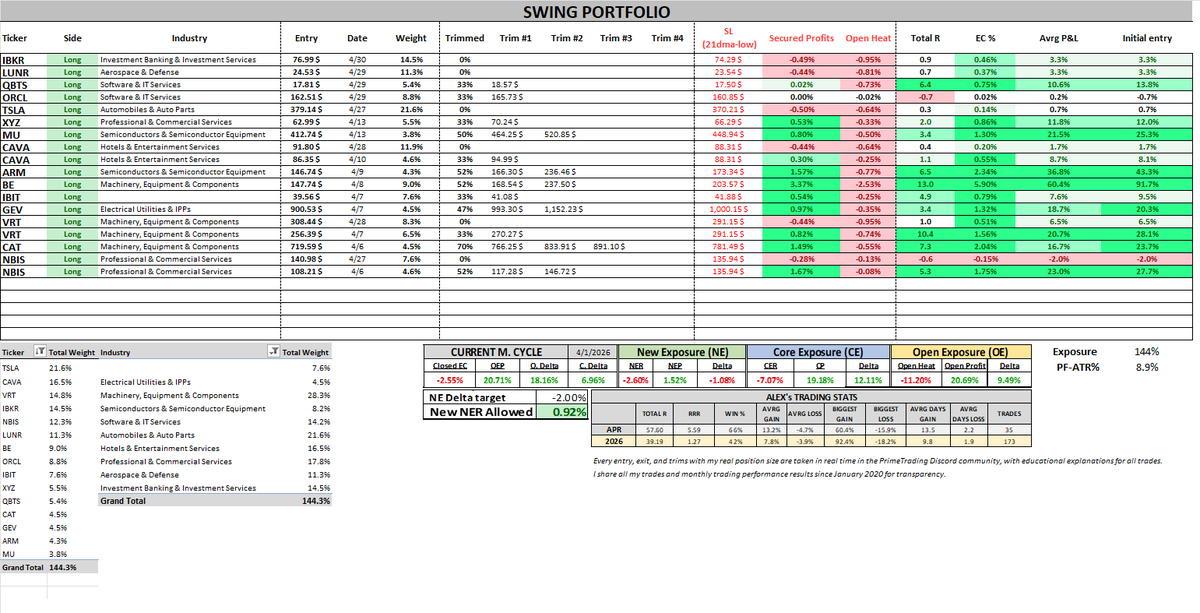
PORTFOLIO UPDATE 4/30
$IBKR $LUNR $QBTS $ORCL $TSLA $XYZ $MU $CAVA $CAVA $ARM $BE $IBIT $GEV $VRT $VRT $CAT $NBIS $NBIS
What a day & week. Market reconfirmed the trend today, with a daily reversal on QQQE, and a hook-up above an already rising 10dma on MCSI. Breadth expending again, while Internals show a clean risk-on picture with Credit Spreads making a full downside reversal after rejecting the declining 21dma-structure. In short, everything says risk-on, from price, breadth, internals, LLs, and my PF feedback.
I pressed a bit more today at the open after having de-risked QBTS, bringing my exposure just shy of 150% as per my gameplan if the market would re-confirm the trend.
For now, it's a game of patience. The goal is to position along the pullback, accept the volatility that comes with it, and stay anchored to the structure. Once the market starts to confirm and momentum slowly comes back in, like today, the job shifts. It’s no longer about adding, it’s about managing. That means limiting new exposure, trimming into extensions and at predefined R multiples, and giving the market time to set up again. Let it digest, let the next leg build, then repeat the process. You’ll probably see me a bit less active, and that’s intentional. Staying disciplined in this phase matters more than doing more.
NER is still at 2.6%, but with a good 1.5% cushion on it. Open Heat back above 10%, while closed delta on the current market cycle is still growing at 7%.
I'll share my April performance update tomorrow, but the highlight is that I'm back green YTD, with my 2nd-best month since 2020/21. We played that one well so far... but still so much work (and patience) to do to NOT fuck this up. It was a pleasure trading alongside you all this month 🙏👊
Cheers HAGN!
Today’s action:
NEW: IBKR
ADDED:
TRIMMED: QBTS (1/3), CAT (1/5)
OUT: