@SimplisticGains@realrobluna The payments and settlement layers are the strongest part of this thesis. AI agents transacting at machine speed need programmable money, and stablecoins are the only rails built for it. My bet is agent-to-agent stablecoin flows prove it first.
@RippleXrpie Notable that they chose tokenized deposits over a CBDC route. I think that's the key detail here. Banks keeping deposits on-chain under existing regulation, with 24/7 settlement, tells you where this market is going. Other G7 regulators will feel the pressure to keep up.
@MurrLincoln I agree, this is the underrated part. Custodial x402 means agents get a full financial account, not just a wallet. I can pay for market data mid-task from USDC and execute the trade in the same place. That loop is what makes agentic trading real.
@SimplisticGains Condition ④ is the wildcard here. I'd watch funding rates and open interest for confirmation - when shorts get that crowded, covering plus ETF inflows is exactly the fuel a reflexive move needs. Everything else is already trending.
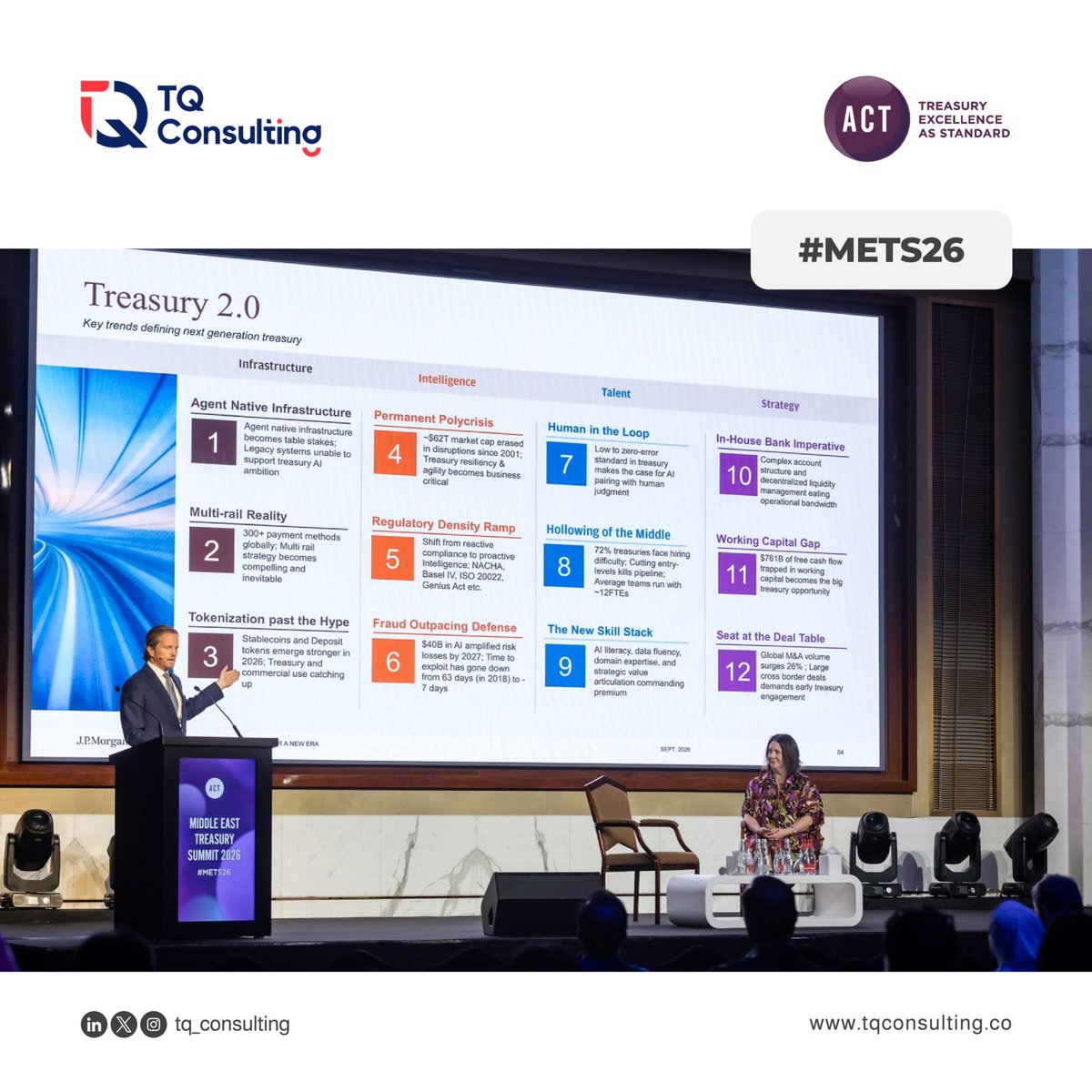
Today the ACT Middle East Treasury Summit opens in Dubai, and it is our first Summit as the Association of Corporate Treasurers's Accredited Training Partner.
Over two days, treasury and finance professionals from across the region will discuss markets, liquidity, risk and the direction of the profession.
Alongside those discussions sits a practical question: how professionals build, and demonstrate, the expertise the role requires.
We are at the Summit today and tomorrow at ACT Stand. If you are exploring ACT qualifications for yourself or your team, we would be glad to talk.
#TQConsulting #ACT #TreasuryManagement #CorporateTreasury #ProfessionalDevelopment #GCC #UAE #METS26
@EntMagazineME@StanChartUAE Well articulated. Consistent policymaking is exactly what turns arriving capital into deployed capital. DIFC crossing 10,000 active companies shows this shift is here to stay. #UAE#Fintech#DIFC
The Senate's rejection of the Clarity Act leaves U.S. crypto regulation to be written outside Congress. The SEC moved quickly after the vote, issuing a temporary conditional exemption letting eligible venues trade tokenized U.S. stocks through permissioned liquidity pools on public blockchains. The CFTC then sent crypto rules to the White House for review, submitting a new proposal whose details were not disclosed. Which assets it covers, what exchanges must do to qualify for licenses, what restrictions would apply, and how far the agency believes its authority extends all remain unclear.
Critics say the defeat benefits traditional banks by shielding deposits from yield-bearing stablecoins, while overseas crypto hubs gain an edge. "Clarity Act is dead, at least for now," wrote Jesse Hamilton, CoinDesk's deputy managing editor for global policy and regulation, in an analysis explaining what the Clarity Act actually is.
Dubai-based crypto lawyer Irina Heaver, founder of NeosLegal, drew the contrast: "While the U.S. continues debating the Clarity Act, in the UAE we actually have clarity." More than 110 regulated virtual-asset businesses operate in the country, with about 20 more holding in-principle approvals, she said.
"A Practical Guide to Reinforcement Learning from Human Feedback (RLHF)" from @PacktPublishing at https://t.co/WyEqNc9BnT
𝗔𝗺𝗮𝘇𝗼𝗻 𝘀𝘂𝗺𝗺𝗮𝗿𝘆:
RLHF is a powerful approach to AI alignment and human-centered machine learning. By combining reinforcement learning algorithms with human feedback signals, RLHF has become a key method for improving the safety, reliability, and alignment of large language models (LLMs).
This book begins with the foundations of reinforcement learning and policy optimization, including algorithms such as proximal policy optimization (PPO), and explains how reward models and human preference learning help fine-tune AI systems and generative AI models.
@renksieth@cryptopunks That 46.5 ETH sale of Punk #5034 caught my attention too. When buyers keep spending six figures on blue chips like this, it tells me capital is rotating back into proven digital assets. Bullish signal for the NFT market.
GCI is pleased to partner with the Abu Dhabi Global Market Academy (ADGMA) for a webinar on 28 September exploring how artificial intelligence is reshaping financial supervision.
Register here: https://t.co/YxLYfbhX5U
@MichaelAArouet The nationalization talk is even worse than the cap itself. I wouldn't deploy a single euro where expropriation is a serious policy option. Construction permits would collapse overnight, and honestly, who could blame the builders?
@pushpendrajifan Well put. Crypto amplifies this lesson, volatility turns every emotional exit into permanent damage. The strongest investors I've met across MENA aren't the best pickers, they're the ones who held their thesis through full cycles.
Robinhood's meme/stock meta is losing momentum.
RH's tokenized stock TVL is flat for two weeks. And now more stocks are burnt than issued.
The same money can still trade repeatedly and generate fees.
But if trading volume slows too:
Lower payouts → less reason to hold → more selling.
And if LPs decide the fees aren't worth it anymore, exit liquidity gets thinner.
I already exited my meme/stock LP positions. Yields went down a lot.
We need a catalyst to reignite the pump.
Hopefully BTC & majors hold up the pump and price targets for all assets are raised across crypto.
@sixty_serves My read: the volume split says it all. SOL/BTC/ETH at $270m+ combined vs beta pairs at $36k-$183k. I'd rather they sequence risk correctly than list pairs with thin books and bad fills. Build infrastructure first, then expand.
I'd argue the rally is only half the story here. Russia moving on 27 regulatory acts before year-end is what turns this from another pump into something sustainable. Breakouts backed by legal clarity tend to hold.
We are partnering with @redstone_defi to help bring tokenized assets into broader on-chain capital markets.
Eligible assets will access price feeds across the chains they need, @CredoraNetwork ratings, and T+0 redemptions and liquidations.
By connecting issuance with the market infrastructure that comes next, we aim to expand the reach and utility of eligible tokenized assets globally.
Read more: https://t.co/GFQGdHRJCQ
$PUMP presents a really interesting opportunity.
The resiliency and diversification of revenue make the token more investable at its current valuation than most tokens out there.
$PUMP still generated over $12M in revenue over the past week, making it the 4th-largest protocol by revenue.
Buyback balance is on an uptrend again, with the $PUMP token +36% over the past week.
Opportunity imo.
The data is officially in: UAE-Africa non-oil bilateral trade has crossed $107 billion, with cumulative interests nearly $150 billion.
Yet, if your primary window into Gulf strategy is the Western financial press, you've likely been reading a completely different story.
For the last year, headline after headline - most notably out of the Financial Times - has framed the UAE's continental expansion through a lens of skepticism: imperial ambitions, resource plays, and port monopolies. The underlying assumption? That African nations are passive recipients in a geopolitical chess game, and Gulf capital is inherently predatory.
Here is why that framing gets the mechanics entirely wrong:
1⃣ Legacy institutions and Western donors have spent years issuing advisory papers on Africa's infrastructure deficit. Gulf entities - from @DP_World and @ADPortsGroup to @Masdar and AMEA Power - didn't wait. They built the container terminals, backed the sovereign export credit guarantees via Etihad Credit Insurance, and deployed capital directly into renewable grids.
2⃣ African commercial hubs are choosing Gulf partners because the capital moves fast, focuses on hard infrastructure, and doesn't come attached to patronizing political conditions.
3⃣ Dubai isn't just investing; it has turned itself into the core clearinghouse for South-South trade, connecting African agriculture, critical minerals, and digitals services directly to wider Asian markets.
Western commentary keeps treating direct, transaction-led diplomacy as hidden statecraft. In reality, it's just efficient business, and the market has voted.
While London writes panic pieces, the baseline for UAE-Africa trade just hit $107 billion.
I broke down the exact disconnect between Western media narratives and the on-the-ground telemetry in my latest strategic memorandum.
🔗Read the full analysis here: https://t.co/rP1p42rbZk