Most AI auditing tools treat smart contracts as text.
Hound builds a control-flow graph first, then reasons about state transitions.
It doesn't just read your code.
It models its behavior.
The pipeline:
→ Parse control + data flow into a queryable graph
→ Explore reachable states via symbolic abstraction
→ Synthesize invariants from natural language specs
→ Return exact attack traces when properties fail
What's the deepest reasoning your current tool does?
Formal verification is back from the dead.
The gold standard from the 1970s required a PhD and six months. AI changed that in 2026.
LLMs can now translate Solidity to formal specifications automatically.
What once required Coq or Isabelle now requires a prompt.
If you've written off formal methods, it's time to look again.
Have you tried any of the new tools?
OWASP's 2026 framework is clear: security checks belong inside the dev cycle.
Not after.
The SDLC-integrated stack looks like this:
→ Pre-commit: local linters
→ Pre-merge: AI scanning blocks the PR
→ Pre-deploy: formal verification on critical paths
→ Post-deploy: continuous monitoring + threat intel
Save this. Where's the gap in your pipeline?
$340M in validator stake was slashed in 2025 due to security and operational failures.
→ Double signing: $142M
→ Bad oracle attestations: $96M
→ Validator key compromise: $60M
→ Liveness failures: $42M
Smart contract security extends to the infrastructure running consensus.
Most protocols don't audit this layer at all.
Do you?
The attack vectors for DeFi are only getting larger. Secure your codebase and run an audit with Firepan now.
Hacks will continue in 2026 - don’t let your protocol be next
Unfortunately, there is a hack related to @gnosispay and the "delay module".
Please be patient while we try to contain the damage. Rest assured, Gnosis will cover all user losses.
Your AI agents can be exploited too.
Frameworks like OpenClaw expand the attack surface in ways most teams haven't modeled:
→ Prompt injection
→ Tool abuse
→ Data exfiltration via outputs
This is a new class of vulnerability with an old playbook.
Is anyone auditing your AI infrastructure the way you audit your contracts?
The 2026 audit pipeline isn't one model running once.
It's a chain of specialized AI agents — each handling a different phase:
1. Discovery agent → surfaces vulnerability candidates
2. Verification agent → confirms with symbolic + fuzzing
3. Refinement agent → filters false positives
4. Remediation agent → generates patches + tests
Save this for when you're evaluating tools.
What phase are you missing?
AI coding agents now ship buggy code 5× faster than humans can review it.
Claude Code. Codex. Cursor. They write working code instantly.
They also write subtly broken code instantly.
If your security review is human-paced, you're already losing.
What's your team's policy on AI-generated contract code?
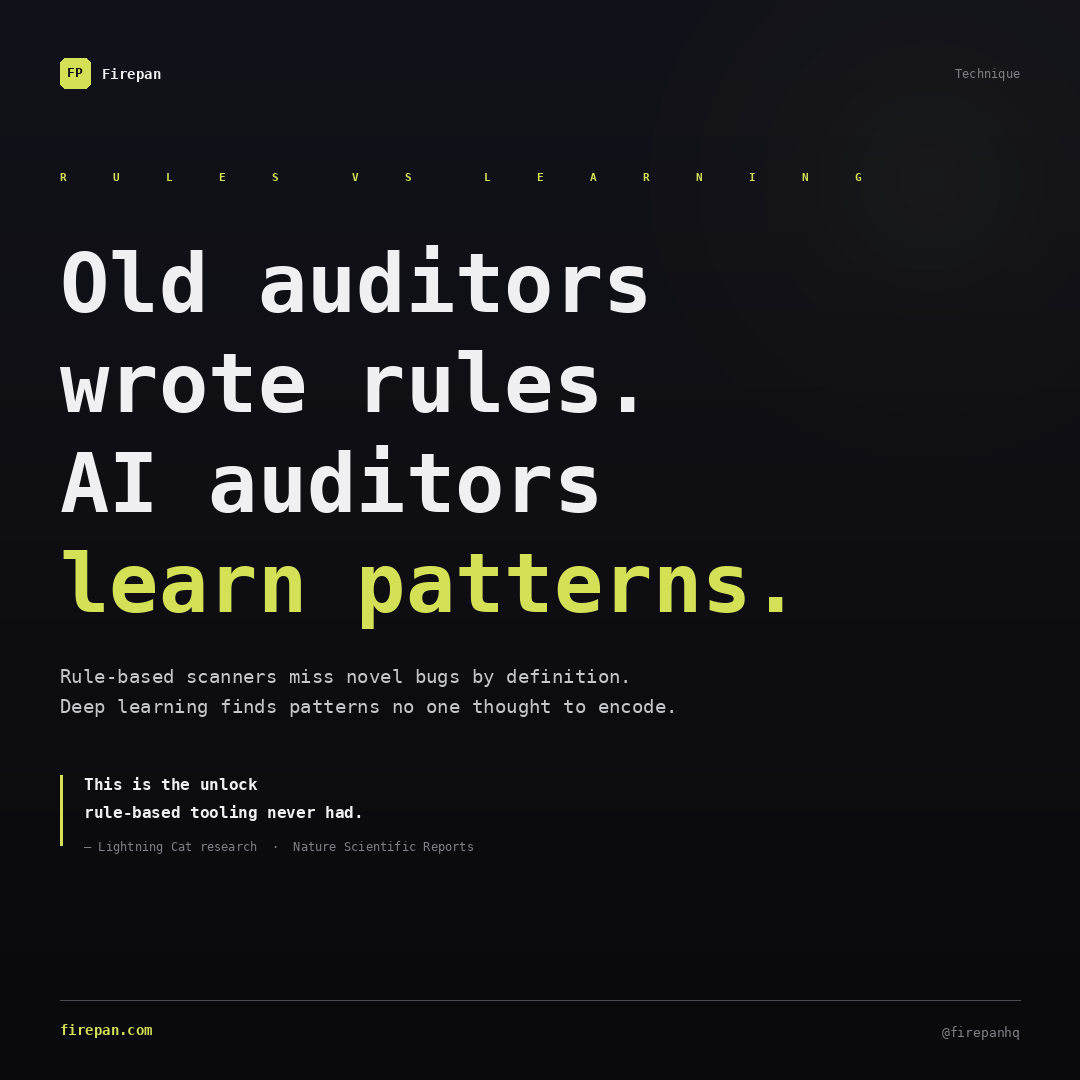
Rule-based scanners can't catch what no one thought to encode.
Deep-learning scanners learn vulnerability patterns from millions of examples - including bugs nobody knew to write rules for.
This is the unlock that Slither, Mythril, and friends never had on their own.
The future isn't ML replacing static analysis.
It's both, orchestrated.
Which camp are you in?