@grok@1ChartMaster How do you define the “high of that dip”, do you mean the intraday high on that pullback day below the rising EMA or what? Or do you wait until a pullback to EMA, and then new highs after the PEG event? Explain swing lows more too
@grok@1ChartMaster Give me 5 examples of such stocks right now and understanding about what kind of buying zones, stop losses and take profits swing traders often look for after these initial PEG moves
@AmeetRai Amen 🙌🏻 Resonates too much at the moment! But I’m glad to have found you and a few other real traders to follow! Looking forward to sit down and actually learn!
Let's break down this latest hit piece by @theinformation, talking about delays at $IREN.
Before I dive into this, it's important to understand that there are 2 "delays" floating on this platform.
First of all, there is the FY27 Q1 CapEx shortfall, for the quarter ending September 30. @Microsoft reported $45.2B in CapEx, compared to its previous guidance of more than $50B, while disclosing that some third-party capacity deliveries originally expected in Q1 had been delayed.
Secondly, there is the CapEx guidance for FY27 Q2, which ends on December 31. Microsoft noted that it expects CapEx to exceed $50B for the quarter, while separately disclosing that some third-party GPU-as-a-Service contracts originally expected in Q2 have been delayed into FY27 H2 (January–June 2027).
The piece by The Information, labeled:
"Exclusive: Microsoft Lowered Data Center Spending Following Delays By Cloud Firm Iren", is strictly speaking about the first topic, the shortfall of ~$5B of CapEx by Microsoft, noting that:
"Microsoft didn’t name the 'third party' behind those delays, but one of them is Iren".
It's important to understand what this means, and how IREN investors should perceive this.
In my opinion, this is not "news", because we are talking about the quarter that has already ended over a month ago.
If we dissect the words from $MSFT's earnings call on October 28, and we believe that IREN was one of the 3rd parties responsible for the delays, as The Information claims, then all this comes down to is a discrepancy between what Microsoft expected on July 29, and what was delivered by IREN after Horizon 1 was accepted on August 13.
Clearly Horizon 1 was delivered and accepted during FY27 Q1, so this lease amount is undoubtedly included in the realized CapEx during that quarter.
So we have to consider what Microsoft expected to record from IREN beyond Horizon 1 in that same quarter.
Logically, this can only be Horizon 2.
And if we go by IREN's own words, the company said on May 7 that H1 was targeted for CY26 Q3, and H2–H4 were targeted by year-end.
So the discussion here is: What is "year-end" for IREN, how should IREN investors have read this, and when did Microsoft expect this to be delivered?
Microsoft held its earnings call more than 2.5 months after IREN announced H2–H4 would be delivered by year-end.
Can we make that deduction here, and claim that Horizon 2 could never have been planned for Q3, because IREN specifically only mentioned H1 to be delivered in CY26 Q3? I think that's debatable, but you may still assume that September is part of the "year-end".
Clearly by August 27, IREN had moved Horizon 2–4 to CY26 Q4, so from IREN to investors, and from IREN to Microsoft, there should have been no surprises anymore that Horizon 2 was not going to be delivered in September.
So we are really only focused on the period between July 29 and August 27.
Could Microsoft have expected Horizon 2 by September when they held their earnings call on July 29, and if so, what happened during the month of August, when IREN specifically put Horizon 2–4 in CY26 Q4?
Well, I think it's incredibly difficult to assume that IREN had told Microsoft by July 29 that they expected Horizon 2 to be ready before the end of September.
First of all, the picture I added is from 7/30, the day after Microsoft said it expected more than $50B in CapEx during FY27 Q1. Clearly, the cooling plant was not ready yet, and lots of construction was still going on.
Secondly, on the day IREN announced that Horizon 1 had been handed over to Microsoft, August 13, IREN received a batch of GPUs for data hall 2.3, which is the last data hall of Horizon 2 (see second picture).
Subsequently, IREN continued to receive GPUs during the next week, with final deliveries in the week of August 20.
Realistically speaking, IREN's GPU procurement team would have been aware of the GPU schedule for that month, and that makes for a strong case that they would not have expected to get everything up and billing, and merged with Horizon 1, before the end of September.
When Microsoft held its earnings call on July 29, and the ENTIRE reason we are now having this discussion about delays from IREN, did they really believe IREN would deliver Horizon 2 before the end of September?
How plausible is that, given that neither the construction progress during July and August nor the GPU delivery schedule indicated that such an event was going to happen?
And clearly IREN made sure that the market knew this, when they clarified on August 27 that they expected to deliver Horizons 2–4 in the December quarter.
So while everyone is zooming in on the past quarter, and pointing out the delays of IREN from the past, how realistic is it that this was actually the case?
And even if it's true that Microsoft did expect Horizon 2 to be delivered by the end of September, then how large is IREN's part in the CapEx miss?
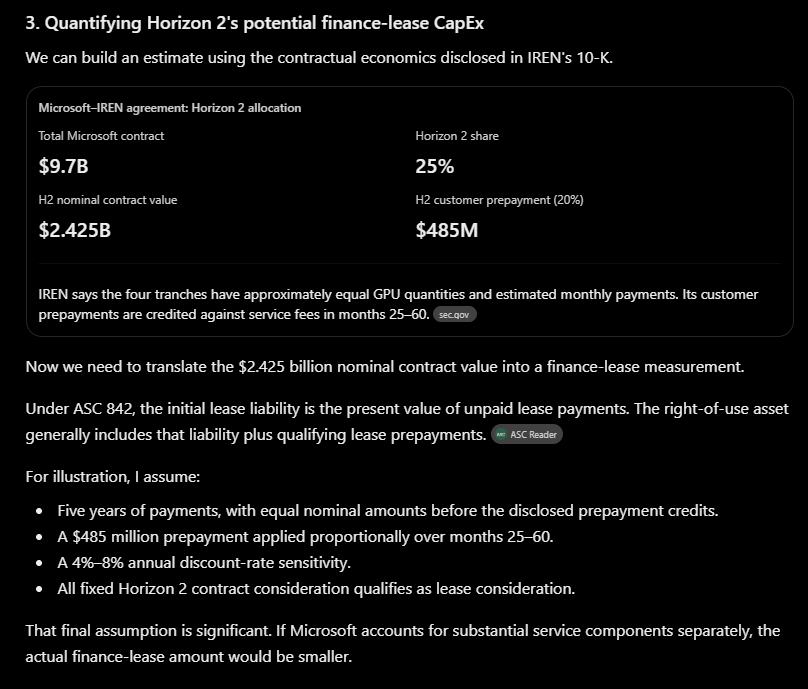
We don't know exactly how Microsoft accounts for IREN's lease and whether it considers the prepayment. But doing a sensitivity analysis, I have the following numbers:
Under the base-case assumptions, Horizon 2 could represent approximately $1.7–2.2 billion, or 34–44%, of a $5 billion shortfall.
That's significant, and in the worst case, that's almost half of the CapEx miss.
But it's important to remember that this hinges entirely on the notion that Microsoft believed IREN would deliver more than Horizon 1 during FY27 Q1.
So we need to consider The Information's source, and then compare that to my research, and you can draw your own conclusions as to who may be right here.
That being said, even if the Horizon 2 delivery was initially expected in FY27 Q1 by Microsoft, the market obviously knew that it didn't happen.
First of all, IREN specifically placed Horizon 2 in the December quarter during their earnings call on August 27. Secondly, there was no subsequent announcement of a Horizon 2 handover and acceptance during the remainder of the quarter ending September 30.
So then we have to take a look at the real implications of this alleged delay, for the contractual relationship between IREN and Microsoft.
In the August 27 10-K, IREN states:
"Horizon 2-4 is targeted for delivery in phases in calendar Q4 2026, with grace periods under the Microsoft Agreement for delivery extending from mid-Q4 of calendar 2026 to the beginning of Q2 of calendar 2027."
We can infer from this that Horizon 2 is within its grace period if it's delivered before "mid-Q4", which we can consider to be November 15.
If Microsoft expected Horizon 2 to be delivered by September 30, then making the grace period for that delivery "mid-Q4" gives it approximately 45 days between the assumed original date and the grace period ending.
Now Horizon 4 has an inferred grace period ending by April 1st, so that would be more than 3 months after IREN's own "EOY 2026" deadline for it.
If Microsoft expected Horizon 2 by September 30, it would have approximately 45 days of grace to meet the "mid-Q4" qualification.
By that same token, would Microsoft then expect Horizon 4 to be delivered 45 days before April 2027?
Why would Horizon 2 receive a shorter grace period than Horizon 4?
This is a very interesting topic, because clearly there is a discrepancy here between what Microsoft knew on July 29 and what has been contractually agreed upon, which matches the grace periods.
Still, I believe that Microsoft would not report something they knew was not going to happen on July 29, despite having contractual agreements saying it should be delivered then.
If Horizon 4 has a similar grace period as Horizon 2, it makes perfect sense that Horizon 2 was agreed upon to be delivered well before September 30.
But that does not overrule the fact that Microsoft was well aware of the status of the project by July 29, when they disclosed their FY27 Q1 CapEx guidance.
Considerations:
-> Did IREN not properly inform Microsoft of the status of Horizon 2 by July 29?
-> Did IREN lean on grace periods, counting on having more time to deliver it within their agreed-upon delivery time with Microsoft, while still being in line with their communication towards the market?
-> Or did Microsoft know about Horizon 2 not making the September quarter, but still guided for it because it was within the original contracted target date?
Taking all things into account, the whole situation doesn't add up.
Either IREN or Microsoft must have known by July 29 that it would be incredibly hard, or near impossible, to get Horizon 2 up and running and merged with Horizon 1 before the end of September.
IREN already indicated to the market that it did not expect to meet a September deadline for Horizon 2 (if there even was any), by explicitly placing Horizon 2 in the December quarter.
Is this a case of miscommunication between IREN and Microsoft in the weeks leading up to their earnings call?
Did Microsoft gloss over all these 3rd party contracts, rounding up their expected CapEx plans for the September quarter, keeping in line with market expectations, and not giving attention to upcoming delays they were already aware of?
IREN is being sacrificed by the market, and targeted by The Information without any kind of nuance considering all I have said above.
As far as we know today, the "delay" is inconsequential, and both parties were well aware of this in August, and more importantly: the market already knew Horizon 2 was placed in the December quarter.
How can anyone confidently make this a real "news" item, if the nuance around this delivery is likely more relevant than the "delay" itself?
Honestly, this whole thing is completely overblown, and given the fact that it just seems to be about finger-pointing at 1 company, while not being able to quantify the delayed amount, I think it's important to scrutinize this calling out of only IREN.
Clearly, this is a great headline for the Blockspaces and SemiAnalysis of this world to run. But if you zoom in, and look at what is really reported, expected, and disclosed, you will find that this is just rehashing old news, in favor of getting clicks and engagement.
Unfortunately, IREN is the AI Cloud scapegoat of 2026, and clearly there are various reasons for that, both founded and unfounded.
But when IREN and Microsoft have internal arrangements that move capacity from one fiscal quarter to another, I think we should not go out here and blame them for delays, when they are well within their contractual (grace) periods.
Now I will go briefly into the other "delay" that is going around, because yes, Microsoft has noted another delay as I said at the beginning of this post.
The FY27 Q2 CapEx guidance also referenced third-party GPU leases that had been pushed into FY27 H2.
I'm well aware of information circulating that Aterio has said that Horizon 4 looks to be delayed, and @Jefferies has cut their price target on IREN for it, but from my latest aerial imagery and satellite footage, I have no reason to believe that H3–H4 as a cluster will miss the year-end deadline.
Unfortunately, my next flyover is probably just after the earnings call, but I will do my best to come back to this when the content comes in.
For now, don't follow the herd and don't just take what The Information tells you as a reason to blame IREN for anything that Microsoft has said.
We don't know a lot of things, and just quoting an unnamed source without any numbers or proof is not how we like to do things around here.
@TheProfInvestor Thank you! Got in at 53.85$ after your earlier post on this! 🙌🏻 sold half for good profit, trailing the rest hoping for more news on the merger
@P_Jones221@1ChartMaster I think any red candle doesn’t mean you are entering this trade setup. The more red 30min candles you have, the more likely this setup is to work. 1 red is nothing, just randomness, for the real pivot there were 3 candles.
@Kurva66@Zalmiakkikala Ei ole pakko tehdä, Ausseissa on usein käytetty 3% creep rule, jonka varjolla omistusta voi kasvattaa 3% 6kk välein sen jälkeen kun on mennyt yli 19%.
https://t.co/VRwRM44yGD