FirstBlock is now on X ⬢
We validate GenesisL1 (genesis_29-2) and we build @unmask_crypto, the on-chain lens on every $L1 trade.
Here: what GenesisL1 ships, validator life, and receipts from the chain.
Our numbers, live: https://t.co/YyI47N0okg
GenesisL1 governance update: the signal proposal to return the unclaimed 2022 airdrop to the community pool has passed. The upgrade that executes it is now in voting.
~5.1M L1 coins (L1), untouched for 4.5 years, would nearly double the pool to ~10.8M L1. No mint. No burn.
Where things stand
• Signal proposal #137 passed with 100% YES: 19.24M L1 in favor, zero against.
• Software Upgrade v1.6.2.1 (proposal #139) is in voting until Nov 28, 13:22 UTC. If approved, it executes at block 14,122,000, expected around Nov 29, 14:00 UTC.
• In a dry run on mainnet state, the upgrade moves 5,131,539 L1 from 575,650 never-used accounts. Final figures are fixed at the upgrade height and published on chain.
What the upgrade does, and doesn't
• No new L1 coins are minted and none are burned. The upgrade verifies that total supply is unchanged and that the community pool grew by exactly the amount moved. If any check fails, nothing is committed.
• Only accounts that have never signed a single transaction and still hold nothing but their ATOM (11 L1) or Evmos (5 L1) airdrop are in scope. Any account that has ever been used keeps everything.
• The list and the rule are public. Anyone can check an address or simulate the result on their own node.
Returning unclaimed airdrops is established practice: Osmosis and Arbitrum closed their claim windows after 6 months. GenesisL1 kept its window open for 4.5 years.
Why it matters: security
Dormant wallets are a long-term weak point in any token distribution. Nobody is watching them, so nobody moves the coins to safety when a key leaks.
The recent Web3Auth incident made this concrete. A flaw in Web3Auth's infrastructure exposed the private keys of some Keplr wallets created with Google or Apple login. GenesisL1 airdrop addresses are controlled by the same keys as the Cosmos Hub and Evmos accounts they came from, and on Nov 10–11 about 190K L1 was swept from 13,893 GenesisL1 accounts, almost all of them airdrop addresses.
Returning the untouched allocations puts ~5.1M L1 out of reach of exposed keys and closes this risk in the L1 distribution.
Why it matters: institutions
GenesisL1 had no founder, team or investor allocation and no token sale. That makes the community pool the largest gateway into GenesisL1: every L1 allocation, whether to builders, infrastructure, liquidity or institutional participants, comes from the pool by public vote. It already funds community liquidity on Base and backup infrastructure.
After the upgrade the pool would hold ~10.8M L1, about 22% of all L1 coins, governed directly by L1 stakers through public on-chain votes. No private deals, no single gatekeeper: every allocation is proposed in public and decided on chain.
For universities, research institutions, biotech companies and infrastructure operators that want to take part in building an open science network, that is a larger and fully transparent entry point.
The release also adds a Go toolchain guard that protects validators from a chain-split risk described in a November 2026 security advisory to Cosmos chains.
Vote on #139 before Nov 28, 13:22 UTC:
https://t.co/a7ycA4i73q
List, rule and verification tools:
https://t.co/zmxx2thH2F
If you hold L1 in a Keplr wallet created with Google or Apple login, move it to a wallet secured by a recovery phrase or a hardware wallet.
Where things stand today:
• Recovery upgrade: voting now, not passed
• Funds framework: draft, not on chain
• Any future allocation: its own vote
Figures: chain at block 14,050,768 (18 Nov), pool balance from 14 Oct.
#GenesisL1 genesisl1:native
5,132,428 genesisl1:native sit in 575,729 airdrop accounts that have never moved.
GenesisL1 is voting on returning them to the community pool.
Nothing has passed yet. Here is what is on the table, and why it matters.
Why the two belong together:
GenesisL1 launched in 2021 with no token sale and no team or investor allocation. There was never a reserve to offer anyone.
If both pass, the coins nobody claimed become that reserve: locked, staked, allocated only by public vote.
AI and science will go crazy.
And I think I found the strongest web3 infrastructure for this narative.
Not even going to mention the project because I don't want this to turn into another token shilling post.
I just want to talk about the problem it's trying to solve, because I"m sure we're about to see something crazy happen at the intersection of AI and science.
AI is getting ridiculously good at biology.
We're reaching a point where software can help scientists analyze millions of proteins, predict molecular structures, and narrow down drug candidates faster than ever.
But there's a problem I don't see nearly enough people discussing.
If AI starts producing scientific results at a scale humans can't keep up with, how do we keep track of what was actually done?
Which data was used? Which model version? Can another researcher reproduce the result? Can another AI agent pick up where the first one left off?
Think about how important this becomes when thousands, eventually millions, of AI agents start contributing to scientific research.
Do we need blockchain infrastructure around these exact problems, or am I hallucinating?
Do we need deterministic, verifiable ML inference?
Do we need a Git-like versioning for genomic data, scientific provenance, and tools that allow researchers to build on previous work?
Meanwhile, someone has spent the last five years quietly building this kind of web3 infrastructure around scientific discover. And we're not talking about some random crypto dev trying to ride the AI hype. We're talking a bioinformatics and blockchain developer with a background in computational biology.
Someone who actually understands the scientific problems he's trying to solve.
I can't stop thinking about how valuable this could become.
Not because of another crypto narrative.
Because of the actual value scientific discoveries can bring to humanity.
A single peptide, if it becomes the basis of a breakthrough drug, could potentially generate more economic value than the entire crypto industry.
ONE molecule.
Learn G........
"Life is a form of protein molecules organisation".
Ive heard this first at the very first biochemistry facultative lesson with ms Tatiana Solomonovna Freindlin when at 10th grade and this phrase changed everything.
Years later after finishing medical university, having knowledge in molecular medicine, bioinformatics, data science and computer programming I understand this phrase much deeper than before and can even expand the meaning from various point of view.
Proteins are binaries, nucleic acids are source codes. Proteins are building blocks, nano machineries, shields and armors, and each and every action is programmed. Together, via their interactions in closed and open systems - internal and external - they drive life. Everything you see living is built by proteins. Everything you see living is programmed by nucleic acids.
Bioinformatics treat it exactly that way - as programs and their codes. And programs and codes are data.
Satoshi Nakamoto and his peers delivered the most successful decentralized database - the blockchain. This database is used to store financial txs data. But data about life is far more valuable than data about financial transactions, and there is no point to not use the best distributed permissionless database technology to store and protect and work with data about life - about programs and their codes that drive life.
This is what GenesisL1 is about: the term DESCI or decentralized science have never had more concrete meaning and this meaning is a Layer 1 that actually runs DESCI natively using that amazing tech pioneered by Nakamoto et el.
And it is not a promise at all, it is working already. Open https://t.co/0E7H5qScqE - more than a million MolNFTs on GenesisL1: PDB structures, AlphaFold models and HLA alleles. 265,786 PDB structures are stored fully on chain - not a link, the structure itself. Every structure is NFT with its own owner and on-chain history, and you can search them, BLAST them and align them right in the explorer. Sperm whale myoglobin - the first protein whose structure was ever solved, back in 1958 - lives on chain right now: https://t.co/VIVIHoB18J. Open science data stays open and verifiable for everyone, private data stays encrypted and owned by those who created it.
Remember - nucleic acids are source codes. And every source code that matters lives in git: commits, diffs, branches, full history of every change. Biological source codes never had their own git. Until now.
On November 16 The Bioinformatics Company deployed GL1-seq (https://t.co/Kq0z8fMRKb) pilot on GenesisL1: chromosome 21 of the human reference genome GRCh38 plus chromosome 21 of 12 public genomes. In coming weeks GL1-seq comes to GenesisL1 in full - novel git for biological sequences and genomes. Full human reference genome stored on chain - not a link, the genome itself. Every other genome is just a diff against it, every change is a commit with its own history, and everything reconstructs back lossless, base by base, in format both scientists and AI agents can read and work with. Built on it - genome, gene and proteome atlas: all human genes and the whole human proteome on chain. Personal genomes never go on chain - only commitments that prove nobody changed them.
In upcoming months and years, on top of AI progress there will be thousands of scientific breakthroughs made. Not talks about breakthroughs, but actual breakthroughs everyone will talk about. And every one of them will need data - open, verifiable, with provable origin. AI can find patterns, but AI can not prove where data came from and that nobody changed it. Blockchain can.
GenesisL1 will transform biotech towards blockchain the same way Bitcoin transformed finance. There is no technical barrier anymore, and there is no more important thing for life than life itself. All resources, all money of the world, all energy and all debates, everything - eventually end up at one single objective - to understand life and to use that understanding to improve and prolong it.
Please, stay tuned.
Human chromosome 21 is now on GenesisL1.
Yesterday, 16 November, The Bioinformatics Company completed a pilot deployment on GenesisL1: human chromosome 21 from the GRCh38 reference genome, together with chromosome 21 of 12 public genomes from the 1000 Genomes Project, written on chain in gl1-seq format.
What is on chain:
• Reference: the complete 46.7 Mb sequence of chromosome 21, with its GENCODE genes, transcripts and exons, and UniProt proteins
• Genomes: 12 open-access genomes in four parent–child trios, 24 haplotypes, each stored as a gl1-seq delta that records exactly what differs from the reference
• Footprint: 71,219 content-addressed objects, 26.8 MB of contract state, 346 transactions
Verifiable by design. Every object is stored under an identifier computed from its own content, so any copy can be checked byte for byte, wherever it was read from. Each of the 24 haplotypes can be rebuilt from the reference and its delta and checked against the identifier recorded for it on chain.
gl1-seq is version control for genomes: git for biological sequences. A genome becomes a verifiable version of a reference, with every change recorded exactly and checkable by anyone.
Open data only. Everything written is open-access public data. Personal genomic data is never written to the chain.
GenomeRegistry: 0x7380e7787566eb1a2f069aeefb9664abbebae020
GenomeStore: 0x955ee39cca0e281cb74b672ade7dbc3ced1e5374
Chromosome 21 was the pilot.
Next, expected before the end of November: the gl1-seq preprint and the complete human reference genome on GenesisL1.
https://t.co/jG2H8HmznY
@tom_bombandil@AlbertNaghel Most importantly, I strongly believe this has been a very significant community stress test for which the community should be proud! Beyond that, recovering 5mln $L1 tokens for the community treasury will be a massive launchpad for the upcoming signals proposals... stay tuned!
Your AI agent can now read GenesisL1. GL1X serves an MCP server: 87 read-only tools. 31 ledger · 43 lab · 6 on-chain AI · 7 chess vs a neural net in a contract. No key, no account. Agents can't sign or move coins.
https://t.co/P69a9cw0NT genesisl1:native #GenesisL1
Proposal #135 executed: @sherlockdefi audit of CIPNFT and GL1F fully paid
The community multisig has carried out signal proposal #135 exactly as voted. No swaps were made at any step, so the L1 price was not affected.
1️⃣ Fees collected from LP position #5633483: 4,827.76 USDC + 25,376.00 wL1
https://t.co/qI0mvIAnuQ
2️⃣ Liquidity withdrawn: 13.14% of the position, releasing 15,173.24 USDC + 120,534.29 wL1
https://t.co/W322gMmL7l
3️⃣ All wL1 returned to the pool: 145,910.29 wL1 (fees + withdrawn) placed as a new single-sided position #6522766, range $0.2462 → $99.90
https://t.co/s4ipo9Kd6L
4️⃣ 20,000 USDC paid to Sherlock
https://t.co/X95i19zGpu
The proposal estimated about 18.8% of liquidity would be needed. Only 13.14% was used because the L1 price has risen since the proposal was drafted, so the position held more USDC. All L1 stays in the pool.
The audit results will be published and announced jointly by GenesisL1 and Sherlock.
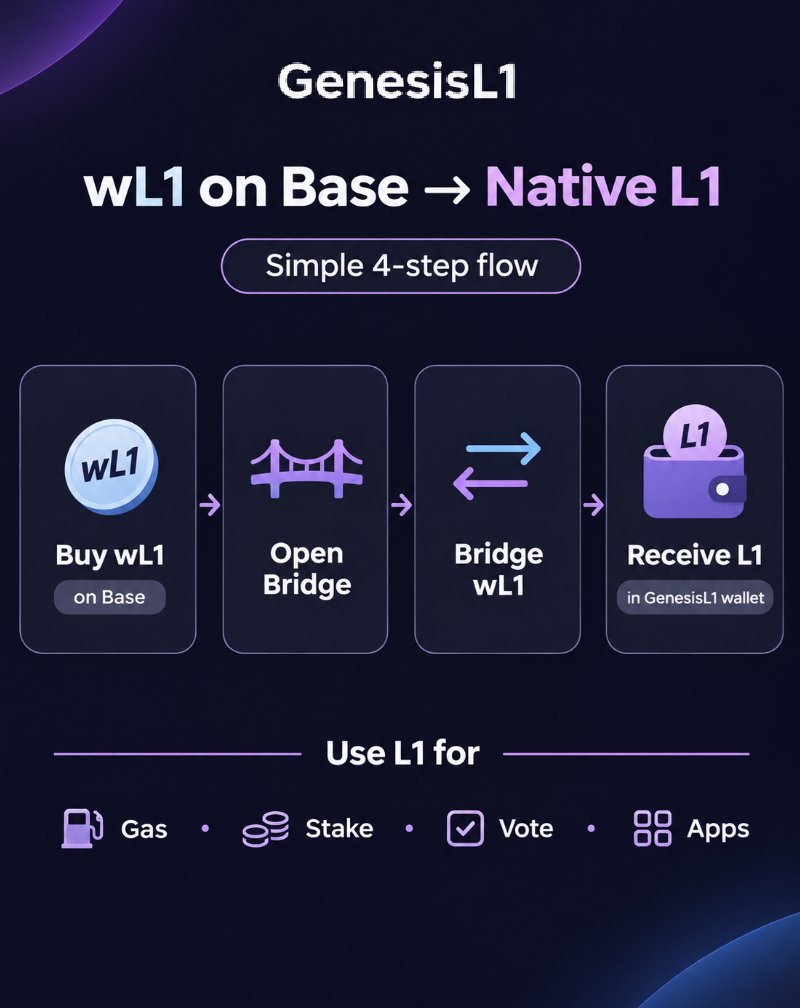
1. Start by purchasing base:0xe6522a891702cd2e8cc2a5182638c9da1dd44b22 on Base.
2. Next, send it through the GenesisL1 bridge.
3. After bridging, your wallet receives native genesisl1:native on GenesisL1.
4. This native L1 can then be used to pay gas, stake with validators, vote in governance, and interact with apps in the ecosystem.
29,247 Osmosis accounts were swept into one address in 13 hours, including 14,657 L1 drained from 60 of them.
The same keys can sign for 8,480 GenesisL1 accounts holding 118,811.91 L1.
Attacker or whitehat recovery? Unconfirmed.
Full findings 👇
https://t.co/0vWCT3IUYg
One trader bought 100k base:0xe6522a891702cd2e8cc2a5182638c9da1dd44b22 2 months ago at 10 12, and sold today at 18 16... Congrats on the 60% gains.
VC wallets are saying thanks and actively slurping.
A new wallet looks to be buying like the 2 VCs wallet.
Just new. But the same ways.
They can't help buying the dips.
VC level of entry on genesisl1:native
Chain and project is pure insanity. Nothing goes 100x in 5 minutes in this world.
You gotta buy when the market is like now. Things that look to be huge, just before they are huge.
Like the Early $Tao whales are saying. This is like Tao when they were the first on it.
Gl.
Dear BioAI, MedAI, SynBio and biohacking community,
We are very happy to present the very first on-chain bioinformatics laboratory, as a part of the broad GenesisL1 decentralized science architecture:
https://t.co/ztmJExp1u0 — Bioinformatics Onchain
Free. No account. Open to humans, programs and AI agents.
What it is
GenesisL1 carries hundreds of thousands of protein and nucleic acid structures published as MolNFT records, stored in contract state or anchored on chain with CID-verified IPFS content. GL1X treats that archive as a scientific database and runs the standard methods of sequence and structure bioinformatics over it, in its own code, with no external services, and each method validated against its reference program.
This is not a wrapper around someone else's server. It is a laboratory that lives on the chain.
What you can do today
🔎 Search & homology — molecular search by PDB ID, UniProt accession, NFT id, title, sequence or motif; full BLAST (blastp/n/x, tblastn, tblastx) over every sequence, identical to NCBI BLAST+ on the test set; PROSITE-style motif scans across sequences and 3D structures; profile HMM search reproducing the hmmsearch pipeline.
🧬 Structure — TM-align superposition of any chain against any other (or your own file); structure search over every indexed chain in seconds via the GSA structural alphabet; pre-computed experiment-vs-prediction comparisons for every UniProt accession present as both.
🔬 Full-atom analysis in the research workbench — DSSP secondary structure and H-bonds, accessibility, half-sphere exposure, contact maps, base pairs with pseudoknots, chain interfaces with buried surface, salt bridges; SS-pattern search (β-hairpins, helix-turn-helix); 3D templates for catalytic triads and metal sites.
💊 Pockets & druggability — cavities with volume, buriedness, hydropathy, charge and a druggability score, searchable across every structure; a ligand index of every cofactor, drug, ion and sugar with its binding-site residues.
🧪 pH environments — structure-based pKa for every ionizable group; charge, pI and stability of a protein in the stomach, intestine, blood, cytosol, endosome or lysosome, with membrane proteins getting a pH on each side.
⚗️ Proteomics — digestion by 24 enzymes, proteotypic peptides across the archive, masses, fragments, isotope patterns, MGF spectrum identification with target-decoy FDR, crosslink checks, HDX/LiP painting, a virtual 2D gel.
🌳 Families, evolution & variants — multiple alignment at MUSCLE-level accuracy, Jensen-Shannon conservation on the structure, NJ trees, mean-field DCA coevolution vs contacts, CD-HIT clustering, disorder/coiled-coil/TM annotation, substitution scans and ΔΔG from GL1F models.
📊 Datasets & on-chain ML — turn any search into a dataset (JSON/CSV/TSV) with documented features, or straight into GL1F model inputs; train off chain, publish the model as an NFT, run it on GenesisL1 on any record.
📚 Literature — PubMed search with up to 2,000 records clustered into a topic map in your browser (Broccoli), every structure linked to its literature.
✅ Proofs — every sequence in every result can be re-derived from the chain at a pinned block and from IPFS, with the calls to replay on your own node. Every hit names the record and the SHA-256 of what it describes. Deterministic answers, reference parity, held-out evaluation.
🤖 Agent-native — every tool above is an MCP tool and an API endpoint. An agent can identify a molecule, BLAST it, find its structural neighbours, analyse its pockets, digest it, align its family, scan its variants, read its literature, build a dataset, run a model and prove the sequences, end to end.
Where this is going
This is the opening move. The horizon is expanding constantly: the full human reference genome and pilot genomes are coming into chain state through GL1-seq, with 1000+ public genomes to follow, alongside Swiss-Prot, RefSeq proteins, UniRef50, paired antibody repertoires and IPD-IMGT/HLA. Peptide design (PEPTL), confidential IP (CIPNFT), scientific DAOs (COLLAB) and DeSci finance (DESCIFI) are being built around the same core.
Our aim is simple and ambitious: hundreds of thousands of researchers working on decentralized infrastructure, with tools and services for open science expanding at a pace the field has not seen before.
This is an invitation
Research on chain. Build on chain. Point your agents at the MCP server, call the API, fork the explorer, publish a model, mint your structures. Everything you compute here is provable, reproducible and belongs to no single server.
→ https://t.co/ztmJExp1u0 · Docs: https://t.co/JJHkPSjCYx · API: https://t.co/0uwYo1LlXk · MCP: https://t.co/UnWL7y4zBE
Welcome to the laboratory.
GenesisL1