Imagine giving an AI agent access to an entire blockchain AND a scientific laboratory.
Now look at GL1X built on genesisl1:native
1M+ molecular records. Bioinformatics. On-chain AI. 87 tools for AI agents.
#GenesisL1 isn't just putting AI on-chain. It's making the chain usable by AI.
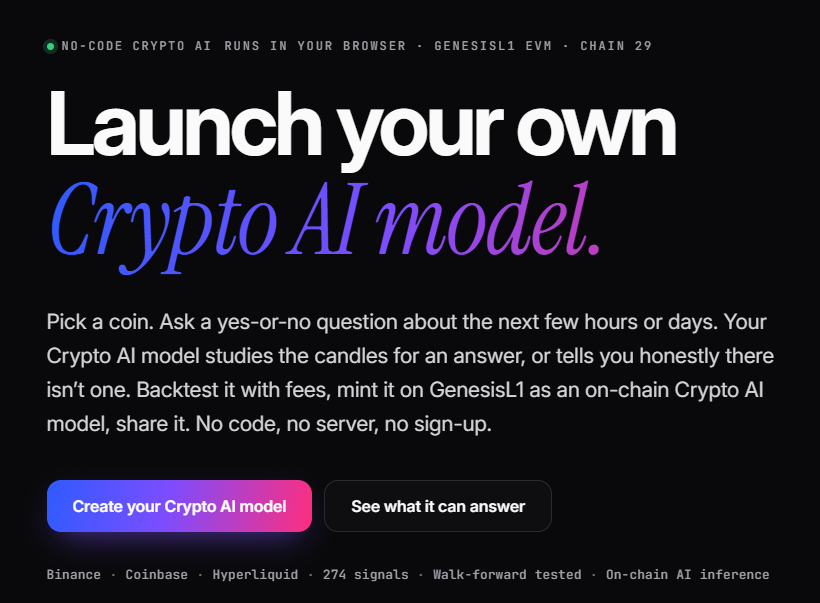
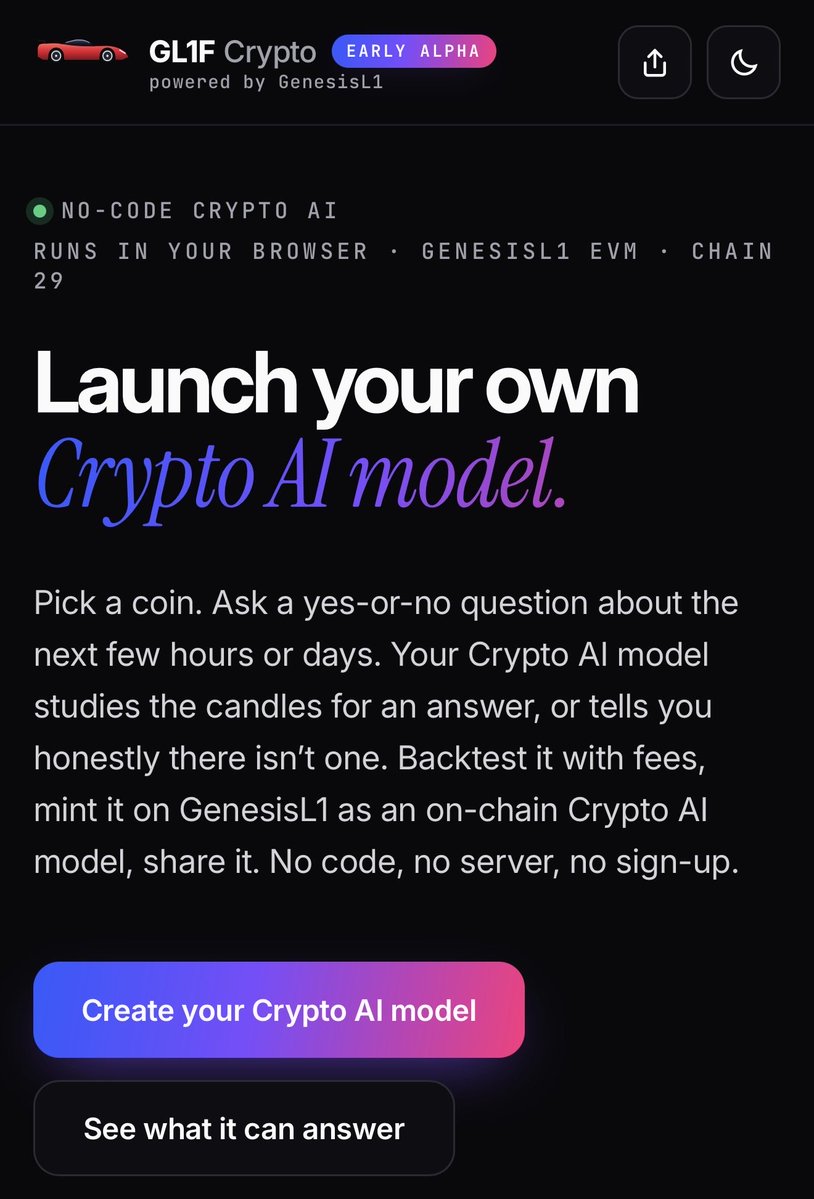
Did you know that you can launch your own crypto AI model with ZERO CODE, thanks to this crazy platform built on GenesisL1? 🤯
GL1F - This HUGE dApp is just a small piece of what we can build on GenesisL1.
YES - You can launch your own crypto AI model with ZERO CODE.
Everything on-chain runs on genesisl1:native
100% of the dApp fees are designed to be burned by whoever wants to press the burn button.
Decentralization level 1000.
If we think about what https://t.co/VzrXhGAGob did by removing the coding barrier to launching tokens... imagine what GL1F could do by removing the coding barrier to building AI models.
This dApp could become HUGE.
And it doesn't have to stop at crypto. Stocks, sports, weather, finance, biotech... basically any problem that can be tackled with tabular data.
HUGEEEE.
But at the same time, it shows just a tiny fraction of GenesisL1's infrastructure potential.
Because when we talk about GenesisL1, we're talking about:
- Deterministic, on-chain AI inference: models whose computations can be independently reproduced and verified.
- Tokenized AI models: turning models into ownable, transferable and potentially revenue-generating assets.
- A decentralized AI inference marketplace: where mainstream AI models can be deployed and served by independent operators.
- AI agents and machine-to-machine payments: autonomous agents discovering services, requesting inference and paying in genesisl1:native.
- Scientific infrastructure: molecular structures, research datasets, reproducible computation and verifiable scientific provenance.
- Privacy-preserving collaboration: encrypted models and scientific artifacts that can be shared with authorized parties.
- A foundation for biotech, pharma and open science: infrastructure for building, tracking and collaborating on scientific research.
The gap between what GenesisL1 is building and how little attention it gets so far is absolutely fascinating.
Learn GenesisL1.
The man is setting the stage for the next big narrative.
DeScience.
And I genuinely believe no blockchain is better positioned to lead this narrative than GenesisL1.
genesisl1:native
Most people have no idea what’s being built.
How to launch your first crypto AI model on GenesisL1.
NO CODING REQUIRED! 🤯
Here’s a quick guide to GL1F Crypto 👇
1️⃣ CHOOSE YOUR DATA
Open https://t.co/t1lJoF2hen → Create Crypto AI model.
Select:
• Exchange: where the data comes from.
• Market: the coin you want to study.
• Candle: data resolution - 15m means one candle every 15 minutes.
• Start / End: the historical period your model will study.
For this example: Binance → ETH → 15m candles → six months of completed history.
2️⃣ DEFINE YOUR QUESTION
Use these example settings:
• Direction: Up
• EMA baseline: 5
• Target: 1%
• Stop: 0.5%
• Horizon: 5 hours
EMA is a moving average that gives more weight to recent prices. “5” means five candles.
Your question becomes:
“Will ETH reach 1% above EMA5 before reaching 0.5% below it, within the next five hours?”
Both levels are measured from the EMA baseline.
The model learns from historical yes/no outcomes.
3️⃣ CHOOSE YOUR SIGNALS
Signals are the information the model can see: price changes, volatility, volume, momentum, BTC movements and more.
Start with the “Optimal” preset.
More signals don’t automatically mean a better model.
Click “Build dataset” → “Continue to training”.
4️⃣ TRAIN YOUR MODEL
For your first experiment, keep the default model settings and use “Walk-forward” validation.
That means learning from earlier data and testing on what happened next.
The main settings:
• Trees: how many learning steps the model can take.
• Depth: how complex each tree can become.
• Learning rate: how much each tree contributes.
• Min leaf: minimum examples supporting a final tree decision.
• Final test %: the latest data reserved for evaluation.
Keep early stopping enabled: it stops adding trees when validation stops improving.
Train, inspect the results, then save your .gl1f file.
5️⃣ BACKTEST WITH COSTS
Use the final test period and include fees and slippage.
“Entry threshold” is the minimum probability required for a simulated signal.
0.60 = at least 60%.
Start with 1× leverage for this exercise.
Check drawdown, trade count and the full equity curve - not just the final return.
Avoid repeatedly changing settings to make the same final test look better.
6️⃣ RUN INFERENCE
Inference means asking your trained model to evaluate a new completed candle.
A result of 0.72 means:
“The model estimates a 72% probability of the specific event you defined.”
It is an estimate, not a guarantee.
7️⃣ OPTIONAL: PUBLISH
When deployment is available, you can mint your model as an NFT on GenesisL1, choose its license and configure free access, tips or paid usage.
Pick a market. Define a question. Build. Test. Learn.
No code required. Fees are burnable.
Experimental research software. Backtests are simulations; the platform explicitly excludes live trading and automated execution. 🤝
genesisl1:native
GL1F vs GL1AI
GL1F: compact ML models like GBDTs.
Train locally → tokenize as Model NFT → store on-chain → deterministic inference directly in the EVM
Perfect for crypto prediction, risk scoring, biomedical & structured data models.
GL1AI: large AI models / LLMs.
Tokenized models → decentralized storage → GPU operators serve inference → users & agents pay in genesisl1:native
Built for LLMs, coding, agents, generative AI & large-scale inference.
GL1F = verifiable on-chain ML.
GL1AI = decentralized AI compute & inference.
Same L1. Two very different AI markets.
Does #GenesisL1 store huge AI models directly on the blockchain? genesisl1:native
No, and it doesn't need to.
Large model weights and artifacts can be stored and replicated through IPFS.
GenesisL1 only needs the small references and metadata required to identify, tokenize and verify those models.
The heavy computation also doesn't happen on-chain.
It runs on the GPUs of independent operators.
So the blockchain doesn't need to store 100GB models or generate every AI token.
It coordinates the models, operators, payments, reputation and verification around them.
That's a much more scalable way to bring large AI models into Web3.
Could anyone with a GPU become an AI inference provider on GenesisL1? genesisl1:native
That's the idea.
Imagine you have an RTX 3090.
You could pull a tokenized Qwen model from the GenesisL1 ecosystem, verify its artifacts, load it locally and offer inference through the marketplace.
Users could compare you with other operators based on price, uptime, performance and reputation.
User pays genesisl1:native → GPU runs inference → user gets the result.
Instead of GPUs sitting behind a centralized AI provider, GenesisL1 can connect independent compute into an open AI marketplace.
The craziest dapp is live on Genesis genesisl1:native.
Pumpfun for machine learning!
You can literally launch your own crypto AI model.
No code. No server. No sign-up.
Everyone will learn how to burn $L1 tokens to launch crypto price prediction models for any crypto asset - bittensor:native , ethereum:0x4a220e6096b25eadb88358cb44068a3248254675 , zcash:native and so on - and eventually monetize them on-chain. 🤯
The game will eventually expand - stocks, sport, weather, whatever, any tabular problem.
Be ready for the moment the mass will wake on this. ⏳
Working on a tutorial so everyone can understand how easy can you launch AI models with GL1F.
This can get addictive.
So be ready to burn $L1 tokens on a daily basis.
Learn GenesisL1. 🤝
“pump fun, but for machine learning genesisl1:native 🤖
pump fun made launching a coin a matter of a few clicks.
GL1F Crypto does the same for machine learning.
You don't launch a coin. You launch your own Crypto AI model and tokenize it on GenesisL1 as a model NFT.
And instead of a bonding curve, you get a backtest.
Anyone can launch.
Anyone can test.
Anyone can verify.”
Why is genesisl1:native up 180% in the last week?
Because a few people have started to find out what Mike is cooking.
More and more will follow.
The hottest thing atm is GL1F.
You can think of it like Pumpfun for machine learning.
If Pumpfun went that crazy by breaking the code barrier for launching tokens, where 99.99% of them are rugs, imagine what GenesisL1 can do by breaking the code barrier for launching your own GBDT AI model.
Then tokenize it and eventually monetize your work.
No coding skills required.
Everything settled in $L1
The collected fees? BURNED. 🔥
But hey… that’s just a small piece of what can be done on this infrastructure.
As I’ve always mentioned in my posts:
Learn GenesisL1.
Don’t be lazy.
There are two different projects, with different paths, the only “comparison” that was made was at subnet level.
Everyone can use their brain to do their own analysis before investing into something , and for those that don’t have one, there’s always intelligence right at the corner as a gpt subscription to do that work for them.
If you're looking at it from the right angle, GenesisL1 combines at least 7 Bittensor subnet ideas into a single project. $TAO $L1
The difference is that everything is built to work as a whole, everything is connected and more importantly, everything works only using $L1 tokens.
This gives value to the token as you need it to deploy AI models, run infrastructure and interact with the ecosystem.
And guess what happens to the $L1 used for fees?
It gets burned. Forever.
Why could genesisl1:native hit $5,000+ per token?
I know. That’s roughly a 20,000x from the current price.
Sounds insane.
But that’s “only” around a $200B market cap.
Now think about what Genesis is actually being built for.
Let’s talk about science first.
A single successful drug can create an enormous amount of economic value.
One successful peptide could be worth more than entire crypto ecosystems.
A single biomedical breakthrough can create billions in value, and GenesisL1 is being built as infrastructure for exactly these kinds of real-world scientific and computational workflows.
Models. Molecular structures. Scientific IP. Verifiable computation. Reproducible research.
Now let’s go further.
We have GL1F - Pumpfun for machine learning.
Pumpfun removed the coding barrier for launching tokens.
GL1F is removing the coding barrier for building machine-learning models.
This can go crazy. Could bring an entirely different type of user on-chain.
Then we have a decentralized Hugging Face + inference market.
Genesis is also building infrastructure where mainstream AI models can become tokenized Web3 objects and independent operators can provide inference.
Users and agents discover models → choose an operator → request inference → pay natively.
With x402, this becomes even more interesting:
machines paying machines for intelligence.
Machine-to-machine payments and inference could create an entirely new category of network activity.
Then add AI agents.
Humans might run 10 experiments.
Agents can run thousands.
Discover a dataset. Test a hypothesis. Train a model. Call another model. Pay for inference. Analyze the result. Repeat.
UI for humans. API for agents.
And all of this connects back to $L1.
And with the planned GL1F fee model, $L1 collected through those fees is intended to be automatically burned.
So now zoom out.
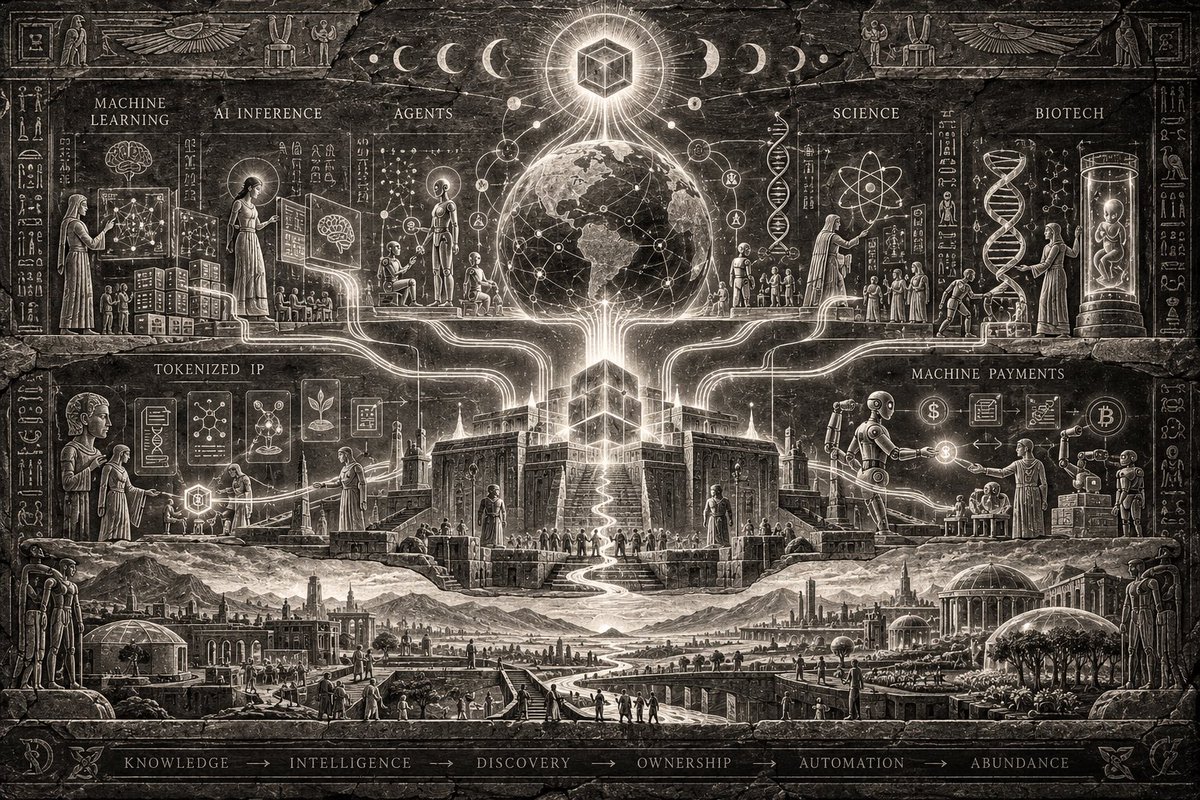
Machine learning + AI inference + agents + science + biotech + tokenized IP + machine payments.
Real-world utility.
Real demand.
Not just crypto speculation.
Learn GenesisL1. 🤝
Pumpfun for machine learning. ⏳
It’s being built now, and it will burn genesisl1:native tokens.
I know this is HUGE, but at the same time, it’s just a little piece of what can be built on the GenesisL1 infrastructure.
Learn GenesisL1.