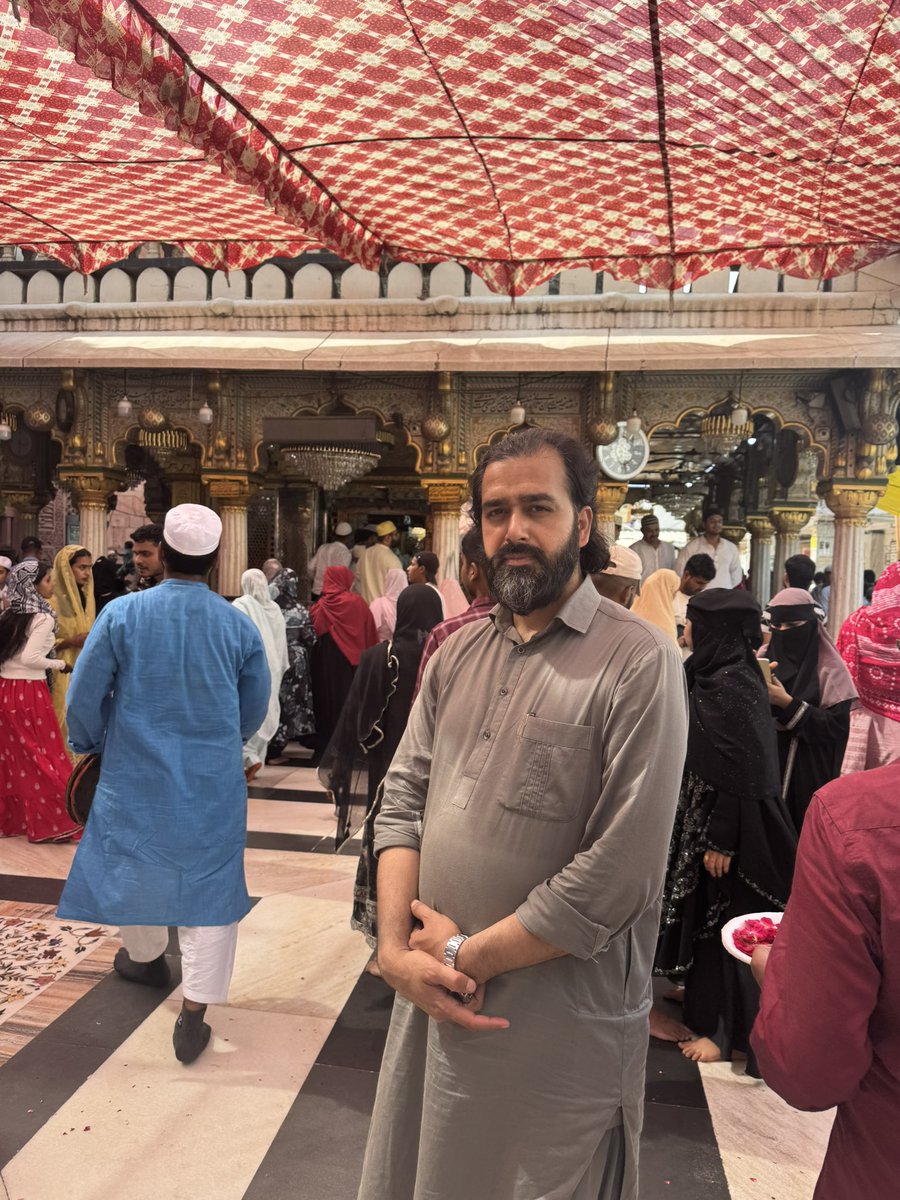
Today I was blessed to visit the Dargah of Mehboob i Ilahi Hazrat Khwaja Nizam ud din Awliya after a long time. The thin alleys leading to Dargah with rose petals, jaggery and aromas sold on both sides for the visitors makes alleys vibrant and some what fragrant with the occasional burning of incense and the smell of Mughlai dishes being prepared in the eateries, where visitors eat and beggars wait endlessly in queues so that any philanthrope may arrange a feast for them.
While entering into the Dargah complex, we first entered into the red stone mosque which is also known as the Jamat Khana Masjid and was built by Khizr Khan, the son of Sultan Ala ud din Khilji as a token of respect for Hazrat Nizam ud din. Even Hazrat Nizam ud din used to pray in this mosque and the grandiose of its architecture is really a treat for eyes to behold.
After Zuhr prayers, we sat alongside the Qawwals who were per chance singing a manqabat of Hazrat Ali and the Qawwals were singing it in between the mausoleums of Hazrat Nizam ud din and Ameer Khusrau. I could feel with my heart, how Khusrau as a master musician would have made a value addition to the Indian classical Sufi Sema by inventing ragas like Hussaini and by improving upon the instruments like Veena and Sitaar. And it is recorded in the historical sources that it was Ameer Khusrau himself who melodised the words of Hadith “ MAN KUNTO MAULA” into a rhythmic metre and which eventually the aforementioned Qawaals were singing in a high pitch. Further, my imagination reeled back to the saga of love and devotion which Tooti e Hindustan Hazrat Ameer Khusrau manifested for his spiritual beloved…. his beloved Nijaam, in a Brij Bhasha accent.
Khusrau Nijaam Kay Bal Bal Jayiyay
Mohey Suhaagan ki ni re mo se Naina Milai key
It reminded me of many spiritually evolved duos like Shamas and Rumi, Sudhama and Krishna, Nanak and Mardana, and many others who were meant for each other as soul mates winding their ways to the realm of the Eternal together. Using the symbolisms of the worldly love, Khusrau was pointing towards something deeper when he was beholding his Nijaam and was saying:
Khusrau Ren Sugaag ki Jaagi Piya kay sangh
Tan Mero Man Piyo ko, Dueoo Bhayay ek Rang
And I was imagining what would have been the state of Khusrau’s mind when the thunder bolt of his beloved Nijaam’s demise would have struck him and when he would have said:
Gori soyay Sejh par aur Mukh par daaray Kaes
Chal Khusrau Ghar aapnay, Raen bhayee chuho Daes
“My beloved is resting on a flower bed with tresses of hair on the face
Come back home Khusrau, time has come to return.
I could feel Ameer Khusrau compiling his Persian Mathnawis and Panegyrics to the beloved Prophet Alaih i Salam, wherein he eulogises him like:
Ay Chehrayyay Zebay i Tu Rashkay Butaan e Aazari
Har Chand wasfat mi Kunam ammaa az aan Baalaa tarie
O you my beloved, your countenance is an envy for the images carved out by the master sculptor, Aazar
Every time I praise you, your stature grows out of the bounds of my words.
Aafaq ha gar deedah am, Mehrey butaan warzidah am
Bisyaar khubaan deedah am, amma tu Cheezay deegarie
I have traversed the horizons, I have seen many dear darlings
I have seen limitless beauties, but O my beloved your are “something” different.
Khusrau ghareeb ast o ghadaa, uftaadah dar Shahr e Shuma
Baayad ki az Behray e Khuda, Suyay Ghareeban bingarie
Khusrau is a destitute traveller, stranded in your City
It behoves you that for God sake, do have a look or two upon the travellers as a mark of your courtesy.
While leaving, I bought some books written by Khwaja Hassan Nizami, the late Sajadah Nisheen of the Dargah, who was a great scholar and literary genius in his own right and had famously held written debate with Dr. Sir Muhammad Iqbal about his ideas regarding Hafiz Shirazi in his books and letters. But the likes of Hassan Nizami are nowhere to be found these days within the circle of Dargah’s keepers unfortunately.
In the end, we all have to leave this world. Nothing here truly belongs to us. We came alone, and one day we will leave alone. So value your time, your prayers, and the people you love before everything becomes just a memory.
Volunteers of Khanqah-i-hydari stepped forward to clean the forest area at Sallar, under the guidance of @drsameersiddiqi , powerful example of خدمتِ خلق in action.
@DCAnantnag@DrBilalbhatIAS
After a pretty long time I happened to visit the Jamia Masjid at Delhi. Every time I visit the places like this, I come to feel the exhibition of aesthetics, elegance and grandeur in the architecture of the medieval religious structures like this.
My imagination immediately led me into the bygone days of Shahjahan Abad, when the alleys and labyrinths between the mosque and the imperial Mughal Court (Lal Qila) would have been bustling with the activities happening around. The Ulema, traders and all sorts of men visiting from Afghanistan, Iran, Central Asia and Ma wara un Nahr. A rich cultural exchange happening near the travellers’ inns like Sarai Kale Khan, near water bodies (Baulis) and near the old city gates like the Kashmiri gate. How come our people from Kashmir would have been coming to Delhi, during those bygone days and a few seeking fortune and fame at the imperial court.
The place reminded me of the great historical upheavals it had seen. The invasion of Nadir Shah Afshaar, the excursions of Ahmed Shah Abdali, the blood and gore past the revolt of 1857 (Ghadr e Hind), when hundreds of patriotic Muslims were hanged around the adjacent Chowks of Jamia Masjid. It reminded me about the Majestic Shah e Jahan, who desired to see his newly built Shahjahan Abad to rival the Isfahan e Nisf Jahan. A look towards the rampants of Lal Qila from Jamia Mosque made me to imagine the decay of the Mughal majesty and the occasional gushes of puritanical piety during Aurangzeb’s era into a flamboyant atmosphere created by the likes of Muhammad Shah Rangeela. It made me to recall the literary gatherings of the royal court; albeit the influence of the court was limited to the walls of Qila only; that were organised by Bahadur Shah Zafar, when Ibrahim Zauq and Mirza Noshah (Ghalib) were vying with each other to steal the show. And it made me to remember the decay of that very Majesty, Grandeur and Elegance into a mere lament when Zafar said:
“Kitna Badnaseeb hai Zafar ki dafan kay liyay
Do gaz zameen bhi na mili kuy e Yaar mein.”
While visiting the tombs of Faqeers like Shah Sarmad and Hare Bhare Shah Sabzwari downstairs, I could imagine the blend of Shariah, the juristic opinions of Fataawa Alamgiri often being challenged by the Majzubs like Sarmad, only to be “martyred” by the sword of Shariah like Mansoor was killed by the Abbasid Court. Anyways, my imagination was loaded through and through with things like this, and this is what always fascinates me whenever I visit the historical Jamia Masjid at Delhi.
The blessed resting place of Hazrat Owais Qarni (RA), a symbol of devotion & sacrifice.
Hazrat Owais Qarni (RA) attained martyrdom while fighting in the Battle of Siffin, standing firmly with Imam Ali (AS).
#OwaisQarni#IslamicHistory#ImamAli
🖤May I be granted the honor of visiting Karbala and living by the path of Imam Hussain (AS). As the trials of the coming times unfold, may my broken heart never drift from the values for which he gave everything."
What are you waiting for? A call from the beautiful city of Karbala? 🏴✨
Some places are visited by the feet, but Karbala is first visited by the heart.